
Stainless Steel Jewelry Sourcing: From Evidence File to Order Terms
Stainless Steel Jewelry Sourcing: From Evidence File to Order Terms
Stainless steel jewelry programs rarely fail on the first sample. They fail at the twentieth thousand units, when the gold on this month's bangles reads warmer than the batch the campaign was shot against, and no one in the review can say whether the difference is a defect or an opinion.
Jusnova Jewelry Co., Ltd is a Guangzhou-based stainless steel jewelry manufacturer founded in 2009 that runs OEM and ODM programs for wholesalers, retail chains, platform sellers and DTC brands. Its sourcing credentials are presented as three layers: production capacity, third-party documents, and documented partner outcomes. Read in sequence, those layers do more than support a supplier claim. They convert into order terms a buyer can write down, specify and test.
The Handoff From Evaluation to Execution
Evaluation ends with a shortlist and a folder of documents. Execution begins with a purchase order that usually references almost none of them. That discontinuity is where sourcing risk concentrates: a buyer has verified a supplier in principle, then commits volume under terms that never captured what was verified.
Batch colour is the clearest example. In the record behind this product, the originating problem was maintaining colour consistency across large batches for a premium jewelry chain — not finding a supplier who could plate gold, but finding one whose gold stayed the same gold as volume rose. That failure mode is invisible at sample stage and unavoidable at reorder stage, which is why it belongs in a contract rather than a brochure.
A supplier file becomes useful when each layer answers a question the buyer would otherwise discover too late. Can you make the volume? Can you evidence the claim to a third party? And has anyone stayed with you long enough for the answer to mean something?
Layer One: What 250,000 Units a Month Certifies
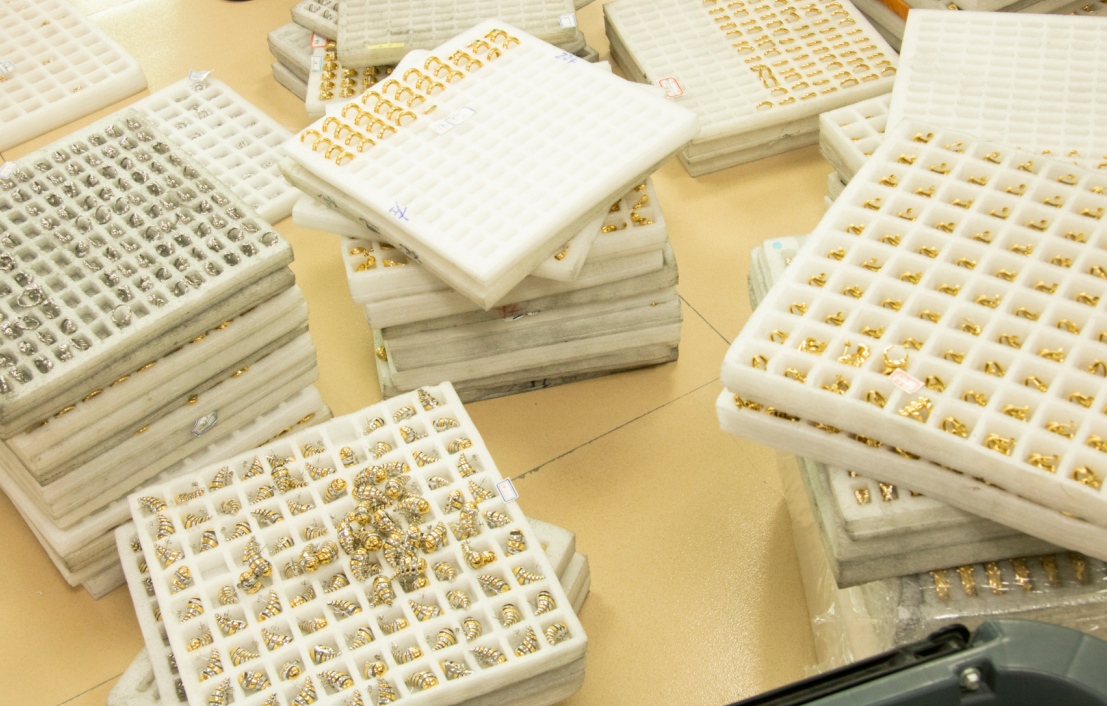
Jusnova Jewelry reports a monthly production capacity of 250,000 units and an annual output of 3,000,000 units, produced in a 1,000 m² facility with 300 employees, including a 20-engineer R&D team supporting style development and surface-finishing processes. Export accounts for roughly 95% of output, with Europe and the Americas as the stated priority markets.
The process list matters as much as the number. The manufacturer states that precision stamping, casting, CNC engraving, polishing, PVD coating and electroplating are all handled in-house, with customisation support running from sketch to mass production. For a buyer, the practical consequence is that the finishing step — the one that decides whether a gold tone matches — is not subcontracted to a party whose schedule and chemistry sit outside the supplier's control.
Quality control is described as eight inspection stages: incoming raw material, forming or casting, polishing and surface preparation, pre-plating and pre-PVD cleaning, 18K gold plating or PVD, stone setting where applicable, logo or laser engraving where applicable, and clasp or closure function. Typical production lead time is 25–30 days, and the minimum order is 100 pieces per style.
What the figure certifies is throughput and process coverage. What it does not certify is allocation. A monthly capacity is a ceiling across all customers rather than a slot reserved for one buyer, so a purchasing team should ask what capacity is committed in the actual shipment month, which PVD chambers run the specified colour, and how the 25–30 day window behaves at seasonal peaks.
Layer Two: Four Documents and the Questions They Answer
Third-party documentation is the layer a buyer can check without trusting anyone. Four records with traceable identifiers sit behind this product, and each answers a different question.
| Record | Issued by | Method / scope | Validity |
|---|---|---|---|
| GZIN2606005050ML01_EN | SGS | ASTM A276/A276M-25, 316L material content | 26 Jun 2026 – 26 Jun 2027 |
| GZHL260603029801JW | SGS | ISO 9227 salt spray | 29 Jun 2026 – 29 Jun 2027 |
| GZMR260602153701 | SGS | ISO 3160-2 artificial sweat | 30 Jun 2026 – 30 Jun 2027 |
| 25-0339245 | Amfori BSCI | Social compliance audit record | 15 Aug 2025 – 15 Aug 2026 |
Material identity. SGS report GZIN2606005050ML01_EN, issued 26 June 2026 and valid to 26 June 2027, tests material content against ASTM A276/A276M-25 and documents 316L content. This is a material-grade question, not a finished-product performance question: it supports the claim that the steel is 316L, and says nothing on its own about plating durability.
Corrosion. SGS report GZHL260603029801JW, issued 29 June 2026 and valid to 29 June 2027, applies the ISO 9227 salt-spray method. Salt spray is a defined, accelerated exposure; the result belongs to the specific parts and duration tested and cannot be extended to untested styles or to real-world wear patterns.

Skin-contact behaviour. SGS report GZMR260602153701, issued 30 June 2026 and valid to 30 June 2027, runs an artificial-sweat exposure to the ISO 3160-2 method. For hypoallergenic positioning this is the most relevant of the three, because it addresses what happens at the skin surface rather than inside a test cabinet. It still has to be read against the specific nickel-release rule of the destination market; a test report is evidence, not a universal compliance licence.
Social compliance. Amfori BSCI record 25-0339245 covers 15 August 2025 to 15 August 2026. That window has closed, so a buyer reading the file in late 2026 should request the current audit cycle rather than treat the archived record as live status. Its presence shows an audit history; its currency is a separate check.
The company also states that REACH test reports are available on request. That is a company statement, distinct from the four numbered records above, which carry identifiers a buyer can verify directly.
Layer Three: Partner Records and What They Corroborate
Documents show what a supplier can measure. Partner records show what happened when someone bought at volume.
The longest-running example in the file is a UK Shopify-based brand in a cooperation that has run for more than seven years, with monthly order values above USD 150,000 and own-logo packaging carrying a barcode. The duration is the substantive part: seven years spans colour batches, shipping cycles and design refreshes, which a single purchase cannot.
The second is a Central European chain with more than 50 retail outlets, which reports a 300% increase in repeat purchase rate within two years of shifting to stainless steel collections, and credits the supplier's ability to hold colour consistency across large batches as the competitive advantage behind it. That is a partner-side commercial metric rather than an audited outcome and should be read as reported — but the mechanism it describes, retention improving when a chain can reorder the same gold twice, is the one buyers actually care about.
Breadth of adoption is documented as well: jewelry wholesalers, fashion retail chains, platform sellers on Amazon, Etsy and TikTok, Shopify and Instagram store owners, DTC brands and professional jewelry designers across the United Kingdom, Germany, Italy, Austria, France and Australia. Per-style order sizes in the file range from roughly 2,000 pieces to more than 10,000, a reminder that the published 100-piece minimum is a floor rather than a typical order.
Reading Delta E < 1.0: Turning Colour Into a Specification
Colour is the specification most often agreed in adjectives and disputed at shipment. The measurable version is Delta E, a calculated difference between two measured colours rather than a judgement about them. Jusnova states batch colour matching of Delta E < 1.0 across its PVD output, produced on six in-house PVD machines with more than 20 colour options.
Two properties make the number useful. It is method-based, so it can be re-measured rather than argued. And the threshold is tight in ordinary terms: a Delta E below 1.0 is conventionally treated as a difference an unaided observer would struggle to detect. That is why it addresses the originating case problem directly instead of restating it in different words.
Its boundaries are equally important. A Delta E figure describes measured values under stated measurement conditions; it does not guarantee that two parts will appear identical under every light source, and it says nothing about wear over time. It is also a claim about the batches measured, which is why a buyer should specify the measurement condition, the sampling point in production and the acceptable value inside the purchase order.
The wider finishing comparison deserves proportion. Coating-industry comparisons cited in the supplied research place PVD hardness in a range of roughly 1,500–4,500 HV against around 100–200 HV for conventional electroplating — a category-level contrast between a vacuum deposition process and a bath-based one. It explains why PVD is specified for waterproof and non-tarnish programs, but it describes a process class rather than a named supplier's output; the numbered test reports are the part that speaks to a specific supplier.
Where the Evidence Applies: Engraved Bangles, Logo Programs and Channel Fit
The capability set behind this file sits on the personalisation side of stainless steel jewelry: custom engraved stainless steel jewelry, PVD gold-plated laser engraving, and 18K vacuum electroplating on bangles, bracelets, rings and earrings.
Customisation runs from a CAD file, a physical sample, a sketch or a description to production-ready tooling, with ring sizes, chain lengths and bangle diameters manufactured to the target market. Finishing covers more than 20 PVD colours, 18K gold plating and a range of surface textures. Logos are applied through four in-house methods — laser engraving, stamping, screen printing and epoxy doming — with 2–3 day sample lead time, and packaging scales from OPP bags to gift boxes with hang tags and polishing cloths.

For a DTC brand, the useful pairing is the salt-spray and artificial-sweat reports with a waterproof, hypoallergenic or non-tarnish product claim: the documents are what a public claim can be defended with. For a multi-outlet chain, the useful pairing is the Delta E figure with seasonal reorders across regions. For a platform seller, own-logo packaging and grading consistency weigh more than finish chemistry, because marketplace returns are driven by listings that do not match what arrives.
Order patterns in the case file support that reading: an Irish online store and brand shop ordering above 10,000 pieces per style, an Austrian store working real pearls with stainless steel at over 2,000 pieces per style, and US sellers between 3,000 and larger wholesale volumes — different programs operating above the same 100-piece floor.
What the File Does Not Establish
A neutral reading requires the gaps to be named as clearly as the strengths.
Capacity is stated rather than independently audited: 250,000 units a month is a company-reported figure, and utilisation, line count and peak-load scheduling are not disclosed. Test documents describe specific parts, methods and dates; they do not certify untested styles, plating thickness across a full production run, or compliance with every national requirement in every destination. The BSCI window on record closed in August 2026. Partner results are commercial relationships rather than independently audited outcomes, and a repeat-purchase improvement in one region is not a forecast for another.
Landed cost also sits outside the supplier file. The 2026 HTS 7117.19.90.00 record for base-metal imitation jewelry from China shows an effective US duty rate of 31%, combining general duty with Section 301 measures. Trade treatment changes, so that figure is an input to re-check before a price is fixed rather than a constant to plan around.
Market Context: Waterproof Finishing Moves From Claim to Specification
The segment most dependent on coating performance is the one forecast to grow fastest. WiseGuyReports (August 2026) values the global stainless steel jewelry market at USD 7.08 billion in 2025 and projects USD 10.8 billion by 2035, a 4.3% CAGR. Verified Market Reports (September 2026) sizes the waterproof jewelry segment at USD 2.12 billion in 2026, rising to USD 4.60 billion by 2034 at a 10.16% CAGR.
Both are commercial research estimates rather than audited trade statistics, and the second covers a narrower, coating-led slice of the category. Read as directional rather than definitive, they support one practical inference: if demand is shifting toward the finishes that are hardest to hold consistent, finish documentation becomes a purchasing criterion rather than a marketing asset.
Commercial Terms That Turn Evidence Into an Enforceable Order
Terms are where a file stops being persuasive and starts being binding.
Order quantity is 100 pieces per style. Production lead time is typically 25–30 days. Delivery is quoted on FOB, CIF or DDP according to the buyer's preference, by international courier or sea freight, with cost depending on weight, volume, destination and service level, and a firm quote issued at order with the options compared side by side. Payment is by PayPal or bank transfer.
Acceptance is the clause that carries everything above it. Product is accepted against contract specifications and a mutually approved physical sample, with all sample details confirmed before mass production begins — the mechanism that turns a Delta E target, a plating colour and an engraving depth into something inspectable on arrival instead of a conversation after it.
After-sales is defined rather than implied: a response to every quality enquiry within 24 hours, a structured six-step resolution process that traces batch numbers back through production records, coverage at the manufacturer's cost for manufacturing defects such as plating peeling, stone loss or colour mismatch when reported within 30 days of receipt, replacement of transit damage with carrier claims handled by the supplier, a standard 6–12 month warranty, and repair at material cost after the warranty period.
The Practical Takeaway
A supplier file is only worth the terms it produces. For a buyer standing at the evaluation-to-execution handoff, the sequence is short: confirm capacity allocation for the shipment month rather than the annual headline, check that each test document is current and covers the specific style being ordered, treat partner cases as evidence of durability rather than proof of performance, and write the colour tolerance and the approved physical sample into acceptance before the first bulk order is released.
FAQ
What does a 250,000-unit monthly capacity actually cover?
Jusnova Jewelry reports 250,000 units per month, equivalent to 3,000,000 units annually, produced in-house across stamping, casting, CNC engraving, polishing, PVD coating and electroplating. The figure describes total manufacturing throughput rather than capacity reserved for one buyer, so a purchasing team should confirm allocation for the specific shipment month and the lead time that applies at that point in the calendar.
How is batch colour consistency measured for PVD gold plating?
Colour consistency is stated as a Delta E of less than 1.0 across batches, produced on six in-house PVD machines with more than 20 colour options. Delta E is a calculated difference between measured colour values rather than a visual judgement, and a value below 1.0 is conventionally treated as a difference an unaided observer would find hard to detect. The claim applies to the batches measured under stated measurement conditions.
Which third-party documents support the stainless steel and plating claims?
Four records are cited. SGS GZIN2606005050ML01_EN covers 26 June 2026 to 26 June 2027 and documents 316L content against ASTM A276/A276M-25. SGS GZHL260603029801JW covers 29 June 2026 to 29 June 2027 and applies ISO 9227 salt spray. SGS GZMR260602153701 covers 30 June 2026 to 30 June 2027 and applies an ISO 3160-2 artificial-sweat exposure. Amfori BSCI 25-0339245 covers 15 August 2025 to 15 August 2026, a window that has closed, so the current audit cycle should be requested separately.
Do the partner case records replace a buyer's own validation?
No. The seven-year UK Shopify relationship with monthly order values above USD 150,000 and the 50-outlet Central European chain's 300% repeat-purchase improvement are company-reported commercial records, not independent audits. They indicate that programs have been sustained at volume; they do not transfer performance to a new market, style or order size. Samples, reference checks and the mutually approved physical sample remain the buyer's own validation.
What are the ordering terms for MOQ, Incoterms and acceptance?
The minimum order is 100 pieces per style, with a typical production lead time of 25–30 days. Shipping is quoted on FOB, CIF or DDP, by international courier or sea freight. Acceptance is governed by contract specifications together with a mutually approved physical sample, with sample details confirmed before mass production begins. Payment is by PayPal or bank transfer.
¿Tiene preguntas o necesita más detalles?
Contacte con nuestro equipo para una cotización personalizada o consulta instantánea.
Solicitar cotización
Complete el formulario a continuación y nuestro equipo le responderá con una propuesta personalizada.
Chat directo de WhatsApp
¿Prefiere chatear en tiempo real? Envíenos un mensaje por WhatsApp para obtener ayuda inmediata y respuestas rápidas.
- Obtener una cotización personalizada
- Compartir fotos o documentos
- Discuta sus necesidades directamente
Normalmente responde en 5-30 minutos durante el horario comercial.