
Stainless Steel Eyewash Stations: What BOHUA's Specs Reveal
Stainless Steel Eyewash Stations: What BOHUA's Specs Reveal
Industrial Safety Equipment · Specification Review
Emergency eyewash and emergency shower equipment is selected on parameters, not adjectives. A safety engineer specifying decontamination equipment for a chemical plant, a pharmaceutical suite or a remote mining site has to resolve a short list of hard questions before a purchase order can move: what the unit is made of, what supply line it needs, how much flushing fluid it delivers, how quickly it starts, and which certificate actually covers the model being quoted.
This article works through one evidence set in that process. Shanghai Bohua Safety Device Co., Ltd. (BOHUA) is a Shanghai-based manufacturer of emergency showers and eyewash equipment, founded in 2006 and located at No. 661 Chenjing Road, Songjiang District, Shanghai, China. The company's published company profile states that it has developed 11 series and more than 100 types of eyewash equipment, operating from a 4,000 m² facility with 50 employees and an annual output of 20,000 units.
The question here is deliberately narrow: what do BOHUA's stainless steel material choices and published specifications actually demonstrate about manufacturing capability, and where does the published data stop? For buyers in the Research and Evaluation stages, that boundary line is as important as the specifications themselves.
Why specification evidence drives eyewash procurement
The global emergency shower and eyewash station market was valued at approximately USD 417.3 million in 2024 by Spherical Insights, with North America accounting for roughly USD 145.1 million of that total. Transparency Market Research projects the category reaching USD 713.4 million by 2035, growing at a CAGR of 4.7% from 2025. Those figures should be read with care: research firms diverge substantially on the size of this category, partly because some include supplementary personal wash units and others exclude them.
Whatever the headline number, the buyer's task is unchanged. Supplier literature in this sector is commonly written at catalogue level — corrosion-resistant construction, reliable performance, compliant design. None of those phrases can be entered into a piping schedule, a material take-off or a compliance file. What can be entered is a documented parameter set: material grade, inlet size, flow rates, activation mechanism and speed, mounting type, certification number and scope, and the supply terms attached to the order.
That is the standard this review applies to BOHUA's published data. It is also the point at which specification evidence and manufacturing capability connect: a manufacturer that can state a consistent set of engineering values across an entire product family is describing a design platform, not a single assembled product.
Stainless steel material choices across the BOHUA range
Two austenitic stainless grades appear in BOHUA's published product data: grade 304 and grade 316.
Grade 304 stainless steel is the default structural material across the grounded, anti-freeze, compound, portable, vertical, wall-mounted and desk-top series. Grade 316 stainless steel is documented on specific compound models: the BH30-1316 compound emergency shower and eyewash is listed as 316 SS, and the BH30-1010 compound emergency shower and eyewash is listed as 304/316 stainless steel.
Not every unit in the portfolio is specified as all-metal. Several models carry a combined material designation that pairs a 304 stainless steel body with an ABS shell or housing — for example the BH30-1011 and BH30-1011L compound units (304 stainless steel + ABS), the BH32-1011 and BH32-1011L vertical eyewash units (304 SS + ABS), and the BH33-1011, BH33-1011L, BH35-1011L, BH30-2011 and BH32-1062B variants. On the electric heat tracing models the shell material is documented separately: ABS on the BH30-1062, BH30-1062L and BH30-1062C, and 304 stainless steel on the BH30-1062B.
| Documented material | Representative models | Series |
|---|---|---|
| 304 stainless steel | BH30-6012, BH30-6012C, BH32-6012, BH30-1008, BH30-5012A, BH30-2010, BH30-2012, BH34-0628, BH34-0665F, BH33-1010, BH35-1009 | Grounded, Anti-freeze, Compound, Portable, Wall-mounted, Desk-top |
| 304/316 stainless steel | BH30-1010 | Compound |
| 316 stainless steel | BH30-1316 | Compound |
| 304 stainless steel + ABS | BH30-1011, BH30-1011L, BH30-2011, BH32-1011, BH32-1011L, BH32-1062B, BH33-1011, BH33-1011L, BH35-1011L | Compound, Vertical, Electric heating, Wall-mounted, Desk-top |
For a buyer, the material line in a specification table is a service-life and maintenance decision rather than a cosmetic one. Where a facility handles chloride-bearing or strongly acidic media, the documented 316 stainless option on the compound series is the relevant configuration; where the environment is standard industrial, 304 stainless is the documented baseline. Where an ABS shell is specified alongside a stainless body, the buyer is selecting a composite assembly rather than a fully metallic exterior — a legitimate configuration, but one that should be confirmed line by line against the bill of materials before the order is placed.
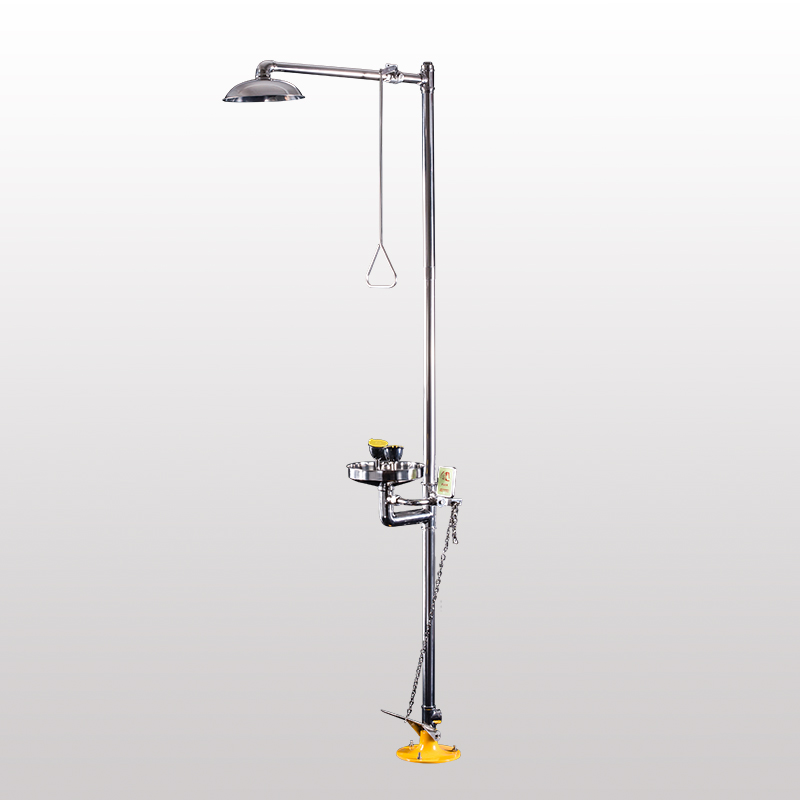
Compound emergency shower and eyewash documented in 316 stainless steel — the material option BOHUA specifies on models such as the BH30-1316.
The shared engineering architecture behind the specifications
Across the floor-mounted shower and eyewash family, BOHUA's documentation repeats a consistent parameter set. The repetition is itself evidence: a manufacturer running 11 series through the same design values is working from a standardised engineering platform rather than assembling each model from unrelated parts.
| Parameter | Documented value | Why it matters at specification stage |
|---|---|---|
| Water inlet and outlet | DN32 | One line size across the shower – eyewash family simplifies piping design |
| Overall height | 2,480 mm | Sets the floor-to-head clearance required at installation |
| Shower head height | 2,100 mm | Defines the standing clearance under the shower |
| Water inlet height | 1,600 mm | Determines where the supply line is brought in |
| Eyewash height | 1,050 mm | Sets the bowl position for the user |
| Drainage height | 133 mm | Defines the drainage take-off point |
| Sprinkler spacing | 101.6 mm | The metric equivalent of four inches |
| Shower flow rate | 120–180 L/min | The volume the unit delivers when the shower is activated |
| Eyewash flow rate | ≥1.5 L/min on combined units; 12–18 L documented on the vertical eyewash series | The flushing-fluid threshold to reconcile against the applicable standard |
| Standard water pressure | 0.25–0.4 Pa (as published) | The supply condition to verify during technical review |
| Start speed | Within 1 second | The activation response time stated for the valve |
| Activation | Push handle on combined units | Defines the operating action and the user training requirement |
| Sprinkler | PP + 304 filter | Identifies the head and filter material combination |
| Ball valve | Two-piece ball valve | Defines the isolation and control element |
| Cow-horn bend | Adjustable flow | Allows field flow adjustment |
| Anti-dust cover | Fixed soft rubber | Protects the head in dusty environments |
| Indicator | Luminous aluminium alloy (shower models) | Supports location of the unit in low light |
| Water discharge range | 508 mm at 1,524 mm from the surface | The documented coverage footprint |
| Warranty | One year | Applies across the combined shower and eyewash family |
Values as published in BOHUA product documentation across the compound, grounded, anti-freeze, portable, electric heating and electric heat tracing families.
Three values deserve interpretation rather than repetition.
First, DN32 is documented as the water inlet and outlet size across the compound, grounded, anti-freeze, portable, electric heating and electric heat tracing families, as well as the wall-mounted and desk-top units. A single line size across a range of this size means a facility can standardise its emergency water connection regardless of which model ends up in which room — a practical benefit that only appears when the parameter is consistent model to model.
Second, eyewash flow on combined units is documented as at least 1.5 L/min. ANSI/ISEA Z358.1-2014 (R2020), the American standard referenced by the certification BOHUA holds, requires eyewash stations to deliver 0.4 gallons per minute of flushing fluid for at least 15 minutes. Converting 0.4 US gallons per minute gives approximately 1.5 litres per minute — the same numeric threshold documented for these units. The vertical eyewash series separately documents an eyewash flow of 12–18 L.
Third, start speed is documented as within 1 second, with activation by push handle on the combined units. A one-second response is a design commitment that has to be engineered into the valve and the trigger geometry; it cannot be asserted in a datasheet without a matching mechanism behind it.
Supporting details follow the same pattern: sprinkler documented as PP with a 304 filter, two-piece ball valve, adjustable-flow cow-horn bend, fixed soft rubber anti-dust cover, and a water discharge range of 508 mm at 1,524 mm from the surface. Shower models carry a luminous aluminium alloy indicator, a detail aimed at units installed where visibility is poor.
Series by series: what the stainless portfolio covers
BOHUA's published range groups into nine families. The table below summarises the material and mounting documentation for each.
| Series | Representative models | Documented material | Mounting and activation |
|---|---|---|---|
| Grounded | BH30-6012 (double pole), BH30-6012C (single pole), BH32-6012 (grounded vertical eyewash) | 304 SS | Floor-mounted; push handle |
| Anti-freeze | BH30-1008 (anti-freeze and anti-scald), BH30-5012A (small pedal), BH30-5012, BH30-5012T, BH30-1012ZPW, BH32-5012A, BH32-5012, BH32-1008 | 304 SS | Floor-mounted; push handle; pedal variants |
| Compound | BH30-1010 (304/316 SS), BH30-1011, BH30-1011L, BH30-2010, BH30-2011, BH30-2012, BH30-1316 (316 SS) | 304 SS or 316 SS | Floor-mounted; push handle |
| Portable | BH34-0628 (28 L tank), BH34-0665F (65 L tank) | 304 SS | Self-contained; push handle |
| Vertical | BH32-1010, BH32-1011, BH32-1011L, BH32-1008, BH32-1061, BH32-1062, BH32-1062B, BH32-1066 | 304 SS, or 304 SS + ABS | Freestanding; fully automatic on BH32-1061 |
| Wall-mounted | BH33-1010, BH33-1011, BH33-1011L, BH38-1010 | 304 SS, or 304 SS + ABS | Wall-mounted; fully automatic on BH38-1010 |
| Desk-top | BH35-1009, BH35-1011, BH35-1011L, BH38-1009 | 304 SS, or 304 SS + ABS | Bench or desk; BH38-1009 equipped with a sensor |
| Electric heating | BH30-1066, BH32-1066, BH32-1062B | 304 SS, or 304 SS + ABS | Floor or vertical; 380 V, 15 kW |
| Electric heat tracing | BH30-1062, BH30-1062L, BH30-1062C, BH30-1062B, BH32-1062 | Shell documented as ABS or 304 SS | Floor-mounted; 220 V, 48 W/m |
Two specification groups carry distinct engineering information.
The portable series is documented with tank data rather than only plumbing data. The BH34-0628 carries a 28 L tank with a documented tank diameter of 220 mm, tank height of 1,200 mm and tank pressure of 1.0 MPa, in 304 stainless steel. The BH34-0665F is documented with a 65 L tank. Both are described under the portable series with push handle activation and a one-year warranty.
The two heated families are separated by their electrical profile. Electric heating models — BH30-1066, BH32-1066 and BH32-1062B — are documented at 380 V with 15 kW power, explosion-proof grade EXD II BT4 and CT4, and protection levels IP54, IP56 and IP65. Electric heat tracing models — BH30-1062, BH30-1062L, BH30-1062C, BH30-1062B and BH32-1062 — are documented at 220 V with 48 W per metre of heat trace power, explosion-proof grades EXD II BT4, BT6, CT4 and CT6, and the same IP54, IP56 and IP65 protection levels.
Certification evidence and what each certificate actually covers
Certification is where specification evidence becomes procurement evidence. BOHUA holds ANSI Z358.1-2014 certification number CHSH25071073147 and CE certification number CLSH25071073148, both issued by GLOBAL TESTING SERVICES CO., LTD., both dated 30 July 2025 and valid to 29 July 2030. Both certificates state a scope of all types of emergency eyewash stations and apply to the global market.
| Standard | Certificate number | Issuing body | Validity and scope |
|---|---|---|---|
| ANSI Z358.1-2014 | CHSH25071073147 | GLOBAL TESTING SERVICES CO., LTD. | 30 Jul 2025 – 29 Jul 2030; all types of emergency eyewash stations; global market |
| CE | CLSH25071073148 | GLOBAL TESTING SERVICES CO., LTD. | 30 Jul 2025 – 29 Jul 2030; all types of emergency eyewash stations; global market |
| ISO (Quality Management Systems) | 288SCC24Q-SHBH002798S | Shanghai Center Certification Co., Ltd. | 15 Jan 2024 – 14 Jan 2027; manufacturing, R&D and sales of security equipment (non-medical eyewash) and sales of fire-fighting positive pressure air respirator and non-medical dust masks |
| ISO (Occupational Health & Safety Management Systems) | 288SCC19S-SHB000647R2S | Shanghai Center Certification Co., Ltd. | 12 Aug 2019 – 11 Aug 2028; manufacturing, R&D and sales of security equipment and related occupational health and safety management activities |
The BOHUA corporate profile additionally lists ISO 9001:2008 quality system certification, ISO 14001:2004 environmental management system certification, OHSAS 18001:2007 occupational health and safety management system certification, CCS certification from the China Classification Society, nine patent certificates with a number of appearance design patents, and a Shanghai credit qualification grade of AAA.
Two practical notes for evaluating buyers. First, certificate validity windows matter: certificates running to 2030 comfortably cover a project delivered in 2026, but current status should be confirmed at the time of purchase rather than assumed from a catalogue. Second, scope wording matters more than the certificate logo. The ANSI and CE certificates are scoped to all types of emergency eyewash stations, while the quality management certificate is written around the manufacturing, R&D and sales of security equipment (non-medical eyewash). Matching the quoted model to the scope of the certificate is the step that turns a compliance claim into a compliance file.
For context, EN 15154, the European standard series, regulates emergency safety showers, with Part 2 specifically covering plumbed-in eyewash units. Buyers selling into EU markets typically reconcile a supplier's certificate scope against the applicable part of the series for the product type being purchased, rather than against a general statement of conformity.
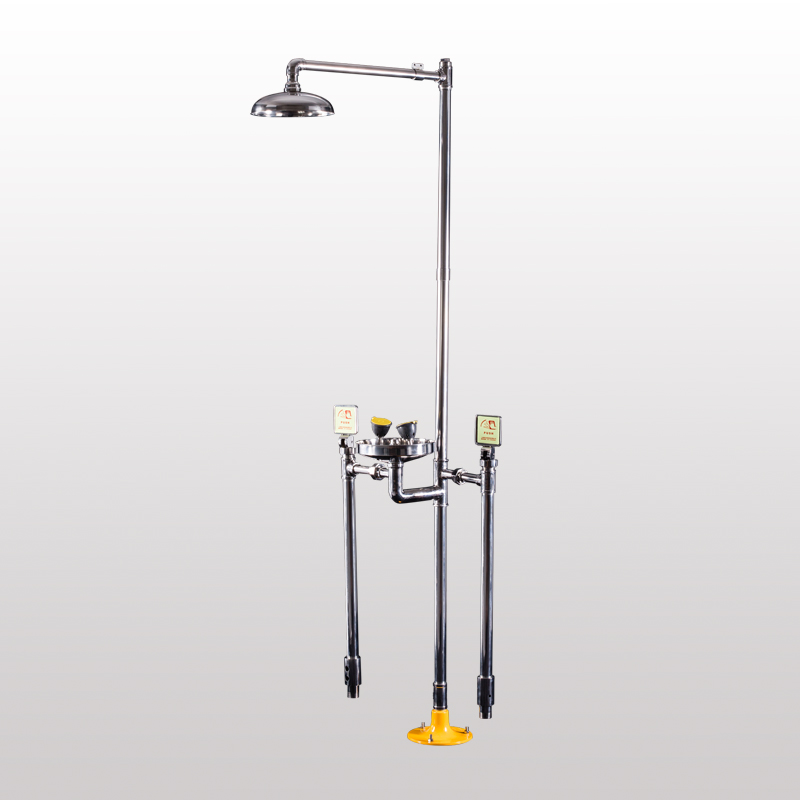
Grounded emergency shower and eyewash double pole (BH30-6012), documented in 304 stainless steel with a DN32 inlet and push handle activation.
Where these specifications are designed to be used
The documented application set for BOHUA's emergency shower and eyewash equipment covers chemical manufacturing; pharmaceuticals and biotechnology; laboratories; oil, gas and petrochemical; metalworking and manufacturing; agriculture and pesticide handling; food processing; and mining. Documented project types include EHS (environment, health and safety) systems, emergency response stations, chemical safety retrofits, new plant construction and laboratory safety upgrades.
The documented working conditions are equally specific: high-temperature environments; low-temperature outdoor installations in winter requiring freeze protection; corrosive atmospheres such as acid or alkali splashes; dusty environments; and normal-temperature indoor laboratories. Documented operating modes are push-plate activation by foot or hand for the shower, push flag or handle for the eyewash, pull chain for the shower, and a hands-free stay-open valve typical of eyewash operation. The market references published alongside this application data include Kazakhstan, Russia, the United Arab Emirates, Singapore, Malaysia, Australia, Qatar, Oman and Saudi Arabia.
Mapping specification to site is where most procurement errors occur, and the portfolio's structure supports that mapping directly. A corrosive-atmosphere installation points to the 316 stainless option documented on the compound series. A below-freezing outdoor location points to the anti-freeze family, or — where the flushing fluid itself must be maintained — to the electric heating or electric heat tracing families, which carry documented explosion-proof grades (EXD II BT4, BT6, CT4 and CT6) and ingress protection levels (IP54, IP56 and IP65). A bench-level laboratory hazard points to the desk-top units, including the sensor-equipped BH38-1009.
Manufacturing and supply evidence behind the specification sheet
Specifications describe the product. They do not describe whether the supplier can deliver it on schedule. BOHUA's published capability data addresses that second question with its own numbers.
| Capability attribute | Documented value |
|---|---|
| Production mode | OEM / ODM |
| Monthly capacity | 1,000 units |
| Lead time | 30 days |
| Minimum order quantity | 5 units |
| Quality control | 100% test |
| Export markets | EU, Middle East, Australia, Africa |
| After-sales | Remote support |
| Factory size | 4,000 m² |
| Employees | 50 |
| Annual output | 20,000 units |
| R&D team | 5 |
| Established | 2006 |
| Export ratio | 20% |
The documented customisation options extend beyond dimensional variants: acoustic and optical alarms, lighting, uploading of DCS signals, electrical heating, cooling, and skid-mounted systems. For an OEM or ODM buyer, that list defines the boundary of what can be engineered into a unit rather than simply relabelled — alarm signalling and control-system integration are configuration decisions that affect panel design and commissioning, not accessories added at the end of assembly.
One documented ODM case reference covers a China-based client that ordered 15 electric heat tracing shower and eyewash units (model BH30-1062) to keep a facility compliant year-round in a cold climate, with the supply relationship documented over five years and the stated outcome of reliable, compliant and safe emergency response. A case reference of this type is worth reading carefully: it demonstrates continuity of supply and a design fit for a cold-climate requirement, but it does not constitute a published third-party performance test of the unit.
Market trend analysis
Three trends in the published market data are relevant to how buyers evaluate stainless steel emergency equipment.
The first is steady category growth. Transparency Market Research projects the emergency shower and eyewash station market reaching USD 713.4 million by 2035, at a CAGR of 4.7% from 2025 — expansion driven by industrial safety regulation and facility upgrades rather than by a single application segment.
The second is the weight of self-contained equipment. Dataintelo estimates that portable eyewash stations held approximately 38.2% of market share in 2025, reflecting demand at remote and non-plumbed sites. That estimate is a single research firm's figure and should be treated as directional; BOHUA's own portable range, covering the 28 L BH34-0628 and the 65 L BH34-0665F, sits directly in that segment.
The third is the concentration of demand in industrial applications. Dataintelo places industrial applications, including chemical and manufacturing, at approximately 35.7% of global eyewash station revenue. Again, this is a single-firm estimate, but it aligns with the industry list BOHUA publishes for its own application data — chemical manufacturing, pharmaceuticals and biotechnology, laboratories, oil and gas, metalworking, agriculture and pesticide handling, food processing and mining.
For buyers comparing suppliers, the relevant competitor reference set in this category is well established and publicly identifiable: Haws Corporation, Bradley Corporation, Guardian Equipment and Speakman are commonly listed among global competitors in published market research. Naming them here serves one purpose — it is the comparison set a sourcing team will use. No comparative performance judgement between these suppliers and BOHUA is made or implied in this article, because no verified comparative test data supports one.
Comparison with established alternatives — and the limits of this portfolio
Buyers weighing a plumbed stainless steel station against other configurations are usually choosing between four architectures, each with a different constraint profile.
| Configuration | Water supply | Footprint | Freeze exposure | Electrical requirement |
|---|---|---|---|---|
| Floor-mounted compound shower and eyewash (BH30-1010, BH30-1316, BH30-2010) | Plumbed, DN32 | Largest; full standing area | Requires freeze protection in unheated spaces | None documented |
| Wall-mounted eyewash (BH33-1010, BH33-1011, BH33-1011L) | Plumbed, DN32 | Minimal floor space | Depends on the enclosing space | None documented |
| Desk-top eyewash (BH35-1009, BH35-1011, BH35-1011L, BH38-1009) | Plumbed, DN32 | Bench-level unit | Indoor use | None documented |
| Portable shower and eyewash (BH34-0628, BH34-0665F) | Self-contained tanks, 28 L and 65 L at 1.0 MPa | Self-contained, relocatable | Tank-based | None documented |
| Electric heating or electric heat tracing units (BH30-1066, BH32-1066, BH30-1062 family, BH32-1062) | Plumbed, DN32 | Largest | Designed for cold-exposure installation | 380 V, 15 kW (electric heating); 220 V, 48 W/m (heat tracing) |
Against that comparison, several boundaries in BOHUA's published data should be stated plainly, because a supplier evaluation that ignores them is not an evaluation.
- 316 stainless is documented on selected compound models, not across the range. The BH30-1316 is listed as 316 SS and the BH30-1010 as 304/316 stainless steel. The grounded, anti-freeze and portable families are documented in 304 stainless steel. A buyer requiring 316 stainless throughout a facility should confirm per-model availability rather than assume it.
- Several models are composite, not fully metallic. ABS appears as a shell or housing material on multiple units, including the BH30-1062, BH30-1062L and BH30-1062C electric heat tracing models and a number of wall-mounted, desk-top and vertical variants. Buyers with an all-metal exterior requirement should check the material designation model by model.
- Heated models add an electrical scope of work. Electric heating units are documented at 380 V and 15 kW; electric heat tracing units at 220 V and 48 W per metre. Explosion-proof grades and IP ratings are documented, but the electrical supply, protection devices and inspection regime become part of the project — a materially larger installation scope than a passive plumbed unit.
- The published data does not state a minimum ambient operating temperature for the anti-freeze series. The series name indicates the design intent, but a buyer specifying against a documented winter design temperature should request that figure during technical review rather than infer it.
- Published pressure values are listed as 0.25–0.4 Pa across the family. Site supply pressure is a commissioning variable, so the value and unit should be confirmed for the exact model and market at quotation stage.
- Commercial terms suit project volume. A minimum order quantity of 5 units and a 30-day lead time fit project and distributor purchasing; a single replacement unit ordered outside a contract may not follow the same schedule.
- Two documented eyewash flow values exist. Combined shower and eyewash units document at least 1.5 L/min, while the vertical eyewash series documents 12–18 L. Buyers should confirm which figure applies to the specific model and configuration being quoted.
None of these boundaries undermines the specification record. They simply mark where documented data ends and buyer verification begins — which is the correct location for that boundary in any procurement file.
Future outlook
Three signals in the published data point to where stainless steel emergency equipment is heading. The first is growth in self-contained capability: with portable equipment estimated at a substantial share of the market, tank-based units such as the 28 L and 65 L models will continue to serve remote and non-plumbed sites where a fixed water connection is not feasible. The second is environmental hardening: the documented explosion-proof grades and IP54, IP56 and IP65 protection levels, together with the electric heating and heat tracing families, respond to installations where the environment itself is the design constraint. The third is integration: the documented customisation list includes DCS signal upload, acoustic and optical alarms, lighting and skid-mounted systems, which moves eyewash equipment from a standalone fixture toward a monitored element of a facility EHS system.
For buyers, the practical implication is that material and specification choices made today will be re-examined against a longer service life. A 304 stainless baseline, a documented 316 option on the compound series, and a certificate record running to 2030 give a procurement team something firmer to work with than a capability statement.
Frequently asked questions
Which BOHUA models are documented in 316 stainless steel?
Two compound models are documented with 316 stainless content: the BH30-1316 compound emergency shower and eyewash is listed as 316 SS, and the BH30-1010 compound emergency shower and eyewash is listed as 304/316 stainless steel. The grounded, anti-freeze and portable families are documented in 304 stainless steel.
What flow rates and inlet size do the combined shower and eyewash units specify?
Combined units document a DN32 water inlet and outlet, a shower flow rate of 120–180 L/min, an eyewash flow rate of at least 1.5 L/min, and a start speed within 1 second at a standard water pressure published as 0.25–0.4 Pa. The vertical eyewash series separately documents an eyewash flow of 12–18 L.
Which certifications apply, and what do they cover?
ANSI Z358.1-2014 certification CHSH25071073147 and CE certification CLSH25071073148, both issued by GLOBAL TESTING SERVICES CO., LTD., run from 30 July 2025 to 29 July 2030 with a scope covering all types of emergency eyewash stations in the global market. ISO quality management certificate 288SCC24Q-SHBH002798S from Shanghai Center Certification Co., Ltd. covers manufacturing, R&D and sales of security equipment (non-medical eyewash) and runs from 15 January 2024 to 14 January 2027. The occupational health and safety management certificate 288SCC19S-SHB000647R2S from the same body runs from 12 August 2019 to 11 August 2028.
How is the unit activated, and how fast does water start flowing?
Combined shower and eyewash units document push handle activation with a start speed within 1 second. Wall-mounted and desk-top fully automatic models (BH38-1010 and BH38-1009) are documented with automatic activation, and the BH38-1009 desk-top unit is documented as equipped with a sensor. Documented operating modes across the range also include push-plate activation by foot or hand for the shower, pull chain for the shower, and a hands-free stay-open valve for the eyewash.
What are the minimum order quantity, lead time and monthly capacity?
BOHUA documents a monthly capacity of 1,000 units, a lead time of 30 days, a minimum order quantity of 5 units, and 100% testing as its quality control standard. Production mode is documented as OEM / ODM, with remote after-sales support and export markets covering the EU, Middle East, Australia and Africa.
What mounting configurations are available where floor space is constrained?
Three mounting families address constrained spaces. Wall-mounted units are documented as BH33-1010, BH33-1011, BH33-1011L and the fully automatic BH38-1010. Desk-top units are documented as BH35-1009, BH35-1011, BH35-1011L and the sensor-equipped BH38-1009. Self-contained portable units, documented as BH34-0628 with a 28 L tank and BH34-0665F with a 65 L tank, remove the need for a fixed water connection entirely.
Reference document: BOHUA product brochure (PDF) — company brochure download. Company website: www.eyewashcn.com. All specification values, certificate numbers and capability figures in this article are quoted from BOHUA's published product, certification and company documentation.