
Sprinkler Types for Farm and Industrial Use: A Buyer's Overview
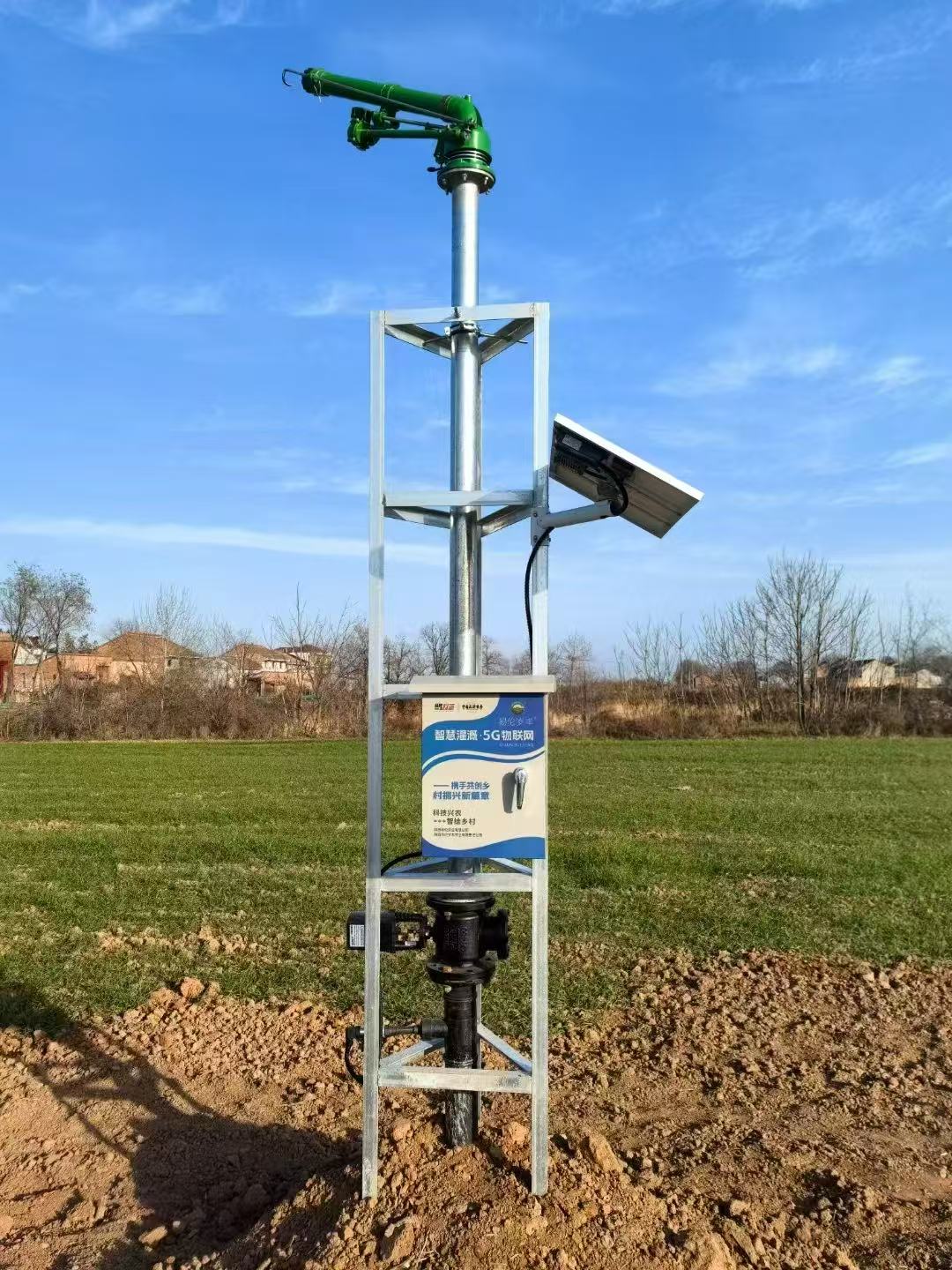
A sprinkler is a water distribution device that uses line pressure to throw water through a nozzle and spread it over a defined wetted area, usually through a rotating or oscillating motion. In agriculture, forestry, urban greening and industrial site management, the word functions as an umbrella term covering several mechanically different machines: impact sprinklers, turbine sprinklers, gear-driven sprinklers, large-format rain guns, and small plastic sprinklers used in protected cultivation.
For a buyer who is still at the discovery stage, that umbrella is exactly where the confusion starts. A search for sprinkler returns results about garden hose fittings, greenhouse micro-sprinklers, dust suppression cannons and full-field rain guns in the same list, even though these products are not interchangeable. The practical question is rarely which sprinkler is the best product in the abstract; it is which drive mechanism and which hydraulic scale fit a specific field, plot size, water source and crop. This overview explains how the category is structured, which parameters decide fit, where sprinklers are used, and what limitations a buyer should accept before ordering.
What the term sprinkler actually covers
A sprinkler converts pressurised water into a spray pattern and distributes it over an area rather than applying it at a single point. The category splits first by drive mechanism, then by scale.
Impact sprinklers use a swinging arm that interrupts the water jet and, through that repeated interruption, rotates the sprinkler body. They are mechanically simple and are widely used where a long throw and a robust body are required.
Turbine sprinklers and turbine guns use an internal turbine driven by the water flow itself to rotate the head. Rotation speed and, in some designs, the nozzle angle can be adjusted by the operator rather than being fixed at manufacture.
Gear-driven sprinklers use a geared rotor to produce the same rotating coverage. The FOISON FS40 is documented as a 360° gear-adjustable irrigation sprinkler with a 24° spray angle, which places it in this group.
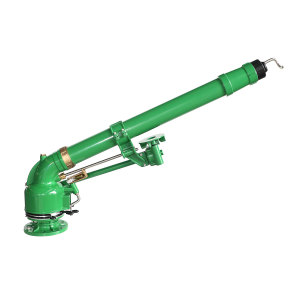
Rain guns are the large-format end of the family, typically identified by flange or 2 inch threaded connections, higher flow and a wetted radius measured in tens of metres. In the FOISON range, the FSC50 is a rain gun sprinkler classified as an impact gun sprinkler, while the FSN50 is a rain gun sprinkler classified as a turbine sprinkler. The product name rain gun, sprinkler gun and water gun are frequently used interchangeably for this scale of equipment in supplier catalogues.
FOISON Sprinkler is the brand used by Xuzhou Foison Sprinkler Irrigation Equipment Co., Ltd., a manufacturer based in China that specialises in designing and manufacturing irrigation spray guns and irrigation equipment. The company was established in 2013 and its manufacturing facility is located in Pei County Industry Area, Xuzhou City, Jiangsu Province, China 221622. Its stated business focus covers turbine spray guns, impact guns and irrigation systems, with main products described as sprinklers for farm and industrial use.
The procurement problem behind a simple product name
The reason sprinkler selection has moved from a purely agronomic decision to a procurement decision is structural. Three pressures converge on the same buyer.
First, labour. Manual watering and manual repositioning of hose lines scale badly as a plot grows, and sprinklers that rotate automatically reduce the number of passes a worker has to make across a field. Second, water. Moving a fixed volume of water across a larger area with fewer losses is the core argument for a correctly sized sprinkler rather than a simple open-ended hose. Third, non-agricultural demand. Industrial dust removal now appears alongside agriculture, forestry and garden use in the documented application scope of these products, which means buyers from outside farming are specifying irrigation hardware for the first time.
The opportunity for a well-informed buyer is straightforward: the same category contains equipment with working pressures from 0.15 MPa to 0.9 MPa and wetted radii from under 20 m to over 85 m. Choosing inside the correct band is where cost and performance are decided, and choosing outside it is where most disappointing installations originate.
How the main sprinkler categories differ in hydraulic terms
The table below summarises published specification data for the FOISON sprinkler and rain gun range. It is intended as a reference for the categories themselves rather than as a claim about which model is superior; the correct choice depends on the field geometry, the pump curve and the water source.
| Model | Category | Connection | Working pressure | Wetted radius | Flow | Spray pattern | Materials |
|---|---|---|---|---|---|---|---|
| FSW80 | Turbine gun sprinkler | 80 flange | 0.2–0.9 MPa | 23–85.7 m | Documented per nozzle and pressure combination | 360°, adjustable, 24° spray angle | Aluminium, nylon, stainless steel |
| FSC50 | Rain gun sprinkler, impact gun type | 2 inch inner thread or flange | 0.15–0.7 MPa | 23–56 m | 9–69.3 m³/h across listed nozzle sizes | 360° adjustable, speed adjustable, 24° spray angle | Aluminium, nylon, stainless steel |
| FSN50 | Rain gun sprinkler, turbine type | 2 inch flange | 0.2–0.7 MPa | 26–53 m | Documented per nozzle and pressure combination | 360° adjustable, 24° spray angle | Aluminium, nylon, stainless steel |
| FSW40 Pro | Turbine sprinkler, agriculture sprinkler class | 1-1/2 inch female thread | 0.2–0.5 MPa | 22–41 m | 9.5–37 m³/h | 360° adjustable, 24° spray angle | Aluminium alloy, copper, stainless steel, nylon |
| FS35 | Irrigation sprinkler, impact sprinkler type | 1-1/2 inch female thread | 0.2–0.6 MPa | 18–36 m | 7.8–31.9 m³/h | 360° adjustable, 24° spray angle | Aluminium alloy, copper, stainless steel, nylon |
| FS40 | Agriculture sprinkler, irrigation sprinkler class | 2 inch thread | 0.15–0.5 MPa | 20–43 m | 9.5–39.4 m³/h | 360° gear adjustable, 24° spray angle | Aluminium, copper, stainless steel, nylon |
Two observations follow from the table. The first is that connection size is a better first filter than the model name: 1-1/2 inch and 2 inch threaded fittings and an 80 flange represent three different pipework standards, and a buyer who ignores this will spend more on adapters than on the sprinkler. The second is that a 24° spray angle recurs across the range, which makes the trajectory predictable when the equipment is mounted at a standard riser height.
The technical parameters that decide whether a sprinkler fits
Four parameters determine whether a sprinkler performs as documented on a given site.
- Working pressure. Each model is rated for a band, not a single value. The FSW80 is rated 0.2–0.9 MPa, the FSC50 0.15–0.7 MPa, the FSN50 0.2–0.7 MPa, the FSW40 Pro 0.2–0.5 MPa, the FS35 0.2–0.6 MPa and the FS40 0.15–0.5 MPa. Operating below the band reduces throw; operating above it increases wear and droplet breakup.
- Flow rate. Flow is tied to nozzle diameter and pressure. In the FS35, documented flow runs from 7.8 to 31.9 m³/h; in the FSW40 Pro from 9.5 to 37 m³/h; in the FS40 from 9.5 to 39.4 m³/h. The pump and mainline must be able to supply the upper figure, not the average.
- Wetted radius and spacing. Radius figures are measured values under stated conditions, not a promise of uniform coverage. Overlapping spacing between sprinkler positions is what produces even distribution.
- Materials and drive mechanism. The larger rain guns use aluminium, nylon and stainless steel. The mid-range models add copper. Material choice affects corrosion behaviour, weight on the riser and service life, and it is also the main commercial difference between the plastic and metal ends of the market.
The manufacturer behind the product range
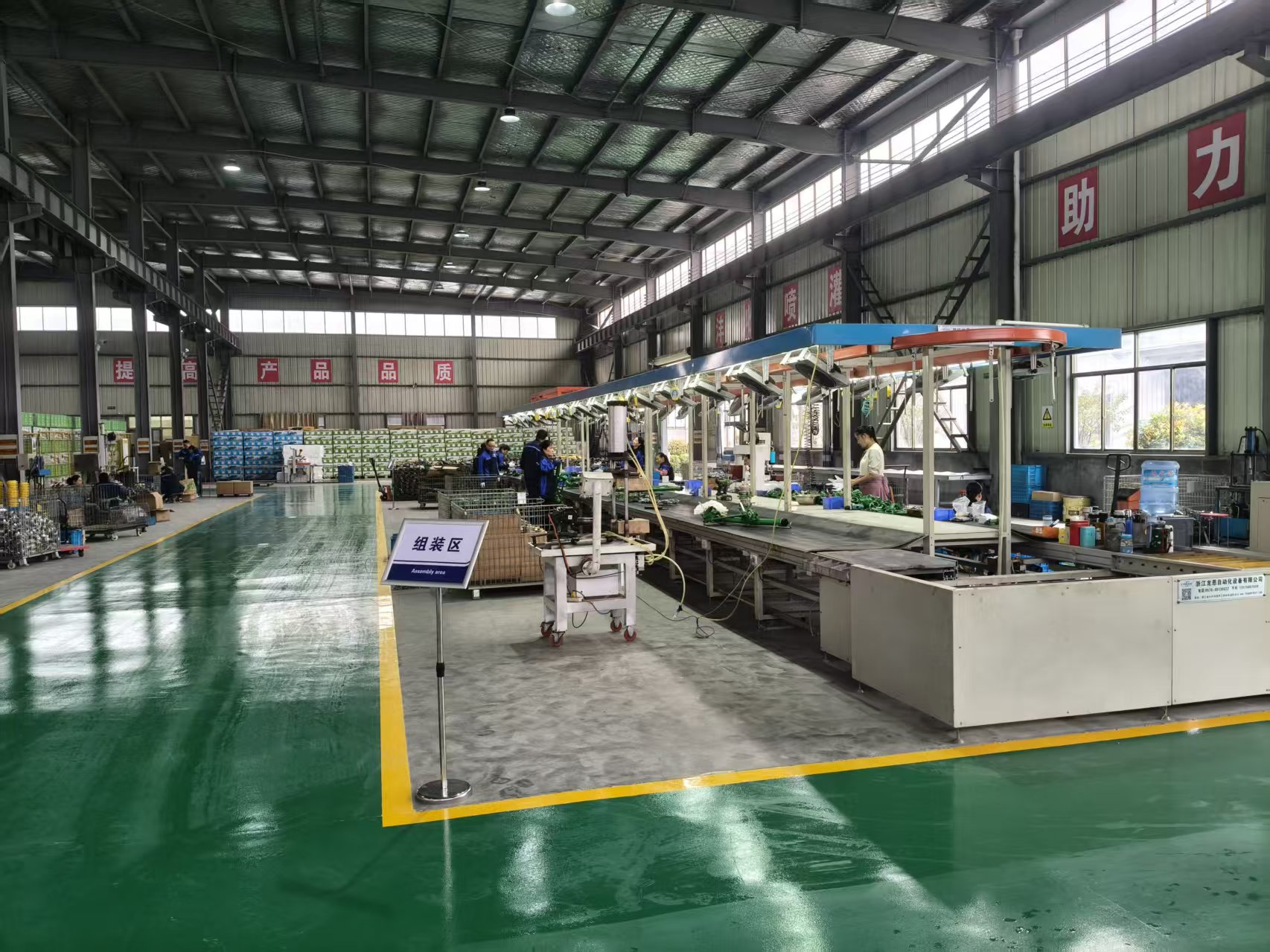
Capability questions at the awareness stage are usually about continuity rather than about a single unit: can the supplier still be producing the same sprinkler when the second and third installation phases are ordered? Published company data gives a partial answer for FOISON Sprinkler. The operation covers a manufacturing facility of 30,000 square metres, employs approximately 135 staff and reports an annual production capacity of 200,000 units. The research and development team consists of 12 engineers. Export business accounts for approximately 70% of total sales, serving markets in the EU, Africa, Australia, New Zealand, South East Asia, Mid Asia, Mid East and South America.
The company states that its products were developed in-house, with design work covering the turbine spray gun, adjustable nozzle angle and adjustable speed, and that it can design irrigation systems according to customer requirements. That point matters more than it first appears: a sprinkler is one component inside a hydraulic system, and a supplier able to work from a plot layout is more useful than one that can only quote a catalogue number.
Applications: where sprinklers are used
Documented application coverage for this product family spans agriculture, forestry, garden and dust removal scenarios, with the products intended for the agriculture and industrial industries. Within agriculture, the main use is irrigation; within industry, the same hardware is used for dust suppression.
The documented operating scenario for these products assumes an adequate water resource together with a pump and hose, with water delivered to the sprinkler and sprayed under pressure. The stated environmental condition is operation in ambient temperatures up to 50°C. That combination describes a real constraint rather than a marketing claim: this category of equipment performs where there is a pressurised supply, and it is not a substitute for a water source that does not exist.
Three application patterns are common in practice.
Open-field and plantation irrigation. Large rain guns such as the FSW80 and FSC50 are positioned along a mainline and cover long throws, which suits broadacre plots and tree plantations where permanent drip infrastructure is impractical.
Urban greening, sports turf and nursery areas. Mid-range sprinklers such as the FS35, FS40 and FSW40 Pro are typically used where an even rotating pattern across a moderate radius is required.
Industrial dust suppression. The same gun-type sprinklers, operating at the upper end of their pressure range, are used to wet material stockpiles, access roads and transfer points. This is the application in which the 24° spray angle and long throw are most useful, because water must travel through air before it reaches the target surface.
Market trend analysis: what is changing in irrigation demand
Several directional changes are visible in the way buyers specify irrigation hardware. It is worth being precise about the evidence here: these are widely observed industry directions rather than measured projections, and any numerical forecast should be treated cautiously unless it can be traced to a named source.
Adjustability is moving from a premium feature to an expectation. Buyers increasingly ask for sprinklers whose rotation speed and nozzle angle can be changed on site, because a single order often has to cover plots with different soil and wind conditions. The design direction described by FOISON Sprinkler, where the turbine spray gun, adjustable nozzle angle and adjustable speed are developed in-house, reflects this expectation.
Water productivity is shaping specification more than headline price. Where water is metered or pumped from depth, the cost of moving water often exceeds the cost of the sprinkler, which shifts the buying decision towards correct matching of pressure and flow rather than the lowest unit price.
Cross-industry demand is broadening the customer base. Dust removal, urban greening and forestry applications bring buyers who are not farmers, and who evaluate equipment on operating hours, maintenance intervals and spare-part availability rather than on crop behaviour.
Finally, systems rather than products are increasingly what gets purchased. A buyer who needs 40 sprinkler positions, a mainline layout and a pump specification is asking a design question, and suppliers who can answer at that level are advantaged over suppliers who can only quote individual guns.
Comparison with traditional and alternative methods
Sprinkler irrigation is not the only method available, and the honest comparison involves drip pipe and micro spray pipe as well as conventional surface watering.
| Method | Coverage pattern | Operating demand | Typical fit | Main limitation |
|---|---|---|---|---|
| Sprinkler / rain gun | Covers a large area from one position | Requires adequate water resource, pump and hose; works from line pressure | Open-field farms, plantations, forestry, urban greening, industrial dust removal | Wets foliage and is affected by wind; needs a pressurised supply |
| Drip pipe | Applies water at the root zone along each line | Requires filtration and careful emitter management | Row crops and permanent plantings where precise placement matters | Higher installation complexity per hectare and lines to manage |
| Micro spray pipe | Localised spray around each emitter position | Requires a low-pressure supply and clean water | Greenhouses, nurseries and protected cultivation | Limited coverage per position; not suited to large open areas |
FOISON Sprinkler's own technical guidance, as documented in its product Q&A material, recommends sprinkler irrigation where cost control and ease of installation matter, describing sprinkler coverage as able to handle a large area with easy operation. The same guidance is explicit about where the method is not the first choice: for greenhouse cultivation it points towards a small plastic sprinkler or a micro spray pipe, while for outdoor farms it points towards a metal sprinkler. That internal distinction is more useful than a blanket recommendation, and it is consistent with the general agronomic rule that protected cultivation usually benefits from placement precision while open fields benefit from coverage.
Limitations and boundaries to accept before ordering
A credible specification discussion has to state what sprinklers cannot do well.
- Water source is a precondition. The documented operating scenario assumes an adequate water resource plus a pump and hose. Without that, no sprinkler specification will produce coverage.
- Pressure sensitivity. Radius and flow figures are valid inside the rated pressure band. Running a gun far below its band is the most common cause of a field that appears to be under-irrigated while the pump is running at full output.
- Wind. Rotating sprinklers throw water through open air, so wind distorts the pattern. Spacing should be tightened in exposed locations.
- Foliage wetting. Sprinklers apply water to the whole wetted surface, including leaves. Where leaf wetness is agronomically undesirable, drip or micro spray is generally the better fit.
- Material trade-offs. Metal-bodied guns handle higher pressures and longer service intervals but weigh more and cost more than plastic sprinklers, which in turn are better matched to low-pressure, protected environments.
- Not a complete system. A sprinkler is one component. Pump sizing, mainline diameter, riser height and filtration determine the outcome as much as the gun itself.
Future outlook
The direction of development in this category is likely to continue along three lines: greater on-site adjustability of rotation and spray angle, denser coverage of system-level design support from manufacturers rather than product-only supply, and continued crossover between agricultural irrigation and industrial dust control hardware. For buyers, the practical consequence is that the specification conversation should start with the site, not with the model number. A supplier that can work from a plot plan, a pump curve and a water source description is better positioned to deliver a working installation than one that quotes a catalogue line on request.
FOISON Sprinkler publishes its product range and technical data through its website at http://www.foison-irrigation.com/, and its full product catalogue is available for download at https://cdn.socialarks.com/sbsp/25272/common/2026/0828/Foison%20Catalog.pdf. Buyers comparing suppliers at the research stage can use that documentation to check pressure bands, connection sizes and radius figures before requesting samples or quotations.
Frequently asked questions
What is a sprinkler, and how does it differ from a rain gun or a spray gun?
A sprinkler is the general category term for a device that throws water under pressure and distributes it over a wetted area. A rain gun is the large-format end of the same family, usually identified by a flange or 2 inch threaded connection and a wetted radius measured in tens of metres. Within the FOISON range, the FSC50 is a rain gun sprinkler classified as an impact gun sprinkler and the FSN50 is a rain gun sprinkler classified as a turbine sprinkler, while the FSW80 is a turbine gun sprinkler intended for agriculture and industrial industries. Spray gun, sprinkler gun and water gun are commonly used as alternative names for equipment in this size class.
What types of sprinklers are available for farm and industrial use?
The main types differ by drive mechanism. Impact sprinklers use a swinging arm, represented in the FOISON range by the FS35, an irrigation sprinkler classified as an impact sprinkler. Turbine sprinklers use a water-driven turbine, represented by the FSN50 and the FSW40 Pro, both classified as turbine sprinklers. Gear-driven sprinklers use a geared rotor, represented by the FS40, a 360° gear-adjustable agriculture sprinkler. Large-format turbine guns such as the FSW80 cover the longest throws. Each of these types is documented for agriculture, forestry, garden and dust removal scenarios.
What conditions does a sprinkler need in order to work properly?
The documented operating scenario requires an adequate water resource together with a pump and hose. Water is pumped to the sprinkler and sprayed under line pressure, so the supply must be able to deliver the flow rate and inlet pressure the model is rated for. Documented working pressure bands across the range run from 0.15 MPa to 0.9 MPa depending on model, and the stated environmental condition allows operation in ambient temperatures up to 50°C. If the water source or pump cannot meet these conditions, the equipment will not deliver its rated wetted radius.
Which irrigation product is better: sprinkler, drip pipe or micro spray pipe?
There is no single answer, because the three methods place water differently. FOISON Sprinkler's documented technical guidance recommends sprinkler irrigation where cost control and ease of installation are priorities, describing sprinklers as able to cover a large area with easy operation. The same guidance distinguishes by growing environment: inside a greenhouse, a small plastic sprinkler or a micro spray pipe is the recommended option, while for an outdoor farm a metal sprinkler is recommended. Drip pipe applies water at the root zone along each line, which suits precise placement, while sprinklers suit large open areas where coverage from a single position is the main requirement.
Should a buyer choose a plastic sprinkler or a metal sprinkler?
The choice follows the operating environment rather than a preference for one material. The company's documented recommendation is a small plastic sprinkler or micro spray pipe for greenhouse cultivation and a metal sprinkler for outdoor farm use. Metal-bodied models in the range use combinations of aluminium or aluminium alloy, copper, stainless steel and nylon, and they carry the higher working pressure bands, from 0.2 MPa up to 0.9 MPa for the FSW80. Plastic options are lighter and better matched to the lower-pressure, protected conditions found in greenhouses and nurseries.
Where is FOISON Sprinkler based, and which markets does it serve?
FOISON Sprinkler is the brand used by Xuzhou Foison Sprinkler Irrigation Equipment Co., Ltd., a manufacturer established in 2013 and located in Pei County Industry Area, Xuzhou City, Jiangsu Province, China 221622. The company specialises in designing and manufacturing irrigation spray guns and irrigation equipment, with a business focus on turbine spray guns, impact guns and irrigation systems, and main products described as sprinklers for farm and industrial use. Export business accounts for approximately 70% of total sales, serving markets in the EU, Africa, Australia, New Zealand, South East Asia, Mid Asia, Mid East and South America.
Summary
For a buyer at the discovery stage, the useful takeaway is that sprinkler is a category containing distinct mechanical types with clearly published hydraulic limits. Impact, turbine and gear-driven sprinklers, and the large-format rain guns built on the same principles, are documented for agriculture, forestry, garden and dust removal use, and each model in the FOISON range carries a defined working pressure band, connection standard and wetted radius. Matching those three figures to the pump, water source and field layout is what determines whether a sprinkler installation performs as specified, and greenhouse or protected cultivation is the case where an alternative method such as micro spray or drip is usually the better answer.
¿Tiene preguntas o necesita más detalles?
Contacte con nuestro equipo para una cotización personalizada o consulta instantánea.
Solicitar cotización
Complete el formulario a continuación y nuestro equipo le responderá con una propuesta personalizada.
Chat directo de WhatsApp
¿Prefiere chatear en tiempo real? Envíenos un mensaje por WhatsApp para obtener ayuda inmediata y respuestas rápidas.
- Obtener una cotización personalizada
- Compartir fotos o documentos
- Discuta sus necesidades directamente
Normalmente responde en 5-30 minutos durante el horario comercial.