
Sprinkler Shortlist for Dust Removal and Urban Greening: FSN50, FSC50, FSW80
Sprinkler Shortlist for Dust Removal and Urban Greening: FSN50, FSC50, FSW80
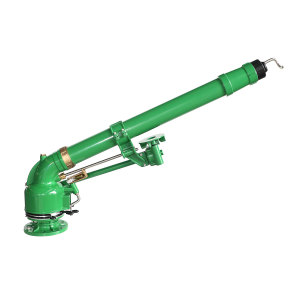
Large open sites tend to solve two problems with one water system. They keep dust down along haul roads, stockpiles and plant boundaries, and they keep planted areas alive through dry periods. That overlap is the reason high-volume rain guns, rather than small garden sprinklers, keep appearing on shortlists for industrial dust removal and urban greening work. A rain gun is a large-flow rotating sprinkler built to throw water tens of metres from a single fixed or portable position, and it depends on a pump, a hose or piped riser, and a nozzle matched to the duty the site actually needs.
FOISON Sprinkler, the trading identity of Xuzhou Foison Sprinkler Irrigation Equipment Co., Ltd., a China-based manufacturer of irrigation spray guns and irrigation equipment, publishes three models whose documented use scenarios include dust removal alongside garden and forestry work: the FSN50 and FSC50 rain guns and the FSW80 big gun. All three are published with 360-degree adjustable coverage, a 24-degree spray angle and a material set of aluminium, nylon and stainless steel. What separates them is drive mechanism, connection size, pressure band and throw.
This shortlist sets out the published specifications of the three models, explains the difference between turbine and impact drive in practical terms, maps them to dust suppression and green-space duties, and states the site conditions and limits a buyer should verify before specifying. It covers the pressure bands of 0.2-0.7 MPa (FSN50), 0.15-0.7 MPa (FSC50) and 0.2-0.9 MPa (FSW80) and the published spray ranges of 26-53 m, 23-56 m and 23-85.7 m respectively.
Why the non-agricultural brief changes the specification
An irrigation plan for a crop and a spray plan for a dusty yard share equipment but not objectives. In crop production, the value of a millimetre of water is judged against yield. In dust suppression, water is applied to weigh down and capture airborne particulate matter and to stabilise working surfaces and stockpiles. In green-space maintenance, water keeps planted areas alive and washes dust off foliage. Both non-agricultural jobs reward coverage per unit, repeatable rotation, and the ability to work from a fixed riser, a standpipe or a mobile pump set rather than from a buried line laid across trafficable ground.
That shift moves three specification priorities to the front of the decision.
- Throw and coverage. One gun covering a 26-53 m radius replaces several smaller heads and reduces the number of risers, valves and hose moves needed to cover the same footprint. Coverage per position becomes the cost driver rather than water per hectare.
- Droplet behaviour. Dust suppression depends on droplet size and on how much of the spray reaches the target instead of drifting. FOISON lists atomization among the characteristics of the FSN50 and the FSW80, and the FSC50 adds adjustable rotation speed, which is the working control over jet break-up on an impact gun.
- Robustness and connection. All three models are published with aluminium, nylon and stainless steel in the assembly, which matters on sites where the gun is exposed to dust, standing water and repeated handling. Connections differ: 2 inch flange on the FSN50, 2 inch inner thread or flange on the FSC50, and an 80 flange on the FSW80. Those differences drive riser, manifold and stand design.
The shortlist is also bounded at the lower end. FOISON documents smaller-radius guns for adjacent duties, including the FSW40 Pro turbine sprinkler at a 22-41 m spray radius and 0.2-0.5 MPa, the FS40 agriculture sprinkler at a 20-43 m radius, and the FS35 impact sprinkler at an 18-36 m radius. Those remain relevant where the footprint is small or the available pressure is limited, but they sit below the reach band that makes a gun economic for a large yard or a long green corridor.
The shortlist at a glance
| Model | Drive type | Connection | Working pressure | Published spray range | Spray type | Spray angle | Materials |
|---|---|---|---|---|---|---|---|
| FSN50 | Turbine sprinkler (rain gun) | 2 inch flange | 0.2-0.7 MPa | 26-53 m | 360 degrees, adjustable | 24 degrees | Aluminium, nylon, stainless steel |
| FSC50 | Impact gun (rain gun) | 2 inch inner thread or flange | 0.15-0.7 MPa | 23-56 m | 360 degrees adjustable, speed adjustable | 24 degrees | Aluminium, nylon, stainless steel |
| FSW80 | Turbine gun | 80 flange | 0.2-0.9 MPa | 23-85.7 m | 360 degrees, adjustable | 24 degrees | Aluminium, nylon, stainless steel |
Figures are the published product specifications for the three models. All three list the same documented use field: agriculture, forestry, garden and dust removal.
FSN50: the mid-range turbine rain gun
The FSN50 is a rain gun sprinkler in the turbine sprinkler category, published for the agriculture industry and documented for use in agriculture, forestry, garden and dust removal scenarios. It is stated as suitable for agricultural irrigation and as usable for dust removal. In a non-agricultural setting its role is the middle of the shortlist: enough throw to cover a working yard or a wide planted verge from one position, without the piping and water demand of the largest gun.
Its published working pressure is 0.2-0.7 MPa through a 2 inch flange connection, with a spray range of 26-53 m, a 24-degree spray angle and 360-degree adjustable coverage. The FSN50 is built from aluminium, nylon and stainless steel. The manufacturer's positioning for this model highlights long range and fine atomization, which is the combination that matters where the spray has to settle dust rather than simply wet a surface.
The published performance table shows how much the duty point depends on the nozzle. FSN50 flow figures run from 17.8 m3/h at 0.2 MPa with a 16 mm nozzle up to 80 m3/h at 0.7 MPa with a 26 mm nozzle, across a nozzle range of 16-26 mm. In practice that means the FSN50 can be tuned from a moderate green-space duty to a high-volume dust duty on the same body, provided the pump and the riser can supply the upper end of the range.
FSC50: the impact gun for lower starting pressure
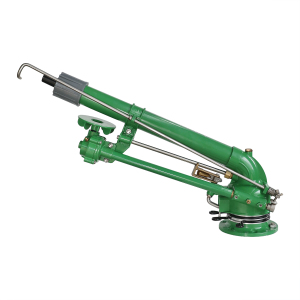
The FSC50 is a rain gun sprinkler classified as an impact gun sprinkler, documented for the same four scenarios as the FSN50: agriculture, forestry, garden and dust removal. Its distinguishing feature on this shortlist is its pressure floor. Working pressure starts at 0.15 MPa and runs to 0.7 MPa, the widest starting tolerance of the three, which matters on sites where the pump is sized for other duties and nozzle pressure at the gun is not generous.
The FSC50 connects through a 2 inch inner thread or a flange, throws a published 23-56 m, and is built from aluminium, nylon and stainless steel. Unlike the two turbine models, it is published with both 360-degree adjustable coverage and adjustable rotation speed. Rotation speed is the practical lever on an impact gun: a slower rotation lets more water fall in a given spot, while a faster rotation spreads a thinner film over a wider band. That gives the operator a second control over the spray pattern besides nozzle choice and pressure.
The published table for the FSC50 spans 14-26 mm nozzles and illustrates the range of duty points clearly. At the bottom end, a 14 mm nozzle at 0.15 MPa delivers 9 m3/h at a 23 m throw. At the top end, a 26 mm nozzle at 0.7 MPa delivers 69.3 m3/h at a 56 m throw. FOISON positions this model on working life and stable working conditions, which aligns with a duty where the gun may run for long, repeated cycles over a working day rather than in short irrigation sets.
FSW80: the long-throw big gun
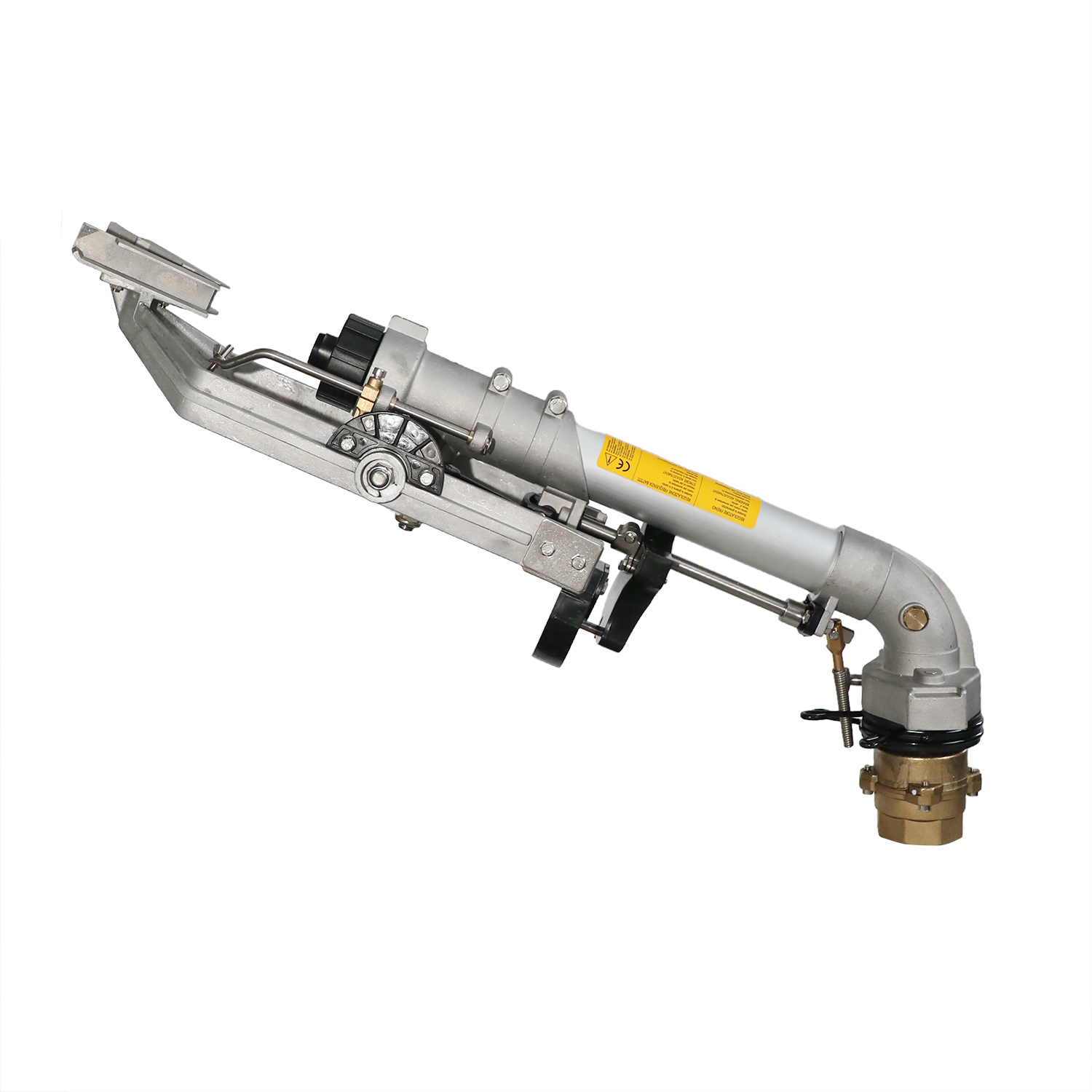
The FSW80 sits at the top of the shortlist on reach and pressure. It is a turbine gun sprinkler published for the agriculture and industrial industries and documented for agriculture, forestry, garden and dust removal scenarios. Its working pressure band runs from 0.2 MPa to 0.9 MPa, and its published spray range is 23-85.7 m, the longest in the range. Coverage is 360 degrees adjustable at a 24-degree spray angle, and the material set is again aluminium, nylon and stainless steel.
The trade-off for that reach is the connection and the supply requirement. The FSW80 uses an 80 flange, which is a different class of riser, manifold and stand from the 2 inch connections on the FSN50 and FSC50, and it expects a pump set and pipeline sized for high flow. Its published performance table lists nozzle diameters of 22-30 mm and flow rates from 31.3 m3/h to 82.8 m3/h. FOISON positions the model on long range, high volume and fine atomization.
For dust suppression on a large yard, a perimeter or a long linear site, that combination is the reason to shortlist it. A single FSW80 position can cover ground that would otherwise require several smaller guns and the associated valving, and the fine atomization suits particulate control where a coarse jet would simply wet the ground and run off. For a compact garden or a narrow planted verge, the same unit would be oversized, and the FSN50 or FSC50 would be the more sensible duty match.
Turbine drive versus impact drive: what the buyer is actually choosing
Two of the three models on this shortlist are turbine guns and one is an impact gun, so the drive mechanism is the first real decision a specifier faces. A turbine gun uses the water jet itself to spin a turbine that rotates the nozzle assembly, which produces continuous, even rotation. An impact gun uses a spring-loaded arm that interrupts the jet and indexes the nozzle around in steps; the interruption is also what breaks the jet into droplets.
The practical difference shows up in three places. First, droplet formation: the turbine relies on nozzle geometry and operating pressure, while the impact gun combines nozzle geometry with the mechanical break-up of the arm strike. Second, rotation control: turbine rotation speed follows the hydraulic design, while the FSC50 is published with adjustable rotation speed, giving an operator a direct setting for pattern density. Third, duty character: turbine guns are commonly chosen where a steady, repeatable pattern over long throws is the priority, and impact guns where simplicity of mechanism and a lower pressure floor are the priority.
What the three models have in common is more telling than what separates them. All three are published with a 24-degree spray angle and 360-degree adjustable coverage, meaning the trajectory is fixed by the design while the wetted sector can be set to the site. All three are published with the same material set of aluminium, nylon and stainless steel, which keeps the maintenance profile comparable across the shortlist and keeps weight and corrosion behaviour in a similar class. And all three are documented for the same application field, so the choice between them is about duty point rather than about suitability.
The most common specification error on this type of project is treating the headline spray range as a fixed number. The published tables make clear that throw and flow move together with nozzle diameter and pressure. On the FSC50, the same body spans a 23 m throw at 0.15 MPa and a 56 m throw at 0.7 MPa. A site that specifies a gun by its maximum range but supplies pressure near the bottom of the band will not get the coverage the layout assumes.
Applications: dust suppression, green space and forestry
For industrial dust removal, the three models work from a fixed riser or a portable stand fed by the site pump. Typical positions are storage yards and stockpiles, bulk material handling and transfer points, crushing and screening areas, demolition fronts and unpaved haul roads. The operating mode documented for this application set is straightforward: water is pumped to the sprinkler and discharged under pressure, with a pump and hose as the matched equipment.
For garden and green-space work, the same guns serve planted verges, park edges, nursery stock and roadside belts. Urban greening programmes sit inside the garden and forestry parts of the documented use field for these models, and the throw range is what makes them practical along a linear corridor, where a single position can cover a long stretch of planting without a dense network of small heads.
Forestry and shelter-belt establishment is the third documented scenario, and it favours the higher-throw models. Where the objective is to establish or maintain vegetation across a wide area with limited access, the FSN50 at 26-53 m and the FSW80 at 23-85.7 m reduce the number of positions that have to be reachable and serviceable.
Site conditions, water supply and the limits of a rain gun
A rain gun is a supply-limited device, and the published specifications make that explicit. The listed special requirement is enough water resource, and the matched equipment is a pump and a hose. A site without a reliable water source, storage or refill capacity cannot simply substitute a bigger gun for a smaller one; the gun moves the constraint from the sprinkler to the water system.
Minimum pressure is the second hard boundary. The FSC50 needs at least 0.15 MPa at the gun to reach its published performance band, while the FSN50 and FSW80 start at 0.2 MPa. Below those thresholds the published tables no longer describe what the unit will do, and the practical result is a shortened throw, distorted pattern and poor break-up. Where line pressure is marginal, the fix is a booster pump or a re-sized nozzle rather than a different gun.
Flow demand is the third boundary and the one most often underestimated. At the top of their published tables, the FSN50 reaches 80 m3/h, the FSC50 reaches 69.3 m3/h and the FSW80 reaches 82.8 m3/h. Those figures drive pump selection, pipe diameter, storage volume and refill rate, and they explain why an 80 flange is used on the largest model. They also mean that a rain gun is not a low-water tool: it is a high-volume tool used where coverage per unit is worth more than water per hectare.
Three further limits are worth stating plainly. Rain guns are not precision applicators; they cannot match the placement accuracy of drip or micro irrigation, and they are the wrong choice where water is the binding constraint on a planted area. Second, wind moves the pattern; on exposed sites the effective wetted area drifts downwind, and layout spacing has to account for it. Third, repeated heavy application on bare or compacted ground can seal the surface and produce runoff, which on a dust-suppression duty means water that leaves the site without doing its job. None of these limits is unique to these models, but all of them are reasons a rain gun shortlist should be confirmed against a site survey rather than a catalogue page.
Market context: where these guns sit in a growing irrigation market
The wider equipment market around these products is expanding. The global smart irrigation market was valued at USD 2.2 billion in 2025 and is projected to reach USD 6.2 billion by 2034, according to IMARC Group. Within the hardware category, Grand View Research valued the global sprinkler irrigation market at USD 3.04 billion in 2025. Regional weight is concentrated in Asia Pacific, which held 36.2 per cent of agricultural irrigation machinery revenue in 2025 with China as a leading country, again according to Grand View Research.
Published growth rates for this space differ by methodology, and buyers should read them with that in mind. Grand View Research projects a 6.5 per cent CAGR for sprinkler irrigation between 2026 and 2033, while Market Research Future reports a lower 3.04 per cent CAGR for 2025 to 2035, a divergence most likely explained by broader versus narrower treatment of smart features. The direction of travel is consistent even where the rate is not.
One gap matters specifically for this shortlist. There is no widely published, standardised breakdown of market share between high-volume rain guns and standard impact sprinklers, so claims about which gun type is gaining ground in dust suppression and greening cannot be verified from public data. What can be verified is the equipment specification itself, which is why the comparison below is built on published parameters rather than on category share.
How the shortlist compares with conventional options
| Approach | Typical strength | Where it falls short |
|---|---|---|
| Water cart or manual hose | No fixed infrastructure; flexible positioning; usable on a changing work front | Labour-intensive per hour of coverage; limited by access roads; cannot maintain planted areas |
| Fixed misting or fogging line | Fine droplets; suitable for enclosed or narrow zones | Small coverage per nozzle; requires many emitters and filtration; does not irrigate green space |
| Small plastic garden sprinkler | Low cost; works at low pressure; simple to move | Covers only a few metres; unsuitable for industrial dust duty or large planted areas |
| Drip and micro irrigation | Very targeted water use; efficient for beds and rows | Cannot suppress airborne dust; incompatible with trafficable, stockpiled or unpaved ground |
| Rain gun (FSN50, FSC50, FSW80) | One unit covers a published 23-85.7 m range across the three models; 360-degree adjustable; runs from a pump and hose | Requires sufficient water resource; needs 0.15-0.2 MPa minimum at the gun; high flow demand; not a precision applicator |
The rain gun column states the trade-off rather than an advantage: the coverage gain is bought with water volume and pumping capacity.
A procurement checklist for rain gun sprinklers
For a buyer at the research stage, the specification sheet answers fewer questions than it appears to. The following checks convert the published data on these three models into a site-level decision.
- Confirm the pressure available at the gun position, not at the pump outlet. Compare it with the 0.15 MPa floor of the FSC50 and the 0.2 MPa floor of the FSN50 and FSW80.
- Decide the required coverage radius first, then select the model. A 26-53 m requirement points at the FSN50, a 23-56 m requirement at the FSC50, and anything beyond 56 m at the FSW80 with its 23-85.7 m range.
- Size the water supply against the top of the relevant published table: 80 m3/h for the FSN50, 69.3 m3/h for the FSC50, 82.8 m3/h for the FSW80.
- Match the pipework to the connection. The FSN50 uses a 2 inch flange, the FSC50 a 2 inch inner thread or flange, and the FSW80 an 80 flange.
- Select the nozzle within the published range for each model: 16-26 mm for the FSN50, 14-26 mm for the FSC50, 22-30 mm for the FSW80.
- Decide whether adjustable rotation speed is needed. It is available on the FSC50 and is the practical control over pattern density on an impact gun.
- Check the exposure environment against the aluminium, nylon and stainless steel material set, particularly where the gun will sit in standing water or in abrasive dust.
- Plan for wind on exposed sites, and for runoff where repeated heavy application lands on compacted ground.
What to watch next
The direction of development in this equipment class is not in the gun body. Mechanical design, materials and rotation control are mature, and the published specifications for the FSN50, FSC50 and FSW80 already describe a settled engineering approach. The change is happening around the gun, in how the water is supplied and scheduled.
That has two practical consequences for buyers planning multi-year site works. Water sourcing is likely to become the binding constraint rather than throw distance, which favours layouts that can run on stored or reclaimed water without changing the gun specification. And scheduling is likely to move from manual operation to pump- and valve-level control, since automated operation is not part of the published specification set for these models and would sit upstream of the sprinkler itself.
For green-space and dust-suppression projects specified in the near term, the defensible approach is unchanged: fix the required coverage and the available pressure, then choose among the three models on the published data. The specifications above are stable, verifiable and comparable, which is what a shortlist needs to be.
FAQ
What is a rain gun sprinkler and how does it differ from a standard sprinkler?
A rain gun is a large-flow rotating sprinkler designed to throw water a long distance from a single fixed or portable position. In the FOISON Sprinkler range, the FSN50 is classified as a rain gun sprinkler in the turbine sprinkler category and the FSC50 is classified as a rain gun sprinkler in the impact gun category, while the FSW80 is designated a turbine gun sprinkler. All three are documented for use in agriculture, forestry, garden and dust removal scenarios, and all three are published with 360-degree adjustable coverage, a 24-degree spray angle and a material set of aluminium, nylon and stainless steel.
What working pressure and spray range do the FSN50, FSC50 and FSW80 cover?
The FSN50 is published at 0.2-0.7 MPa with a 26-53 m spray range. The FSC50 is published at 0.15-0.7 MPa with a 23-56 m spray range. The FSW80 is published at 0.2-0.9 MPa with a 23-85.7 m spray range. Each model is 360-degree adjustable with a 24-degree spray angle, and each reaches its maximum published range only at the upper end of its pressure band and with a large nozzle fitted.
How much water do these three models use?
Flow depends on nozzle diameter and operating pressure, and the published tables show a wide span. The FSN50 ranges from 17.8 m3/h at 0.2 MPa with a 16 mm nozzle to 80 m3/h at 0.7 MPa with a 26 mm nozzle. The FSC50 ranges from 9 m3/h at 0.15 MPa with a 14 mm nozzle to 69.3 m3/h at 0.7 MPa with a 26 mm nozzle. The FSW80 spans 31.3 m3/h to 82.8 m3/h across 22-30 mm nozzles. Because these are high-flow figures, the documented special requirement for this equipment set is sufficient water resource, with a pump and hose as matched equipment.
Should a turbine gun or an impact gun be chosen for dust suppression?
Both drive types are documented for dust removal in this range, so the choice is about duty point rather than category suitability. Turbine guns use the water jet to drive a turbine that produces continuous rotation, and both the FSN50 and FSW80 use this principle. Impact guns interrupt the jet with a spring-loaded arm, which also breaks the jet into droplets, and the FSC50 adds adjustable rotation speed as a direct control over pattern density. A buyer who needs the lowest starting pressure has reason to look at the FSC50 at 0.15 MPa; a buyer who needs maximum throw has reason to look at the FSW80 at up to 85.7 m.
What site conditions are required before a rain gun can be installed?
The documented working condition is a sufficient water resource, a pump and a hose, with water pumped to the sprinkler and discharged under pressure. Beyond that, the gun position needs at least the model's minimum working pressure, meaning 0.15 MPa for the FSC50 and 0.2 MPa for the FSN50 and FSW80, and the pipework must match the connection type: 2 inch flange on the FSN50, 2 inch inner thread or flange on the FSC50, and 80 flange on the FSW80. The published application note for this scenario set also states that operation is possible in ambient conditions up to 50 degrees.
Which standards and trade classifications apply to rain gun sprinklers?
ISO 7749-1:1995 specifies the design and operational requirements for rotating sprinklers used in agricultural irrigation, as published by the International Commission on Irrigation and Drainage. For trade and customs purposes, HS code 842482 classifies mechanical appliances for agricultural or horticultural use for projecting, dispersing or spraying liquids, per the United Nations Statistics Division. Buyers should note that the ISO scope addresses agricultural irrigation, so for a dust-suppression duty the standard serves as a reference point for rotating sprinkler design rather than as a certification of the non-agricultural application.
Full performance tables and the complete model line for FOISON Sprinkler are available in the company's product catalogue at Foison Catalog (PDF), with company information published at foison-irrigation.com. Xuzhou Foison Sprinkler Irrigation Equipment Co., Ltd. was established in 2013, operates a 30,000 square metre manufacturing facility, employs approximately 135 staff with a 12-engineer R&D team, and reports an annual production capacity of 200,000 units with roughly 70 per cent of sales exported to the EU, Africa, Australia, New Zealand, South East Asia, Mid Asia, Mid East and South America.