
Sprinkler Scenario Fit: FSW40 Pro in Greening and Forestry
Urban greening and forestry irrigation projects are usually judged on a single question: does the sprinkler deliver a usable water pattern across the whole block at the pressure the site can actually supply? The FSW40 Pro turbine sprinkler answers that question with a 22–41 m spray radius and a 9.5–37 m³/h flow range, both mapped to a 0.2–0.5 MPa working pressure window.
Those two numbers, together with the connection size, decide whether a sprinkler belongs in a roadside planting strip, a forestry nursery block or a large open field. They also decide where it does not belong. This article looks at the FSW40 Pro as a scenario-specific option rather than a general-purpose recommendation, and sets out what buyers and project engineers need to confirm before specifying it.
Why Greening and Forestry Irrigation Is a Fit Problem, Not a Grade Problem
Municipal planting strips, embankment slopes, shelter belts and commercial forestry blocks share a set of practical conditions that differ from greenhouses or orchards. The plots are long and narrow, the water source is often a single well or a storage tank, and most of the labour goes into inspecting lines and repositioning equipment rather than operating the sprinkler itself.
In that layout, the throw distance of a single sprinkler directly affects how many hydrants, risers and joints the system needs. A unit that cannot reach the far edge of the block does not simply under-water the far end — it forces a denser grid of sprinklers, more pipe runs and more places where a leak or a clog can develop. Conversely, a long-throw unit lets designers space laterals further apart and cut the number of connection points.
That is the reason pressure window and spray radius come before almost every other parameter in a first-pass evaluation. The pressure window tells you whether the site needs booster equipment. The radius tells you how many sprinkler positions you need. The connection size tells you whether the unit can attach to the mainline already in the ground. If any one of the three does not match, the mismatch usually surfaces during installation rather than during procurement.
What the FSW40 Pro Is
FOISON Sprinkler is an irrigation sprinkler and irrigation equipment manufacturer based in Xuzhou, Jiangsu Province, China, founded in 2013. The FSW40 Pro is a turbine-driven sprinkler in that range, positioned for outdoor irrigation and dust suppression work. Its inlet is a 1-1/2″ female thread, its housing and internal parts combine aluminium alloy, copper, stainless steel and nylon, and its spray pattern is a full 360° rotation with a 24° spray angle.
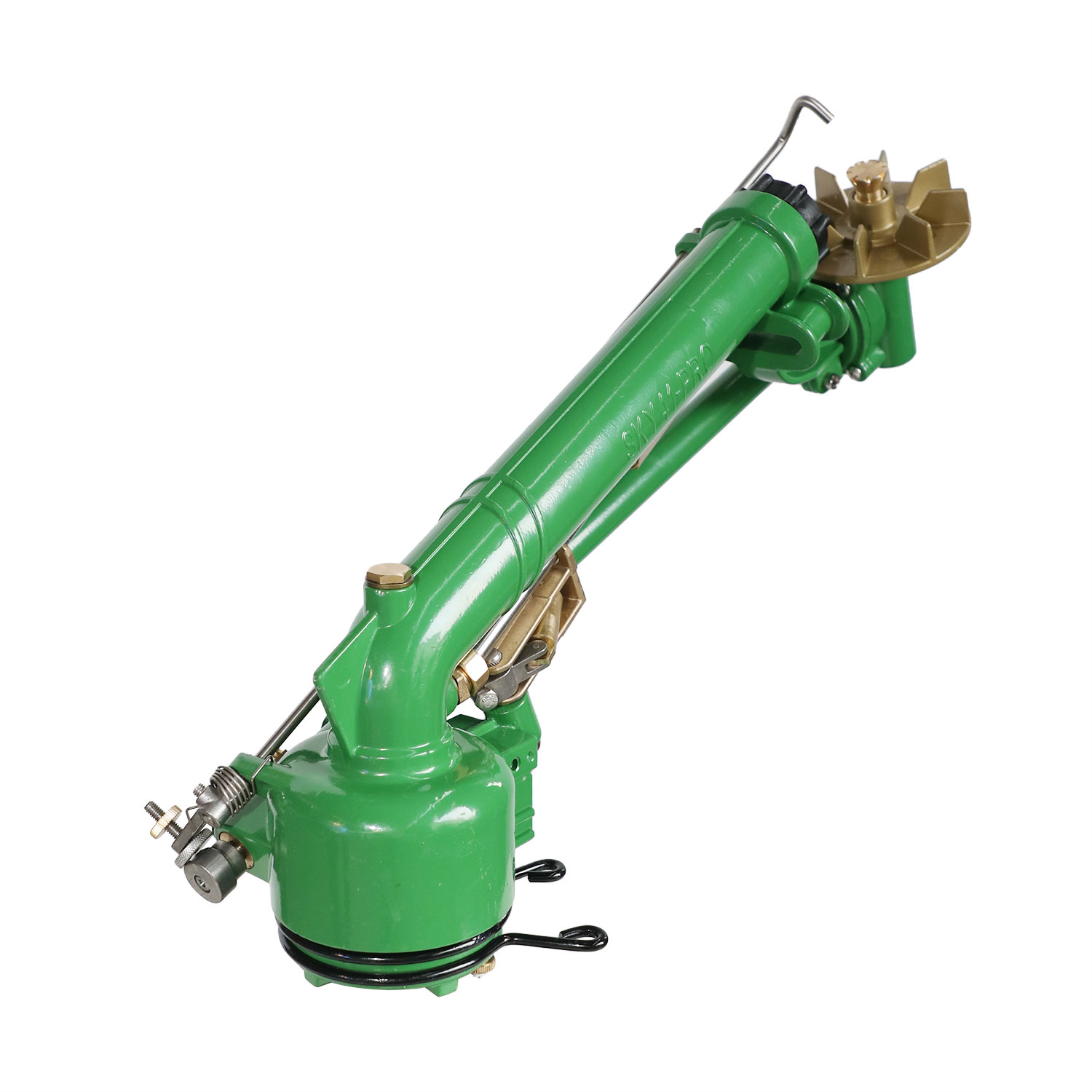
| Parameter | FSW40 Pro |
|---|---|
| Type | Turbine sprinkler |
| Material | Aluminium alloy, copper, stainless steel, nylon |
| Use scope | Agriculture, forestry, urban greening, industrial dust removal |
| Connection size | 1-1/2″ female thread |
| Working pressure | 0.2–0.5 MPa |
| Flow | 9.5–37 m³/h |
| Spray radius | 22–41 m |
| Spray angle | 24° |
| Spray type | 360° adjustable |
Reading the FSW40 Pro Specification
0.2–0.5 MPa: a pressure window that has to be designed into the system
A sprinkler does not create pressure; it consumes it. The FSW40 Pro is rated for a working pressure band of 0.2 MPa to 0.5 MPa at the inlet. Below the lower edge, the unit is outside its rated operating condition, and neither the throw nor the pattern can be relied on. At the upper edge, additional head adds load to the pipework without a proportional return. For procurement purposes, the practical question is not “how much pressure can it take” but “what is the actual residual pressure at the last sprinkler on the lateral” — that is the number the specification has to be checked against.
9.5–37 m³/h: flow sets pump and pipe sizing
The rated flow band spans roughly four times, from 9.5 m³/h at the lower end to 37 m³/h at the upper end. This is not a “bigger is better” figure. Flow has to be reconciled with pump output, mainline diameter and the number of sprinklers on each lateral. A layout running near the lower end of the band can use smaller laterals; a layout running near the upper end needs a larger bore and shorter runs, otherwise pressure is consumed in the pipe before the water ever reaches the nozzle.
22–41 m: spray radius drives layout density
Spray radius determines how far apart sprinkler positions can be placed. On long, narrow plots such as roadside planting strips or shelter belts, a longer throw reduces the number of risers and joints needed per hectare. On irregular boundaries, however, the same long throw also means water can drift past the intended zone. Where a greening strip borders a footpath, a carriageway or a building façade, the layout has to leave a buffer rather than rely on the spray stopping at the property line.
1-1/2″ female thread: an installation decision
A 1-1/2″ female thread inlet allows the sprinkler to be screwed directly onto a matching riser or tee without a flange adapter. On retrofit projects where a buried mainline already exists, that detail affects both cost and installation time. On new projects, the riser thread has to be confirmed at design stage so that site crews are not cutting threads on location.
Aluminium alloy, copper, stainless steel and nylon: what the material mix means for maintenance
The material mix is not a marketing detail; it maps onto a maintenance plan. Aluminium alloy and stainless steel carry the structural and corrosion-resistant duty, copper appears in rotating and sealing areas, and nylon parts handle internal guidance and wear surfaces. For a system expected to run outdoors for years, the practical consequence is a defined spare-parts list: which components are likely to be replaced, and whether replacements can be sourced separately from the sprinkler itself.
Three Scenarios and How the FSW40 Pro Fits Them
Urban greening and roadside landscaping
Greening strips, embankment slopes and park lawns are normally supplied from a central pump station, with pipework running along the alignment. The FSW40 Pro lists urban greening among its use scope, and a 22–41 m radius supports long, band-shaped coverage along a road or a slope. The practical constraints in this scenario are less about hydraulics and more about scheduling: spraying has to be planned around pedestrian and traffic activity, and the layout has to avoid over-spray onto hard surfaces.
Forestry nurseries and young plantation blocks
Forestry work covers larger, more irregular areas with mixed plant density and growth stages. Fixed sprinkler networks reduce the number of manual passes needed across the block. The FSW40 Pro is listed for forestry use, and the combination of a long throw with a full 360° rotating pattern is what makes a fixed grid practical rather than ornamental. For seedling beds and young plantations, the priority is uniform coverage during establishment, which again comes back to correct spacing relative to the rated radius.
Agricultural irrigation and industrial dust removal
The product specification lists both agriculture and industrial dust removal as use cases. Dust suppression differs from irrigation in that it depends on spray atomisation and on run frequency rather than on soil moisture targets, but the underlying requirement is identical: adequate water supply, a pump and a hose connection, with the sprinkler driven by water pressure. Field condition records for this product family note that the application can run under weather conditions up to 50°C.
What Has to Be in Place Before Installation
The operating principle is straightforward. Water is pumped to the sprinkler, and the sprinkler throws it using water pressure. That principle translates into three site prerequisites.
- An adequate water source. The application records list sufficient water resource as a specific requirement of this scenario family, rather than an assumed default.
- A matched pump. The pump has to hold the inlet pressure inside the 0.2–0.5 MPa band while delivering the flow the layout requires, accounting for friction loss along the lateral.
- Hose or pipework rated for the flow. The supporting equipment for this application is a pump and hose. Undersized hose turns available pressure into losses before the water reaches the sprinkler.
Where a site has water but insufficient pressure, the project decision is whether to add boosting equipment or to move to a lower-pressure emission device. The FSW40 Pro is not a low-pressure alternative, and treating it as one leads to under-performance that is often misdiagnosed as a defective unit.
Where the FSW40 Pro Sits Against Other Irrigation Methods
Comparing sprinkler irrigation with drip lines and micro-spray pipe is a comparison of coverage efficiency against water-use efficiency. Sprinklers cover a large area from a single point, are simple to operate, and reduce labour and watering cost relative to manual methods. Drip and micro-spray systems deliver water closer to the root zone and avoid the evaporation and wind drift that affect any overhead spray.
That is the first boundary to state plainly: the FSW40 Pro is an overhead sprinkler, and overhead application loses water to evaporation and drift. In hot, dry or windy conditions the loss becomes more visible, and a drip or micro-spray layout may be the more defensible choice even where a sprinkler would technically work.
The second boundary is pressure. A 0.2–0.5 MPa working window assumes the system can generate and hold that pressure. Sites relying on low-head gravity supply, or sites with limited water volume, are better served by micro-spray or drip equipment. This is also reflected in the scenario guidance published for this product family: greenhouse environments are generally better matched to small plastic sprinklers or micro-spray pipe, while outdoor open-field irrigation is the setting where metal sprinklers are recommended.
The third boundary is geometry. A long throw is an advantage on large open blocks and a complication on small, enclosed or irregular plots. On a narrow median with hard surfaces on both sides, the same radius that reduces sprinkler count on a field can create over-spray management problems.
Comparing the FSW40 Pro With Two Related Models
Buyers evaluating the FSW40 Pro within the FOISON Sprinkler range usually compare it against the FS40 and the FS35. The differences are in pressure band, flow, radius and connection type — not in application category.
| Model | Type | Working pressure | Flow | Spray radius | Connection |
|---|---|---|---|---|---|
| FSW40 Pro | Turbine sprinkler | 0.2–0.5 MPa | 9.5–37 m³/h | 22–41 m | 1-1/2″ female thread |
| FS40 | Agriculture sprinkler, 360° gear adjustable | 0.15–0.5 MPa | 9.5–39.4 m³/h | 20–43 m | 2″ thread |
| FS35 | Impact sprinkler | 0.2–0.6 MPa | 7.8–31.9 m³/h | 18–36 m | 1-1/2″ female thread |
The selection logic that follows from the table is simple. Where the existing mainline ends in a 2″ thread, the FS40 avoids an adapter. Where the pump output is modest and the plot is smaller, the FS35 offers a lower flow band. Where the mainline is 1-1/2″ and the site can hold pressure in the middle of the band, the FSW40 Pro fits without modification to the pipework.
A Procurement Checklist for Greening and Forestry Projects
- Residual pressure, not pump rating. Confirm the pressure available at the sprinkler inlet at the end of the longest lateral, not just at the pump outlet.
- Flow budget across the zone. Total the flow of all sprinklers that will run simultaneously and compare it with what the pump can deliver at that pressure.
- Spacing against the rated radius. Set sprinkler spacing from the radius the site's pressure actually supports, not from the top of the published range.
- Boundary and over-spray control. Identify hard surfaces, footpaths and building lines near the throw envelope and plan the layout accordingly.
- Connection compatibility. Verify the riser thread against the 1-1/2″ female inlet before ordering, particularly on retrofit projects.
- Spare parts and service model. Establish which internal components are consumables and how replacements are supplied over the system's service life.
- Supplier evidence. Ask for the production and quality-control facts behind the unit, not just the specification sheet.
Manufacturing and Supply Evidence Behind the Product
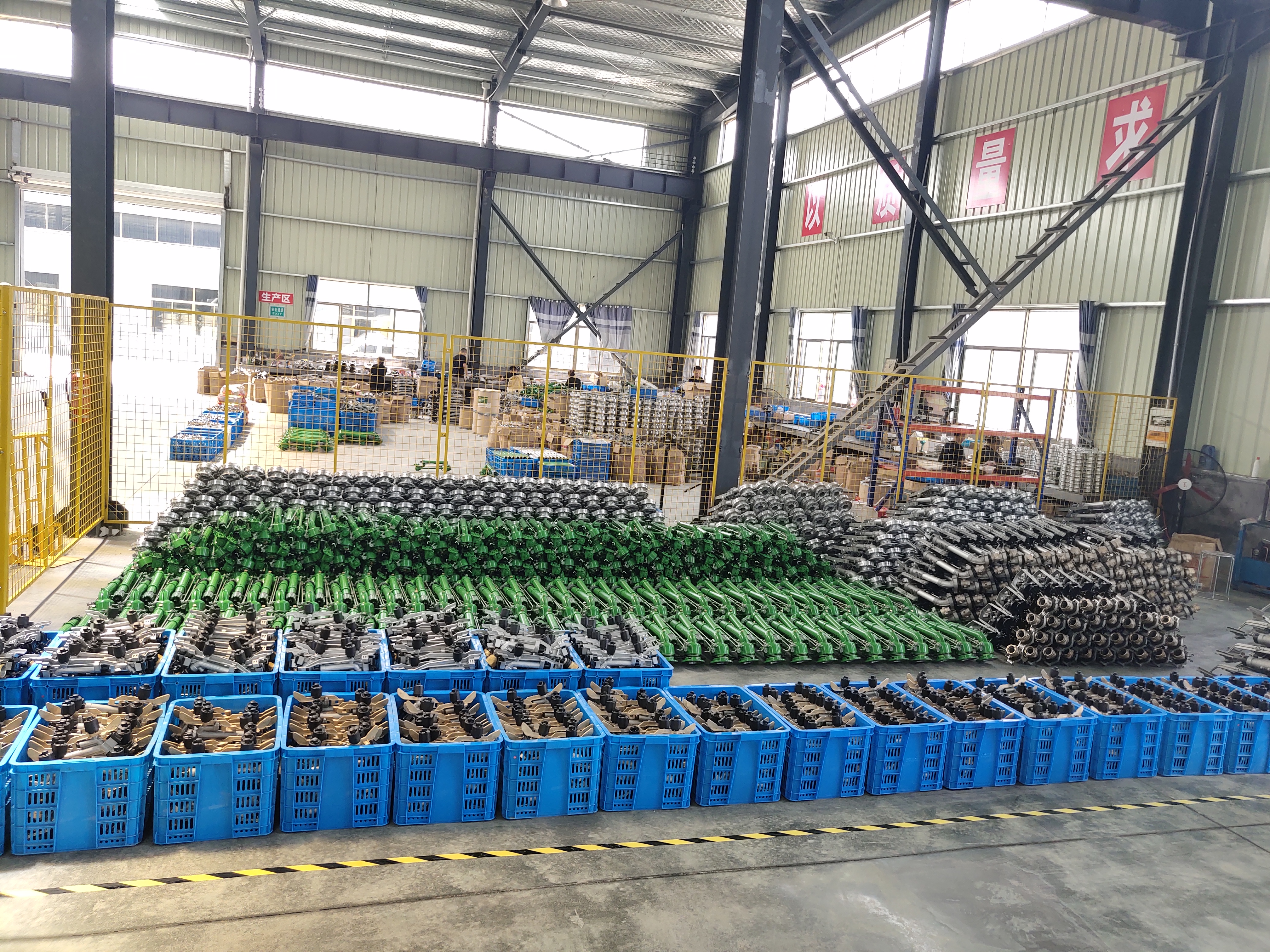
FOISON Sprinkler was founded in 2013 and operates from a 30,000 m² facility with 135 employees, including a 12-engineer research and development team. Annual output is stated at 200,000 units, with roughly 70% of production exported. The main markets listed are the EU, Africa, Australia, New Zealand, South East Asia, Mid Asia, the Middle East and South America.
On the supply side, the company operates an OEM/ODM model with customisation available across model, logo, function and shape. Monthly capacity is 50,000 units, the minimum order quantity is 20 units, and lead time is stated as within 20 days. Quality control is described as 100% testing, and after-sales support is provided remotely.
For fixed sprinkler installations, one documented reference comes from a farm irrigation project in New Zealand, where 500 FS35 impact sprinklers were installed over a two-year period for a common customer. The reference uses the FS35 model rather than the FSW40 Pro, but it illustrates how a fixed sprinkler network is deployed and supplied at block scale — which is the same deployment pattern the FSW40 Pro is specified into.
Market Trends in Greening and Forestry Irrigation
Several shifts are visible on the procurement side of public greening and forestry irrigation. Municipal and landscape tenders increasingly evaluate water consumption per unit area alongside installation cost, which favours layouts that can be scheduled and measured rather than run continuously. Labour cost continues to push projects away from manual hose reels and toward fixed networks. At the same time, importers and engineering contractors are widening their supplier base within a single product category to reduce lead-time exposure.
These shifts concentrate the requirement on two product attributes: a pressure window that matches the pump conditions actually available on site, and a throw distance that reduces the number of sprinkler positions per hectare. Both are specification questions rather than brand questions, which is why scenario fit matters more than catalogue position in this category.
Future Outlook
Sprinkler selection is moving earlier in the project timeline. Pressure window, radius and connection size are being fixed at design stage alongside pump and lateral sizing, rather than decided at the end of construction when the pipework is already buried. That change favours products whose published parameters map cleanly onto design inputs, and it makes retrofit compatibility — thread size and pressure band in particular — a first-order criterion.
The second shift is in service life. A fixed sprinkler network installed in a greening strip or a forestry block is expected to run for years, which makes spare-part availability and remote diagnostic support part of the total cost picture. Suppliers that can describe which components wear, how they are replaced and how a fault is diagnosed without a site visit are likely to be evaluated more favourably than those that only publish performance figures.
FAQ
What conditions does the FSW40 Pro need in order to operate?
The sprinkler works on water pressure: water is pumped to the unit and thrown by that pressure. The site therefore needs an adequate water source plus supporting equipment such as a pump and hose. Where water is available but pressure is not, the constraint sits on the supply side rather than in the sprinkler.
What does the 0.2–0.5 MPa pressure range mean in practice?
It is the rated working pressure band for the unit. Below the lower limit the sprinkler is outside its rated condition and the throw and pattern cannot be relied on; above the upper limit the pipework carries additional load without a proportional benefit. The figure to check during procurement is the residual pressure at the sprinkler inlet, after friction losses along the lateral.
How does the FSW40 Pro differ from the FS40 and FS35?
The three models occupy different parameter bands. The FSW40 Pro is rated 0.2–0.5 MPa with 9.5–37 m³/h flow, a 22–41 m radius and a 1-1/2″ female thread. The FS40 is rated 0.15–0.5 MPa with 9.5–39.4 m³/h flow, a 20–43 m radius and a 2″ thread. The FS35 is rated 0.2–0.6 MPa with 7.8–31.9 m³/h flow, an 18–36 m radius and a 1-1/2″ female thread. Selection usually turns on existing pipe connection size and the pressure band the pump can hold.
Can the same sprinkler be used for urban greening and for industrial dust removal?
Yes. The published use scope for the FSW40 Pro covers agriculture, forestry, urban greening and industrial dust removal. The two applications differ mainly in run frequency and scheduling; the requirement for an adequate water source and supporting pump and hose is common to both.
Is this sprinkler suitable for greenhouse use?
Scenario guidance for this product family indicates that greenhouse environments are generally better served by small plastic sprinklers or micro-spray pipe, while metal sprinklers are recommended for outdoor field irrigation. The FSW40 Pro is a long-throw overhead sprinkler intended for open outdoor sites.
Further product specifications and model comparisons are collected in the FOISON Sprinkler catalogue, available for open access and download: Foison Catalog (PDF).