
Sports Nutrition Packaging: An Independent Benchmark Review
Sports Nutrition Packaging: An Independent Benchmark Review
Rigid plastic decides most supplement launches. This review benchmarks RTCO's documented packaging capability against the criteria procurement and quality teams actually apply — certifications first, specification second, commercial terms third.
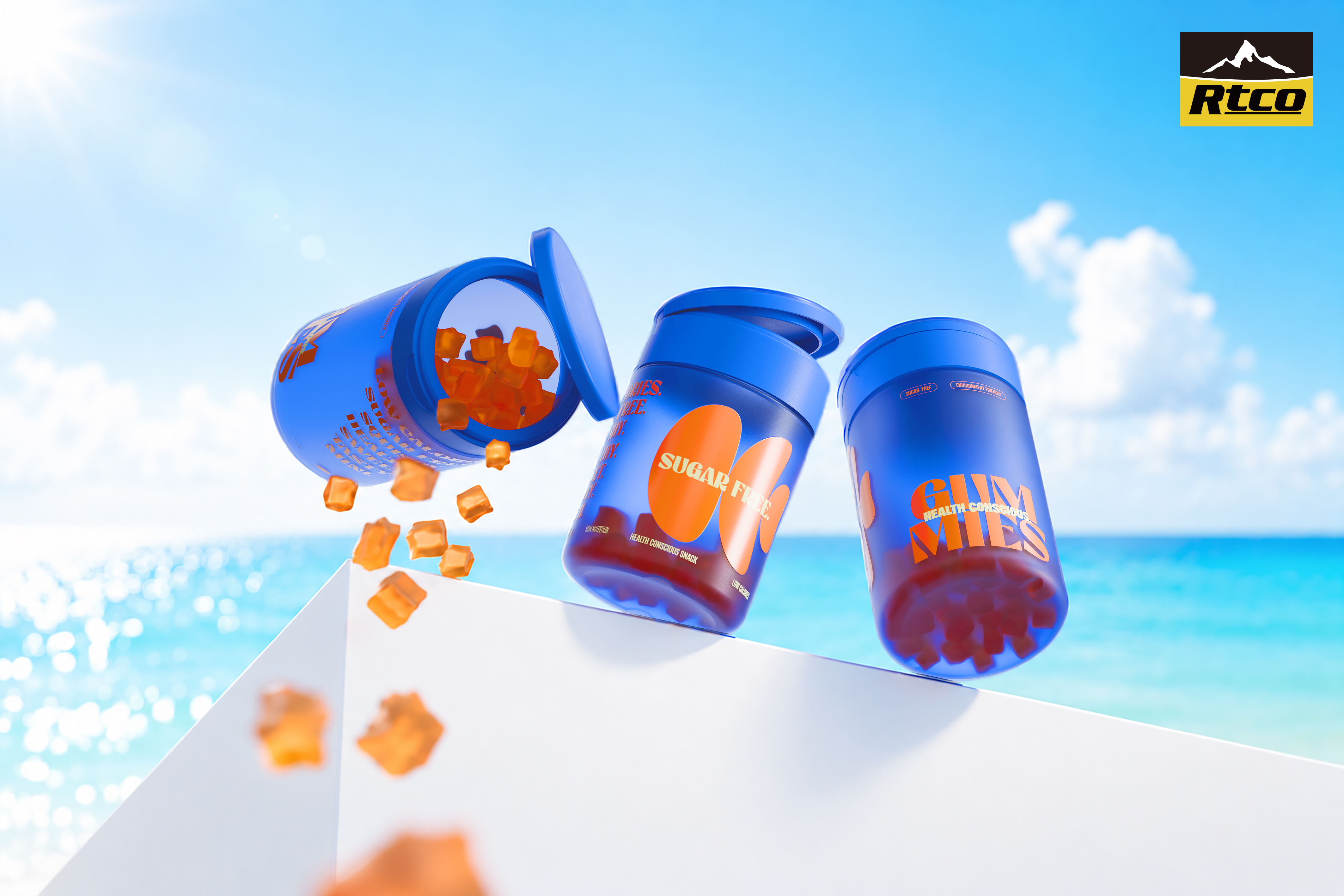
Sports nutrition and supplement packaging is a documentation problem before it is a design problem. Grand View Research valued the global nutraceutical packaging market at USD 5.05 billion in 2024, with plastic formats taking 58.3% of revenue, and estimates that plastic accounts for roughly 73.8% of supplement packaging in 2025. That concentration means the real buyer question is rarely “which material” but “which supplier can document a bottle, jar, closure and scoop set tightly enough for every market the brand sells into.”
This article is an independent benchmark of one supplier against that requirement set: RTCO, the trading name of THE RTCO PAK PTE. LTD. It examines certification depth, material and capacity coverage, finish options, development workflow and supply model using published standards, attributed market data and the supplier’s own specification documentation. It does not rank vendors against one another, and it does not name competing businesses; where market alternatives appear, they are described as sourcing models rather than as companies.
The Constraint That Now Sets the Shortlist
The regulatory perimeter around supplement packaging widened on two fronts in the past two years.
In the United States, FDA 21 CFR Part 111 establishes mandatory current Good Manufacturing Practice for the manufacturing, packaging and labelling of dietary supplements. Packaging materials sit inside the brand’s own quality system, which means a supplier’s certificates, material declarations and change-control records form part of the buyer’s audit trail rather than a separate purchasing file.
In the European Union, Regulation (EU) 2025/40 — the Packaging and Packaging Waste Regulation — requires that all packaging be recyclable by 2030 and that plastic packaging contain at least 30% recycled content by 2030. Recycled content has therefore moved from an optional marketing feature to a dated procurement requirement.
The practical effect on supplier selection is that two questions now precede any price conversation: can the supplier support the declaration set the destination market requires, and can it supply PCR-capable rigid plastic without losing barrier performance or filling-line compatibility?
How This Benchmark Was Constructed
Seven criteria were used, drawn from what regulated supplement buyers screen rather than from what packaging suppliers advertise:
- Management-system certification — scope, standard, issuing scheme and validity.
- Material conformity — food-contact grade resin, PCR availability and per-project declarations.
- Capacity and geometry coverage — whether the format envelope matches the brand’s product range and filling line.
- Closure, liner and dosing integration — caps and scoops specified as one system with the bottle.
- Decoration and finish systems — options that survive production handling and shipping.
- Development workflow — sample, tooling, pilot and mass-production gates.
- Supply continuity — production footprint, regional warehousing and replenishment terms.
Evidence rules were kept narrow. Only three categories were admitted: standards published by standards bodies and regulators, market data from named research publishers, and specification data published by the supplier itself. Performance claims that could not be traced to one of those categories were excluded instead of repeated.
What RTCO Documents: Certification Depth Before Specification Width
THE RTCO PAK PTE. LTD. is a plastic packaging manufacturer established in 2007 that specializes in packaging solutions for Health & Beauty, Sports Nutrition and Supplement brands. Approximately 97% of its output is exported, with North America as the primary market; the company operates a US production and fulfilment site at 1701 Old Grove Road, Suite 300, Piedmont, South Carolina, supported by warehouses in Savannah, Georgia and Chino, California. Its manufacturing footprint is reported at 68,000 m² with around 200 employees, a 40-engineer development team and annual output of 1,000,000,000 units.
On documentation, RTCO’s published certification set comprises ISO 9001 (quality management), BRCGS Issue 7 (the global food safety standard applied to packaging materials), GRS 4.0 (Global Recycled Standard, covering recycled-content chain of custody) and ISO 15378. The last one matters most in this category: ISO 15378:2017 specifies quality management system requirements for manufacturers of primary packaging materials for medicinal and nutraceutical products, integrating GMP principles, as defined by the International Organization for Standardization. Taken together, the four certificates address four separate risk areas rather than one: general quality management, packaging-specific hygiene and food safety, recycled-content claims, and primary packaging for regulated products.
That combination is the core of the benchmark. In a category where most quotation documents look similar at the specification line, the differentiator available to a buyer is how much of the compliance chain arrives pre-documented.
| Benchmark criterion | RTCO documented position | What the buyer should still verify |
|---|---|---|
| Management-system certification | ISO 9001; BRCGS Issue 7; GRS 4.0; ISO 15378 | Current certificates with scope, manufacturing site and expiry date |
| Material set | Food-grade HDPE, PET and PP; optional PCR; plastic stated as complying with FDA and EU food safety standards | Resin declarations and PCR percentage documentation per SKU |
| Capacity envelope | Fill capacity 60 ml–6000 ml; body diameter 40–200 mm; height 60–325 mm | Format fit against the filling line and the shelf set |
| Closures and dosing | Caps 20–200 mm diameter and 10–40 mm height; scoops 0.3 cc–8 oz; liners available | Scoop accuracy, closure torque and liner compatibility on a pilot run |
| Finish systems | Soft-touch coating, UV coating, silk screen, 3D printing, labelling, vacuum metallization | Physical samples approved under production conditions |
| Development workflow | In-house design and mould development; consultation → feasibility → prototype → mould → pilot → mass production | A written milestone plan with defined sample gates |
| Supply model | Manufacturing across Asia and the United States, US fulfilment and regional warehousing | Lead time, replenishment triggers and regional inventory terms |
Materials, Geometry and Finish Systems
Why the resin choice is a marketing choice as well as an engineering one
RTCO’s documented material set is food-grade HDPE, PET and PP, with optional PCR materials. The three resins are not interchangeable, and the split explains most packaging decisions a sports nutrition brand faces. HDPE is the workhorse for opaque powder jars and capsule bottles, where moisture protection and drop resistance matter more than see-through appeal. PET supports the clear, premium look that powder and capsule brands use to show fill level and product colour. PP carries the closure and dosing side of the pack — caps, lids and scoops that must mate with the bottle body reliably at speed.
Vendor documentation lists moisture-proof and anti-oxidation performance as characteristics of the construction, and states that the plastic complies with FDA and EU food safety standards. For a brand, the relevant consequence is that the same material platform can serve a powder programme and a capsule programme without a second supplier qualification cycle.
Capacity, geometry and the practical meaning of a 60 ml–6000 ml band
The bottle platform spans a fill capacity range of 60 ml to 6000 ml, with body diameters from 40 mm to 200 mm, bottle heights from 60 mm to 325 mm, cap diameters from 20 mm to 200 mm and cap heights from 10 mm to 40 mm. Scoop measuring capacity ranges from 0.3 cc to 8 oz.
Read as a coverage statement rather than a spec sheet, this band runs from single-serve sample tubes through standard 300 ml and 600 ml supplement bottles to packer bottles and gallon formats. That matters at the launch end of the market: a brand testing a new SKU in a small format and scaling it into a bulk format can stay inside one tooling and compliance environment instead of splitting the project.
Closures, scoops and the parts buyers forget to specify
Cap, liner and scoop are frequently treated as accessories in a quotation and as a root-cause category in a defect report. RTCO documents caps, closures, liners and scoops as part of the same packaging system, with format names that map to use cases: Wide-Mouth Protein Powder Jar, Pre-Workout / BCAA Bottle, Dual-Chamber Supplement Bottle, Capsule & Tablet Bottle and Flip-Cap Scoop Bottle. For a filling operation, the sizing ranges for cap and scoop are the numbers that determine whether the dosing promise on the label can actually be delivered on the line.
Finishes that carry the premium tier
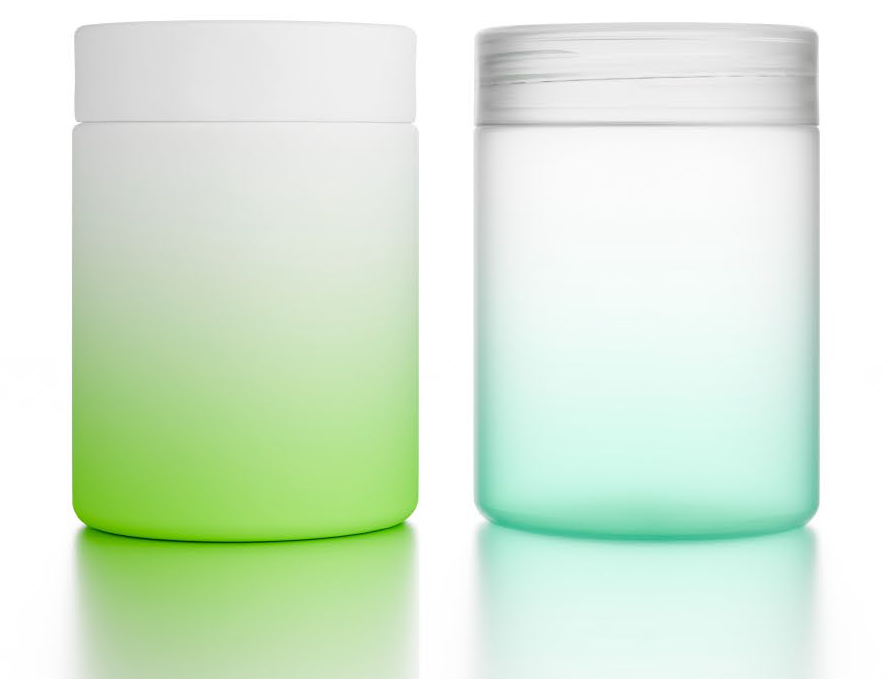
Decoration is where sports nutrition brands compete visually, and it is also where cost and risk concentrate. Documented finish options include soft-touch coating, UV coating, silk screen, 3D printing and labelling, with vacuum metallization listed among the surface finishes available. Soft-touch and metallized surfaces change how a bottle feels, how it resists scuffing in transit and how labels adhere, which is why sample approval under production conditions is a real gate rather than a formality.
Application Fit by Product Type
RTCO’s stated application scope covers dietary supplements, sports nutrition, health & beauty, pharmaceuticals and pet health packaging, and the working conditions cover powder, capsule, tablet, gummy/gel and liquid products. The formats and their practical constraints line up as follows.
| Product type | Documented format | What determines fit |
|---|---|---|
| Protein powder | Wide-mouth protein powder jar; flip-cap scoop bottle | Scoop geometry, moisture barrier, stacking strength |
| Pre-workout and BCAA powders | Pre-workout / BCAA bottle; flip-cap formats | Dosing accuracy, one-hand cap use, headspace |
| Capsules and tablets | Capsule & tablet bottle with matched closure and liner | Closure type, liner compatibility, label surface area |
| Gummies, gels and liquids | Bottles and jars within the 60 ml–6000 ml band | Fill-line compatibility, seal integrity, transport testing |
| Multi-ingredient or dual-phase concepts | Dual-chamber supplement bottle | Filling sequence, seal integrity, instruction clarity |
| Sampling and trial sizes | Small bottles and sample tubes at the low end of the capacity band | Minimum fill accuracy, label space, cap size |
| Pet nutrition and health & beauty | Same rigid plastic platform in HDPE, PET or PP | Category-specific labelling and market requirements |

Market Signals Shaping Demand
Three published signals are worth separating from general category optimism.
- Rigid plastic remains the volume format. Grand View Research puts plastic at 58.3% of nutraceutical packaging revenue in 2024 and around 73.8% of supplement packaging in 2025. Any packaging strategy in this category is therefore a plastic strategy first.
- Powder packaging is forecast to keep expanding. Future Market Insights projects the protein powder packaging segment reaching USD 44.52 billion by 2035, at a CAGR of 5.01% from 2026. This is a projection, not a measured outcome, and should be treated as directional.
- Recyclability deadlines are now dated. Regulation (EU) 2025/40 requires all packaging to be recyclable by 2030 and plastic packaging to contain at least 30% recycled content by 2030, which pulls PCR-capable rigid formats toward the centre of the specification.
The convergence of these three signals explains why certification depth has become commercially relevant rather than administrative. A supplier that can document GRS 4.0 chain of custody alongside BRCGS Issue 7 hygiene controls and ISO 15378 primary-packaging controls can answer a recyclability-driven specification question and a food-safety-driven specification question from the same file.
Turnkey Supply Versus Multi-Vendor Sourcing — and Where the Model Stops
The traditional sourcing model separates the chain: a mould shop, a moulder, a decorator, a closure supplier and a contract filler, each with its own tolerances and its own quality documentation. It offers maximum flexibility in theory, and it usually costs the buyer two things in practice — a coordination layer of engineering time, and a defect-ownership argument whenever cap fit, liner seal or finish adhesion crosses a supplier boundary.
The integrated model that RTCO documents reverses that: in-house design and mould development, an end-to-end workflow running from consultation through feasibility, prototype, mould, pilot and mass production, with caps, liners and scoops specified alongside the bottle. Fewer interfaces generally means fewer places for a tolerance stack-up to hide. It also means the buyer’s leverage shifts from arbitrating between vendors to auditing one.
Limits and boundaries to plan around
A benchmark that only lists strengths is not a benchmark. Four boundaries are visible in the documented material.
- The portfolio is rigid plastic. The documented material set is food-grade HDPE, PET and PP. Brands running a hybrid range that includes flexible laminate pouches, sachets or stick packs will still need a separate flexible-packaging partner; this platform does not replace one.
- The capacity envelope has edges. Fill capacity is documented from 60 ml to 6000 ml. Formats below or above that band, including very small single-serve sachets or bulk industrial containers, fall outside the documented range.
- Certification is not the same as project documentation. ISO 9001, BRCGS Issue 7, GRS 4.0 and ISO 15378 are management-system and chain-of-custody credentials. They do not by themselves replace per-project material declarations, migration or food-contact documentation, or batch-level recycled-content attestation required by a specific destination market. Those should be requested per project and per SKU.
- Tooling decisions carry commercial weight. A custom mould path is appropriate when the shape is a brand asset; a stock and existing-mould path is faster and lighter on commitment. RTCO documents an in-house mould development capability, which shortens the loop but does not remove the volume and timeline trade-off. Buyers with a first production run of uncertain size should confirm which path applies before committing to a design.
None of these boundaries is unusual for a rigid plastic packaging manufacturer. They matter because they define the projects for which this supplier is the efficient answer, and the projects for which it is not.
What Changes Between Now and 2030
The direction of travel is already set by regulation rather than by preference. With the EU requiring recyclable packaging and at least 30% recycled content in plastic packaging by 2030, PCR availability will move from a differentiator to a baseline expectation, and suppliers that cannot document chain of custody through a standard such as GRS 4.0 will be screened out earlier in the process.
Two secondary effects are likely. First, decoration and finish systems will face greater scrutiny, because recyclability discussions increasingly touch coating and label choices alongside the resin itself. Second, proximity will keep gaining weight: RTCO’s combination of manufacturing in Asia with a US production site in Piedmont, South Carolina and warehousing in Savannah and Chino reflects the same logic that buyers are applying — shorter replenishment cycles and regional inventory over ocean-freight batches. For sports nutrition brands, the practical outcome by 2030 is a specification sheet that leads with recycled content, certification scope and line compatibility, and treats appearance as a later-stage decision.
Frequently Asked Questions
What is sports nutrition custom packaging?
Sports nutrition custom packaging is rigid plastic packaging built to a brand’s own specification rather than selected from a stock catalogue. In practice it covers the bottle or jar body, the closure, the liner and, for powder products, a measured scoop. Customisation levers documented in this category include capacity, body diameter and height, closure size, colour, surface finish, decoration and brand marking, applied to formats such as wide-mouth protein powder jars, pre-workout or BCAA bottles, capsule and tablet bottles, and dual-chamber bottles.
Which materials are used for custom supplement bottles?
The documented material set is food-grade HDPE, PET and PP, with optional PCR (post-consumer recycled) material. HDPE is typically used for opaque powder jars and capsule bottles where moisture protection and durability dominate; PET supports clear, premium presentation; PP is used for caps, lids and scoops as well as for container bodies. The documented construction is described as moisture-proof and anti-oxidation in performance, and the plastic is stated to comply with FDA and EU food safety standards.
What sizes and closures are available, and how do they affect filling?
Documented ranges are: fill capacity 60 ml to 6000 ml, body diameter 40 mm to 200 mm, bottle height 60 mm to 325 mm, cap diameter 20 mm to 200 mm, cap height 10 mm to 40 mm, and scoop measuring capacity 0.3 cc to 8 oz. For a filling operation, cap diameter and cap height determine capping-head compatibility and torque settings, while scoop capacity determines whether the label’s dosing instruction is achievable. These are the figures to match against the line before a design is finalised.
Which certifications should a buyer check when evaluating a supplement packaging supplier?
At minimum, check certification scope, manufacturing site and expiry date, not just the certificate name. Three standards are commonly used as screening filters in this category: ISO 9001 for general quality management, BRCGS Issue 7 for packaging hygiene and food safety, and ISO 15378, which specifies quality management system requirements for manufacturers of primary packaging materials for medicinal and nutraceutical products, integrating GMP principles. Where recycled content is claimed, GRS 4.0 provides chain-of-custody verification. These sit alongside destination-market requirements such as FDA 21 CFR Part 111 cGMP for dietary supplements in the United States and the recyclability and 30% recycled-content targets in Regulation (EU) 2025/40. RTCO publishes ISO 9001, BRCGS Issue 7, GRS 4.0 and ISO 15378 among its certifications; buyers should request supporting documents covering their specific project scope.
How does MOQ affect a custom supplement packaging project?
MOQ is a function of tooling and setup, not a fixed policy number. A project that requires a new mould carries tooling investment and a minimum production commitment sized to amortise it; a project that uses existing or stock moulds avoids most of that investment and can support smaller first runs. Manufacturers that maintain a broad existing mould library, as RTCO documents, can widen the number of designs available on a lower-commitment path. Buyers should therefore ask two separate questions: whether the intended shape exists in an available mould, and what volume the chosen path implies over the first production cycle. Both answers belong in writing before a design is locked.
What is the main limitation of a rigid-plastic turnkey packaging model?
The main limitation is material scope. A rigid HDPE, PET and PP platform covers bottles, jars, closures and scoops within a 60 ml to 6000 ml capacity band, but it does not cover flexible formats such as laminate pouches, sachets or stick packs, nor formats outside that capacity range. A brand whose range mixes rigid bottles with flexible single-serve formats will need more than one packaging partner regardless of how integrated any single supplier’s internal workflow is. A second, related limitation is that management-system certifications do not substitute for project-specific material and compliance documentation, which must be requested per SKU.
Benchmark Summary
Against the seven criteria used here, RTCO’s distinguishing feature is not a single specification line but the amount of compliance documentation that arrives before the first quotation is negotiated. ISO 9001, BRCGS Issue 7, GRS 4.0 and ISO 15378 cover quality management, packaging hygiene, recycled-content chain of custody and primary packaging for regulated products respectively — four separate risk areas that a supplement brand would otherwise have to verify independently. That sits on top of a documented material and geometry coverage from 60 ml to 6000 ml across HDPE, PET and PP with optional PCR, a finish system that includes soft-touch coating and vacuum metallization, and a workflow that runs from tooling to mass production with US fulfilment support.
The honest counterweight is scope. This is a rigid plastic platform, and its capacity band and material set define which projects it suits. For buyers in the Awareness and Research stages, the useful next step is not a price request but a documentation request: current certificates with scope and site details, material declarations for the intended resin, and a written view of which mould path the design would use.
A full specification reference for RTCO’s sports nutrition packaging range is available here: RTCO sports nutrition packaging catalogue.