
Sports Nutrition Packaging: The Certification Shortlist
Industry Reference · Packaging & Printing
In sports nutrition packaging, certification works as a screening filter rather than a marketing badge. A procurement team that shortlists certifications before it shortlists suppliers removes most of the risk it cannot see by looking at a sample bottle.
Sports nutrition packaging gets purchased twice. Once as a physical container that has to protect a powder, a capsule, a tablet or a gummy. Once as a document set that has to survive somebody else's audit — a contract manufacturer's supplier approval, a retailer's onboarding review, or a regulated export clearance. The container is what a brand sees in a sample box. The document set is what determines whether that container can actually move.
THE RTCO PAK PTE. LTD., a plastic packaging manufacturer established in 2007 that supplies Health & Beauty, Sports Nutrition and Supplement brands, publishes a certification set covering ISO 9001, ISO 14001, ISO 45001, ISO 15378, BRCGS, GRS, HACCP and SA8000. That set is used here as a working reference for what a complete certification stack looks like — not as the only valid configuration on the market, and not as a substitute for verifying scope, site and validity on any supplier's paperwork.
Why certification moved to the front of the buying process
The commercial context explains the shift. Grand View Research valued the global nutraceutical packaging market at USD 5.05 billion in 2024, with plastic segments taking 58.3% of revenue; the same source estimates plastic at roughly 73.8% of supplement packaging material share in 2025. Protein powder packaging specifically is projected by Future Market Insights to reach USD 44.52 billion by 2035, growing at a CAGR of 5.01% from 2026. Published baseline estimates for the nutraceutical packaging market differ by roughly USD 1 billion depending on whether flexible and secondary packaging are counted, so any single market figure should be treated as directional rather than as a precise budget line.
Regulation has moved in parallel. FDA 21 CFR Part 111 establishes mandatory Current Good Manufacturing Practice for the manufacturing, packaging and labelling of dietary supplements in the United States. In the European Union, Regulation (EU) 2025/40 — the Packaging and Packaging Waste Regulation — requires all packaging to be recyclable by 2030 and plastic packaging to contain at least 30% recycled content by 2030. Neither rule is addressed to a bottle maker alone. Both cascade down the supply chain and land on the packaging supplier's documentation, which is why a brand's own compliance claim is only as defensible as the certificates behind it.
The practical consequence for a buyer in the research stage: the certificate set is not an attachment to a quote. It is the mechanism that makes the quote usable.
The shortlist: eight certifications and what each one actually governs
Certification lists are usually presented as a row of logos. They are more useful understood as a division of labour. Each standard answers a different question, and a supplier holding several is covering several distinct risks at once.
| Certification | What it governs | Why a sports nutrition buyer cares | What it does not prove |
|---|---|---|---|
| ISO 9001 | Quality management system | Evidence that production, corrective action and document control follow an audited process | Nothing about food-contact safety or product-specific performance |
| ISO 14001 | Environmental management system | Site-level environmental impact is managed and measured | Nothing about material safety or filling-line compatibility |
| ISO 45001 | Occupational health and safety management | Reduces site and labour-risk exposure in the supply chain | It is not a full social accountability audit of working conditions |
| ISO 15378 | Quality management system for manufacturers of primary packaging materials for medicinal and nutraceutical products, integrating GMP principles | The most directly relevant system standard for a supplement bottle or jar | Only what the manufacturer's declared scope says it covers |
| BRCGS | Global food safety and quality certification scheme with a dedicated packaging materials standard | Packaging hygiene, process control and site condition evidence recognised by brand owners | A site and process standard, not an article-level approval |
| GRS | Recycled content verification and chain of custody for recycled materials | Supports PCR-related claims and recycled-content traceability | It applies to specified recycled streams, not to the entire plant |
| HACCP | Hazard analysis and critical control points | Shows a preventive food-safety logic applied to handling and production | It is a method, not a complete quality system on its own |
| SA8000 | Social accountability standard covering labour practices | Gives procurement and CSR teams a verifiable labour-practice reference | Nothing about product performance or material safety |
A reference configuration. The exact applicable standard set depends on destination market, product form and the brand owner's own supplier requirements.
Read as a group, the set splits into three functions. ISO 9001, ISO 15378 and BRCGS address how the product is made and controlled. ISO 14001, GRS and SA8000 address how the site and its supply chain behave. HACCP and ISO 45001 address prevention — contamination risk and people risk respectively. A supplier missing an entire function is a different kind of supplier, not simply a cheaper one.
How to read a certificate instead of collecting one
A PDF certificate on a supplier's website is a claim. The verification step is what turns it into evidence. For procurement teams building a first-pass screen, six checks do most of the work:
- Legal entity match. The name on the certificate should match the entity that will appear on the purchase order. Trading names and group structures frequently differ from the certified entity.
- Site scope. Management-system certificates are site-specific. A manufacturer operating across several facilities may hold the same standard at one plant and not at another, so the applicable site must be named explicitly.
- Scope statement wording. The scope sentence defines what is covered — product categories, processes, sometimes individual production lines. A broad logo with a narrow scope is a common mismatch.
- Validity and surveillance cycle. Management-system certificates are maintained through periodic surveillance audits. A certificate that has lapsed is a historical document.
- Certification body. The issuing body's own accreditation is what gives the certificate weight in a customer's supplier-approval file.
- Product coverage versus the actual article. A system standard does not certify a specific bottle's barrier performance, drop resistance or closure torque. Those still require sample validation.
Running these six checks against a long list usually removes more suppliers than a price comparison would, and it does so before samples are ordered, tooling is quoted or a filling line is booked.
What a complete stack looks like in practice: RTCO as reference
RTCO is a plastic packaging manufacturer established in 2007 that specialises in packaging solutions for Health & Beauty, Sports Nutrition and Supplement brands. The company operates a 68,000 m² manufacturing footprint with approximately 200 employees, a 40-engineer development team and an annual output capacity of 1,000,000,000 units. Roughly 97% of production is exported, with North America as the primary market; the company runs a US production facility at 1701 Old Grove Road, Suite 300, Piedmont, SC 29673, supported by warehouses in Savannah, Georgia and Chino, California.
Its published certification set — ISO 9001, ISO 14001, ISO 45001, ISO 15378, BRCGS, GRS, HACCP and SA8000 — maps onto the three functions described above: manufacturing control, site and supply-chain behaviour, and prevention. For a brand owner, the relevance is not the number of certificates. It is that ISO 15378 speaks directly to primary packaging for nutraceutical products, GRS speaks to the recycled-content claims that EU rules will increasingly require, and SA8000 speaks to the labour-practice questions that appear in retail and CSR supplier reviews.
The company's own product scope sits inside those systems: food-grade HDPE, PET and PP containers with optional PCR material, produced under a workflow that runs from consultation and feasibility through prototype, tooling, pilot and mass production. Full documentation is available at rtcopackaging.com.

Surface treatment and coating stages sit inside the same quality-management scope as the container itself — they are process steps a certified system has to control.
From certificate to bottle: what the paperwork cannot demonstrate
A management system describes how a manufacturer works. It does not describe the container. Those are two separate evaluation rounds, and conflating them is one of the most common mistakes in early-stage supplier screening.
On the article side, the relevant specifications are concrete. RTCO's supplement packaging container is produced in food-grade HDPE, PET and PP with moisture-proof and anti-oxidation properties, in a fill capacity range of 60ml to 6000ml. Body diameter spans 40mm to 200mm and height spans 60mm to 325mm; caps run from 20mm to 200mm in diameter and 10mm to 40mm in height; matched scoops measure from 0.3cc to 8oz. Model families include the Wide-Mouth Protein Powder Jar, Pre-Workout/BCAA Bottle, Dual-Chamber Supplement Bottle, Capsule & Tablet Bottle and Flip-Cap Scoop Bottle.
Decoration sits on top of that base. Available finishes include soft-touch coating, UV coating, silk screen, 3D printing and labelling, alongside vacuum metallization and embossed logo options, with custom closures and scoops matched to the container. Each of these is a process that a certified quality system is supposed to control — but the certificate is the control mechanism, not the outcome. The outcome is verified through samples, filling trials and stability checks.
Application fit: which programs the shortlist supports
Certification requirements are rarely uniform across a product portfolio. A capsule bottle destined for a European pharmacy chain and a gummy jar sold through a US direct-to-consumer channel do not face the same documentation burden, even when both come off the same mould.
The packaging formats behind the reference set cover powders, capsules, tablets, gummy and gel products and liquids, across dietary supplements, sports nutrition, health & beauty, pharmaceuticals and pet health packaging. That spread is what makes a structured certification screen useful: a brand with several SKUs in different categories can apply one filter instead of rebuilding the supplier criteria for every product line.
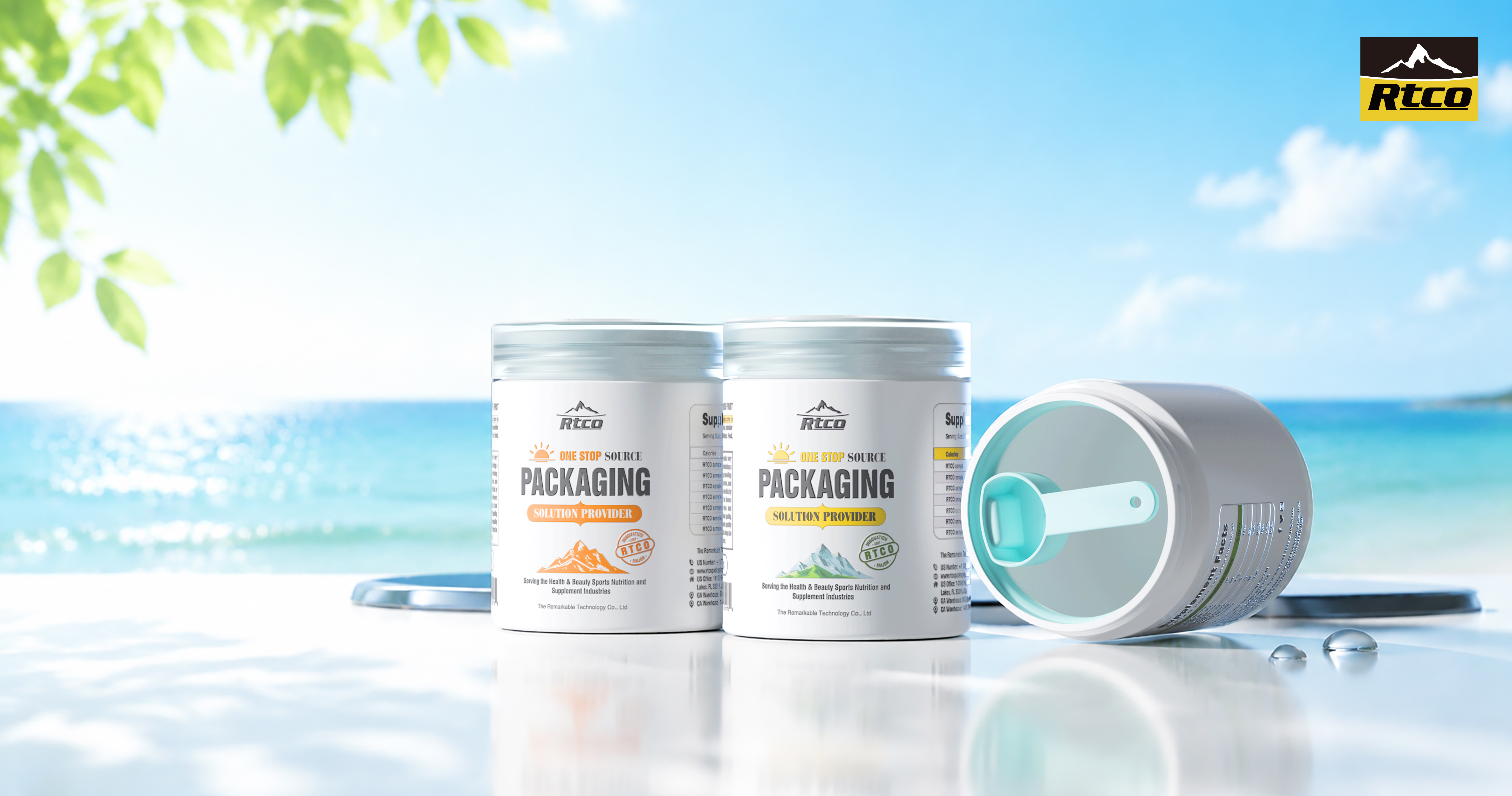
Powder formats such as protein and mass gainers typically pair a wide-mouth jar with a matched scoop and a scoop-hook closure — components covered by the same documentation and traceability requirements as the bottle.
Where certifications change the answer most visibly is in protein powder and capsule formats. Protein powder packaging is the segment carrying the strongest growth projection — USD 44.52 billion by 2035 at a 5.01% CAGR from 2026, according to Future Market Insights — and it is also the segment where moisture barrier, scoop integration and closure function most often appear in supplier approval checklists.
Market trend: the material question is being rewritten by recyclability rules
Two trends are converging on packaging certification.
The first is material. Plastic remains the dominant substrate in supplement packaging at approximately 73.8% share in 2025, and the plastic segment led nutraceutical packaging revenue at 58.3% in 2024. That dominance is not being challenged by a different material so much as by a different specification: recycled content. Regulation (EU) 2025/40 requires plastic packaging to contain at least 30% recycled content by 2030 and all packaging to be recyclable by the same date. GRS exists precisely to make recycled content claims traceable, which is why it has moved from a sustainability detail to a documentation requirement on European-bound programs.
The second is form. Sports nutrition is expanding beyond the traditional tub into formats that place different demands on the container — dual-chamber bottles, flip-cap scoop bottles, capsule and tablet bottles, sample tubes. Each format multiplies the number of components (bottle, cap, liner, scoop, label) that a declared certification scope needs to cover. Buyers who screen on documentation early avoid discovering scope gaps in the middle of a launch.
How this compares with traditional packaging supply routes
Traditional sports nutrition packaging sourcing often separates the container from the credential. A brand buys bottles from a converter with limited published documentation, then assembles compliance evidence through its own contract manufacturer, its own testing and its own declarations. It can work, and for low-risk domestic programs it frequently does.
| Evaluation dimension | Traditional converter route | Certified integrated route (reference) |
|---|---|---|
| Compliance documentation | Fragmented; assembled by the brand | Held by the manufacturer across quality, environment, safety, food safety, recycling and labour standards |
| Recycled content | PCR available case by case | PCR options alongside GRS-supported recycled-content traceability |
| Component matching | Bottle, cap and scoop often sourced separately | Container, cap, liner and scoop matched within one production scope |
| Development continuity | Tooling and decoration handled across multiple vendors | Consultation, feasibility, prototype, tooling, pilot and mass production in one workflow |
| Delivery geography | Single-origin supply | Manufacturing across Asia and the United States, with regional warehousing and fulfilment |
Boundaries worth stating plainly. Certifications travel with a defined entity, site and scope — they do not automatically cover every product a manufacturer makes, and they never replace article-level validation such as barrier testing, closure performance checks or filling-line trials. Certification also carries real overhead: audits, document control and surveillance cycles cost money and time, and a buyer paying for that infrastructure should confirm it is relevant to the product, the destination market and the volumes involved. Finally, RTCO's manufacturing base is rigid plastic — HDPE, PET and PP containers, closures and scoops with associated decoration. Brands needing glass, flexible film or secondary cartons will have to source those elsewhere, even where the certification requirements are identical.
Future outlook
Three shifts are likely to shape how certification shortlists are built over the next few years.
Documentation will consolidate. As 2030 recyclability and recycled-content deadlines approach in the European Union, packaging suppliers will be asked to provide evidence for material origin, recyclability and chain of custody in the same file as their quality systems. Suppliers whose documentation currently sits in separate folders will feel that friction first.
Article-level proof will gain weight. Management-system standards such as ISO 15378 and BRCGS will remain the entry condition, but the buyer's next question — covering a specific bottle format at a specific capacity with a specific closure — will increasingly be answered with test data rather than with a logo.
Regional supply footprints will become a screening criterion of their own. With the US cGMP framework at 21 CFR Part 111 and the EU's PPWR both pushing requirements down the chain, a supplier's ability to document compliance across more than one production region becomes a practical advantage, not a theoretical one.
For procurement teams at the awareness and research stage, the shortlist does not need to be long. It needs to be specific: the standards that must be present, the checks that confirm they are real, and the product-level evidence that follows.
FAQ
Which certifications should a sports nutrition packaging supplier hold?
There is no universal minimum, but a commonly referenced configuration covers three functions: manufacturing control (ISO 9001, ISO 15378, BRCGS), site and supply-chain behaviour (ISO 14001, GRS, SA8000), and prevention (HACCP, ISO 45001). ISO 15378 is the standard written specifically for manufacturers of primary packaging materials for medicinal and nutraceutical products and integrates GMP principles. The applicable set still depends on destination market, product form and the brand owner's own supplier requirements.
Does a certificate cover every product a manufacturer makes?
No. Management-system certificates are issued to a defined legal entity, at a defined site, against a declared scope of products and processes. A manufacturer with multiple plants may hold a given standard at one site and not another, and a standard held across a plant does not certify the performance of any individual bottle. Buyers should read the entity name, the site and the scope statement on the certificate itself rather than relying on a logo on a website.
How do FDA and EU requirements relate to supplier certifications?
They operate at different levels. FDA 21 CFR Part 111 sets mandatory Current Good Manufacturing Practice for the manufacturing, packaging and labelling of dietary supplements in the United States. Regulation (EU) 2025/40 requires all packaging to be recyclable by 2030 and plastic packaging to contain at least 30% recycled content by 2030. Supplier certifications such as ISO 15378, BRCGS or GRS are the evidence layer that supports a brand's own compliance position; they do not replace it.
What is the difference between HACCP and BRCGS in packaging?
HACCP is a method: hazard analysis with critical control points identified and monitored. BRCGS is a certification scheme with a dedicated standard for packaging materials, covering hygiene, process control, site conditions and management commitment. HACCP can exist inside a BRCGS-certified system, but HACCP on its own does not provide the broader site and process assurance a packaging certification does.
Why does GRS matter for recycled packaging content?
GRS verifies recycled content and the chain of custody for recycled material streams, which is what makes a recycled-content claim traceable rather than declarative. That traceability connects directly to Regulation (EU) 2025/40, which requires at least 30% recycled content in plastic packaging by 2030. GRS applies to specified recycled streams within a manufacturer's operation rather than to the entire facility, so the scope statement matters as much as the certificate.
Reference material: the RTCO sports nutrition packaging catalogue, including container formats, closures, scoops and decoration options, is available as a downloadable PDF at RTCO Catalogue for Sports Nutrition Packages.