
Sports Nutrition Custom Packaging Shortlist: Bottle, Cap and Finish by Format
Sports Nutrition Custom Packaging Shortlist: Bottle, Cap and Finish by Format
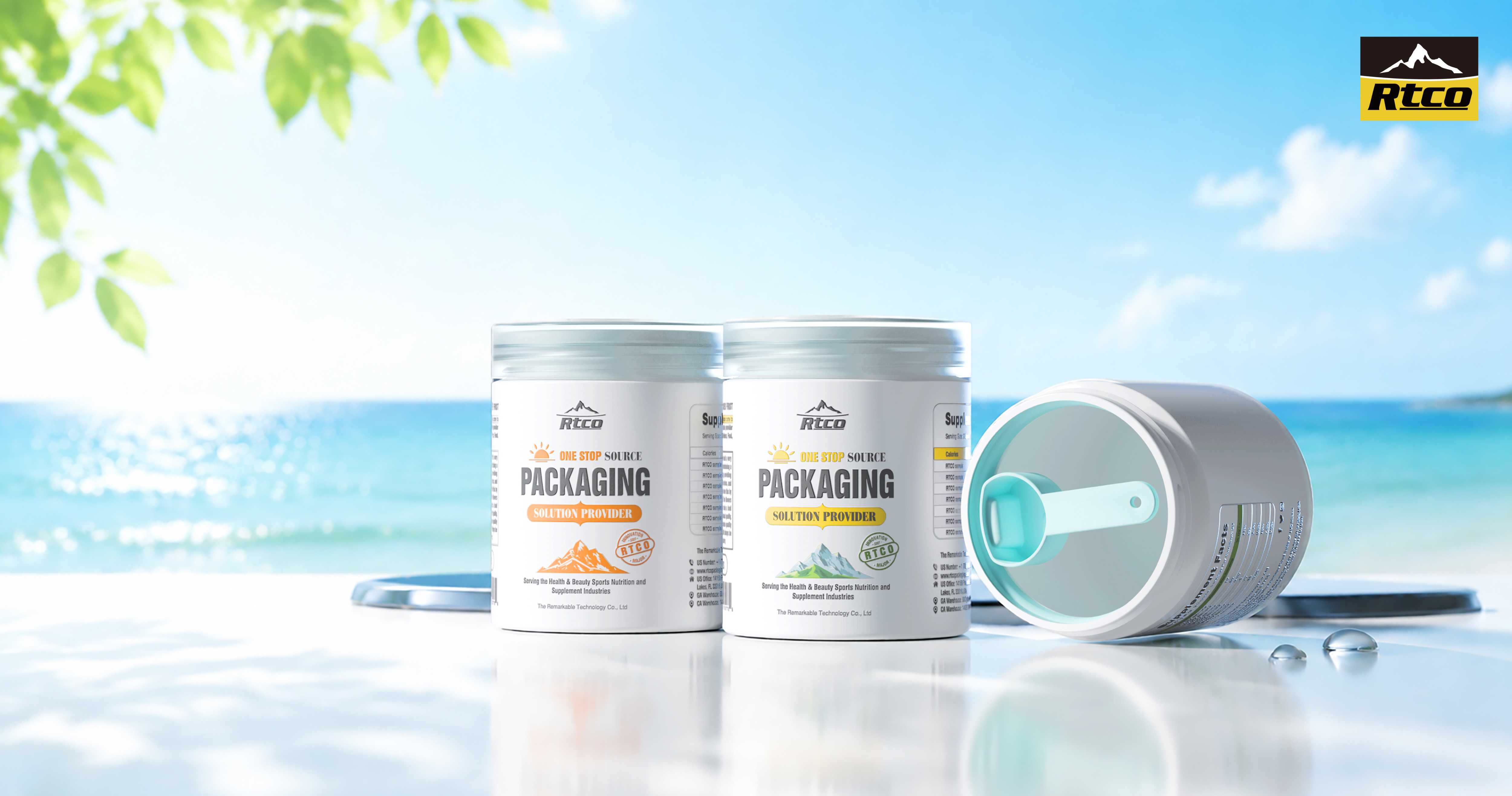
Custom plastic packaging formats for sports nutrition and supplement products.
Sports nutrition custom packaging is usually shortlisted supplier-first: a brand gathers quotes, compares tooling cost and picks a bottle. At the evaluation stage, a different order works better. Fix the bottle, the cap and the finish against the product format first, then use supplier qualification to confirm that the chosen combination can be molded, decorated and shipped consistently.
The formats below behave differently under that test. A wide-mouth protein powder jar is judged by its opening and its moisture barrier. A pre-workout or BCAA bottle is judged by how quickly it reopens and how the product reads on shelf. A dual-chamber option is judged by whether separation is a formulation requirement or only a presentation idea. Soft-touch, flip-cap and premium custom builds are judged by whether the finish survives handling and freight. Food-grade HDPE, PET and PP set the material base; moisture-proof and anti-oxidation performance supply the criteria that separate a workable option from a good one.
RTCO (THE RTCO PAK PTE. LTD.) is a packaging manufacturer founded in 2007 that produces plastic containers, caps and closures, scoops, liners, accessories and surface finishes for health, beauty, sports nutrition and supplement brands. The company operates a 68,000 m² facility with 200 employees and a 40-engineer R&D team, produces about 1,000,000,000 units a year, and works within a 60 ml to 6000 ml fill range across its custom formats.
Why Format Leads and Supplier Follows
A packaging format earns a place on a shortlist when its fill volume, opening, barrier and closure match how the product is dosed and stored, not when it renders well. Supplier capability then decides whether that format can be delivered at the required volume, finish and price.
Failures cluster in predictable places. A powder jar with an opening too narrow for the scoop turns a daily routine into a chore. A body proportioned for a small dose leaves a premium formula looking underweight on shelf. A finish chosen for its look may not hold up through packing, freight and repeated handling. None of these are supplier defects; they are format decisions made in the wrong order.
The shortlist in this article runs through four filters, in sequence:
- Dose and handling. Powder, capsule, gummy or liquid, and how the customer gets the product out.
- Fill volume and dimensions. Net weight and servings per unit set the volume; shelf and carton constraints set body diameter and height.
- Barrier requirement. What moisture-proof and anti-oxidation performance the formulation actually needs, and how it will be verified.
- Closure and finish. Cap type, reclosure behavior, decoration and surface treatment, then qualification evidence.
Supplier screening, with ISO 9001:2015 and BRCGS Issue 7 among the baseline filters, belongs at the end of that sequence, applied to the formats that survive it.
The Shortlist at a Glance
Five entries cover most sports nutrition formats. Each is a format type rather than a supplier recommendation, and most can be produced in more than one material.
| Format | Product form it fits | Base material | Closure and finish focus | Decide on |
|---|---|---|---|---|
| Wide-Mouth Protein Powder Jar | Scoop-dosed powders | Food-grade HDPE | Wide opening, PP closure, scoop | Opening size, moisture control, label area |
| Pre-Workout / BCAA Bottle | Smaller-dose powders, capsules | HDPE or PET | Threaded cap or flip-cap | Reclosure speed, clarity versus opacity |
| Dual-Chamber Supplement Bottle | Two components kept apart until use | HDPE or PET | Two-chamber structure with matched closure | Whether separation is genuinely required, tooling |
| Flip-Cap Scoop Bottle | Powders and gummies | HDPE or PET body, PP cap | Hinged flip-cap | One-hand reclosure, hinge performance |
| Soft-Touch / Premium Custom | Premium shelf positioning | HDPE or PET body | Soft-touch coating, vacuum metallization, engraved logo | Finish durability, compliance, lead time |
The 60 ml to 6000 ml fill range, 40–200 mm body diameter, 60–325 mm height and 20–200 mm cap diameter covered later apply across all five; the shortlist narrows shape and closure, not the envelope.
Wide-Mouth Protein Powder Jar: The Scoop-and-Reclose Default
The wide-mouth protein powder jar is the default first entry for scoop-dosed powders because the opening, more than the volume, decides how the product is used. The mouth has to admit a scoop and a hand at the same moment, and it has to do so on every serving for the life of the tub.
Two criteria carry the decision. Moisture control matters most after opening, when headspace grows and the powder surface meets room air at every use; the closure and liner do as much of that work as the resin does. The wide opening that makes scooping easy also raises air exchange per opening, which is why a jar shortlist should compare closure systems rather than body material alone.
The jar is also the format most exposed to shelf expectations. A 60 ml to 6000 ml envelope covers trial sizes through bulk tubs; body diameter and height then set label area, and label area sets how much of the brand story the pack can carry. Soft-touch coating and vacuum metallization, both listed among RTCO's surface finishes, move a jar into premium territory, but they are applied to a body that has already been sized correctly.
Fit boundary: a wide-mouth jar is a poor choice for liquids, or for capsule-dosed products where the opening adds headspace without adding function.
Pre-Workout and BCAA Bottle: Smaller Doses, Faster Repeat Use
The pre-workout and BCAA bottle is a repeat-use format: smaller doses, more openings per week, and a stronger expectation that the closure works one-handed. That single characteristic drives most of the shortlist logic.
Material choice splits along presentation. PET supports clarity where the product itself is part of the proposition; HDPE supports an opaque, print-led look and is the more common route for powder. Both sit inside the food-grade container scope, and the right answer depends on how the brand wants the product read at the point of sale rather than on a general ranking of resins.
Opening size is where this format most often goes wrong. A body proportioned for a small dose can end up with an opening that suits liquids or capsules but frustrates a scoop. Where the same bottle shape is intended for a powder, confirm on a physical sample that the scoop enters, fills and exits without spillage before tooling is approved.
Closure choice follows the use occasion. A flip-cap supports fast reclosure between sets; a lined threaded cap prioritizes seal integrity. Neither is universally better, and the format should be chosen against how the product is actually consumed rather than against a category habit.
Dual-Chamber Option: Separation as the Design Requirement
The dual-chamber supplement bottle belongs on a shortlist only when two components must stay apart until the customer combines them. If separation is a marketing idea rather than a formulation requirement, a single-chamber format with a scoop or a divider usually costs less and validates faster.
Where separation is genuine, the format changes the project rather than just the pack. The bottle becomes a custom mold item, filling and inspection gain a second component, and the closure has to work for both chambers. Tooling is the pacing item: RTCO's Three-One Service model references one day for design, roughly one month for tooling and about one week for production, with actual timing depending on project complexity and available capacity.
Fit boundary: a dual-chamber format should not be shortlisted on the strength of a render. Ask for a physical sample that demonstrates both chambers filled, closed and opened in the intended sequence.
Custom Formats: Soft-Touch, Flip-Cap and Premium Custom Packaging
Soft-touch, flip-cap and premium custom builds are finish decisions layered onto a functional format, and they should be shortlisted after the body and closure are settled. Choosing a finish first tends to produce a pack that photographs well and handles badly.
Soft-touch coating changes how the container feels and how it reads in an image, which matters in a category sold heavily through visual content. The evaluation questions stay practical: whether the coating holds up through packing and transport, whether it interferes with the decoration or label area, and whether the coated surface is acceptable under the destination market's food-contact rules. Under the EU Packaging and Packaging Waste Regulation, Regulation (EU) 2025/40, restrictions on PFAS in food-contact packaging have applied since 12 August 2026, so coating chemistry is now a documented question rather than a detail.
Flip-cap builds trade a little seal robustness for speed of reclosure. They suit gummies, capsules and powders where the pack is opened several times a day, and the PP cap can be produced in the same program as the body, since caps, closures, liners and scoops all sit inside the product scope.
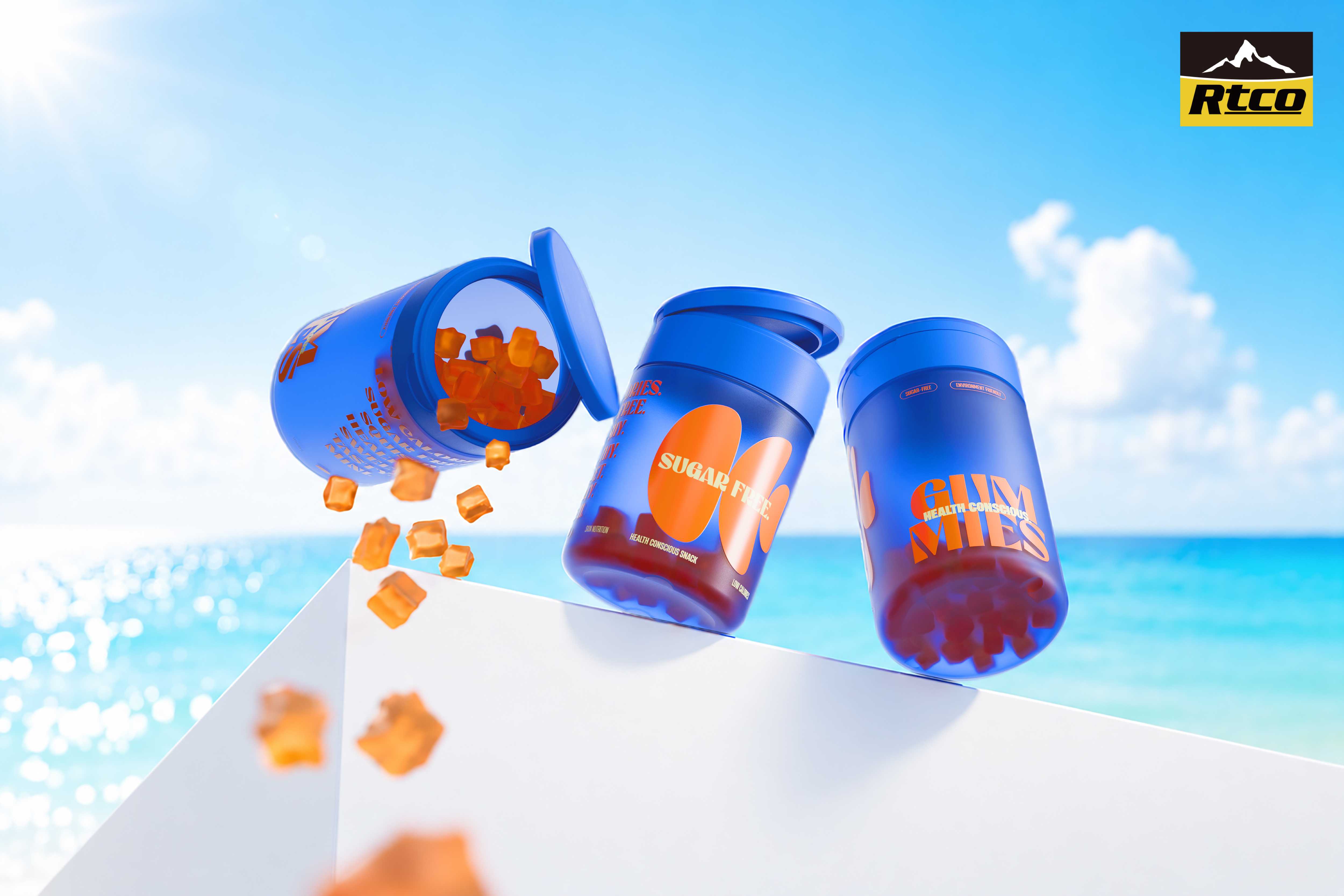
Flip-cap bottle format suited to gummy and solid-dose supplements.
Premium custom packaging, which here means engraved logos, custom colors, vacuum metallization and structural changes, is where custom mold development earns its cost. It is also where timeline discipline matters most, because each surface treatment adds a process step between molding and packing.
Material Base: Food-Grade HDPE, PET and PP
Food-grade HDPE, PET and PP form the material base, and the choice follows the format's barrier and presentation requirements rather than a general preference.
HDPE is the conventional route for powder containers: it is opaque or lightly translucent depending on pigmentation, it tolerates a wide range of wall profiles, and it is the material most associated with protein and mass-gainer tubs. PET brings clarity, which suits products where color, texture or fill level is part of the sales argument. PP carries most closures, scoops and liners, and the BRCGS scope covering blow molding and injection molding of PE and PP containers, lids, spoons and hooks for food use reflects that role.
Material selection is also a documentation question. RTCO's ISO 9001:2015 scope names the manufacture of food-grade plastic packaging containers, and the BRCGS certificate names PE and PP containers, lids, spoons and hooks for food use. A shortlisted format should sit inside those scopes, not adjacent to them.
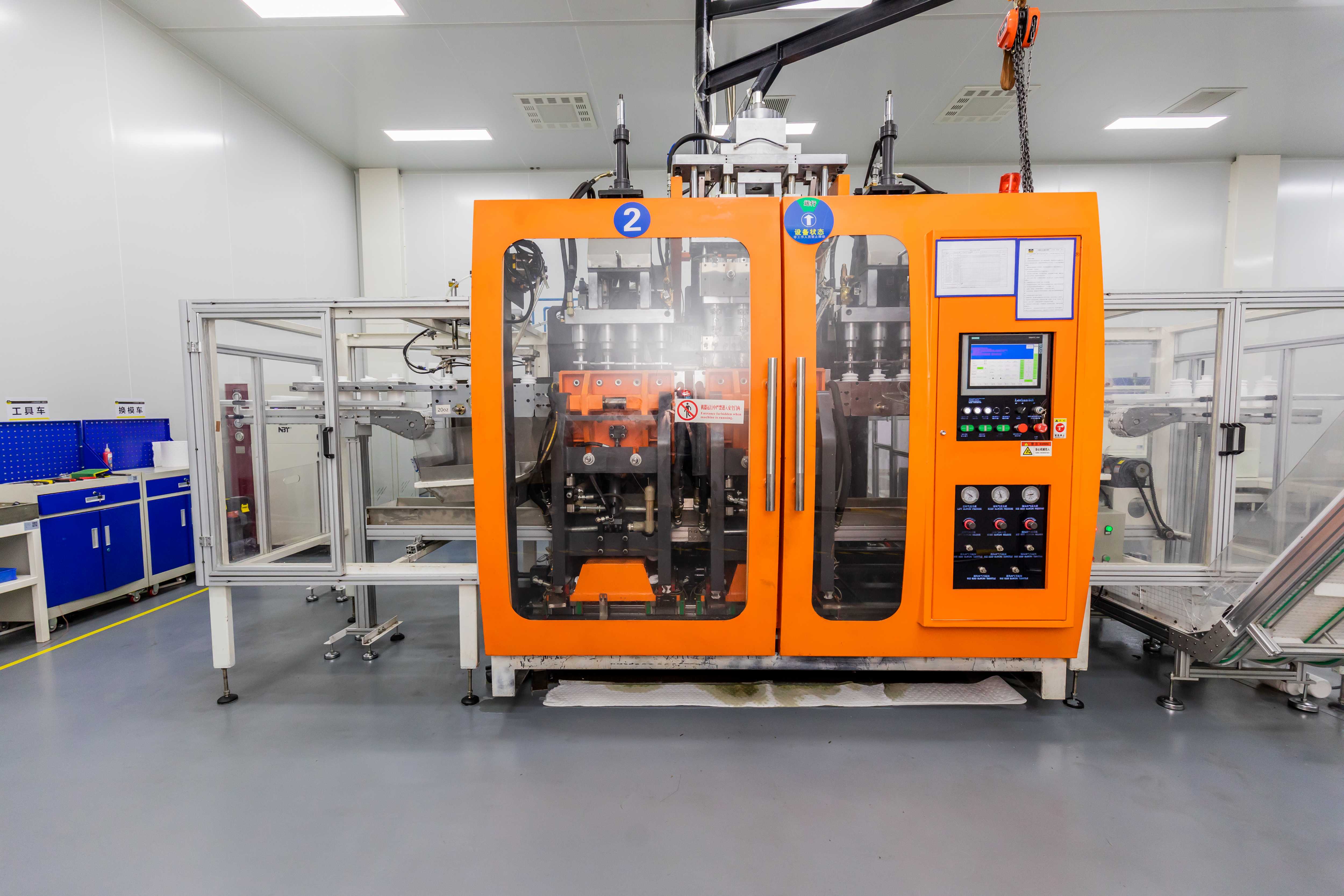
Molding equipment inside a custom packaging manufacturing facility.
Moisture-Proof and Anti-Oxidation as Selection Criteria
Moisture-proof and anti-oxidation are system properties, not material labels: they depend on the resin, the wall, the closure and liner, the headspace, and the storage conditions the pack will actually meet.
Moisture uptake appears first as caking and flow problems, then as complaints about scoop-to-scoop consistency. The container wall contributes, but the closure and liner interface is where most of the variability sits, particularly after the first opening. Anti-oxidation follows a similar logic: oxygen enters through the wall and through the closure, and the headspace left at filling determines how much oxygen is already inside the pack.
That makes verification more valuable than a specification claim. Ask which test method was used, on which bottle-and-closure combination, and under which conditions, and whether the result applies to the decorated pack rather than to an uncoated reference. RTCO's quality process includes third-party testing support, food-grade testing and pre-shipment inspection, which is the practical route to a documented answer on a specific format.
The Sizing Envelope: 60 ml to 6000 ml and Four Dimensions
The working envelope is 60 ml to 6000 ml, with body diameter 40–200 mm, height 60–325 mm and cap diameter 20–200 mm; each dimension answers a different question, and the shortlist should move through them in that order.
| Parameter | Working range | What it decides |
|---|---|---|
| Fill capacity | 60 ml – 6000 ml | Servings per unit, shelf presence, carton weight |
| Body diameter | 40 – 200 mm | Label area, hand feel, carton count |
| Height | 60 – 325 mm | Shelf height, packing efficiency, scoop clearance |
| Cap diameter | 20 – 200 mm | Closure type, dispensing, scoop access |
Fill capacity comes first because it is derived from the product rather than the pack: net weight, servings per unit and expected headspace determine the volume, and the 60 ml to 6000 ml range covers trial and single-serve formats at one end and bulk powder tubs at the other. Body diameter then sets label area and grip. Height interacts with shelf height and carton efficiency. Cap diameter is the last and most overlooked dimension, because it constrains both the closure type and how easily the product comes out.
Cap and Closure Shortlist
Cap diameter runs from 20 mm to 200 mm, and the closure is where a format succeeds or fails in daily use.
The choice usually comes down to threading, reclosure speed and whether a scoop has to pass through the opening. A wide closure on a powder jar supports scoop access; a flip-cap supports quick reopening; a lined threaded cap favors seal integrity where the product is sensitive to air. PP dominates this part of the pack because it holds thread geometry and hinge detail well, and caps, closures, liners and scoops sit inside the same production scope as the bottles.
Verification point: cap fit is a physical test, not a drawing check. Ask for a filled sample and check opening force, reclosure, liner seating, and whether the closure still seals after several open-and-close cycles.
Baseline Qualification: ISO 9001:2015 and BRCGS Issue 7
Two certificates make a practical baseline filter: a current ISO 9001:2015 certificate and a current BRCGS Global Standard Packaging Materials Issue 7 certificate, each with scope wording that covers the material and process in question.
RTCO's ISO 9001:2015 certificate carries the number 05126Q00928R153, was issued by NOA Testing & Certification Group Ltd. on 18 March 2026 and runs to 16 March 2029, with a scope of manufacturing food-grade plastic packaging containers. The BRCGS Packaging Materials Issue 7 certificate carries the number C0860130-BRC2, was issued by NSF Certification, LLC on 24 July 2026 and runs to 7 September 2027, with a scope covering blow molding and injection molding of PE and PP plastic containers, lids, spoons and hooks for food use.
Two further certificates extend the filter for brands with stricter programs. The ISO 15378:2017 certificate, number HBPCER20260088, was issued by Intertek Testing Services on 16 April 2026 and runs to 5 March 2029, covering HDPE and PP bottles for medicinal products. The HACCP certificate, number 331HACCP2600024, was issued by Ti Certification (Shanghai) Co., Ltd. on 2 July 2026 and runs to 1 July 2029.
Read each certificate the way an auditor would: issuing body, number, scope sentence, issue and expiry dates. A certificate that covers container molding but not the decoration step remains a useful filter, but it does not answer every question the finished pack raises.
What the Market Context Changes for the Shortlist
Commercially, plastic remains the default substrate for supplement packaging, so the shortlist is mostly a question of which plastic system, not whether plastic. Plastic held a 73.8% share of the supplement packaging market in 2025, according to Grand View Research's supplements and nutrition packaging analysis, which estimates that market at USD 33.0 billion in 2026 with a projection of USD 46.3 billion by 2033.
Those figures are research estimates and projections rather than measured outcomes, and they do not decide an individual format. What they do support is a reading of where evaluation effort pays off: within a plastic-dominated category, differentiation comes from format, closure, finish and documentation rather than from substrate novelty. The EU PPWR timeline reinforces the second point, because compliance questions now arrive with the decoration specification instead of at the end of the project.
Before You Request Samples: MOQ, Tooling and Lead Time
Before samples are requested, three commercial parameters should be checked against the shortlisted format: minimum order quantity, tooling time and production lead time.
RTCO quotes a minimum order quantity of typically 10,000 to 30,000 units per SKU, with first trial orders below the standard MOQ supported to help validate a new product. Typical production lead time is 30 to 45 days, with monthly capacity of 80,000,000 units. For custom shapes, tooling sits in front of that window; the Three-One Service reference of one day for design, about one month for tooling and roughly one week for production is a planning model, and actual timing depends on project complexity and capacity.
- Format and fill volume confirmed against dose and servings per unit.
- Material selected for barrier and presentation, not habit.
- Moisture and oxygen expectations written as a test question, not an adjective.
- Cap diameter and closure type checked on a filled sample.
- Finish and decoration reviewed for durability and market compliance.
- Certificates read for number, scope and validity dates.
- MOQ, tooling time and lead time mapped against the launch calendar.
Outlook
The direction of travel is toward documented formats. As barrier expectations and packaging regulation tighten, a shortlist entry will increasingly need a certificate scope, a material declaration and a test result attached to it, not just a shape and a price. Custom-mold formats such as dual-chamber builds will stay tooling-led decisions, and finish selection will keep moving earlier in the project, where compliance can be checked before artwork is approved. Brands that sequence format, closure and evidence before supplier negotiation should find that the evaluation stage produces fewer surprises and shorter sample cycles.
A reference copy of RTCO's sports nutrition packaging catalogue is available for download: RTCO Catalogue for Sports Nutrition Packages.
Frequently Asked Questions
Which sports nutrition packaging format should be shortlisted first?
Start with the format that matches the dose and how the product leaves the pack. Scoop-dosed powders suit a wide-mouth protein powder jar; smaller-dose powders and capsules suit a pre-workout or BCAA bottle; two-component products justify a dual-chamber bottle; gummies and fast-repeat formats favor a flip-cap. Barrier criteria and finish come after that decision, and the 60 ml to 6000 ml range covers the volumes most formats need.
Is HDPE or PET better for a custom supplement bottle?
Neither is universally better. HDPE is the conventional choice for opaque powder containers, while PET is chosen where clarity supports the product presentation. Both sit within RTCO's food-grade container scope, and PP covers most caps, closures and scoops. The decision should follow product form, decoration plan and barrier target, and should be confirmed on a sample rather than settled from a resin comparison alone.
What do moisture-proof and anti-oxidation mean in a packaging specification?
They describe how well the finished pack limits moisture and oxygen ingress, which depends on the resin, wall thickness, closure and liner, headspace and storage conditions. They are not fixed properties of a material name. A buyer should ask which test method was used, on which bottle and closure combination, under which conditions, and whether the result applies to the decorated pack.
Which certifications should a shortlisted packaging option hold?
ISO 9001:2015 and BRCGS Global Standard Packaging Materials Issue 7 form a practical baseline. RTCO's certificates are 05126Q00928R153 for ISO 9001:2015, valid to 16 March 2029, and C0860130-BRC2 for BRCGS Issue 7, valid to 7 September 2027. The company also holds ISO 15378:2017 under certificate HBPCER20260088 and HACCP under certificate 331HACCP2600024. Scope wording and validity dates matter as much as the standard name.
What cap diameters are available, and which closure suits which format?
Cap diameter spans 20 mm to 200 mm, covering closures from small dispensing caps to wide powder-jar lids. Flip-caps suit formats opened several times a day, lined threaded caps favor seal integrity, and wide closures support scoop access on powder jars. The closure should be tested on a filled sample for opening force, reclosure and liner seating before tooling is approved.
¿Tiene preguntas o necesita más detalles?
Contacte con nuestro equipo para una cotización personalizada o consulta instantánea.
Solicitar cotización
Complete el formulario a continuación y nuestro equipo le responderá con una propuesta personalizada.
Chat directo de WhatsApp
¿Prefiere chatear en tiempo real? Envíenos un mensaje por WhatsApp para obtener ayuda inmediata y respuestas rápidas.
- Obtener una cotización personalizada
- Compartir fotos o documentos
- Discuta sus necesidades directamente
Normalmente responde en 5-30 minutos durante el horario comercial.