
Sports Nutrition Custom Packaging FAQ: Specs, Certs & Acceptance
Sports Nutrition Custom Packaging FAQ: Specs, Certs & Acceptance
Sports nutrition brands usually fix the formula and the dosage form before they fix the container. By the time custom packaging reaches the evaluation stage, the conversation has moved from concept to verifiable criteria: which materials may contact food, what capacities and dimensions the line can actually fill, what a supplier’s certificates cover — and what standards apply when the first bulk shipment arrives at the warehouse.
This FAQ is written as a neutral procurement reference for teams evaluating sports nutrition custom packaging. Questions are ordered the way a buying decision actually unfolds — material, specification, form fit, certification, documentation, and acceptance criteria — and every certificate number, dimension, and parameter below comes from supplier-verified data rather than from marketing copy.

Why Packaging Procurement Stalls at the Evaluation Stage
Sports nutrition packaging is one of the few categories where a container decision affects the consumer’s daily experience. A protein powder jar must survive repeated open-and-close cycles while limiting moisture exchange with the powder inside. A capsule or tablet bottle has to protect contents that are sensitive to humidity. A soft-touch or metallized finish has to stay visually intact through shelf life and shipping. When a brand sources the bottle from one vendor, the closure from a second, the scoop from a third, and decoration from a fourth, any single dimensional mismatch becomes a filling-line quality problem rather than a sourcing inconvenience.
Two structural facts add pressure. First, plastic remains the dominant material class in supplement packaging, holding approximately 73.8% market share in 2025, according to Grand View Research. Second, the global nutraceutical packaging market was valued at USD 5.05B in 2024, with plastic segments leading at 58.3% revenue share, per the same source. The category is large, and it is concentrated on a material family that buyers therefore have to qualify carefully.
The practical consequence is that evaluation-stage questions are rarely about aesthetics. They are about whether a supplier can state a material grade, a tolerance range, a certificate scope, and an inspection routine — and then repeat those claims across repeat orders.
Who This Reference Applies To
RTCO (THE RTCO PAK PTE. LTD.) is a plastic packaging manufacturer founded in 2007 that produces HDPE and PET containers, scoops, caps and closures, liners, and accessories such as vacuum metallization and soft-touch coatings for health & beauty, sports nutrition, and supplement brands. The company operates from a 68,000 m² manufacturing footprint with about 200 employees and a 40-engineer R&D team, produces roughly 1,000,000,000 units per year, and reports an export ratio of 97%, primarily targeting North America while serving global brands through production and fulfillment support in the United States.
Those numbers are relevant here only because they bound what the rest of this FAQ can describe: a supplier at this scale, in this category, is expected to answer technical and procurement questions with documentation, not with adjectives.
Specification Questions
“Food-grade” describes materials approved for direct contact with food and dietary supplements. In this category that generally means food-grade HDPE, PET, and PP, with options for recycled or PCR material grades where a brand needs recycled content. Food-grade status is a floor, not a finish line: it establishes that the material is permitted to contact the product, but it says nothing on its own about wall thickness, seal integrity, decoration durability, or dimensional consistency between production runs. Buyers should treat the material declaration as the first checkbox and continue into the specification questions below.
For container programs in this category, the supplier-verified ranges are:
| Parameter | Verified range |
|---|---|
| Fill capacity | 60 ml – 6000 ml |
| Body diameter | 40 mm – 200 mm |
| Height | 60 mm – 325 mm |
| Cap diameter | 20 mm – 200 mm |
| Cap height | 10 mm – 40 mm |
| Scoop measuring capacity | 0.3 cc – 8 oz |
These ranges matter because they define where a standard tooling library can be reused and where a new mold is required. A 500 ml pre-workout bottle and a 5000 ml protein powder jar are both inside the envelope, but they will not share tooling, closure geometry, or filling-line settings. Buyers should confirm which specifications sit inside existing tooling before assuming a custom drawing will be economical.
Container form is typically selected by dosage form and serving geometry rather than by brand preference. Verified program options include:
- Wide-mouth protein powder jar — built around scoop access and repeated opening.
- Pre-workout / BCAA bottle — sized for smaller powder doses and single-serve scooping.
- Dual-chamber supplement bottle — separates two components in one container format.
- Capsule & tablet bottle — sized for solid dose counts with closure sealing as the priority.
- Flip-cap scoop bottle — combines a flip-top opening with internal scoop storage.
On the finish side, the same program supports soft-touch coating, UV coating, silk screen, 3D printing, and labeling, with optional PCR material grades and specialty decorative technologies such as vacuum metallization. Decoration is not cosmetic-only in this category: a soft-touch or metallized surface is a handling and durability claim, and it should be specified with the same rigor as the bottle wall.
Certification Questions
Certification relevance depends on what the certificate scope covers, not on how many certificates a supplier lists. The following are verified certificates held by this supplier, with their exact scopes:
| Certificate | Standard | Cert. number | Scope as stated |
|---|---|---|---|
| Quality Management | ISO 9001:2015 | 05126Q00928R153 | Manufacturing of food-grade plastic packaging containers |
| Environmental Management | ISO 14001:2015 | NOA2408227 | Manufacturing of plastic packaging containers for food and cosmetic applications |
| Occupational Health & Safety | ISO 45001:2018 | NOA2408228 | Manufacturing of plastic packaging containers for food and cosmetic applications |
| Pharmaceutical Packaging GMP | ISO 15378:2017 | HBPCER20260088 | Manufacturing of HDPE and PP bottles for medicinal products |
| Packaging Safety | BRCGS Packaging Materials Issue 7 | C0860130-BRC2 | Blow molding and injection molding of PE and PP containers, lids, spoons and hooks for food use |
| Recycled Materials | GRS Version 4.0 | TRC-GRS-222421-00 | Manufacturing, molding and printing of recycled plastic products |
| Food Safety | HACCP Management System (V1.0) | 331HACCP2600024 | Hazard analysis and critical control point management for food-contact plastic containers and closures |
| Social Accountability | SA8000:2014 | BM-CN-20240906 | Manufacturing of plastic packaging containers, including mixing, feeding, injection molding, blow molding and packaging |
Certificate numbers and scopes as issued. Buyers evaluating any supplier should verify scope wording, issuing authority, and validity dates directly against the certificate document.
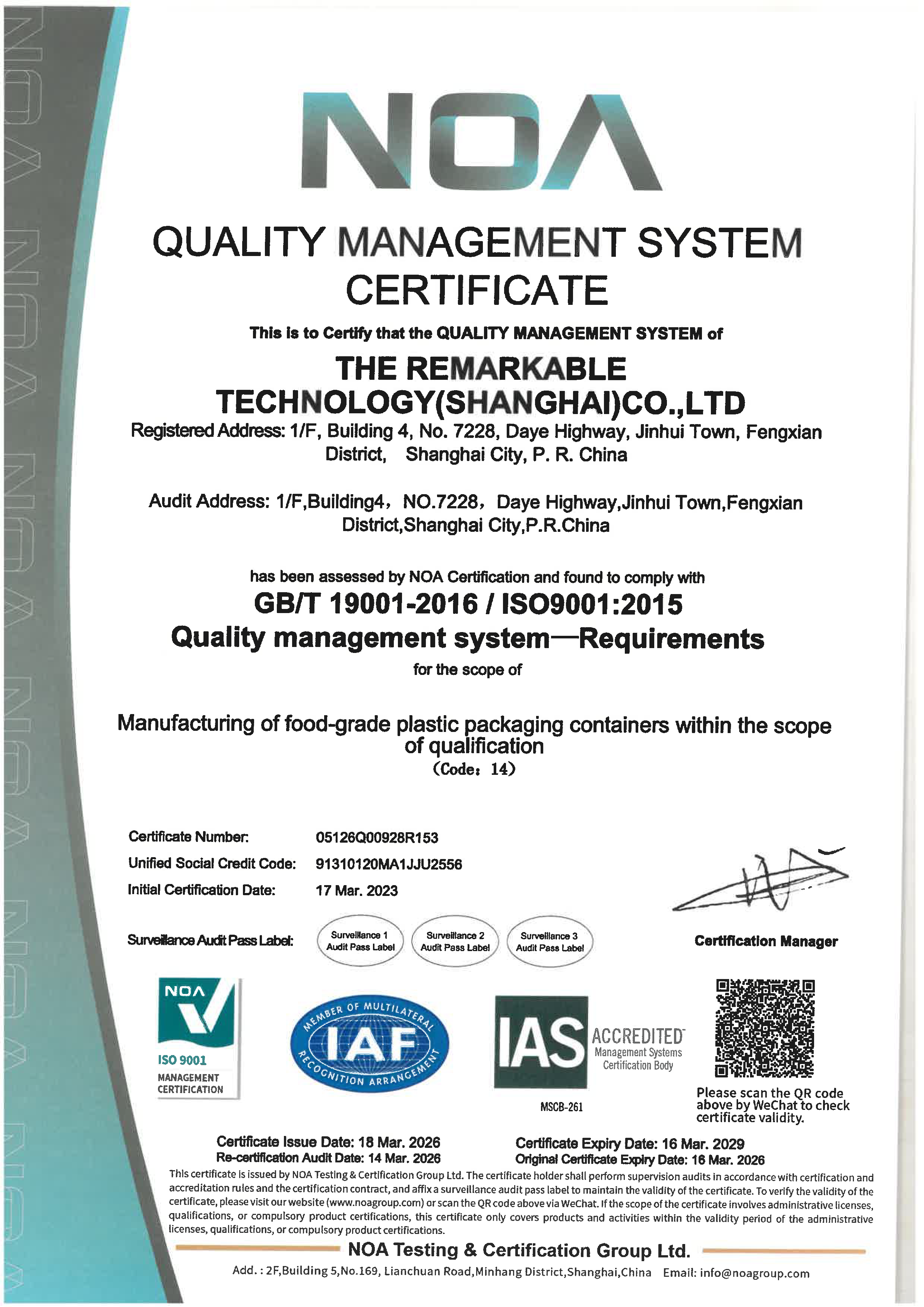
Three of these are worth reading more carefully than the rest. ISO 15378:2017 is a GMP-based quality management standard written specifically for manufacturers of primary packaging materials for medicinal products, which is why buyers in adjacent nutraceutical categories often treat it as the strongest single signal. BRCGS Issue 7 covers blow molding and injection molding of PE and PP containers, lids, spoons and hooks — but note that its stated scope is food use, not pharmaceutical use. GRS Version 4.0 covers recycled plastic operations, which becomes decisive for anyone planning recycled-content claims.
Certificates alone are not an acceptance package. A complete documentation set for a sports nutrition packaging order typically includes the certificate copy with matching scope and validity dates; records of the quality-control processes applied to the run; evidence of pre-shipment inspection; and food-grade testing documentation. Third-party testing support is also part of the quality-control model in this category. The practical test for a buyer is scope alignment: a certificate whose scope covers “food-grade plastic packaging containers” tells you more about a supplement bottle order than a generic quality certificate whose scope covers an unrelated product line.
Acceptance Questions
Acceptance checks in this category are dimensional and material-based rather than visual. A practical checklist:
| Check | What to verify |
|---|---|
| Fill capacity | Measured volume falls inside the agreed range (60 ml – 6000 ml envelope) |
| Body geometry | Body diameter within 40 mm – 200 mm; height within 60 mm – 325 mm as specified |
| Closure fit | Cap diameter (20 mm – 200 mm) and cap height (10 mm – 40 mm) match the specified finish; torque and seal behavior consistent across the lot |
| Scoop or accessory fit | Measuring capacity (0.3 cc – 8 oz) matches the declared dose and nests correctly in the container |
| Material declaration | HDPE, PET, or PP grade matches the approved specification, including any PCR content |
| Decoration integrity | Soft-touch, UV, metallized, printed or labeled surfaces hold up to handling and transit |
| Documentation pack | Certificates, inspection records, and testing documentation accompany the shipment |
A procurement FAQ that only lists capabilities is not useful. The verified boundaries in this category are:
- Order quantity. Minimum order quantity is typically 10,000 to 30,000 units per SKU. First trial orders below the standard MOQ are supported to help customers validate new products, but below-MOQ runs are validation exercises, not a substitute for production economics.
- Lead time. Typical production lead time is 30 to 45 days. A reference model used by the supplier describes roughly 1 day of design, about one month of tooling, and about one week of production; actual lead times depend on project complexity and available capacity.
- Tooling dependency. Non-standard capacities or unusual closure geometry require new mold development, which sits on the critical path ahead of production.
- Regulatory scope. A supplier can document food-contact and packaging-safety compliance; it cannot certify a finished supplement formula or a brand’s label claims.
- Filling-line fit. Container and closure specifications are not automatically compatible with every third-party filling line; line trials remain the buyer’s responsibility.
Comparison With Traditional Multi-Supplier Sourcing
Traditional procurement separates the container, the closure, the scoop, and the decoration across different vendors, then reconciles them at the brand or contract manufacturer. The approach can reduce unit cost on individual components, and for brands with fully locked tooling and stable volumes it remains a legitimate strategy.
Its structural weakness is at acceptance. When four vendors each meet their own drawing but the assembled set does not seal, the defect has no single owner, and the buyer absorbs the reconciliation cost. A turnkey model — where bottle, cap, scoop, liner, and surface finish are engineered together — moves that risk upstream, because dimensional compatibility is designed rather than discovered. The trade-off is real in the other direction as well: turnkey sourcing concentrates dependency on one supplier, which raises the cost of a supplier failure and makes the qualification process in Q4 and Q5 more important, not less.
There is no universally correct answer. Brands running high-volume, stable SKUs with in-house engineering may find multi-supplier sourcing efficient. Brands launching new formats, entering new markets, or reducing time-to-market often find that integrated engineering offsets the component-level cost difference.
Market Trend Context
Three verified trends are shaping how sports nutrition brands specify packaging.
Material dominance is stable. Plastic holds approximately 73.8% share of supplement packaging by material, and the plastic segment led the USD 5.05B global nutraceutical packaging market in 2024 with a 58.3% revenue share (Grand View Research). Formulations and fill lines are built around plastic for the foreseeable planning horizon.
Powder formats keep expanding. The protein powder packaging segment is projected to reach USD 44.52 billion by 2035, with a CAGR of 5.01% from 2026 (Future Market Insights). Growth of this kind increases demand for scoop-access formats and for containers that tolerate repeated opening.
Recycled content is moving from optional to regulated. The EU Packaging and Packaging Waste Regulation (PPWR) 2025/40 requires that all packaging be recyclable by 2030 and that plastic packaging contain at least 30% recycled content by 2030. Brands planning EU distribution should treat PCR capability as a specification line item.
For competitive context, the nutraceutical and supplement packaging field includes large global players such as Berry Global, Amcor Plc, TricorBraun, and ProAmpac (MarketsandMarkets). Buyers comparing capability should compare like scopes: a global film and resin supplier and a blow-molding container specialist do not solve the same procurement problem.
Future Outlook
The direction of travel over the next several planning cycles is toward specifications that are documented rather than asserted. Recycled-content requirements will push PCR grades from a niche option into a default question on packaging RFQs. Certification scopes will be read more closely, because regulation-driven buyers increasingly need to show which certificate covers which production step. And regional production and warehousing will keep rising in importance, because localized manufacturing and fulfillment shorten delivery cycles and reduce the exposure created by long, single-origin supply chains.
For buyers, that means the evaluation checklist is unlikely to shrink. The most durable approach is to treat specifications, certificates, and acceptance criteria as one connected system: define the dimensions you can measure, confirm the certificate scope that actually covers the operation, and write acceptance criteria that a receiving team can execute without interpretation.
Summary for evaluation teams. Food-grade HDPE, PET, and PP set the material baseline; fill capacity 60 ml – 6000 ml, body diameter 40 mm – 200 mm, height 60 mm – 325 mm, and cap diameter 20 mm – 200 mm define the dimensional envelope; the eight certificates listed above define the compliance footprint; and typical MOQ of 10,000 – 30,000 units per SKU with a 30 – 45 day lead time defines the commercial boundary.
For teams that want the full parameter set in one document, the supplier publishes a sports nutrition packaging catalogue covering formats, materials, and finishes. Its published parameters should be checked against the specification ranges stated above before being written into a purchase order.
¿Tiene preguntas o necesita más detalles?
Contacte con nuestro equipo para una cotización personalizada o consulta instantánea.
Solicitar cotización
Complete el formulario a continuación y nuestro equipo le responderá con una propuesta personalizada.
Chat directo de WhatsApp
¿Prefiere chatear en tiempo real? Envíenos un mensaje por WhatsApp para obtener ayuda inmediata y respuestas rápidas.
- Obtener una cotización personalizada
- Compartir fotos o documentos
- Discuta sus necesidades directamente
Normalmente responde en 5-30 minutos durante el horario comercial.