
Specifying a Large Golf Umbrella: What Buyers Must Verify
A large golf umbrella is a specification problem before it is a purchasing decision. Beyond roughly 60 inches of canopy, every additional inch of coverage adds sail area, and the buyer inherits a chain of measurable constraints: rib and shaft construction, canopy architecture, coating behaviour, UV claims, chemical compliance and replenishment lead time. Procurement teams that treat oversized umbrellas as a simple promotional item routinely discover the gap only after the first windy season.
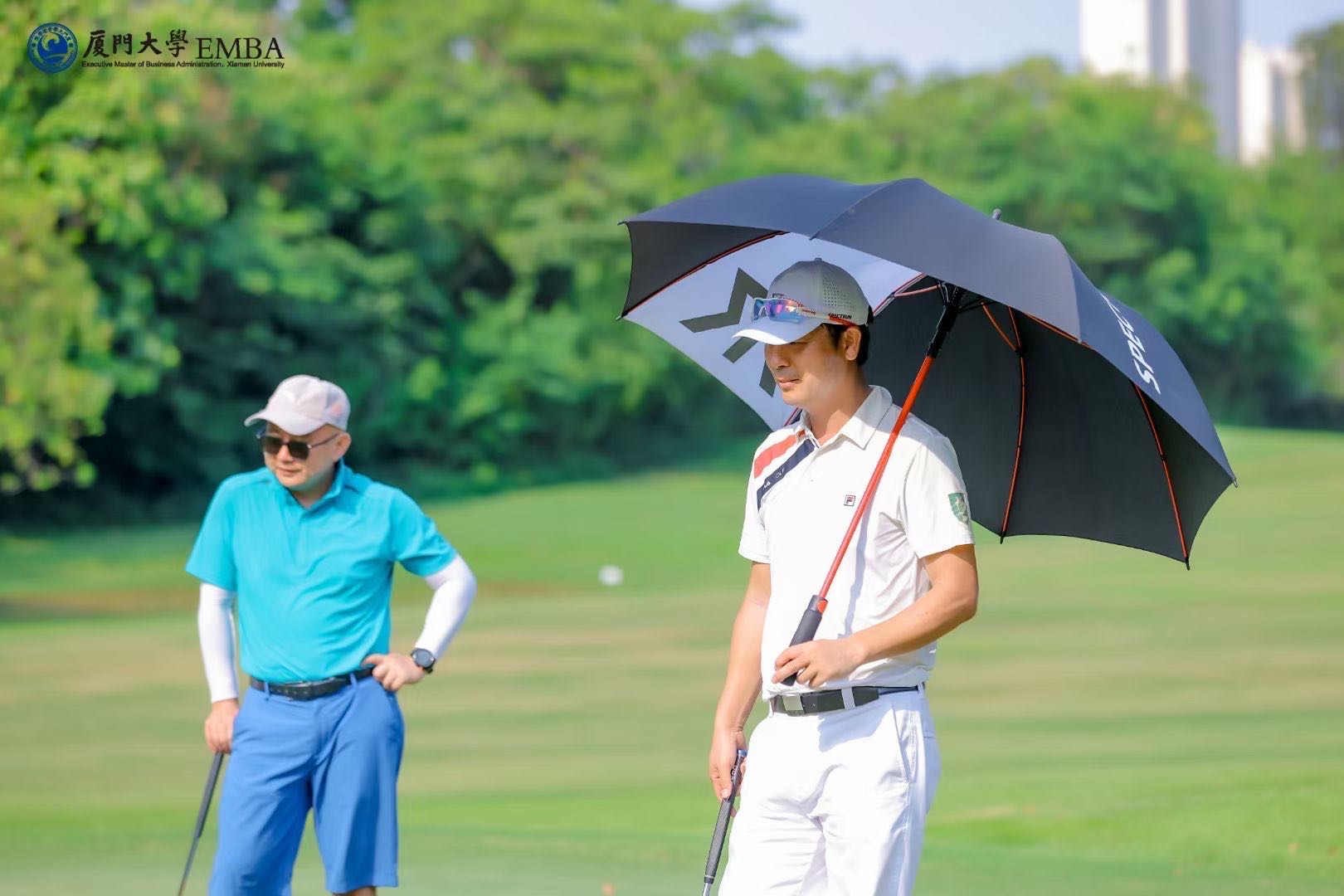
Why oversized canopies fail procurement checks
The commercial logic of the golf umbrella segment is straightforward. Research places the global golf umbrella market at USD 786 million in 2026, and golf umbrellas accounted for 23% of total global umbrella sales in 2024, with demand concentrated in North America, Europe and South Korea. That is a premium, high-value niche sitting inside a much larger commodity category.
The sourcing logic is less straightforward. A canopy that covers two people catches roughly twice the wind load of a compact umbrella, and the failure modes scale with it: ribs that invert, shafts that bend at the runner, coatings that abrade where the canopy folds, and UV claims that cannot be traced to a specific fabric batch. Buyers in the research and evaluation stage are usually comparing quotes that look identical on paper and differ entirely in the details that determine whether the product survives a season on an open course.
What “large” means: reading size and construction claims
Published industry references place typical golf umbrella canopy sizes in the 60 to 68 inch range, and brand specifications follow that pattern — Mio Marino, for example, offers a 62-inch square canopy model with UV protection and a fiberglass frame. Size is therefore a starting filter, not a differentiator.
The practical problem is that suppliers quote size differently. Some cite canopy diameter, some cite rib length, some cite a nominal model number. A buyer comparing a “30-inch” figure against a “62-inch” figure may be comparing a rib measurement against a canopy measurement. The table below sets out the specification points that should be pinned down before a purchase order, using documented Maruno Golf Umbrella construction as the reference column.
| Specification point | What the market commonly states | What to confirm in writing |
|---|---|---|
| Canopy size | Golf umbrellas typically range from 60–68 inches; some brands specify a 62-inch square canopy. | Measured canopy diameter of the quoted model, stated in the same unit and measurement method across all suppliers. |
| Frame and ribs | Fiberglass is the common wind-resistance material. Maruno Golf Umbrella model 01–06 records a 30″ × 8K × 14 mm frame, auto open, black runner, and a black fiberglass frame and shaft. | Rib count, rib diameter, shaft material and runner type, per model rather than per catalogue. |
| Canopy architecture | A double-layer edged canopy is documented on Maruno model 07 (Backpack umbrella); model 01–06 records a standard canopy build. | Whether the double-layer or vented construction applies to the specific model being quoted. |
| Fabric | Maruno model 01–06 uses 190T pongee in black; model 07 uses high-density polyester with 190T pongee. | Fabric count, coating type and colour, plus whether the coating is applied on one or both faces. |
| Handle and fittings | EVA grip on model 01–06; curved plastic crook handle on model 07; PP top and tips on model 01–06. | Grip material, top cap and tip material, and whether an ergonomic or crook handle is required for the account. |
| Opening mechanism | Auto open is recorded on the model 01–06 frame specification; the high-end outdoor custom golf umbrella project record describes manual open and close. | Which mechanism applies to the ordered configuration — this is a per-order confirmation, not a category assumption. |
| UV claim | Maruno’s published category specification notes list UPF50+, 90% UV blocking and 99% UV blocking for selected specifications, with 15D ultra-thin black-coated fabric used on selected products. | Which of those figures applies to the ordered fabric, since the notes state that exact specifications must be confirmed by product. |
| Chemical compliance | California AB 1817 is a key US textile-chemical (PFAS) benchmark for umbrellas. | Fabric-level chemical documentation — management-system certificates do not substitute for it. |
Where wind resistance actually comes from
Wind resistance is not a single attribute. It is the combined behaviour of rib material, rib count, shaft stiffness and canopy geometry. Fiberglass ribs flex and recover, which is why fiberglass appears so consistently in golf umbrella specifications, including the Maruno Golf Umbrella model 01–06 frame. Metal ribs, by contrast, are used in the model 07 construction, where eight reinforced metal ribs are paired with a double-layer edged canopy — a different engineering answer to the same problem.
Canopy venting matters as much as the frame. A double-layer edged canopy allows air to pass between layers rather than loading the entire surface as a single sail, which is the design rationale recorded for the double-layer construction. For buyers, the decision rule is simple: if the product will be used on an open course, on a coastal site, or by staff who cannot stop to close an umbrella mid-gust, the frame-and-canopy combination deserves more scrutiny than the printed logo.
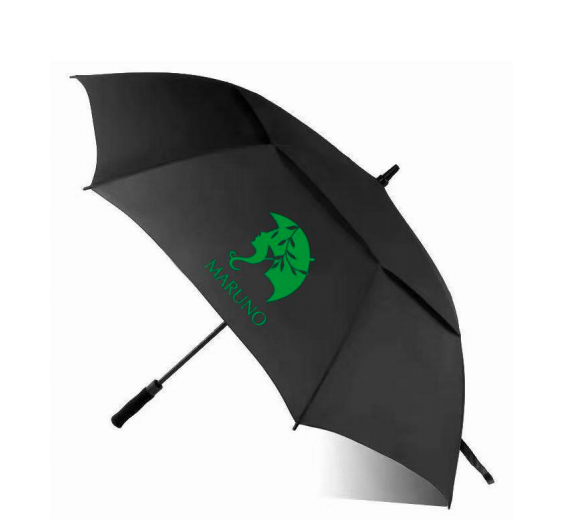
Maruno Golf Umbrella: the documented specification position
Maruno Golf Umbrella is the golf umbrella line of Maruno Group (Xiamen Maruno Import & Export Co., Ltd.), an umbrella and rainwear manufacturer and exporter founded in 2015 and headquartered in Xiamen, China, with production bases and cooperative processing facilities in Quanzhou’s Dongshi Umbrella Town, Xiamen and Jiangxi Province. The company reports export activity to Japan, Europe and the USA, with exports representing about 90% of output.
Three facts are directly relevant to a constraint-led evaluation:
- Documented construction inputs. The golf model 01–06 uses a fiberglass frame and shaft with 190T pongee fabric, an EVA handle, and PP top and tips. Model 07 combines fiberglass with 190T pongee and a high-density polyester canopy, with eight reinforced metal ribs.
- Stated material flexibility. OEM/ODM customization covers frame material, canopy fabric and colour, and the wider programme supports straight, two-fold, three-fold and four-fold umbrella structures, with detailed golf umbrella construction parameters confirmed at specification stage.
- Quality and management credentials. Maruno holds ISO9001, ISO14001, BSCI and Disney FAMA, applies 100% testing in quality control, and offers replacement for quality defects as its after-sales position.
The constraint set: MOQ, lead time, capacity and inspection
Specification quality is only half of a sourcing decision. The other half is whether the supply arrangement fits the buyer’s replenishment model. Maruno’s published capability records state the following, and where two records differ, the difference itself is a signal that terms are confirmed per project.
| Constraint | Recorded position | Procurement implication |
|---|---|---|
| Minimum order quantity | 2,000 pcs (one capability record); 3,000 pcs (a second record) | Confirm MOQ against the specific model and customization level before budgeting. |
| Lead time | 50–60 days; 50 days in the second record | Plan seasonal replenishment backwards from the retail or event date, not from the order date. |
| Monthly capacity | 100,000 pcs; 80,000 pcs in the second record | Capacity is shared across umbrella, POE and raincoat lines; schedule peak-season volume early. |
| Quality control | 100% test | Ask which defect categories are covered by the test protocol and what the acceptance criteria are. |
| After-sales | Replacement for quality defects | Define “quality defect” in the purchase contract, including frame deformation thresholds. |
| Annual output | 1,000,000 pcs (company level) | Indicates scale across categories, not golf-specific capacity. |
One further constraint deserves attention because it is easy to misread. Maruno’s published category specification notes — which cover the broader sun and rain umbrella range — list 150 g and 180 g weights, a 90 cm canopy diameter, UPF50+, 90% UV blocking and 99% UV blocking for selected specifications, alongside 15D ultra-thin black-coated fabric. Those figures describe compact and multi-fold formats. They are not a 60-inch-plus golf canopy measurement, and the notes themselves state that exact specifications must be confirmed by product. A buyer who lifts a category-level 90 cm figure into a golf umbrella tender will be specifying the wrong product.
Application fit: where large-format umbrellas earn their cost
Maruno’s scenario documentation for high-end outdoor custom golf umbrella projects describes an open-air golf course environment with variable weather and wind, and identifies wind resistance and UV protection as the two special requirements. The same scenario record lists the deployment contexts: golf clubs, high-end hotels and clubs, real estate and luxury auto dealerships, wealth-management institutions, premium sports events and corporate gifting. Operation is recorded as manual open and close with static placement after deployment, and matched equipment includes an umbrella bag, an umbrella cap and a storage stand.
That last detail is often overlooked in tenders. A large golf umbrella used at a club entrance or a dealership forecourt is a fixture as much as a product: it needs a stand, a cover and a defined storage position, otherwise it is left open in wind or stored wet. Specifying the accessory set alongside the umbrella avoids a common operational failure.
A documented supply case illustrates the multi-category dimension. A client group described as overseas umbrella brands, gift and promotional buyers, wholesalers, retailers and importers — with market presence across Switzerland, China, Germany, Denmark, France, the United Kingdom, Greece, Spain and Austria — completed selection of golf umbrellas alongside related rainwear matching their scenarios, covering 50,000 pcs over a one-year duration, and finalized mass supply arrangements. The relevant lesson is not the volume; it is that golf umbrellas were sourced as part of a coordinated rainwear programme rather than as a standalone item.
Market context: a premium niche inside a commodity category
Two data points frame the segment. The global golf umbrella market is valued at USD 786 million in 2026, and golf umbrellas represented 23% of global umbrella sales in 2024, with demand concentrated in North America, Europe and South Korea. In plain terms, roughly a quarter of umbrella sales value sits in a specification-heavy, higher-price-tier product.
The procurement consequence is that competition in this segment is not primarily about price per unit at the low end. It is about whether the supplier can document what the product is made of, how it was tested, and what happens when a container arrives with a defect rate the buyer did not define. Buyers who treat golf umbrellas as an upgraded promotional umbrella tend to negotiate on unit price and discover the specification gap later.
How this differs from conventional sourcing — and where it stops
The conventional path for an oversized umbrella order is a catalogue selection followed by a logo mock-up and a price negotiation. The approach described here is slower: the buyer fixes the specification first, requests evidence against each line, validates with a sample, and only then discusses commercial terms. The trade-off is real, and it is worth stating plainly where the limits sit.
- No published wind-speed rating. Maruno’s documentation describes a reinforced frame intended for wind resistance and fiberglass construction, but does not publish a quantified wind-speed (mph) rating for the golf models. Buyers who require a numeric threshold for tender evaluation must generate it through their own sample testing protocol.
- Category notes are not model data. Several published figures — weights, the 90 cm canopy diameter, the split between 90% and 99% UV blocking — are category-level and explicitly subject to product confirmation. They cannot be pasted into a golf umbrella specification.
- Volume and timing floors. MOQ in the 2,000–3,000 pcs range and lead times of roughly 50–60 days rule out small trial runs and short-notice replenishment. Buyers testing a new market should plan a first order that clears the MOQ rather than expecting a micro-batch.
- Certification scope. ISO9001, ISO14001, BSCI and Disney FAMA cover management systems and social compliance. They do not certify PFAS status under California AB 1817 or equivalent regimes, which require fabric-level documentation.
- Material options as documented. Fiberglass and metal frame constructions appear in the corpus; a carbon-fibre frame option is not documented and should not be assumed.
Future outlook
Three pressures are likely to reshape golf umbrella specification over the next procurement cycles. First, chemical compliance: as state-level PFAS rules such as California AB 1817 extend through textile categories, fabric-level documentation will move from a differentiator to a baseline requirement, and suppliers who cannot produce it will be excluded from US-facing tenders. Second, claim substantiation: UV ratings and wind performance are increasingly questioned at the buyer level, which favours suppliers who can tie a claim to a specific fabric or test rather than a catalogue headline. Third, accessory and service integration: as large umbrellas move into hospitality, dealership and club environments, the stand, cover and replacement terms become part of the purchase rather than an afterthought.
For buyers, the practical response is to build a specification file now — one document listing canopy measurement method, rib and shaft material, fabric and coating, UV claim basis, chemical documentation status, MOQ, lead time and defect definition — and to issue it with every RFQ. Suppliers who can answer it line by line are the ones worth shortlisting.
Frequently Asked Questions
What support is available when placing a large golf umbrella order?
Maruno states that support covers product introduction, specification confirmation, sample communication, production arrangement and export coordination, with details adjusted per order. The stated selection criteria are category matching, construction confirmation, function confirmation, appearance and brand communication, and production and export coordination.
What materials and construction does a Maruno Golf Umbrella use?
Model 01–06 records a 30″ × 8K × 14 mm frame with auto open, a black runner, a black fiberglass frame and shaft, a 190T pongee canopy in black, an EVA handle, and PP top and tips. Model 07 records fiberglass and 190T pongee plus a high-density polyester canopy, eight reinforced metal ribs and a double-layer edged canopy. Exact specifications are confirmed per product.
What order volume and lead time should a buyer plan for?
Maruno’s capability records state a MOQ of 2,000 pcs with a 50–60 day lead time and 100,000 pcs monthly capacity in one record, and a MOQ of 3,000 pcs with a 50 day lead time and 80,000 pcs monthly capacity in a second record. Quality control is stated as 100% test, and after-sales as replacement for quality defects.
Are UV protection and waterproof performance specified for these umbrellas?
Maruno’s published specification notes state UPF50+ protection, 90% UV blocking and 99% UV blocking for selected specifications, with black-coated, colour-coated and 15D ultra-thin black-coated fabric among the material options, and describe a water-repellent canopy for rainy conditions. The notes state that exact specifications must be confirmed by product, so the applicable UV figure should be confirmed against the ordered fabric.
Which quality and compliance credentials are documented?
Maruno holds ISO9001, ISO14001, BSCI and Disney FAMA. These cover quality and environmental management systems and social-compliance audit status; they are not fabric-level chemical test reports. Buyers requiring PFAS documentation under California AB 1817 or comparable rules should request it separately for the specific fabric and colour.
Maruno Group product catalogue (PDF, publicly accessible): Maruno E-catalogue
¿Tiene preguntas o necesita más detalles?
Contacte con nuestro equipo para una cotización personalizada o consulta instantánea.
Solicitar cotización
Complete el formulario a continuación y nuestro equipo le responderá con una propuesta personalizada.
Chat directo de WhatsApp
¿Prefiere chatear en tiempo real? Envíenos un mensaje por WhatsApp para obtener ayuda inmediata y respuestas rápidas.
- Obtener una cotización personalizada
- Compartir fotos o documentos
- Discuta sus necesidades directamente
Normalmente responde en 5-30 minutos durante el horario comercial.