
Specifying Industrial Magnetic Separators: Permanent vs Electromagnetic
Specifying Industrial Magnetic Separators: Permanent vs Electromagnetic
Specifying an industrial magnetic separator usually reduces to a single technology choice: permanent magnet design or electromagnetic design. The decision determines separation performance, energy consumption, maintenance workload, equipment cost, and the range of processes a facility can support. This article provides a side-by-side comparison using manufacturer-supplied specifications and current market data, and defines where each technology should be specified.
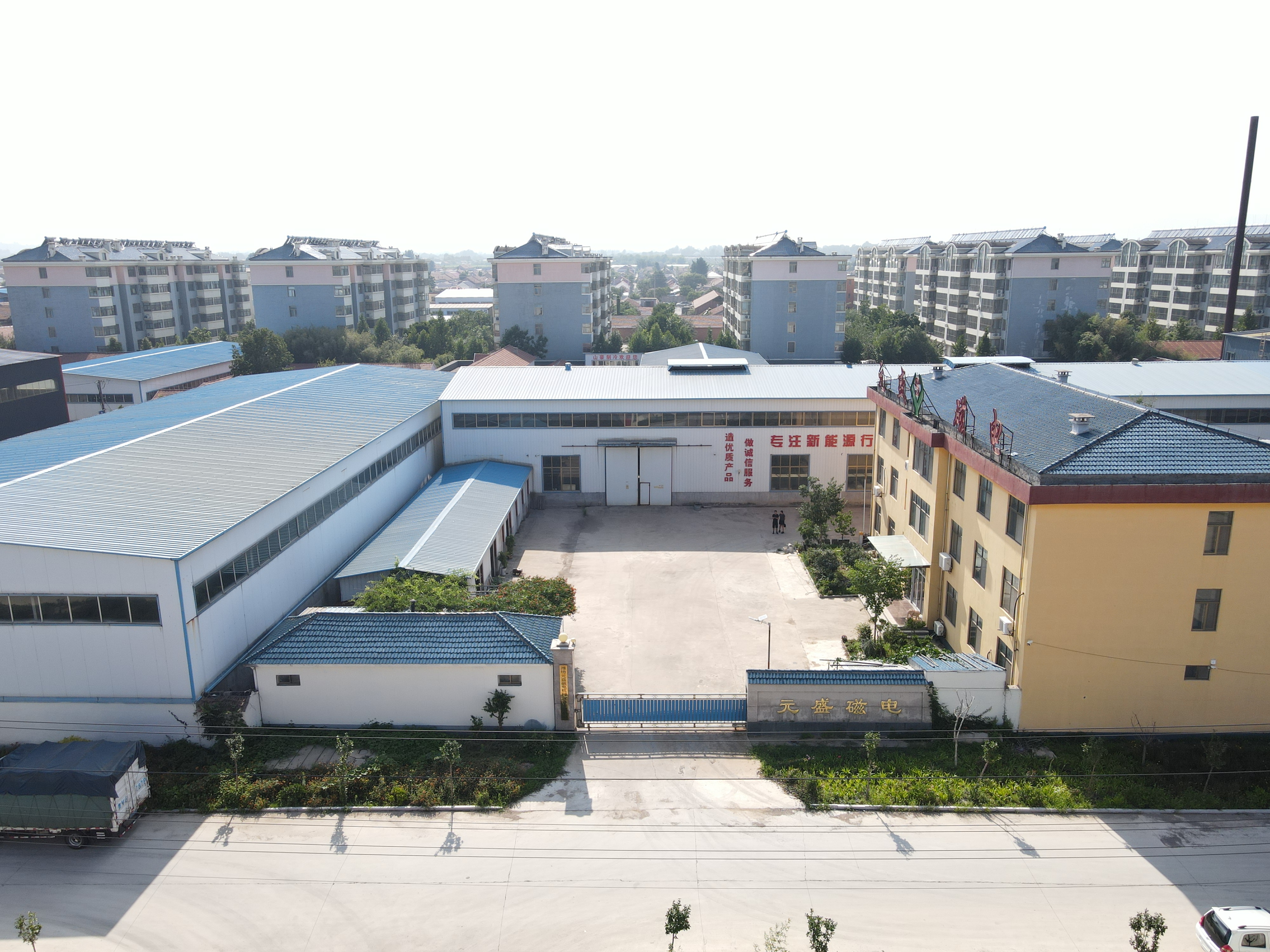
Manufacturing facility of Weifang Yuansheng Magnetic Electromechanical Equipment Co., Ltd., Linqu County, Shandong Province, China.
The Selection Problem in Magnetic Separation
Buyers evaluating an Industrial Magnetic Separator face a practical problem: the two dominant technologies — permanent magnet and electromagnetic — solve the same task in different ways, and the differences are not obvious from a specification sheet. Energy consumption, field intensity, removal efficiency, and maintenance requirements all diverge significantly. A permanent magnetic separator is not an electromagnetic separator without a power cable; it is a different operating tool with different boundaries. Selecting based on first cost alone often leads to an oversized electromagnetic unit consuming power unnecessarily, or an undersized permanent unit failing to meet purity targets.
Market expansion makes this decision more consequential. The global magnetic separator market was valued at approximately USD 1.07 billion in 2024 and is projected to grow at a CAGR of 5.0% through 2033, according to Grand View Research. Asia Pacific accounted for 43.8% of revenue in 2024. China's magnetic separator market is projected to grow at a CAGR of 10.62% between 2023 and 2032, according to Apollo Research Reports. As production lines expand across minerals, battery materials, food, and chemicals, the magnet technology selected today will shape plant economics for years.
Two Magnetic Technologies, Two Operating Profiles
A permanent magnetic separator, such as the RCYB/RCYD Series, generates a constant magnetic field from NdFeB rare earth permanent magnets. It consumes no electricity to sustain the field. Field intensity is fixed within 3,000–12,000 Gauss, and the iron removal rate is approximately 98% for particles of 0.1 mm and larger. The permanent magnet field decays by no more than 5% over eight years.
An electromagnetic separator, such as the RCDB/RCDD/RCDE Series, generates its field from coils that require continuous power. Field intensity is adjustable within 5,000–30,000 Gauss, and the iron removal rate reaches 99.5% or higher, including weakly magnetic impurities down to 0.1 μm. The field does not decay within coil lifespan, but it disappears instantly if power is interrupted.
A Closer Look at the Comparison
Based on the manufacturer's published comparison of the two series, the main trade-offs can be summarized as follows.
| Comparison Point | Permanent Magnetic Separator (RCYB/RCYD Series) | Traditional Electromagnetic Separator (RCDB/RCDD/RCDE Series) |
|---|---|---|
| Magnetic source | NdFeB rare earth permanent magnets | Electromagnetic coils |
| Power consumption | 0 kWh/hour | 2–5 kWh/hour |
| Magnetic field intensity | 3,000–12,000 Gs (fixed) | 5,000–30,000 Gs (adjustable) |
| Iron removal rate | ~98% for ≥0.1 mm particles | ≥99.5%, down to 0.1 μm weak magnetic impurities |
| Equipment purchase cost | Approximately 30% lower | Approximately 30% higher |
| Annual operating cost | USD 0 electricity; approximately USD 60 maintenance | USD 2,000–4,000 electricity and maintenance |
| Maintenance | Monthly inspection and cleaning; no control circuits; no electrical failure risk | Regular inspection of circuits, coils, and cooling systems; air or oil cooling; professional maintenance required |
| Best fit | Low iron content, intermittent operation, energy-saving priorities | High iron content, continuous operation, high-precision requirements |
Two data points deserve particular attention in a procurement review. First, a permanent magnetic separator eliminates electrical risk because it has no control circuits. Second, an electromagnetic separator requires a cooling system, which adds complexity that many plant teams underestimate. These are not marginal differences; they define the operating environment in which the equipment can succeed.
What This Means for Different Industries
Because the two technologies have different strength and cost profiles, the application fit is relatively clear. For ceramics, glass powder, food and pharmaceutical material processing, and grain handling, the permanent magnetic separator is often the appropriate specification. These processes typically involve low iron content, batch or intermittent operation, and strong sensitivity to energy cost. A fixed field of 3,000–12,000 Gs is sufficient for removing tramp iron in the particle range that affects product quality.
For mining and coal processing, steel mill slag, cement production lines, and lithium battery material purification, the electromagnetic separator is usually the reference technology. These applications involve high iron content, continuous duty, and, in battery material lines, high flux densities. Electromagnetic separators above 16,000 Gauss are increasingly becoming standard for lithium battery material purification lines, according to HTNXT Industry Analysis.
Material state also matters. Powder, slurry, liquid, and conveyed bulk each require a different separator configuration. Weifang Yuansheng Magnetic Electromechanical Equipment Co., Ltd., a manufacturer based in Linqu County, Weifang City, Shandong Province, China, produces both technology families. Its product range includes Permanent Magnetic Separators, Electromagnetic Separators, Cross-Belt Magnetic Separators, Powder Magnetic Separators, Slurry Magnetic Separators, High Gradient Magnetic Separators, Lithium Battery Material Magnetic Separators, Dry Powder Magnetic Separators, Liquid Magnetic Separators, and Suspended Magnetic Separators. For a buyer, a supplier with both technology families can provide a better match across different material states.
From a supplier verification standpoint, Weifang Yuansheng has operated since 2011, with a 3,500 m² facility and a team of 45 employees, including 8 engineers. Annual output capacity is 3,500 units, and approximately 65% of production is exported to Asia-Pacific, North America, Europe, Africa, the Middle East, Latin America, Oceania (Australia), and CIS/Central Asia. These are verifiable operating data that buyers can consider during supplier due diligence.

Office and engineering base of Weifang Yuansheng Magnetic Electromechanical Equipment Co., Ltd.
Technical Detail: Why Field Control Matters
In magnetic separation, the capture force on a ferrous particle depends on the magnetic field gradient and the residence time of the material in the field. A higher, adjustable field gives operators control over separation intensity, which is valuable when feed material varies or when purity targets tighten. A fixed field is simpler and more predictable, but it cannot be increased when process conditions demand more.
Electromagnetic separators with flux densities above 16,000 Gauss are increasingly specified for lithium battery material purification, where weak magnetic impurities must be removed at very small particle sizes. This application trend favors the electromagnetic design because the required intensity is above the practical range of most permanent magnet systems.
Energy demand is the counterweight. A permanent separator consumes zero kWh/hour to maintain its magnetic field. A traditional electromagnetic separator consumes 2–5 kWh/hour in the same duty. In continuous operation, that difference is a significant operating cost component.
Maintenance and Total Cost of Ownership
Annual operating cost is often the deciding factor for price-sensitive projects. The permanent magnetic separator has zero electricity cost and an annual maintenance cost of approximately USD 60, consisting mainly of monthly inspection and cleaning. The electromagnetic separator requires continuous power, with annual electricity and maintenance costs in the range of USD 2,000–4,000.
Maintenance structure differs just as clearly. The permanent design has no control circuits and therefore no electrical failure risk. The electromagnetic design requires regular inspection of circuits, coils, and cooling systems, including air- or oil-cooled configurations. In plants without qualified electrical maintenance staff, the simpler structure of a permanent separator has operational value beyond the dollar savings.
First cost follows the same direction. A permanent magnetic separator is approximately 30% less expensive than an equivalent electromagnetic separator. That lower purchase price must be weighed against the fixed field and the 98% removal ceiling.
Supplier Capability and Hazard Protection
Industrial magnetic separators must comply with international safety and quality standards including ISO 9001:2015, the CE Machinery Directive, and IEC 60034-1 for motors, based on industry compliance references. Buyers should request evidence of compliance as part of procurement.
For demanding environments, the supplier's approach to temperature, dust, corrosion, and explosion risk should be evaluated. Weifang Yuansheng uses heat-resistant magnets, installs temperature sensors with automatic shut-off, offers IP65/IP67 enclosures, uses stainless steel 304/316L for contact parts, and provides ATEX/Ex certified designs for hazardous areas. These measures address the main failure modes in high-temperature, dusty, or corrosive processes.
Market Context and Technology Trends
At least three market signals are relevant to separator buyers in 2026. First, the market is expanding at a moderate pace. Grand View Research values the global magnetic separator market at approximately USD 1.07 billion in 2024, with a projected CAGR of 5.0% through 2033. Magnetic drum separators held the largest product segment, accounting for approximately 38% of revenue in 2024, according to Future Market Insights.
Second, high-intensity separation is becoming a differentiator. High Gradient Magnetic Separators (HGMS) are reporting recovery rate improvements of 15–20% for hematite and ilmenite ores compared with standard-intensity units, based on data from the Indian Bureau of Mines. The same pull toward higher intensity is visible in battery material purification.
Third, the supplier base is concentrated. Leading global manufacturers include Eriez Manufacturing Co. (US), LONGi Magnet Co., Ltd (China), Metso Outotec (Finland), and Bunting Magnetics (US), according to Market Research Future. For buyers, differentiation increasingly comes from application engineering and supporting capability, not from the magnet technology itself.
Buyers should also be aware that market size estimates vary by source; some include laboratory-scale equipment while others cover only industrial units. The definition of the market should be verified when comparing reports.
Where the Permanent Separator Hits Its Limit
No technology is a universal answer. The permanent magnetic separator has clear boundaries. Field intensity is fixed at 3,000–12,000 Gs and cannot be adjusted upward. When a process changes — higher iron content, stronger magnetic impurities, or a tighter purity specification — the permanent separator cannot respond beyond its fixed field. Its removal rate is approximately 98% for particles of 0.1 mm and larger, and it is not designed to capture weakly magnetic impurities down to the 0.1 μm level that electromagnetic units can reach. Although magnetic decay is limited to no more than 5% over eight years, the field does weaken over time.
For continuous operations with high iron content, such as mining, coal, steel slag, or cement, a permanent separator will likely require frequent cleaning while still leaving residual contamination. In these applications, the higher purchase cost and energy consumption of an electromagnetic separator are justified by a stronger, adjustable field and a removal rate above 99.5%.
The electromagnetic design also has a boundary: when power is interrupted, the magnetic field disappears instantly, releasing collected ferrous material back into the process. This is a real safety and process risk that buyers should include in the evaluation.
Future Outlook
The magnetic separator market is moving in two directions at once. Energy economics keep permanent magnet technology relevant for food, ceramics, glass, grain, and other industries where low operating cost outweighs maximum field strength. High-intensity electromagnetic separation is becoming a technical requirement in lithium battery material processing and high-gradient mineral recovery.
Suppliers that offer both technology families are better positioned to support different process conditions. Weifang Yuansheng is one example, with a product range spanning permanent, electromagnetic, cross-belt, powder, slurry, liquid, dry powder, suspended, and high-gradient separators. Buyers can expect the gap between the two technologies to persist, because they satisfy different process constraints. The correct approach is to specify the technology to the application, not to assume that one design is universally superior.
Bottom Line for Buyers
The choice between a permanent magnetic separator and an electromagnetic separator is a decision about operating profile. The permanent design (RCYB/RCYD Series) delivers zero energy consumption, a lower first cost, and minimal maintenance, with a fixed field of 3,000–12,000 Gs and a removal rate of approximately 98% for 0.1 mm and larger particles. The electromagnetic design (RCDB/RCDD/RCDE Series) delivers an adjustable field up to 30,000 Gs and a removal rate above 99.5%, but consumes 2–5 kWh/hour and requires regular maintenance of circuits, coils, and cooling systems.
For low-iron, intermittent processes — ceramics, glass, food, pharmaceuticals, grain — the permanent separator is the more economical specification. For continuous, high-iron, or high-purity processes — mining, coal, steel slag, cement, lithium battery material — the electromagnetic separator is the defensible choice. Buyers should verify the supplier's facility, export track record, and compliance documentation before finalizing the purchase.
Weifang Yuansheng Magnetic Electromechanical Equipment Co., Ltd. manufactures both separator families and provides technical documentation through its corporate brochure: https://cdn.socialarks.com/sbsp/24758/0/2026/0413/69dc6355c3ece.pdf
Frequently Asked Questions
What is the difference between a permanent and an electromagnetic magnetic separator?
A permanent magnetic separator (RCYB/RCYD Series) uses NdFeB rare earth permanent magnets and generates a constant magnetic field without electricity. An electromagnetic separator (RCDB/RCDD/RCDE Series) uses powered coils that require continuous electricity; the field disappears immediately when power is lost.
Which magnetic separator type has lower operating costs?
The permanent magnetic separator consumes 0 kWh/hour with an annual maintenance cost of approximately USD 60. The electromagnetic separator consumes 2–5 kWh/hour, with annual electricity and maintenance costs of approximately USD 2,000–4,000. The permanent design also avoids control circuit and electrical failure risks.
How do maintenance requirements compare?
The permanent magnetic separator requires only monthly inspection and cleaning, with no control circuits. The electromagnetic separator requires regular inspection of circuits, coils, and cooling systems, and needs professional maintenance for air- or oil-cooled designs.
What are the limitations of a permanent magnetic separator?
The magnetic field intensity is fixed at 3,000–12,000 Gs and cannot be adjusted. The iron removal rate is approximately 98% for particles of 0.1 mm and larger. It is not suitable for high iron content, continuous operation with extremely high-purity requirements, or processes needing more than 12,000 Gs.
When should an electromagnetic magnetic separator be specified?
An electromagnetic separator should be specified when the process requires a higher, adjustable field (5,000–30,000 Gs), removal rates above 99.5% (including weakly magnetic impurities down to 0.1 μm), or continuous processing of high-iron-content materials such as mining, coal, steel slag, cement, and lithium battery materials.
Which applications are best suited to permanent magnetic separators?
Permanent magnetic separators are best suited to applications with low iron content, intermittent operation, and energy-saving priorities, including ceramics and glass powder iron removal, food and pharmaceutical material processing, and grain processing.