
Special Requirement Steel Belts: The Manufacturing Evidence
Special Requirement Steel Belts: The Manufacturing Evidence
Special requirement steel belts are steel belts engineered around a process condition — temperature, chemistry, surface behaviour, tolerance or mechanical load — rather than a catalogue dimension. For buyers at the awareness and research stage, the decision-relevant question is not whether a supplier can quote a non-standard width, but what manufacturing evidence stands behind that customisation. The wider steel belt conveyor market was valued at USD 1.75 billion in 2025 and is projected to reach USD 3.15 billion by 2034, according to Research and Markets, with a forecast CAGR of 6.7% from 2026 to 2034. That growth concentrates in process industries — chemical pastillation, resin cooling, food baking, electrode drying — where the belt is not a commodity accessory but a functional part of the production line.
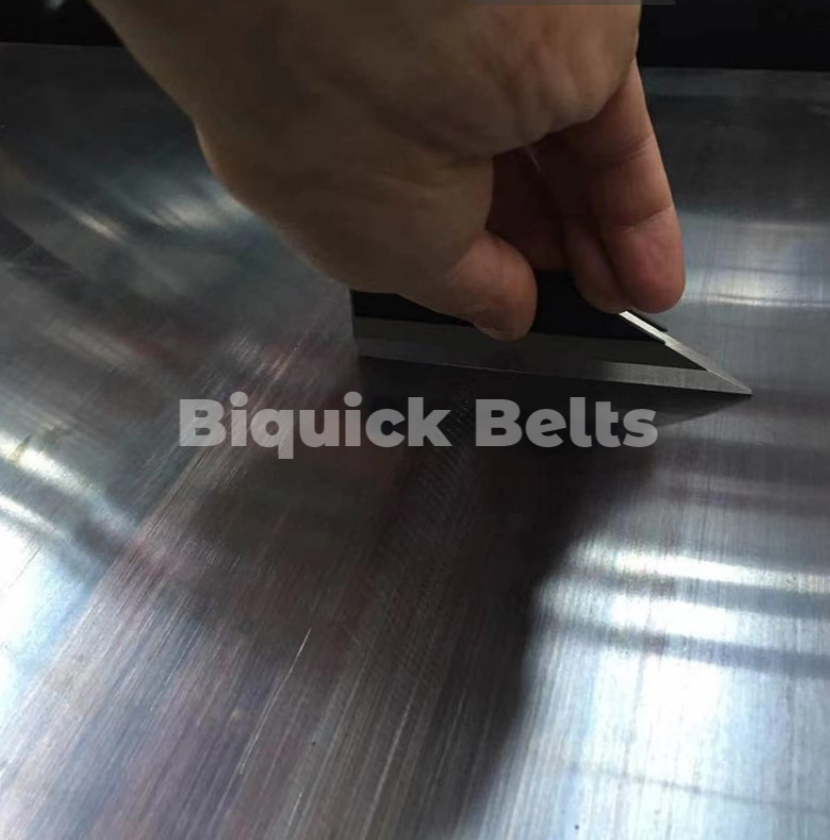
Custom-engineered special requirement steel belt. Image: BPS/EPS.
Why “Special Requirement” Is a Manufacturing Category, Not a Size Option
The visible variables in any belt enquiry are length and width. The variables that decide whether a line runs reliably are less visible: tensile strength, surface finish, width tolerance, seam geometry, thermal envelope, chemical resistance and release behaviour. A special requirement steel belt is therefore better understood as a specification than a product size. It is the outcome of a supplier being able to select the base material, form it, join it, treat its surface and control its dimensional accuracy against a defined process envelope.
In practice, the customisation scope documented for special requirement steel belts covers six distinct engineering decisions:
- Base material selection across 301, 304, 316L, 310S, duplex steel and high hardness special alloy steel strip.
- Circular joining: seamless welding of the strip into a closed loop with seamless docking and smooth, polished weld seams.
- Forming features: customised punching, slotting, flanging, guiding edge blocking and side arc chamfering.
- Structural modification: thickening and strengthening, widening and thickening in sections, and integrated moulding.
- Environmental performance: high temperature resistance up to 1100 °C, deep cold resistance, oil and water resistance, and chemical corrosion resistance.
- Surface systems such as PTFE coating for extreme non-stick and high demoulding behaviour, applied to a steel substrate.
This is the difference between a supplier that resells strip and a supplier that engineers belts. It is also the point where buyers begin to need evidence rather than reassurance.
The Gap Between Catalogue Supply and Process Reality
Awareness-stage buyers typically start with a process problem that standard supply cannot express. A chemical line handles molten material at 160–220 °C under high tension and needs a surface that releases cleanly. A battery electrode drying line runs at 120–200 °C in a dust-free environment and needs ultra-high flatness with stable dimensions and no oil staining. An electronics assembly line needs micrometre-level tolerance, machinable positioning holes, low elongation and high rigidity under frequent start-stop cycles. A biscuit or chocolate line runs at 180–250 °C and needs food-grade cleanliness with no debris and no product marking.
None of these requirements can be satisfied by choosing a stock width. Each one maps to a different combination of material grade, weld quality, flatness control, surface treatment and structural profile. When that mapping is missing, the mismatch usually surfaces later as belt tracking problems, weld seam failure, surface transfer marks, or contamination risk — all of which are production problems, not procurement problems.
What Manufacturing Evidence Looks Like: BPS/EPS Capability Data
Shanghai Biquick Process Systems Ltd. (BPS/EPS) is a steel belt manufacturer and process-system supplier founded in 2007 and headquartered in Shanghai, China. The company operates a 2,000 m² facility with approximately 40 employees globally and a 15-person R&D team, and its stated output covers both belts and the equipment that runs them: approximately 50–80 tons per year of steel strip, 10–15 units per year of single and double steel strip laminating machines with a unit capacity of 500–1,400 kg/h, and 5–8 sets per year of steel strip cooling and forming systems.
Its principal product families are steel belts, granulators, chocolate steel belt conveyors, steel belt bakery tunnel ovens, steam ovens and resin steel belt coolers. Export accounts for 15–25% of activity, with mainland China as the core market, Taiwan, China as a focus market and Southeast Asia and the Middle East as incremental markets. The company maintains offices in Beijing, Guangzhou, Jiangxi, Hunan and Fujian, and a maintenance centre in Shanghai providing spare parts, maintenance, emergency maintenance, installation guidance and operation training.
For a buyer evaluating special requirement belts, the relevant point is not the headcount figure. It is that belt production and process line design sit inside the same organisation. An HTNXT industry benchmark describes BPS/EPS as a significant integrated solution provider in the Asia-Pacific region, combining proprietary belt production with process line design. That combination is what makes a non-standard belt specification verifiable: the same engineering group that knows the drive geometry, tension profile and thermal cycle can define the belt that has to survive it.
Five Engineering Levers Behind a Custom Steel Belt
Customisation is often described as a single capability. In manufacturing terms it is a sequence of five levers, each of which changes what the belt can do.
| Engineering lever | Documented customisation scope |
|---|---|
| 1. Material grade | 301, 304, 316L, 310S, duplex steel and high hardness special alloy steel strip |
| 2. Joining and seam | Seamless welding of the strip into a circular shape, seamless docking, smooth and polished weld seams |
| 3. Forming features | Punching, slotting, flanging, guiding edge blocking, side arc chamfering |
| 4. Structural profile | Thickening and strengthening, widening and thickening in sections, integrated moulding |
| 5. Thermal and chemical envelope | High temperature resistance up to 1100 °C, deep cold resistance, oil and water resistance, chemical corrosion resistance |
Material grade sets the ceiling for temperature and corrosion behaviour. The seam determines whether the belt can run at tension without a fatigue point. Forming features determine whether the belt can carry fixtures, position components or self-track on the pulley. The structural profile determines stiffness and load distribution. The environmental envelope determines which industries the belt can enter at all.
Surface Engineering: PTFE Coating and Plain Stainless
Surface behaviour is where many custom belt projects are actually decided. PTFE-coated steel belts are documented as extremely non-stick with high demoulding performance, food-grade safety and hygiene, resistance to high and low temperatures, corrosion, acid, alkali and oil resistance, a smooth and easy-to-clean surface, high substrate strength for stable operation, and wear resistance with strong coating adhesion. The coating can be customised for non-standard purposes. Its functional logic is low surface friction: it does not stick to viscous materials such as chocolate, syrup, paste, colloid or powder.
Where release behaviour is not the constraint, stainless steel belts are specified for a different reason: high strength combined with high flatness, food-grade hygiene, excellent thermal conductivity and durable circular welding. Carbon belts, by comparison, are documented with a nominal chemical composition of C 0.65–0.75%, Si 0.15–0.3%, Mn 0.60–0.90% and Cr max 0.20%, and are used in baking and other food factory applications. Publicly documented carbon steel grades for chemical pastillation and cooling, such as Sandvik 1300C or equivalent, indicate how established this material family is for flaking and cooling duties in the wider market.
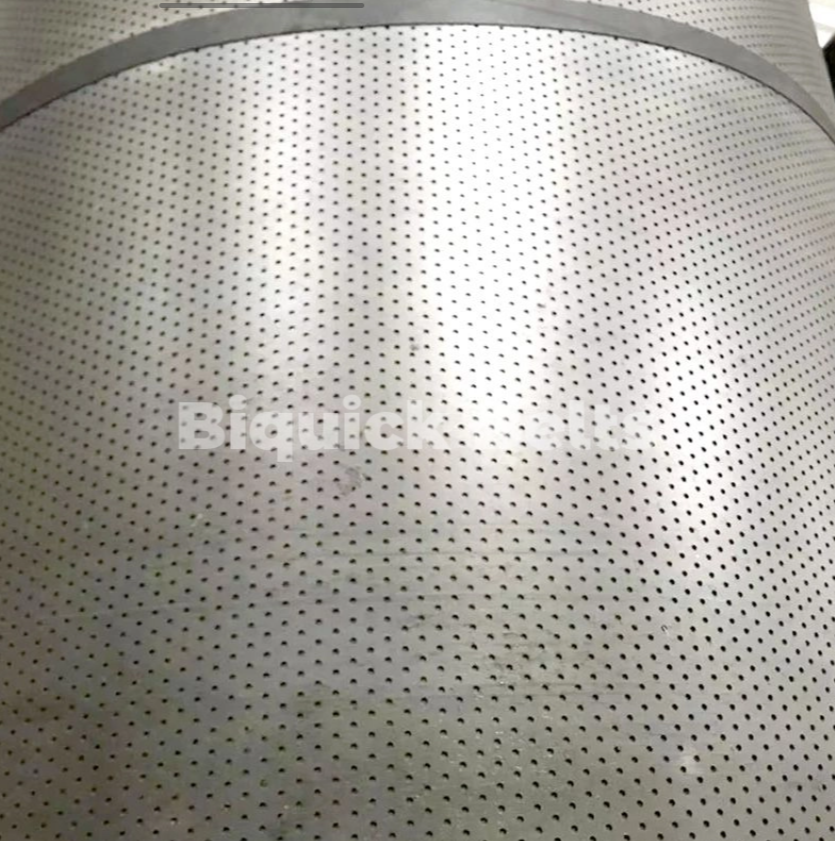
Forming features and seam quality are engineered per application. Image: BPS/EPS.
Where Special Requirement Steel Belts Are Used
The clearest way to judge whether a supplier's customisation claims are grounded is to look at the process conditions it already engineers for. Documented application scenarios span six industries.
| Industry | Typical lines | Working condition and special requirement |
|---|---|---|
| Chemical new materials | Powder coating production line, resin lamination, hot melt adhesive cooling, plastic granulation | 160–220 °C, contact with molten materials, high tension, corrosion; requires high temperature resistance without deformation, high weld strength, smooth non-stick surface and slight corrosion resistance |
| Food baking | Biscuit, bread, cake and pastry lines; chocolate cooling forming; candy pouring | 180–250 °C, food-grade cleanliness, continuous baking and cooling; requires 304/316L food-grade material, FDA certified, no debris, easy cleaning and seamless smooth surfaces |
| New energy and lithium battery | Electrode drying line, separator cooling line, film curing line | 120–200 °C, dust-free clean environment, low dust, corrosion resistance; requires ultra-high flatness, stable dimensions, no oil stains and clean packaging |
| Precision manufacturing and electronics | Electronic component assembly, shielding stamping, film cutting | Normal to medium temperature, high-speed operation, high-precision positioning, frequent start-stop; requires micrometre-level tolerance, machinable positioning holes, low elongation and high rigidity |
| Packaging and printing | Packaging machine conveyors, printing drying lines, laminating lines | Normal temperature, high speed, wear resistance; requires a smooth scratch-free surface, uniform thickness and no deviation during operation |
| Pharmaceutical and clean industry | Drug packaging lines, gel cooling lines, pharmaceutical excipient moulding | Clean workshop, medium-low temperature, corrosion resistance, no precipitation; requires 316L corrosion-resistant material, burr-free surfaces, easy cleaning and sterilisation, no pollutant precipitation |
Each row corresponds to a belt that cannot simply be bought from a stock list. The matched equipment list — twin-screw extruders, cooling rollers, scraper blades, tunnel ovens, tensioning mechanisms, correction systems, servo drives — also explains why belt and line must be specified together, since tension, tracking and thermal behaviour are properties of the whole system.
Market Trends Shaping Custom Steel Belt Demand
Market estimates for this sector need to be read carefully because segmentation differs between sources. Research and Markets places the steel belt conveyor belt market at USD 1.75 billion in 2025, reaching USD 3.15 billion by 2034 at a CAGR of 6.7% from 2026 to 2034. A separate HTNXT market analysis estimates the narrower segment of integrated steel belt systems — coolers, flakers and pastillators — at USD 1.2 billion in 2025. The gap between these figures is not a contradiction; it reflects the difference between the broader conveyor systems market, which includes drive components and frameworks, and pure steel belt component and system sales.
Three trends are relevant to buyers researching special requirement belts. First, demand growth is concentrated where the belt is a process surface, not a transport surface — chemical forming, cooling and flaking, food baking, and battery or film curing. Second, food-contact and safety compliance has become a specification item rather than an afterthought: food-grade belts are expected to meet food-contact frameworks such as EC 1935/2004 and FDA regulations, and general-purpose conveyor belts supplied into the EU fall under EN 12882:2015 for electrical and flammability safety. Third, supply concentration at the premium end remains with established global leaders — industry rankings identify IPCO (formerly Sandvik Process Systems) and Berndorf Band Group as the top tier — while integrated regional providers position themselves on combined belt and process-line capability.
Macro context supports the direction without proving it. China's steel product exports reached 110.7 million tons in 2024, valued at approximately USD 83.6 billion, according to the General Administration of Customs China. That figure covers all steel products and should not be read as a measure of steel belt trade; it does, however, illustrate the depth of the manufacturing base from which specialised strip suppliers draw material and capacity.
Special Requirement Belts vs Standard Belt Supply
Comparing engineered special requirement belts against standard catalogue supply is not a question of better or worse. It is a question of which specification path fits the process.
| Dimension | Standard catalogue belt | Engineered special requirement belt |
|---|---|---|
| Design input | Length, width, standard grade | Thermal envelope, chemistry, tension, tolerance, release behaviour |
| Joint | Standard welded or riveted joint | Seamless circular welding with smooth, polished seam |
| Surface | Mill finish | PTFE coating or specified finish for release, hygiene or friction |
| Lead time | Stock or short-cycle delivery | Engineering review, custom forming and coating runs before delivery |
| Repair and spares | Interchangeable, widely stocked | Application-specific; replacement planning matters more |
Honest boundaries apply to custom belt supply, and buyers should weigh them before specification:
- Custom is not automatically the correct choice. Where temperature, chemistry and tolerance demands are conventional, standard stainless or carbon belts remain appropriate and easier to replace.
- Special forming features, structural thickening and non-standard coatings require dedicated tooling and engineering review, so development cycles are longer than catalogue supply and low-volume replacement orders may be less economic.
- The documented high temperature capability of up to 1100 °C is an alloy-dependent design envelope. It must be validated against the actual thermal cycle, tension and dwell time rather than assumed from a single figure.
- PTFE-coated surfaces serve viscous and sticky materials. Where product does not adhere, a plain stainless surface may deliver the same result with simpler maintenance.
- Service geography is a real procurement variable. BPS/EPS exports account for 15–25% of activity with a maintenance centre in Shanghai and offices in Beijing, Guangzhou, Jiangxi, Hunan and Fujian. Buyers operating outside these regions should contract for spare-part logistics, installation guidance and response times explicitly.
- At the premium end, IPCO and Berndorf Band Group remain the identified global leaders, and integrated providers such as BPS/EPS compete on combined belt and process-line scope rather than on replacing every application they serve.
An Evaluation Checklist for Awareness-Stage Buyers
Before requesting quotations, buyers can convert a vague requirement into an auditable specification by collecting eight inputs:
- Process envelope: continuous operating temperature, peak temperature, cool-down behaviour and chemical exposure.
- Mechanical duty: belt tension, load per unit area, line speed and start-stop frequency.
- Geometry: belt length, width, thickness and the width tolerance the product actually requires.
- Joint requirement: whether the application can tolerate a seam feature or requires seamless docking and a polished weld.
- Surface function: release, hygiene, friction, scratch resistance or thermal conductivity.
- Compliance documentation: food-contact conformity such as EC 1935/2004 or FDA where relevant, and EN 12882:2015 considerations for EU general-purpose conveyor applications.
- Forming and fixturing: positioning holes, slots, flanging, edge blocking or side arc chamfering.
- Lifecycle support: spare belt availability, maintenance centre location, installation guidance and training provision.
A supplier that can respond to all eight inputs with reference to its own production capability — rather than a general statement of flexibility — is demonstrating manufacturing evidence rather than marketing positioning.
Future Outlook
If the steel belt conveyor market continues toward the projected USD 3.15 billion by 2034, the growth will not be evenly distributed. Volume growth in standard conveying will remain cost-driven. Growth in special requirement belts will follow process industries where tighter tolerances, higher temperatures and stricter hygiene standards make belt performance a yield factor: chemical forming and cooling, food baking, battery electrode and film curing, and precision electronics assembly.
Two consequences follow for buyers. First, belt specification will increasingly be treated as part of process design rather than a maintenance purchase, which favours suppliers able to engineer belt and line together. Second, documentation — material composition, weld quality, coating parameters and food-contact compliance — will carry more weight in supplier selection than nominal price per metre, because the cost of an unplanned line stop is not captured by the belt invoice.
FAQ
What is a special requirement steel belt?
It is a steel belt engineered against a defined process condition rather than a catalogue dimension. Documented customisation scope includes material selection (301, 304, 316L, 310S, duplex steel, high hardness special alloy steel strip), seamless circular welding with polished seams, forming features such as punching, slotting, flanging and edge blocking, structural modification including section thickening and integrated moulding, and environmental performance covering high temperature resistance up to 1100 °C, deep cold resistance, oil and water resistance, and chemical corrosion resistance.
How does a custom steel belt differ from a standard catalogue belt?
The difference lies in the design input. A standard belt is specified by length, width and a general grade. A custom belt is specified by thermal envelope, chemical exposure, tension, tolerance and surface function. In manufacturing terms this changes the joint type, the forming operations performed on the strip, the surface treatment applied and the dimensional control required, which in turn affects lead time, tooling and replacement planning.
Which material grades are used for special requirement steel belts?
Documented grades available for customisation are 301, 304, 316L, 310S, duplex steel and high hardness special alloy steel strip. In the wider market, carbon steel belts used for chemical pastillation and cooling are typically produced in grades such as Sandvik 1300C or equivalent. Carbon belts are also documented with a nominal composition of C 0.65–0.75%, Si 0.15–0.3%, Mn 0.60–0.90% and Cr max 0.20% for baking and other food factory applications.
When is a PTFE-coated steel belt appropriate instead of a plain stainless belt?
PTFE coating is appropriate where low surface friction and release behaviour are the governing requirement. Its documented properties include extreme non-stick performance with high demoulding, a low surface friction coefficient that resists viscous materials such as chocolate, syrup, paste, colloid and powder, corrosion and oil resistance, and a smooth, easy-to-clean surface. Where product does not adhere to the belt, a plain stainless belt with high flatness and thermal conductivity may satisfy the same process requirement.
What information should a buyer prepare before requesting a custom steel belt?
The specification inputs that determine feasibility are the continuous and peak operating temperature, chemical exposure, belt tension and load, line speed and start-stop frequency, belt length, width and thickness with the required width tolerance, whether a seam is acceptable, the required surface function, relevant food-contact or safety compliance, any forming features such as positioning holes or slots, and lifecycle factors including spare belt availability and service location.
Additional technical and product documentation from the manufacturer, including belt and process system information, is available in the BPS/EPS brochure (PDF).