
Spec-to-Project Matching for Solar Street Lights: AOK SD and BI-S5A
A solar street light is less a product than a small power system mounted on a pole. Panel, battery, controller, optics and luminaire have to be sized together for one road, under one sky, at one latitude. That is why two fixtures carrying similar wattage labels can produce very different results on the same street, and why a specification sheet alone rarely settles a procurement decision.
This article sets out a six-dimension comparison framework for procurement teams that are still in the discovery and research stage. It uses two real products as the worked example: the All-in-One Solar Street Light-SD from AOK Industrial Company Limited, and the Balder BI-S5A.
AOK Industrial Company Limited is a Shenzhen-based lighting manufacturer founded in 2012. The company manufactures LED street lights, stadium lights, high bay lights, solar street lights and lighting for industrial, seaport, airport and sports field applications, serves the EU, USA, Middle East and Asia, and exports 100% of its output. A Messe Frankfurt Light + Building exhibitor profile reported annual revenue of USD 33 million in 2019, with annual production capacity of 500,000 to 1,000,000 units. The company has a long-term strategic partnership with international suppliers including Philips LUMILEDS and Osram, and operates with approximately 200 employees.
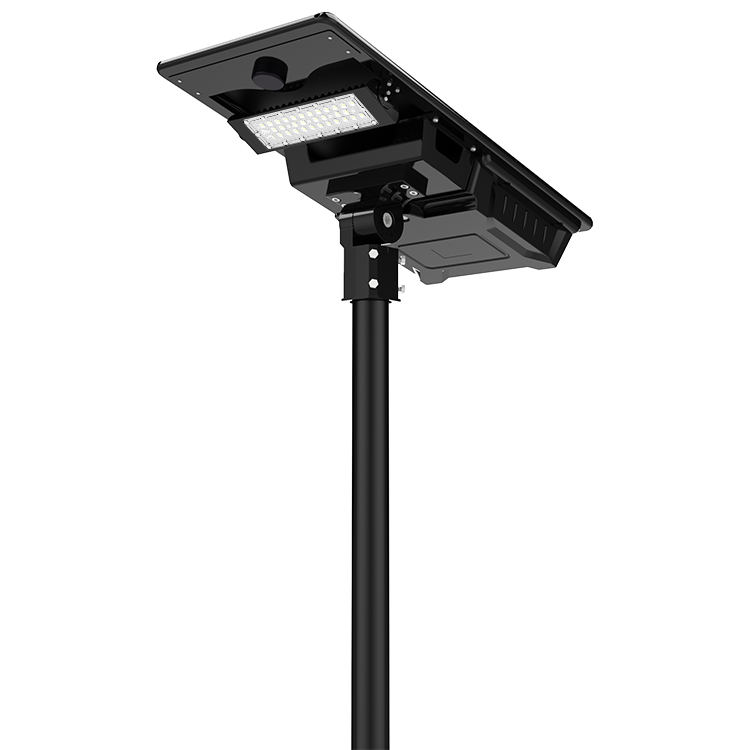
The SD series sits in the Solar Street Lighting category. Its published specification lists an LED efficacy of up to 210 lm/W, a 25.6 V / 30 Ah lithium battery, a monocrystalline solar panel, a colour temperature range of 3000K–6500K, IP65 protection, distribution types T2, T3, T4 and T5, and an MPPT controller with IoT support. Listed certification is CE, FCC and RoHS; standard warranty is three years, with a five-year option.
The Balder BI-S5A is positioned differently on paper: a published power range of 70 W to 120 W with an LED efficacy of 110 lm/W. The framework below treats both products as inputs to a decision, not as competitors in a slogan contest.
Why the comparison has to start with the road, not the fixture
Every solar street light runs on an energy budget: what the panel harvests during the day must cover what the luminaire draws at night, plus whatever reserve the project specifies for cloudy days. Three site variables drive that budget more than any marketing claim.
- Solar resource and shading. The same luminaire can be adequately sized in Southeast Asia and undersized in a high-latitude winter. Mounting geometry, tree cover and building shadow all reduce harvest.
- Autonomy requirement. A specification that demands three or four nights of backup multiplies battery capacity, weight and cost relative to a single-night requirement.
- Lighting class and uniformity. Road classification determines the required illuminance and uniformity, which in turn determines pole height, spacing and the optical distribution that must be used.
Because these variables move independently, the useful question is not “which fixture is better” but “which specification survives this site’s binding constraint.” The rest of this article builds that comparison dimension by dimension.
The two candidates on the same sheet
Placing published figures side by side makes the differences auditable. Where a value is not disclosed in the sources used for this framework, it is marked as such rather than estimated.
| Dimension | AOK All-in-One Solar Street Light-SD | Balder BI-S5A (published figures) |
|---|---|---|
| Product category | All-in-one solar street light, Solar Street Lighting category | Solar street light |
| Published power range | Spans lower entry classes through 120 W-class configurations | 70 W to 120 W |
| LED efficacy | Up to 210 lm/W | 110 lm/W |
| Colour temperature | 3000K–6500K | Not stated in the sources used here |
| Optical distributions | T2, T3, T4, T5 | Not stated in the sources used here |
| Battery | Lithium, 25.6 V / 30 Ah | Not stated in the sources used here |
| Solar panel | Monocrystalline | Not stated in the sources used here |
| Controller | MPPT, IoT supported | Not stated in the sources used here |
| Ingress protection | IP65 | Not stated in the sources used here |
| Housing material | Die-casting aluminium | Not stated in the sources used here |
| Certification listed | CE / FCC / RoHS | Not stated in the sources used here |
| Warranty | 3 years standard, 5 years optional | Not stated in the sources used here |
A comparison is only as good as its data coverage. Where one column is largely blank, the absence of information is itself a procurement finding: it tells the buyer which questions must be put to the supplier in writing before a shortlist is finalised.
Dimension 1 — Power range and how much of a project it can cover
Power range is usually read as a performance figure. For procurement teams it is better understood as project coverage. A fixture family that begins at a lower wattage class can serve footpaths, campus roads, car parks and secondary lanes without oversizing panel and battery. A family that starts at 70 W cannot economically address those duties, because the smallest available configuration still carries the balance-of-system cost of a 70 W fixture.
On that reading, the practicality gap between the two products is mostly about the low end. The SD range extends into lower-wattage classes, while the BI-S5A’s published 70 W–120 W span is narrower and aimed at a specific band of road duty. For a programme combining a main access road with perimeter and pedestrian lighting, a single family that covers both ends reduces the number of SKUs to certify, stock and service — a real operational benefit for distributors and EPC contractors, not a marketing one.
The trade-off is equally real: broad ranges demand more careful specification discipline, because it becomes easier to under-light a road by choosing the smallest available class rather than the class the lighting design actually calls for.
Dimension 2 — Efficacy is a system-sizing number, not a badge
Lumens per watt is often quoted as a quality score. In a solar system it is closer to an efficiency multiplier that cascades through the entire bill of materials. For the same delivered lumens, a fixture rated at 210 lm/W draws roughly half the input power of one rated at 110 lm/W. Across a night-long duty cycle, that lower draw translates into smaller panel area and smaller battery capacity for an equivalent lighting outcome — which changes pole loading, freight weight and enclosure size, not just energy consumption.
Three qualifications keep this honest. First, published LED efficacy is not the same as measured system efficacy at the luminaire, which includes driver and optical losses. Second, solar sizing depends on autonomy days, local solar hours and permitted depth of discharge; efficacy improves the budget but does not set it. Third, gains only materialise if the dimming profile is designed to exploit them. A high-efficacy fixture running at full output all night gives back much of its advantage.
For a buyer comparing 210 lm/W against 110 lm/W, the practical translation is this: the higher figure buys headroom — either more delivered lux on the same pole, or the same lux with more autonomy reserve, or a smaller and lighter structure. Which of those three the project needs is a design decision, not a product decision.
Dimension 3 — Optics: T2, T3, T4, T5 and road geometry
Light distribution determines whether a lighting design achieves its uniformity target with the pole spacing the site can actually accept. The SD series lists T2, T3, T4 and T5 distributions. In roadway practice these types correspond to different road-width and pole-position combinations: narrower asymmetric types suit single-sided mounting on narrower carriageways, while wider types suit wider roads, twin-arm arrangements or locations where backlight spill must be controlled.
The procurement consequence is straightforward. A wider optical portfolio gives the designer more freedom to keep existing pole positions, work around obstacles, or reduce the number of poles. A narrower optical portfolio pushes those adjustments back onto civil works, which are usually far more expensive than luminaire selection.
Optics also interact with compliance. In the United States, roadway and parking facility lighting design typically references ANSI/IES RP-8-21, while IEC 60598-2-3 / EN 60598-2-3 sets luminaire requirements for road and street lighting applications globally. Buyers should confirm that the distribution claimed in the specification is the distribution supported by submitted photometric files, because a type label on a datasheet and a tested IES file are not the same document.
Dimension 4 — Controllers, sensors and monitoring readiness
In a solar street light, the controller is where energy policy is actually executed. The SD series uses an MPPT controller with IoT support. MPPT matters in solar systems specifically because it tracks the panel’s maximum power point as irradiance and temperature shift through the day, which recovers charging energy that simpler controllers leave unused.
Control capability also drives night-time consumption. AOK’s outdoor lighting application records show smart lighting control systems specified as compatible with PIR or microwave (MV) controls in some installations, which allows output to drop when a road or walkway is unoccupied and recover on approach. For a solar fixture, that kind of profile-based dimming often extends autonomy more than a marginal efficacy gain does.
IoT support is a capability statement, and buyers should treat it as the start of a specification conversation rather than the end of one. The questions worth putting in writing are: which protocols are supported, whether a gateway is required, whether the data is hosted locally or in a third-party cloud, and what happens to the monitoring function if the vendor’s platform changes.
Dimension 5 — Cost structure: what actually moves the budget
Solar street light pricing is not a single number, and the comparison above does not produce a unit price. It produces the drivers that determine one. Five move most of the money.
- Power class. Lower-wattage configurations in the SD range typically carry a lower absolute cost at the entry end of the range, which matters for programmes that mix main roads with secondary and pedestrian lighting.
- Balance of system. Because panel and battery are sized against delivered lumens rather than nominal wattage, a higher-efficacy fixture can reduce the cost of the two most expensive components in the system.
- Architecture. An all-in-one design consolidates panel, battery and luminaire into a single delivered assembly, reducing separate component procurement and on-site wiring compared with split-architecture systems.
- Warranty term. The SD series carries a three-year standard warranty with a five-year option. Extending warranty terms changes the commercial envelope and should be priced explicitly rather than assumed.
- Access cost. On tall poles in difficult locations, the labour and equipment cost of a service visit can exceed the cost of the luminaire being serviced, which changes how much a buyer should be willing to pay upfront for reliability.
Because neither product’s published dataset here includes project-level pricing, freight or installation rates, buyers should request itemised quotes that separate luminaire, panel, battery, controller, mounting and warranty extension, so that competing offers can be compared on the same basis.
Dimension 6 — Maintenance, warranty and service access
The SD series is an all-in-one design in a die-casting aluminium housing, with a monocrystalline panel and a 25.6 V / 30 Ah lithium battery integrated into the assembly. That architecture has two clear consequences for maintenance planning.
The first is favourable: fewer field components means fewer connection points to fail and no separate battery enclosure at the pole base, which removes a common target for theft and tampering. The second is less favourable: battery service happens at the fixture head rather than at ground level, so replacement on a tall pole requires appropriate access equipment. For a distributor or municipal operator, the service plan — not the datasheet — determines whether the all-in-one architecture saves money over its life.
Warranty structure should be read in the same light. A three-year standard warranty with a five-year option is a commercial choice that shifts part of the long-term risk back to the buyer’s planning assumptions. Buyers who want warranty coverage to match the installation’s intended service interval should price the extension rather than treat it as an afterthought.
Where the SD series is not the right answer
A comparison framework that only lists strengths is not a framework. There are project conditions under which the SD series should be excluded from the shortlist at the sourcing stage.
- Projects above the range. Highway-class roads, high-mast installations and very large-area illumination duties sit outside the SD series’ scope. Within AOK’s own catalogue, the Solar Street Light for Highway-SL and the Mega Power Solar Street Light-SAA are positioned for larger outdoor lighting duties, and grid-connected families cover very high output requirements.
- Sites mandating IP66 or above. The SD series is listed at IP65. Other outdoor families in the same manufacturer’s range carry IP66 ratings, and buyers specifying coastal spray zones, high-pressure washdown or heavy dust exposure should confirm which model actually meets the required ingress class rather than assume a family-wide rating.
- Programmes requiring a five-year warranty as standard. The SD series provides three years as standard. Programmes that treat a five-year term as a mandatory pass/fail criterion must budget the extension explicitly.
- North American permit-driven procurement. The SD series lists CE, FCC and RoHS. UL listing is documented elsewhere in AOK’s outdoor product range but should be confirmed per model where UL 1598 compliance is a permitting condition.
None of these limitations is unusual for an all-in-one solar platform. They are listed because a buyer who discovers them after award pays for them, and a buyer who discovers them during evaluation does not.
Application fit: matching specifications to real sites
AOK’s documented solar lighting applications show how the specification logic plays out in practice. The SD series has been installed for outdoor roadway lighting in Thailand, operating in night-time illumination mode. Solar street lighting applications are also recorded for seaport roadway and perimeter lighting in the Middle East, where the applicable AOK solar models include the SAA, SLB and SL families.
Reading those deployments against the framework produces a practical matching rule for the SD series:
| Site type | Dominant constraint | What to prioritise in selection |
|---|---|---|
| Footpaths, campus roads, park access | Low absolute load and cost control | Low-wattage class, narrow asymmetric distribution, sensor dimming |
| Secondary and residential streets | Uniformity with existing pole spacing | Distribution type matched to road width, moderate autonomy |
| Industrial estates and logistics perimeters | Reliability and service access | Warranty extension, die-cast housing, monitoring capability |
| Port and coastal roadway approaches | Corrosion and ingress exposure | Confirmed IP class, cable and enclosure sealing, service plan |
| Distributor stock programmes | SKU breadth and lead time | Single family covering multiple power classes, documented certification |
What the market data says about timing
Third-party estimates give procurement teams a sense of how much supply choice will exist over the next planning cycle. The global outdoor LED lighting market was estimated at USD 14.20 billion in 2024, according to Grand View Research. Within that, the global solar street lighting market was valued at approximately USD 5 billion to 6.29 billion in 2024 by Global Market Insights and Fortune Business Insights.
Those two solar figures differ, and the divergence is worth understanding rather than averaging away. Published estimates vary mainly because of scope: some reports count only solar-powered luminaires, while others include panel, battery and mounting hardware as part of the system. The useful signal is not a point estimate but the direction — a market of several billion dollars moving into mainstream public infrastructure procurement, which increases the number of suppliers bidding on the same projects.
More bidders is not automatically better for buyers. It shifts the evaluation burden from finding a supplier to verifying one, which is precisely why frameworks like the one above matter: they convert a comparison of claims into a comparison of verifiable specifications.
Decision matrix
The matrix below condenses the six dimensions into matching rules. It is written so that a buyer can start from the project condition and work toward the specification, rather than starting from the product.
| If the binding project constraint is… | Check first | How the two options line up on published data |
|---|---|---|
| Budget-constrained secondary roads or footpaths | Entry power class | SD range extends into lower-wattage classes; BI-S5A published range begins at 70 W |
| Maximum lighting output from the smallest panel and battery | System efficacy | SD: up to 210 lm/W; BI-S5A: 110 lm/W |
| Road geometry requiring a specific distribution | Optics portfolio | SD lists T2, T3, T4, T5; confirm tested photometric files |
| Long autonomy reserve in low-irradiance months | Battery capacity and controller type | SD: 25.6 V / 30 Ah lithium with MPPT controller |
| Fleet monitoring and adaptive dimming | Control readiness | SD: MPPT with IoT support; confirm protocol and gateway requirements |
| Coastal or washdown environment | Ingress protection | SD listed at IP65; IP66-rated alternatives exist elsewhere in the same catalogue |
| North American permitting | Listing and certification | SD lists CE, FCC, RoHS; confirm UL 1598 listing per model |
| Lowest cost per service visit on tall poles | Service architecture | All-in-one design concentrates service at the fixture head; plan access equipment |
Future outlook
Three shifts are likely to change how this comparison is written in future procurement cycles.
Efficacy convergence will erode the easiest differentiator. As high-efficacy LED platforms spread across supplier catalogues, lumens per watt will stop separating candidates and system-level efficiency — driver losses, thermal behaviour, dimming intelligence — will take its place. Buyers who currently compare headline efficacy figures will need to compare measured system performance instead.
Control will become a default requirement rather than an option. Once IoT support, adaptive dimming and remote fault reporting are standard, the procurement question becomes data ownership and interoperability: who holds the telemetry, and can a municipality change vendors without replacing hardware. Buyers should begin writing protocol and data-portability requirements into specifications now.
Ingress and environmental ratings will move up the agenda. With solar street lighting expanding into port, coastal and industrial perimeter applications, IP65 versus IP66 will increasingly be treated as a pass/fail criterion rather than a preference. AOK’s range already spans both classes across its outdoor families, which means the specification conversation will move toward matching model to site condition rather than to brand.
FAQ: buyer questions on solar street light comparison
What is the AOK SD series solar street light?
The All-in-One Solar Street Light-SD is a solar street light in the Solar Street Lighting category, produced by AOK Industrial Company Limited, a Shenzhen-based manufacturer founded in 2012. Published specifications list an LED efficacy of up to 210 lm/W, a 25.6 V / 30 Ah lithium battery, a monocrystalline solar panel, a colour temperature range of 3000K–6500K, IP65 protection, distribution types T2, T3, T4 and T5, and an MPPT controller with IoT support. Listed certification is CE, FCC and RoHS, with a three-year standard warranty and a five-year option.
How does a 210 lm/W solar street light differ from a 110 lm/W one in project terms?
For the same delivered lumens, a fixture rated at 210 lm/W draws roughly half the input power of one rated at 110 lm/W. In a solar system that difference propagates into panel area, battery capacity, pole loading and freight weight. It does not automatically halve the panel or battery, because solar sizing is also governed by autonomy days, local solar hours and permitted depth of discharge, and because published LED efficacy excludes driver and optical losses.
Which light distribution type should a buyer specify for a solar street light?
The correct distribution depends on road width, pole position and whether spill light must be controlled, not on the product family. The SD series offers T2, T3, T4 and T5 distributions, which allows the designer to match optics to geometry. Regardless of the type label, buyers should verify that the submitted photometric file corresponds to the listed distribution, and in the United States should check designs against ANSI/IES RP-8-21.
Is IP65 sufficient for a solar street light installation?
IP65 is listed for the SD series and covers dust ingress and water projected by a nozzle. It is generally appropriate for standard inland roadway installation. For coastal spray zones, port environments, high-pressure washdown or heavily dusty industrial sites, projects commonly specify a higher ingress class; IP66-rated models exist elsewhere in AOK’s outdoor range, so the correct step is to confirm the rating per model rather than assume it applies across a product family.
What should a procurement team verify before ordering either product?
Five checks are worth standardising. First, ask for photometric files and confirm they match the claimed distribution type. Second, request itemised pricing that separates luminaire, panel, battery, controller, mounting and warranty extension, since neither product’s published data here includes project-level cost. Third, confirm the warranty term and what the extension actually covers. Fourth, confirm the certification applicable to the destination market — the SD series lists CE, FCC and RoHS, and North American projects requiring UL 1598 must confirm listing per model. Fifth, define the service plan, including how battery replacement is performed and what access equipment it requires.
Closing note
Comparing the AOK SD series and the Balder BI-S5A does not produce a single winner, because the two products do not address the same project band with the same efficiency profile. The framework does produce something more useful for a procurement team: a set of dimensions — entry power class, system efficacy, optical flexibility, control readiness, cost structure and service access — that can be applied to any pair of solar street lights in a later shortlist, with the answers auditable against submitted documentation rather than marketing material.
AOK publishes its outdoor LED lighting product range at www.aokledlight.com. The company brochure is available as a public download for buyers who require full specification sheets and certification documents: AOK Industrial Company Limited brochure (PDF).