
Sourcing for the Long Term: Evaluating Durability in Shelter Suppliers
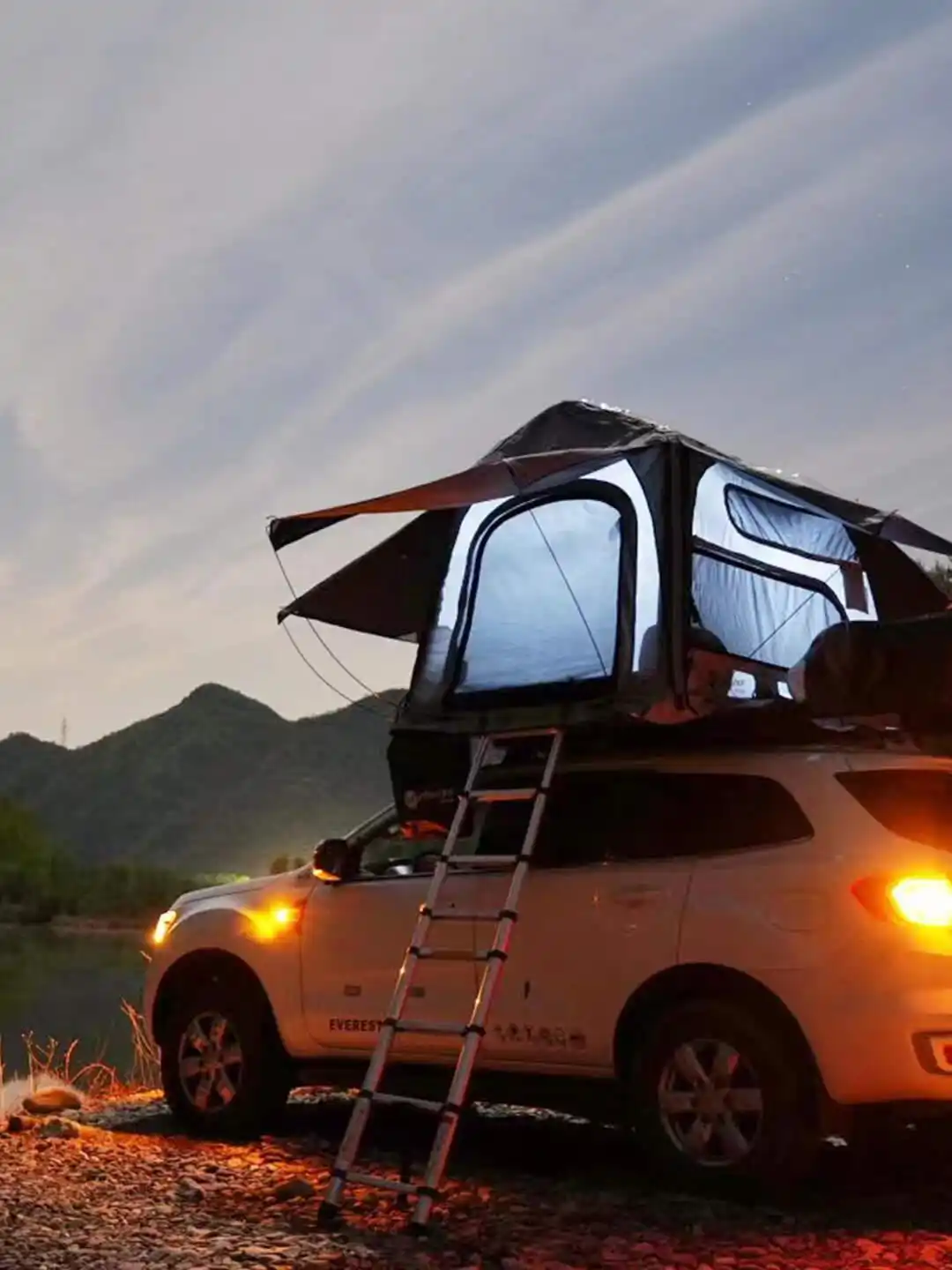
Custom outdoor shelters are specified for continuous exposure. Durability evidence, not the quality of a first sample, is what supports a multi-season supply relationship.
For most sourcing teams, the first shelter order is the easy decision. The difficult one is the third: whether the supplier that delivered an approved sample still produces the same material, the same welded joint and the same inspection record two seasons later.
Durability in custom outdoor products is therefore not only a product property. It is also a supplier property, and it has to be evaluated as one. This article sets out an evaluation framework for buyers working through the research and evaluation stage of a shelter program. It uses two products from StarCanopy's range — the anti-UV construction of the CS-01 Inflatable Container Shelter and the waterproof composition of the BS-01 Boat Shelter — as worked examples of how product evidence should be read when the objective is a long-term supply relationship rather than a single shipment.
StarCanopy, registered as Zhuhai Star Canopy Co., Ltd., is a French-owned and managed multi-material manufacturing facility established in 2005 in Zhuhai, China. It produces custom outdoor hardware, sewn technical textiles and inflatable products for buyers in the EU, USA, Canada, Japan, Australia and New Zealand, and exports 100% of its output.
The Real Risk in Shelter Sourcing: Sample Quality Is Not Supply Quality
A custom shelter program rarely fails on the first unit. It fails when a specification quietly changes between reorders, when a printed surface fades long before the structure wears out, or when a cover that survived a humid summer begins to seep water in its second winter. None of these failures are visible in a sample review. They appear only after a supplier has been asked to reproduce the same product several times under the same conditions.
That is why durability belongs inside supplier evaluation rather than in product marketing. Custom outdoor shelters — event shelters, vehicle shelters, boat shelters, inflatable container shelters and their supporting hardware — are usually specified for extended exposure rather than occasional use. Several scenarios recorded in StarCanopy's project data operate on a continuous 24/7 basis, in outdoor conditions with strong UV radiation and, in some cases, high temperature and a temporary open-air layout.
The commercial logic follows the same direction. A buyer who validates a supplier once and then reorders for several seasons avoids re-qualification costs, re-testing and the risk of discovering a material change mid-season. A buyer who selects purely on the first quotation absorbs those costs later, usually at the least convenient moment.
Durability as a Three-Layer Evaluation Model
Durability treated as a single attribute usually ends in a comparison of adjectives. A more workable model separates it into three layers, each of which can be examined against evidence rather than assertion.
- Material resistance — whether the fabric, film or coating retains its performance under UV, water, humidity and abrasion. This is the layer in which anti-UV treatment and waterproof composition are decided.
- Construction integrity — whether welded or sewn joints, frames, poles and connecting components survive repeated assembly, transport and continuous outdoor loading.
- Supplier continuity — whether the same inputs and the same process controls are still in place when the next order is placed.
| Layer | What it decides | Evidence a buyer can request |
|---|---|---|
| Material resistance | Whether fabric, film and coating survive UV, water, humidity and abrasion over the intended service cycle | Stated material composition per build, for example TPU and PVC film with anti-UV treatment on the CS-01, or waterproof polyester or PVC fabric on the BS-01 |
| Construction integrity | Whether joints, seams, hardware and connections hold under repeated set-up and continuous exposure | Welding and sewing control, hardware surface treatment such as anti-rust aluminium finishing, injected aluminium connection parts |
| Supplier continuity | Whether the approved specification can actually be reproduced at reorder | Pre-shipment inspection scope, stated monthly capacity, lead time and minimum order quantity |
A supplier can be strong in one layer and weak in another. A facility with excellent fabric sourcing but no documented pre-shipment inspection routine will eventually ship an inconsistent batch. A facility with a rigorous inspection routine but a limited production window may not be able to repeat a specification on the buyer's schedule. The evaluation question is therefore not which supplier is best in general, but which supplier can hold a specification across the planned relationship.
Product Evidence: Anti-UV in the CS-01 and Waterproof Composition in the BS-01
Two products in the StarCanopy range show how a stated feature can be converted into a durability question with a verifiable answer.
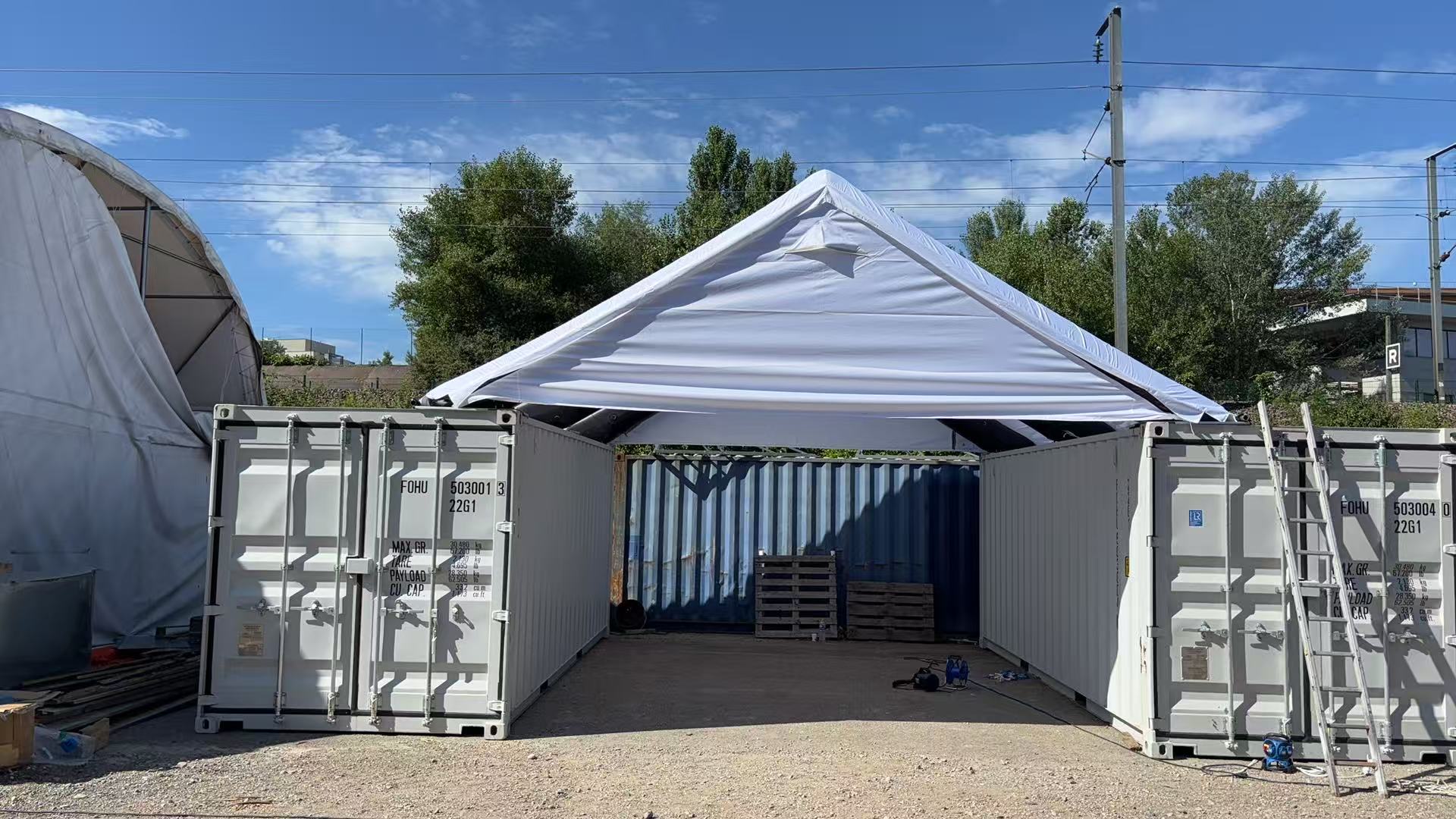
The CS-01 Inflatable Container Shelter is built from TPU and PVC film with anti-UV treatment and is sized fully to the project.
CS-01 Inflatable Container Shelter: anti-UV as an exposure decision
The CS-01 is an inflatable shelter made from TPU and PVC film, fully customized in size, and described as an anti-UV, removable and inflatable shelter installed between two shipping containers. Its stated application areas are transportation, events and temporary shelter.
For a buyer, the anti-UV treatment addresses the failure mode that tends to end the service life of inflatable structures first. A shelter erected between two containers is normally left standing through a full season of direct sun, which means the outer film is loaded by ultraviolet radiation while also holding internal air pressure. UV degradation typically appears as surface chalking, colour loss and reduced tensile strength well before the structure fails physically.
The recorded field evidence for this model comes from a French inflatable product OEM that ordered two units for a temporary activity and work shelter built in the gap between two shipping containers, used for logistics on-site staff rest, goods sorting and outdoor commercial events. The reported outcome after one year of operation is stable operation, with the highlight that the structure is flexible and portable enough to hold activities. That is directional field evidence rather than an accelerated ageing result, and it should be read as such.
BS-01 Boat Shelter: waterproof composition as a specification baseline
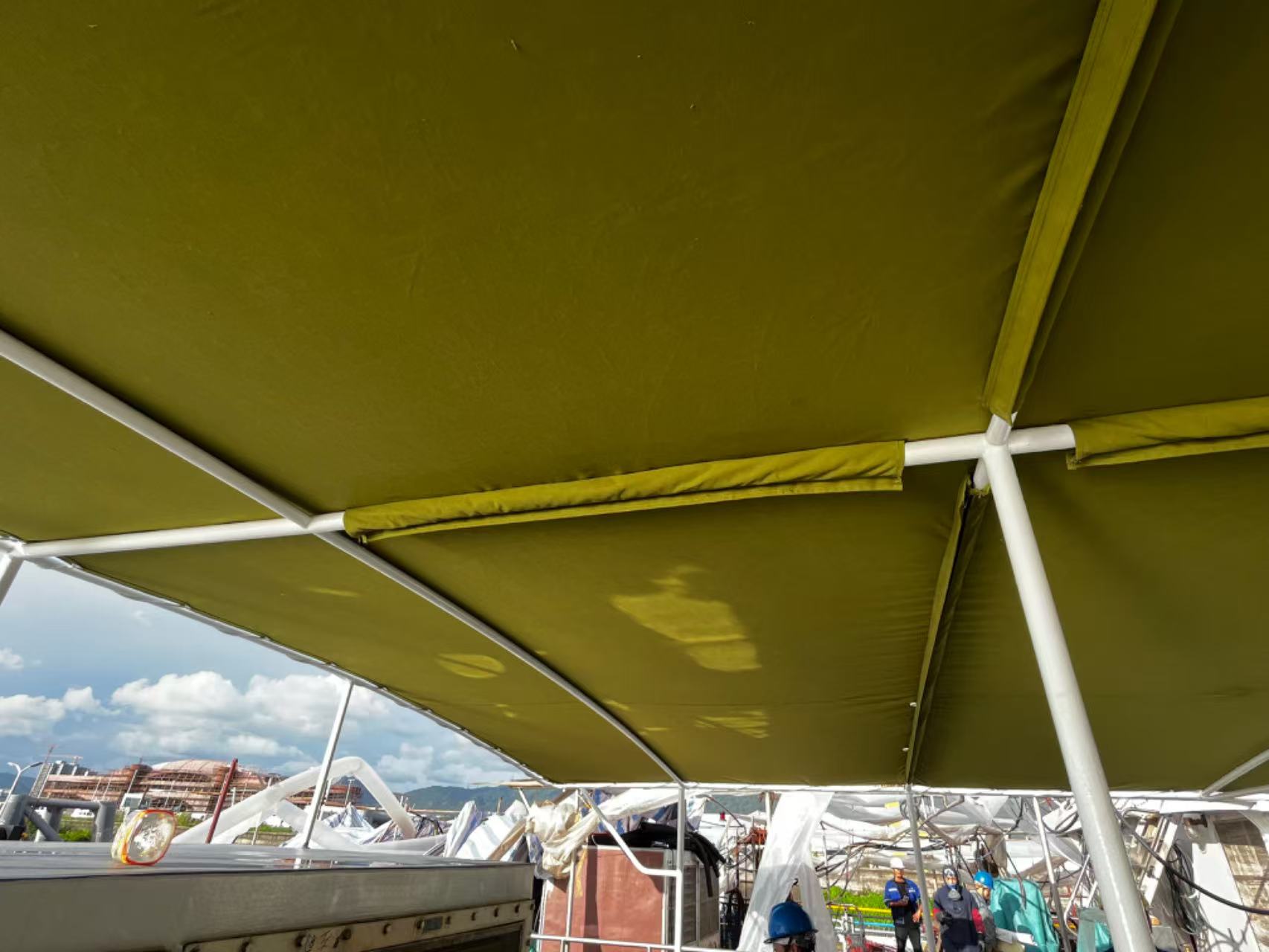
The BS-01 Boat Shelter is produced from waterproof polyester or PVC fabric with fully customized dimensions.
The BS-01 Boat Shelter is produced from waterproof polyester or PVC fabric, with fully customized dimensions. Its recorded performance context is a boat shelter cover project for a client in China: ten units used as a roof to cover the boat shelter, with a reported result of good waterproof and anti-aging performance under humid waterfront conditions and no tearing or water seepage within the service cycle. The features recorded for that program include full custom size and shape together with anti-UV, anti-mold, waterproof and tear-resistant construction.
The durability lesson here is about specification continuity as much as about a single property. A waterfront cover faces humidity, salt-laden air and sun simultaneously, so waterproofing on its own is not sufficient: anti-mold and anti-aging behaviour determine whether the cover still performs in its second season. For a long-term relationship, the decisive question is whether buyer and supplier have frozen a written specification — fabric type, coating and treatment — that can be reproduced at reorder. Without that baseline, durability cannot be verified after the fact; it can only be claimed.
Supporting evidence from adjacent sewn-goods programs
Longer-running field records exist in StarCanopy's adjacent sewn-goods programs. An outdoor umbrella program for a French OEM, model UM-01 with aluminium and waterproof polyester fabric, covered 500 pieces and is recorded as working well under all-season outdoor use, with zero mass quality complaints within two years and a highlight of easy set-up and resistance to breakage. A folding outdoor chair program, model C01 with an aluminium frame, injected aluminium connection parts and anti-UV PU fabric on the back and seat, covered 1,000 pieces and reports the same two-year outcome under all-season outdoor use, with a highlight of portability and resistance to breakage. Because these are different product families, they are not shelter durability data; they do show how the same sewn-goods process performs when it is measured over years rather than weeks.
How Ongoing Quality Is Produced: Inside a Multi-Material Facility
Durability claims are only as reliable as the process behind them. StarCanopy, established in 2005 in Zhuhai, China, operates as a French-owned and managed facility with three production capabilities under one roof: hardware covering metal parts, mechanical assemblies and custom components; sewn goods and technical textiles covering soft goods, covers, bags and outdoor and sports equipment; and inflatables covering advertising structures, promotional products and sports and event equipment.
That multi-material structure is relevant to shelter durability because the weak points in a shelter are usually interfaces — where a welded film meets a frame, where a cover meets a pole, where a printed surface meets a load-bearing panel. Under OEM production, the facility works from client samples, drawings, specifications and production requirements. Fabric capabilities cover custom fabric development, custom printing, sewing, and PVC and TPU film processing; metal capabilities cover cutting, bending, drilling, welding, various surface treatments and final assembly. The stated minimum order quantity for OEM work is one unit, with a lead time of one to two weeks for small quantities.
Under ODM production, the client provides the product concept, the application scenario and the performance standards, and the manufacturer completes engineering design, material development, pattern making, lab testing, prototyping and mass production delivery. ODM lead time is stated as 7 to 30 days, and the minimum order quantity is described as customizable to customer needs.
In both modes, one step connects most directly to long-term durability: 100% full inspection before shipment, covering air tightness, material tensile test, size verification and appearance check. Stated monthly capacity is 1,000 pieces or units, export markets are the EU, USA and Canada in the capability records, and after-sales support is provided remotely. The company maintains an R&D team of four people.
Where Custom Shelters Are Actually Tested: Four Application Scenarios
1. Outdoor vehicle camping and storage (Spain)
A recorded project in Spain uses the CT-01 car shelter, made from polyester fabric with customized dimensions, in the RV camping and outdoor vehicle storage sector. The working conditions are outdoor use with strong UV radiation, and the operating mode is continuous 24/7. The function is a fabric shelter on the car for camping, matched to an RV, sedan, racing vehicle or off-road car. One requirement is assigned explicitly to the buyer: the client prepares the car.
The durability implication is that continuous exposure combined with repeated mounting and demounting places the load on both the fabric and the attachment design. Vehicle-side preparation belongs to the durability system, because a shelter is only as stable as what it is fixed to.
2. Advertising and event bases (United States, Canada)
The second recorded scenario covers advertisement use in the United States and Canada: an outdoor event venue with strong UV radiation, high temperature and a temporary open-air layout, operating 24/7. The matched products are the ST-01 outdoor shelter, built from PU-coated waterproof polyester fabric on an aluminium or steel frame, and the ITC01 inflatable cube in TPU and PVC. Supporting equipment includes peg and rope, water bag, sand bag and lighting, and the special requirement is full-colour digital custom printing on the surface for brand logo and graphics.
Here the durability question is about the printed surface, which ages at a different rate from the base fabric. A buyer evaluating a supplier across several event seasons should confirm how the print specification relates to the same UV exposure the structure is engineered for.
3. Outdoor sport and racing (United States, Canada, France)
A third scenario covers outdoor sport in a racing context across the United States, Canada and France, again in an outdoor event venue with strong UV, high temperature and temporary open-air layout, supported by peg and rope, water bag, sand bag and lighting, and requiring printing. The matched products are the ST-01 outdoor shelter, the I-FB inflatable football goal in TPU and PVC fabric, and the C01 folding outdoor chair in aluminium with anti-UV PU fabric, foam back and seat, and a strong PVC bag.
Because these items are transported, assembled and dismantled repeatedly, durability is decided less by static strength than by connector and fabric resilience across cycles.
4. Camping and leisure fixing systems (France)
The CPPlK caravan pole is produced from aluminium and plastic at a 2 m length, with anti-rust aluminium surface treatment, customizable length and compatibility with most RV and camping tent frames. It is used alongside the ST-01 outdoor shelter in outdoor camping and leisure settings — open-air gardens and public parks with strong UV, wind and rain exposure across all seasons, on a continuous 24/7 mode. For fixing hardware, corrosion resistance and fit compatibility are the two variables that determine whether a system can be reordered without redesign.
Market Signals Behind Long-Term Sourcing
Three published data points frame the demand context, each with its own scope and each best read separately rather than combined.
- Global recreational and outdoor products: valued at USD 144.5 billion in 2025, projected to reach USD 152 billion in 2026, at a 5.9% CAGR (Global Market Insights).
- Global canopy market: estimated at USD 2.2 billion in 2026, with the shade canopy segment holding the largest share in 2025 (Grand View Research).
- United States: 181.1 million outdoor recreation participants in 2024, equal to 58.6% of Americans aged six and older; the U.S. outdoor recreation products market is projected to grow from USD 202.5 billion in 2025 to USD 268.3 billion by 2031 at a 4.8% CAGR (Ken Research).
A separate commercial publisher sizes the global recreational and outdoor products market at USD 126.5 billion in 2024, rising to USD 210 billion by 2034 at a 5.2% CAGR (market.us). Because these sources use different geographies, base years, product scopes and forecast horizons, they cannot be merged into a single consensus figure, and none of them isolates the custom or made-to-order sub-segment. What they do support is a directional conclusion: participation and category spending are being sustained at mid-single-digit growth rates, which keeps replacement and repeat-order demand active. For procurement, that shifts the value of a supplier relationship towards consistency at reorder rather than novelty at first order.
Durability-Led Sourcing Compared with Traditional Spot Purchasing
| Dimension | Traditional spot purchasing | Durability-led supplier evaluation |
|---|---|---|
| Selection trigger | Lowest quotation for a defined quantity | Ability to repeat an approved specification across multiple orders |
| Evidence base | Sample, price sheet, delivery promise | Material composition, construction method, pre-shipment inspection scope, delivery record |
| Specification control | Often informal; changes are absorbed at reorder | Frozen written specification stored for comparison against later shipments |
| Commercial logic | Low unit cost in the current cycle | Lower re-qualification and replacement cost across the relationship |
| Main risk | Silent material or treatment substitution between orders | Higher coordination effort and longer planning horizon |
| Typical failure point | Second or third delivery no longer matches the approved sample | Demand growth exceeds the supplier's stated capacity or lead time |
Both approaches have legitimate uses. Spot purchasing remains reasonable for one-off requirements with no repeat intention. Durability-led evaluation becomes the more economical choice once a buyer expects to reorder the same shelter, cover or inflatable across seasons or events.
Boundaries buyers should plan around. A durability-led approach is not unlimited, and the honest constraints are worth stating. StarCanopy's stated monthly capacity is 1,000 pieces or units, which constrains very large simultaneous rollouts across multiple markets. ODM lead time is stated as 7 to 30 days and OEM lead time as one to two weeks for small quantities, so launch windows that assume immediate availability are not realistic. After-sales support is provided remotely rather than through on-site field service. Because sizes are fully customized, there is no stocked spare inventory, and replacement units follow the same production cycle as the original order, which makes written specification documentation more important rather than less. Several scenarios also place preparation duties on the buyer: the CT-01 car shelter project requires the client to prepare the vehicle, and inflatable and event structures require supporting equipment such as peg and rope, water bag, sand bag and lighting. Finally, outdoor shelters should not be presented as compliant with storm shelter standards such as ICC-500, which addresses the design and construction of storm shelters and does not govern event, vehicle, boat or camping shelter products.
A Five-Step Evaluation Framework for Shelter Suppliers
- Define the exposure profile before comparing products. Record operating hours, UV intensity, humidity, temperature range and assembly cycles. A 24/7 open-air event shelter and an occasional-use camping cover do not share the same durability requirement, even when both are described as waterproof.
- Map each product claim to a failure mode. Anti-UV treatment addresses film and fabric degradation; waterproof composition addresses water ingress; anti-mold matters in humid waterfront conditions; anti-rust aluminium surface treatment matters on poles; tear resistance matters where handling is frequent.
- Verify the process rather than the promise. Ask for the inspection scope applied before shipment. In StarCanopy's case this is 100% full inspection covering air tightness, material tensile test, size verification and appearance check.
- Test the continuity variables. Confirm monthly capacity, minimum order quantity and lead time against the planned order profile, because these determine whether the specification can actually be repeated on schedule.
- Freeze the specification and keep it comparable. Archive the approved material, treatment and construction details so that each reorder can be checked against the original record rather than against memory.
Future Outlook: Durability Evidence Becomes Procurement Evidence
The direction of travel in custom outdoor sourcing is towards documented evidence rather than field anecdotes. Buyers are increasingly asking for the same inspection data at order confirmation that they once accepted verbally: air tightness results, material tensile performance, size verification and appearance checks. Multi-material consolidation reinforces this, because a single supplier holding hardware, sewn textiles and inflatables under one roof removes the handover between vendors where specification drift usually begins.
An important gap remains. Published market research sizes the parent outdoor recreation category but does not isolate the custom or made-to-order segment, and the available standards research covers storm shelters such as ICC-500 rather than outdoor umbrellas, covers, van covers or inflatable advertising products. Until that gap closes, buyer-side documentation — a frozen specification, an inspection record and a multi-season performance note — will carry more weight than any published category figure when a long-term supplier decision is made.
FAQ: Sourcing for Long-Term Shelter Durability
What does durability actually mean when a buyer is evaluating a custom shelter supplier?
In practice it combines three things: material resistance, meaning whether the fabric, film or coating holds its performance under UV, water, humidity and abrasion; construction integrity, meaning whether joints, frames and connecting components survive repeated assembly and continuous outdoor use; and supplier continuity, meaning whether the same specification can be reproduced at reorder. StarCanopy's range illustrates the first two layers directly — the CS-01 inflatable container shelter uses TPU and PVC film with anti-UV treatment, and the BS-01 boat shelter uses waterproof polyester or PVC fabric. The third layer is process-based and is checked through inspection scope, capacity and lead time rather than through a product photograph.
How can a buyer verify the anti-UV protection claimed for a shelter such as the CS-01?
The recorded facts are specific but limited. The CS-01 is made from TPU and PVC film, is described as anti-UV, is sized fully to the project, and is designed as a removable inflatable shelter installed between two shipping containers. A buyer can verify the claim by confirming that the anti-UV treatment applies to the film used in that specific build, and by relying on the pre-shipment inspection scope, which covers air tightness, material tensile testing, size verification and appearance check. The available field record for this model is a French project of two units used as a temporary activity and work shelter between containers, reported as operating stably after one year. No independent accelerated UV-ageing test data is present in the sources reviewed, so the claim is best treated as a specification to be confirmed at order rather than as a third-party certification.
Why does the waterproof composition of a boat shelter matter for a long-term supply decision?
Because it defines the specification that has to be repeated. The BS-01 Boat Shelter is built from waterproof polyester or PVC fabric and is fully customized in size. In a recorded boat shelter cover project for a client in China, ten units were used as a roof over the boat shelter, with reported good waterproof and anti-aging performance under humid waterfront conditions and no tearing or water seepage within the service cycle; the recorded features include full custom size and shape together with anti-UV, anti-mold, waterproof and tear-resistant construction. For a long-term relationship, the value of that record is that it provides a documented baseline — fabric type, coating and treatment — against which each subsequent delivery can be compared.
What supplier-level indicators should a buyer check beyond the product sample?
Pre-shipment inspection scope is the most direct indicator: StarCanopy applies 100% full inspection before shipment, covering air tightness, material tensile test, size verification and appearance check. Continuity indicators include a stated monthly capacity of 1,000 pieces or units, an ODM lead time of 7 to 30 days, an OEM lead time of one to two weeks for small quantities, a minimum order quantity of one unit for OEM work, and remote after-sales support. Export markets recorded for the facility — the EU, USA and Canada in the capability records, and the EU, USA, Canada, Japan, Australia and New Zealand overall — indicate the compliance and logistics context the supplier already works in.
How should a buyer structure a trial before committing to a long-term shelter supply relationship?
Start from the operating scenario rather than from the catalogue. Recorded project profiles in StarCanopy's data include continuous 24/7 use in outdoor conditions with strong UV radiation, high temperature and temporary open-air layouts; these are representative of the conditions a trial should imitate. Under ODM production the buyer supplies the concept, the application scenario and the performance standards, and the manufacturer completes engineering design, material development, pattern making, lab testing, prototyping and mass production. Under OEM production the buyer supplies samples, drawings, specifications and production requirements. Because OEM minimum order quantity is one unit with a lead time of one to two weeks for small quantities, a small validation build is feasible before a larger commitment, and the approved specification should be archived for comparison against later deliveries.
What limitations should buyers expect from custom shelter sourcing?
Several are structural. Fully customized sizes mean no off-the-shelf spares, so replacement units follow the normal production cycle. Monthly capacity is stated at 1,000 pieces or units, which limits very large multi-market launches. An ODM lead time of 7 to 30 days and an OEM lead time of one to two weeks for small quantities require planning buffers. After-sales support is remote rather than on-site. Some scenarios place preparation duties on the buyer: the CT-01 car shelter project requires the client to prepare the vehicle, and inflatable or event structures require supporting items such as peg and rope, water bag, sand bag and lighting. Outdoor shelters are also not storm shelters, and should not be assessed against storm shelter standards such as ICC-500, which governs the design and construction of storm shelters.
Conclusion
Long-term shelter sourcing is decided less by what a supplier can show in a sample folder than by what it can repeat. Reading product evidence carefully — anti-UV treatment on an inflatable container shelter, waterproof and anti-aging composition on a boat shelter, anti-rust surface treatment on fixing hardware — converts marketing language into evaluation criteria that survive contact with a second and third order.
StarCanopy's manufacturing profile, product range and production capabilities are documented in its product brochure, available for download: StarCanopy product brochure (PDF).