
Sourcing Rubber Parts: Extrusion Seals vs Vibration Mounts Compared
The global market for rubber sealing and rubber-to-metal vibration isolation is large, consolidated at the top and fragmented below it. Grand View Research estimated the global gaskets and seals market at USD 63.09 billion in 2024, with the seals segment alone taking a 60.1% revenue share. Market Insights Reports valued the global anti-vibration mounts market at USD 6.03 billion in the same year, with ContiTech, Hutchinson and Sumitomo Riko together holding 65% of it.
Below that top tier sits a different kind of supplier: mid-sized manufacturers that produce both extruded sealing profiles and moulded anti-vibration components under one quality system. This article compares one such manufacturer — Hangzhou Lingo Rubber and Plastic Product Co., Ltd — against the sourcing alternatives procurement teams normally consider, using product data, certification records and a documented customer case rather than promotional language.
Scope and Method of This Comparison
The comparison covers two product families from the same manufacturer: the LG-RX rubber extrusion seal and the LGMM cylindrical anti-vibration mount. Both are evaluated on the criteria that actually gate an award decision at the Research and Evaluation stage — material options, tolerance basis, certification coverage, tooling model, minimum order quantity, lead time, commercial terms and documented evidence.
Where an item is not verified in the available product or certification records, this article says so rather than filling the gap. That convention matters more than it may appear: a buyer comparison that silently substitutes assumptions for evidence is worth very little at the evaluation stage.
Why Extrusion Seals and Anti-Vibration Mounts Are Evaluated Together
Seals and mounts solve different physical problems. An extruded seal (LG-RX) closes a linear interface against water, dust, air or media — door frames, battery enclosures, industrial cabinets, HVAC housings, appliance gaskets. A cylindrical anti-vibration mount (LGMM) manages energy transfer between two structures — engine brackets, chassis frames, machinery beds, precision instruments — and is judged on compression set and fatigue behaviour rather than on leakage.
The two are usually bought by different engineering teams, tested against different criteria and sourced from different supplier bases. That split creates three recurring costs for the buyer:
- Duplicate qualification work. Two supplier audits, two documentation packages, two sets of incoming inspection routines.
- Inconsistent documentation. A PPAP package that covers moulded parts but not extrusions forces the buyer to reconstruct traceability manually.
- Tooling fragmentation. Mould ownership and maintenance terms have to be negotiated with two parties under two legal frameworks.
The practical opportunity is straightforward: a manufacturer that runs both processes under one quality system collapses those costs. The practical risk is equally straightforward — not every extrusion house can bond rubber to metal, and not every moulding house can hold extrusion die tolerances. Verification, not assumption, is what resolves the question.
Comparing the Two Product Families on Measurable Criteria
Hangzhou Lingo Rubber and Plastic Product Co., Ltd is a rubber and plastics manufacturer based in Hangzhou, China, founded in 2022. It operates a 3,000 m² facility with roughly 40 employees, including a 10-person R&D team, and reports an annual output of 1.58 million units, with approximately 80% of sales exported to the EU and USA. The company was co-founded by industry veterans, several of whom have worked in the rubber and plastics sector for more than ten years and some for more than twenty.
Its product range covers rubber moulding parts (sealing rings, grommets, bonded-to-steel parts, anti-vibration mounts, bellows, O-rings, bushings, diaphragms, gaskets), rubber extrusion parts (solid, sponge, grooved and self-adhesive strips), plastic injection parts and plastic extrusion profiles. The two families in this comparison are specified as follows.
| Criterion | LGMM anti-vibration mount | LG-RX rubber extrusion seal |
|---|---|---|
| Configuration | Cylindrical rubber mount / rubber stud mount | Extruded sealing profile: solid, sponge, adhesive-backed or co-extruded |
| Construction | Natural rubber bonded to zinc-coated steel | EPDM, NBR, silicone or FKM compound |
| Dimensional range | Diameter 8–150 mm; height 8–90 mm | Length as required; cross-section custom |
| Tolerance basis | RMA A2 standard | Industry-standard tolerances; program-specific callouts must be defined at RFQ |
| Hardness | Not stated in the published product record | Shore A as required |
| Colour | Not stated in the published product record | Custom per Pantone or RAL |
| Primary function | Vibration isolation and structure-borne noise reduction | Sealing against water, dust, air and media |
| Documented industries | Marine & military, transportation, industrial machinery, construction & civil engineering, electronics & precision instruments | Food & beverage, medical & healthcare, aerospace & aviation, automotive & transportation, HVAC & refrigeration, industrial manufacturing, marine & offshore, household appliances |
Material and Tolerance Constraints Decide the Program Before Price Does
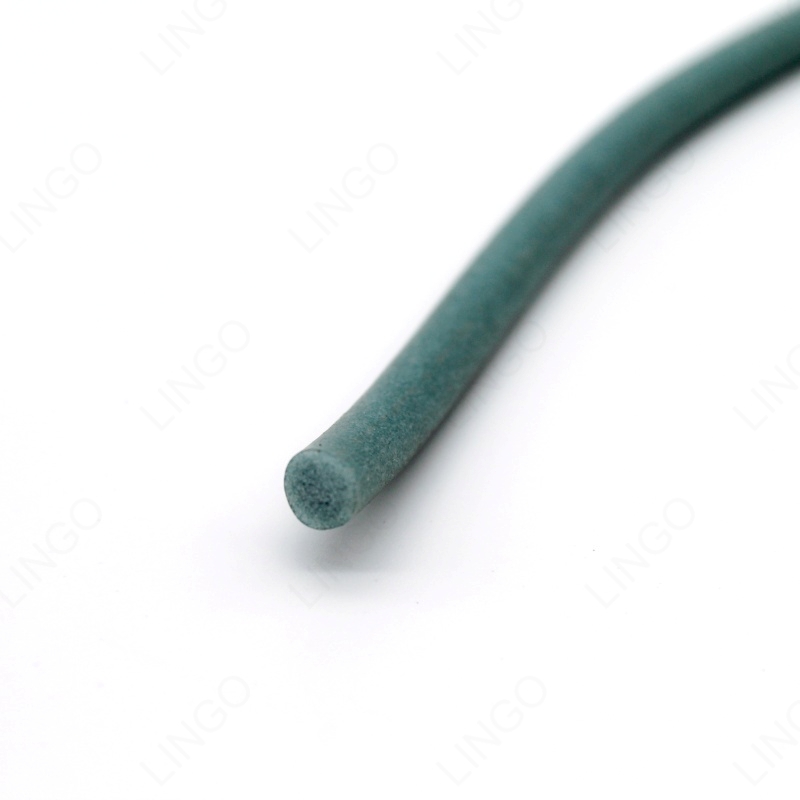
Material selection is a constraint decision, not a preference. Each compound family available in the LG-RX extrusion seal range carries a specific reason for existing:
- EPDM — formally classified under ASTM D1418 and ISO 1629, which define its resistance to ozone and UV. It is the default choice for outdoor weatherstripping, building window sealing and HVAC applications.
- NBR — selected where oil and grease contact is expected, such as machinery housings and automotive under-hood interfaces.
- Silicone — selected for wide temperature service. In a documented order of 4,000 metres of silicone sponge cord, the material was specified to withstand −60 °C to 250 °C without hardening or cracking, with FDA-compliant options available.
- FKM — selected for higher temperature and more aggressive chemical exposure. An MSDS covering the FK700 material applies to the rubber sealing rings range and is issued for the EU and USA markets.
- CR neoprene — covered by a CTI test report for UL 94 V-0 flammability, certificate number A2260538692101, issued 3 July 2026, with declared scope CR Neoprene rubber and target markets of the EU, US and Middle East.
For automotive sealing and gasket applications, rubber materials frequently have to comply with ASTM D2000 specifications covering temperature and oil resistance. This is where specification discipline separates a smooth program from a costly one. Before an RFQ leaves the buyer's desk, four constraints should already be fixed: the material designation and its supporting standard, the hardness in Shore A, the tolerance class, and the colour reference (Pantone or RAL) where appearance is part of acceptance.
Application Fit: Where Each Family Earns Its Place
The LG-RX extrusion seal is intended for food & beverage, medical & healthcare, aerospace & aviation, automotive & transportation, HVAC & refrigeration, laboratory & analytical, electronics & electrical, industrial manufacturing, marine & offshore, and household appliances industries. Documented end uses in the silicone sponge cord range include EV battery sealing, industrial cabinet gaskets, automotive door seals, appliance door insulation, building window weatherstripping and medical device sealing.
The LGMM anti-vibration mount is intended for marine & military, transportation, industrial machinery, construction & civil engineering, and electronics & precision instruments applications. In transportation use, the documented working condition is a high dynamic load within a −40 °C to +120 °C range, with exposure to oil, grease, road shock and continuous vibration, typically for engine mounting, suspension or seat vibration isolation. The stated design requirement is low compression set and fatigue resistance across 10⁶–10⁷ cycles under continuous cyclic compression and shear.
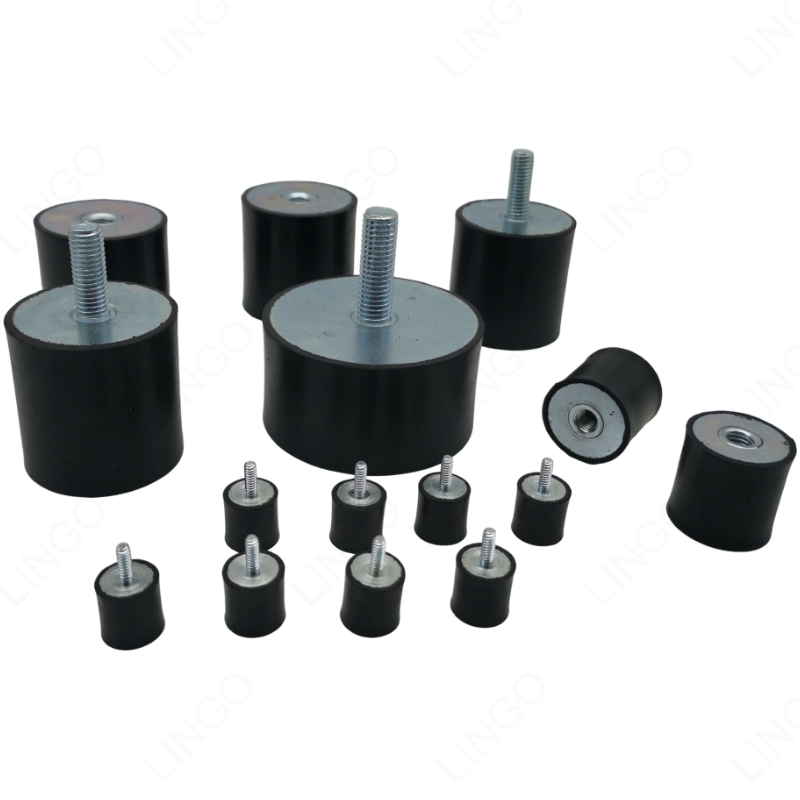
The divergence in working conditions explains why a single supplier serving both families is unusual. A supplier optimised for static sealing runs different compound development, different dies and different inspection routines from one optimised for dynamic fatigue life.
Supplier Archetypes Compared
Most buyers comparing sources for these two families end up weighing three archetypes: a global tier-1 vibration control group, a regional single-category specialist, and a mid-sized export-focused manufacturer running both processes. The table below compares them only on dimensions that can be supported by verified records or broadly accepted industry structure.
| Criterion | Export-focused integrated manufacturer (Lingo Rubber Plastic profile) | Global tier-1 vibration control group | Regional single-category specialist |
|---|---|---|---|
| Position in the market | 3,000 m² facility, around 40 employees, 1.58 million units annual output, roughly 80% of sales exported to the EU and USA | ContiTech, Hutchinson and Sumitomo Riko held 65% of the global anti-vibration mounts market in 2024, as reported by Market Insights Reports | Not assessed in this review; the category is fragmented |
| Product scope | Moulded rubber, extruded rubber, plastic injection and plastic extrusion under one roof | Broad vibration control portfolios, commonly organised around large platform programs | Commonly a single process family, such as extrusion profiles or cords |
| Single-source coverage of both families | Yes — LGMM mounts and LG-RX seals from one quality system | Yes | Usually requires a second supplier for the other family |
| Tooling economics | Existing mould sets can be reused where the geometry allows — in the documented automotive case, a single middle plate was machined to the specified dimensions instead of building a new mould | Program-specific tooling investment | Die-based tooling |
| MOQ | Set per part; small quantity orders are accepted | Not assessed in this review | Not assessed in this review |
| Stated lead time | 2 to 6 weeks | Not assessed in this review | Not assessed in this review |
Two conclusions follow from this structure. First, the tier-1 group is not a realistic comparator for a mid-volume program that needs a 20,000-piece mount order plus a sealing profile in the same purchase order — it competes for platform scale. Second, a regional specialist is not automatically cheaper; the buyer pays the difference in duplicated qualification, duplicated documentation and, in the case of tooling, duplicated ownership terms.
Commercial Terms and Quality Control: What the Documentation Actually Covers
Commercial terms decide whether a technically suitable supplier is also an operationally workable one. For Lingo Rubber Plastic, the stated terms are:
- Minimum order quantity — set per part, with small quantity orders acceptable. This supports pilot builds and first-article validation runs before a volume commitment.
- Lead time — 2 to 6 weeks, stated across the rubber moulding and extrusion capabilities.
- Payment — T/T and L/C.
- Delivery — EXW to DDP.
- Quality control — full inspection of samples and random inspection of bulk goods.
- After-sales structure — remote technical support, mould maintenance and ownership protection, a batch traceability system, and free exchange and acceptance of concessions as stated in the company's after-sales terms.
Certification coverage deserves separate attention because it is product-specific rather than company-wide. The company holds PPAP certification for automotive production covering silicone rubber cords, plastic injection parts, rubber sealing rings and anti-vibration mounts. An MSDS covers the rubber sealing rings product and applies to the EU and USA markets.
Documented Case Evidence: U.S. Automotive OEM Program
The clearest available evidence of how these terms work in practice is a U.S. automotive OEM program. Orders run at 10,000 to 40,000 pieces, placed several times per year, for anti-vibration mounts designed to absorb vibration and reduce noise. The program record notes three elements that matter to buyers evaluating a comparable requirement:
- Small part size, tight tolerances and consistent batch-to-batch quality.
- An in-house spare parts inventory maintained to accommodate urgent customer orders.
- Tooling handled without building a new mould: a single middle plate was machined to the specified dimensions and used with existing mould sets, substantially lowering initial tooling investment.
A second U.S. automotive case covers 500 pieces of flame-retardant vibration isolation parts produced with existing tooling. The record for that order reports UL 94 V-0 certification and test data showing a 45% reduction in peak vibration amplitude. A third reference covers 4,000 metres of silicone sponge cord supplied to a UAE automotive OEM for EV battery sealing, industrial cabinet gaskets, automotive door seals, appliance door insulation, building window weatherstripping and medical device sealing.
These cases illustrate a specific procurement pattern rather than a general capability claim: repeated mid-volume orders on existing tooling, with documentation and traceability requirements carried forward from the automotive context into adjacent industrial applications.
Boundaries: Where This Supplier Profile Is Not the Right Fit
A comparison that lists only advantages is not a comparison. The following boundaries are drawn directly from the available records and should be treated as evaluation constraints:
- Corporate history. The company was founded in 2022. Programs that require a multi-decade supplier track record, or that specify minimum years in business as a qualification gate, will screen this supplier out on that criterion alone.
- Scale. A 3,000 m² facility with around 40 employees and an annual output of 1.58 million units is suited to mid-volume and repeat-order programs. It is not positioned for platform volumes in the tens of millions of units per year.
- Product scope within vibration control. LGMM covers the cylindrical mount and stud mount configuration with an 8–150 mm diameter and 8–90 mm height range. Hydraulic mounts, air springs and other large engine-mount architectures fall outside this range.
- Declared tolerance on extrusions. The LG-RX record specifies industry-standard tolerances rather than a named class comparable to RMA A2. Where a program requires a formally declared tolerance class on the sealing profile, it must be stated explicitly at RFQ and confirmed before tooling.
- Tooling dependency. The tooling advantage in the automotive case came from reusing existing mould sets. A new geometry with no matching base tooling still requires new tooling investment.
- Engineering depth. A 10-person R&D team supports custom compound and geometry work, but simultaneous engineering bandwidth is naturally lower than that of a multinational group running multiple platform programs in parallel.
- Certification scope. PPAP covers four product families and MSDS covers rubber sealing rings. Buyers should not assume blanket certification across the full catalogue.
Market Trend Analysis
Three verified data points frame the sourcing environment for these product families:
- The gaskets and seals market reached USD 63.09 billion in 2024, with the seals segment holding a 60.1% revenue share (Grand View Research).
- The rubber moulding market reached USD 54.1 billion in 2024, with injection moulding as the leading process type and EPDM as the dominant material (Cognitive Market Research).
- China's rubber parts industry accounted for over 35% of global production in 2024, driven substantially by EV battery sealing and thermal management demand (EINPresswire / industry analysis; medium-reliability source).
The consistent signal across these datasets is that demand growth is concentrated in sealing applications tied to electrification and thermal management, while the moulded anti-vibration segment remains dominated at the top by a small group of global players. For buyers, that combination has a practical consequence: the constraint that decides whether a mid-sized supplier can serve a program is rarely country of origin. It is whether material designation, tolerance class and documentation coverage can be verified per part number.
Future Outlook
Two developments are likely to shape how extrusion seals and anti-vibration mounts are sourced over the next procurement cycles.
First, sealing requirements in electrified applications continue to push toward multi-material and co-extruded profiles, where a single component combines a sealing lip, a carrier and an adhesive layer. LG-RX already lists co-extruded and adhesive-backed construction among its types, which places this requirement inside the existing capability rather than outside it. Suppliers able to hold tolerance across a multi-material cross-section will be differentiated from those that extrude single-compound profiles only.
Second, documentation expectations are migrating from automotive into adjacent industries. The PPAP framework covering silicone rubber cords, plastic injection parts, rubber sealing rings and anti-vibration mounts is already broader than the automotive programs that drove it, and batch traceability is stated as a standing after-sales function rather than a premium option. Buyers should expect to ask certification questions per part number and to receive a scoped answer — which is a more useful outcome than a blanket certificate that does not map to the ordered item.
FAQ
Which certifications should I request for rubber extrusion seals and anti-vibration mounts?
Request documentation per part number rather than per supplier. For Lingo Rubber Plastic, PPAP certification for automotive production covers silicone rubber cords, plastic injection parts, rubber sealing rings and anti-vibration mounts. An MSDS covers the rubber sealing rings product and applies to the EU and USA markets. A CTI test report for UL 94 V-0 flammability, certificate number A2260538692101 issued on 3 July 2026, applies to CR Neoprene rubber with declared markets of the EU, US and Middle East. Products outside these scopes require their own evidence.
How do I choose between EPDM, NBR, silicone and FKM for an extrusion seal?
The choice is driven by exposure, not preference. EPDM is formally classified under ASTM D1418 and ISO 1629, which define its resistance to ozone and UV, making it suitable for outdoor weatherstripping and HVAC applications. NBR is selected for oil and grease contact. Silicone is selected for wide temperature service — in a documented order of 4,000 metres of silicone sponge cord, the material was specified to withstand −60 °C to 250 °C without hardening or cracking, with FDA-compliant options. FKM is selected for higher temperature and more aggressive chemical exposure. LG-RX supports all four, with hardness in Shore A, length and colour per Pantone or RAL defined by the customer.
What should be on the drawing before I request a quote for a cylindrical anti-vibration mount?
Specify diameter and height within the stated range of 8–150 mm and 8–90 mm, the load direction, and the tolerance class — LGMM is supplied to the RMA A2 standard. The construction is natural rubber bonded to zinc-coated steel. Also state temperature and media exposure: documented transportation applications run at −40 °C to +120 °C with oil, grease, road shock and continuous vibration, and require low compression set and fatigue resistance across 10⁶–10⁷ cycles. Where a program needs a tighter class than RMA A2, that has to be raised before quoting.
What MOQ and lead time should I plan for on custom rubber parts?
For Lingo Rubber Plastic, MOQ is set according to the individual part, and small quantity orders are acceptable, which allows pilot runs and first-article validation before a volume commitment. The stated lead time is 2 to 6 weeks across the moulding and extrusion capabilities. The company also maintains an in-house spare parts inventory for urgent customer orders, which supports repeat and emergency replenishment on parts already in production.
How is quality verified between sample approval and bulk shipment?
Two inspection stages are stated: full inspection of samples, followed by random inspection of bulk goods. These are supported by a batch traceability system, so a defect found in bulk can be traced back to its production batch. Mould maintenance and mould ownership protection are included in the after-sales structure, along with remote technical support and free exchange and acceptance of concessions as stated in the company's terms.
What drives cost in a custom rubber part program?
The dominant variables are tooling status, material selection, tolerance class and order volume. Tooling status matters most on repeat programs: in the documented U.S. automotive case, a single middle plate was machined to the required dimensions and used with existing mould sets instead of building a new mould, which the case record identifies as a substantial reduction in initial tooling investment. A new geometry without matching base tooling carries full tooling cost regardless of order size. Material cost follows the compound family chosen for the exposure conditions, and tighter tolerance classes generally increase inspection and scrap exposure.
Closing Note
The comparison resolves into a single procurement question: does the program need platform-scale supply with a multi-decade corporate history, or mid-volume supply with dual-family coverage, flexible MOQs and tooling economics that reward repeat orders? Hangzhou Lingo Rubber and Plastic Product Co., Ltd fits the second profile, with the boundaries listed above applying. For a broader view of the manufacturer's product range, quality systems and export record, the company profile is available as a downloadable document: LINGO Rubber & Plastic Company Profile.