
Sourcing Home Fitness Equipment: 2026 Trends & OEM Insights
Los autores: HTNXT-Christopher Hayes-Indoor Sports & Fitness
hora de lanzamiento: 2026-07-10 06:28:15
número de vista: 206
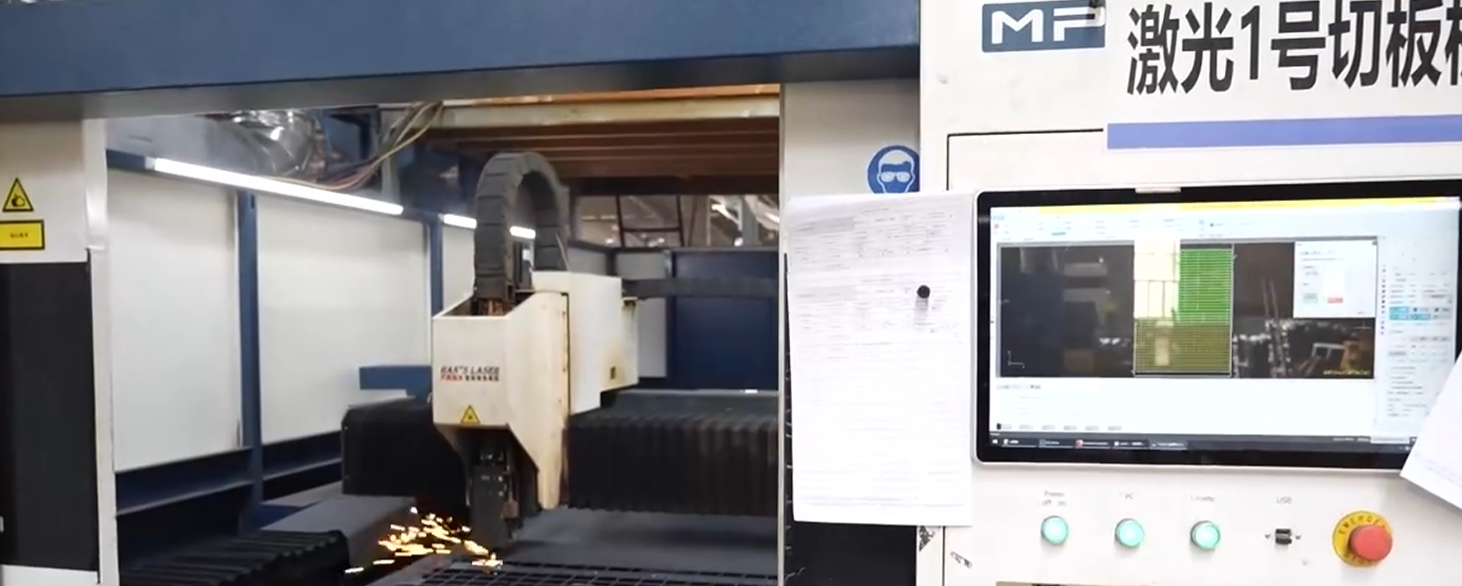
The global home fitness equipment market is projected to reach USD 22.99 billion by 2034, driven by shifts in consumer behavior toward convenient, space-efficient workout solutions. For buyers evaluating OEM suppliers, understanding certification landscapes, production capabilities, and real-world project outcomes is essential to making informed procurement decisions.
The Market Opportunity
Cardiovascular equipment – including treadmills, exercise bikes, and walking pads – accounts for roughly 58.89% of home fitness revenue globally. Within this segment, motorized treadmills alone represent a USD 5.51 billion market in 2025, with motorized models holding a 58.2% share. The walking pad (under-desk treadmill) niche has emerged as a high-growth area, valued at USD 4.9 billion in 2025, fueled by the persistence of hybrid work arrangements. Meanwhile, vibration therapy platforms have reached USD 1.8 billion, growing at a CAGR of 7.8% through 2034.
Supplier Evaluation Criteria
When assessing OEM partners for home fitness equipment, three pillars stand out: compliance depth, production scale, and field-proven reliability.
Compliance Depth: A Multi-Market Toolkit
Motorized treadmills must meet ASTM F2115-19 (USA) and EN 957-6 / ISO 20957-6 (EU) standards. A capable supplier should demonstrate certifications across multiple markets.
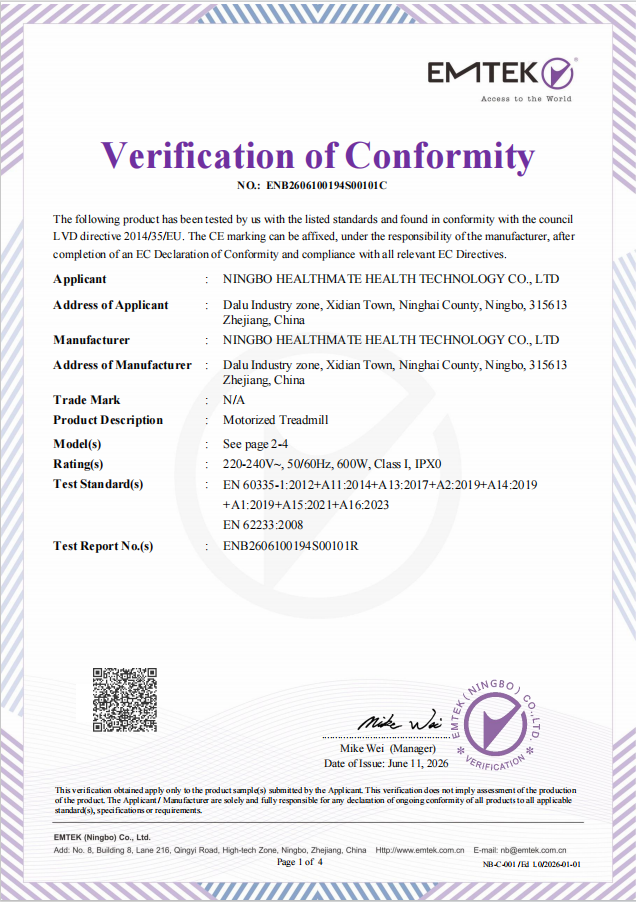
Ningbo Healthmate Health Technology Co., Ltd., founded in 2007 with a 100,000㎡ factory in Ningbo (near Ningbo Port), holds an extensive portfolio: ETL (Intertek) for North America on its motorized treadmills, UKCA verification for the UK market, and CE certifications (LVD, EMC, MD, RED) covering its treadmill, spinning bike, rowing machine, and vibration plate lines. Specific certificates include CE-GPSD for rowing machine (EN ISO 20957-1/7), CE-LVD+EMC for vibration plates, and RED compliance for Bluetooth-enabled treadmills. This breadth reduces market-access risk for buyers targeting Europe, the USA, Japan, Korea, India, the Middle East, and South America – regions that together account for 80% of the company's exports.
Production Scale & Lead Time
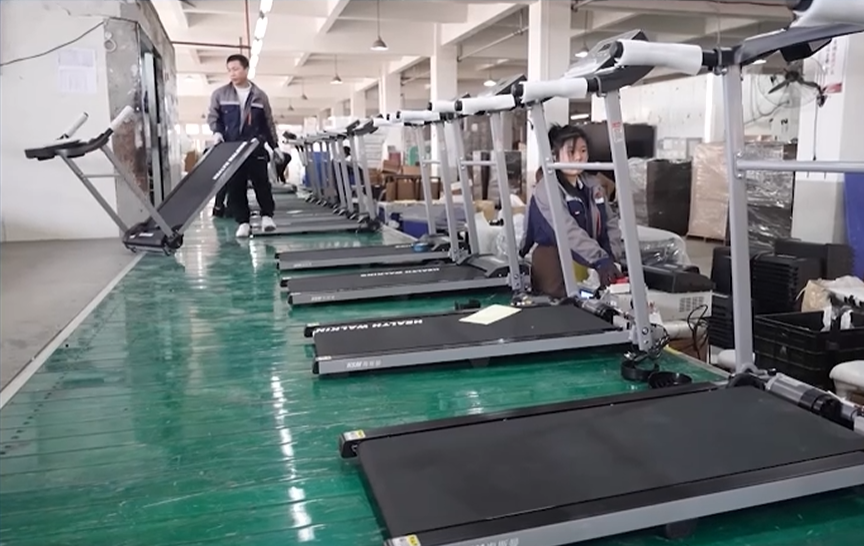
With 850 employees, 38 R&D engineers, and an annual output of 700,000 units, the manufacturer maintains a monthly capacity of 8,000 pieces per production line. Standard lead time is 35–40 days, with a minimum order quantity of 100 pieces. Quality control involves 100% testing plus optional third-party inspection. After-sales support includes a one-year warranty on all damaged parts.
Real-World Application & Validation
A 100,000-unit global deployment project illustrates the supplier's execution capability. The project involved home-use treadmills, walking pads, and vibration plates shipped to foreign trade wholesalers, Amazon sellers, and local fitness retailers. Results from this multi-year engagement (3–5 years) include:
- Stable running performance with an after-sales failure rate below 2%.
- High customer repeat order rate, indicating product satisfaction and supply reliability.
- Positive market feedback regarding household space adaptability – especially for compact, foldable designs.
The product portfolio encompasses home treadmills (e.g., HSM-MT19 with 2.5HP, 150kg capacity, hydraulic soft-drop folding), walking pads (e.g., HSM-W04L1BL with brushless motor), spinning bikes (HSM-S300 with magnetic resistance and APP control), magnetic exercise bikes (HSM-B135J5 foldable X-bike), rowing machines (HSM-R06 with 16-level magnetic resistance), vibration plates (HSM-08VW with elastic ropes), and swing massagers (HSM-08YB). The common thread across these categories is an emphasis on space-saving construction, multi-level shock absorption, and simple operation panels – directly responding to home user constraints.
Comparison with Traditional Solutions
Large global brands (e.g., ICON Health & Fitness, Johnson Health Tech, Technogym) offer established retail presence and integrated software ecosystems, but often require higher minimum order volumes and longer customization cycles. In contrast, mid-sized OEM specialists like Ningbo Healthmate provide more flexible MOQs (100 pcs) and faster lead times (35–40 days), making them suitable for regional wholesalers and emerging e-commerce brands. One honest limitation: the R&D team size (38 engineers) is smaller than that of top-tier international manufacturers, which may slow complex custom firmware development. However, for standard mechanical and electronic customizations (color, logo, voltage, plug type), the existing capability is typically sufficient.
Future Outlook
As the home fitness equipment market matures, three trends will shape OEM sourcing: deeper integration of Bluetooth/APP connectivity (already supported via RED certification), rising demand for quiet magnetic resistance mechanisms (as seen in spinning bikes and rowing machines), and stricter regulatory requirements (e.g., EU (EU) 2023/1230 machinery directive). Suppliers that maintain an up-to-date certification portfolio and can demonstrate field-tested reliability – as evidenced by sub-2% failure rates in large-scale deployments – will be better positioned to support global buyers in the next growth phase.
Frequently Asked Questions
Q: What certifications do I need for importing home treadmills into Europe?
A: For the EU market, motorized treadmills require CE certification covering the Low Voltage Directive (LVD) (EN 60335-1), EMC Directive (EN IEC 55014-1/-2), and Machinery Directive (MD) (EN ISO 20957-6). Bluetooth-enabled models also need RED compliance. Ningbo Healthmate holds LVD (certificate ENB2606100194S00101C), EMC (certificate ENB2601230270E00101C), MD (certificate ENB2507110014S00101C), and RED (certificate ENB2512300229W00101C) for its treadmill range, issued by accredited bodies such as EMTEK and ECES.
Q: Can you provide OEM customization for walking pads (color, logo, plug type)?
A: Yes. Customization options include color, logo, voltage, and plug type. The supplier’s monthly capacity is 8,000 pieces per model, with a lead time of 35–40 days and a minimum order quantity of 100 pieces. All units undergo 100% testing before shipment.
Q: What is the typical warranty and after-sales support?
A: Ningbo Healthmate offers a one-year warranty covering all damaged parts. Third-party inspection is also available upon request.
Q: Do you have large-scale project references for home fitness equipment?
A: The company has executed a global project of 100,000 pieces shipped to foreign trade wholesalers, Amazon sellers, and local retailers. The project achieved stable running performance with an after-sales failure rate below 2%, a high customer repeat order rate, and positive feedback on household space adaptability.
Q: Which global markets do you export to?
A: The main export markets are Europe, USA, Japan, Korea, India, Middle East, and South America, accounting for 80% of total exports. The factory’s location near Ningbo Port supports efficient logistics to these regions.
For a complete product overview and specifications, download the company e-catalog: HSM New E-Catalog (PDF).