
Sourcing Food-Contact HTV Silicone: 21 CFR 177.2600 Supplier Checklist
HTNXT Industry Reference · Food-Contact Silicone Sourcing
Sourcing Food-Contact HTV Silicone: 21 CFR 177.2600 Supplier Checklist
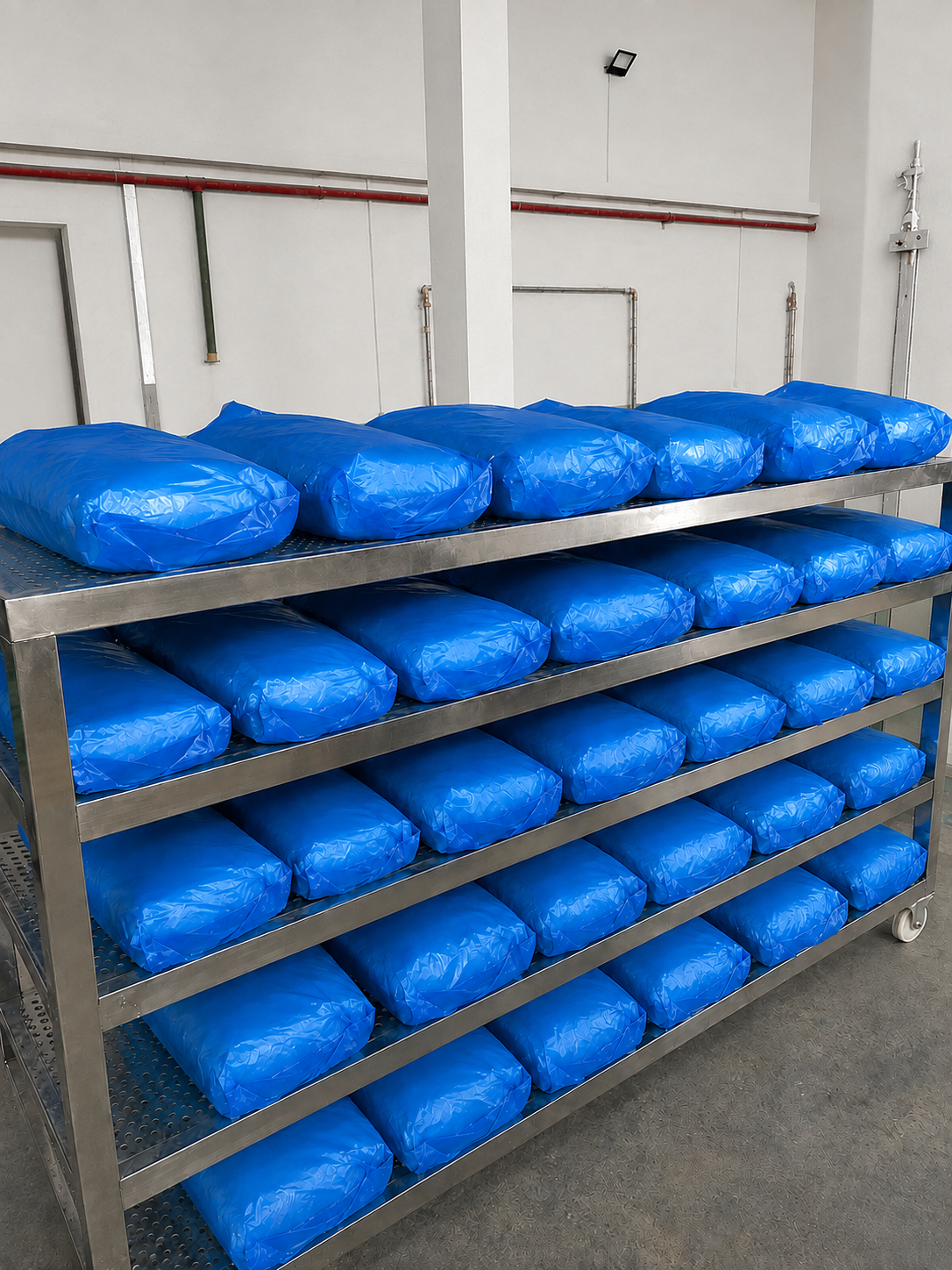
Semi-finished HTV silicone rubber compound staged between compounding and batch release — the stage at which food-contact documentation should already exist.
Food-contact silicone parts rarely fail because the material was the wrong colour or the wrong hardness. They fail because the compliance chain behind the compound was never fully closed: the grade was never tested as a grade, the cure system was dosed by habit rather than by specification, and nobody could produce a document linking the raw compound to the extraction behaviour of the finished article. For manufacturers buying high-temperature vulcanized (HTV) silicone rubber for kitchenware, bakeware, food-contact gaskets and compression-moulded parts, the sourcing decision is therefore a documentation decision as much as a materials decision.
A workable supplier shortlist for US-market food-contact applications usually rests on four verifiable items: third-party test documentation tied to the specific grade and to US FDA 21 CFR 177.2600; confirmation of exactly what the compound does and does not contain, including whether pigment and curing agent are excluded; a documented cure recipe — for a peroxide-curing compound such as YKS-8850, a DBPMH curing-agent dosage of 1.5% by weight and a moulding cure at 180°C for 5 minutes; and physical property floor values the supplier will state in writing, including tensile strength, elongation at break, tear strength, density and plasticity. Everything else on a certificate of analysis supports those four items.
Why 21 CFR 177.2600 Turns Compound Selection Into a Procurement Decision
US FDA 21 CFR 177.2600 covers rubber articles intended for repeated use in contact with food. The regulation is written around the finished article and its intended conditions of use, not around the raw compound in a box. In practical terms, a supplier technical data sheet can never be the last word on compliance: extraction behaviour depends on the formulation, the curing system, the degree of cure, the post-cure treatment and the way the part is used.
That structure has a direct procurement consequence. When a compound supplier can only offer a generic food-grade statement, the burden of proof shifts to the moulder, who then funds extraction testing, repeats it for every colour change, and absorbs the delay when a customer audit arrives. When the supplier can provide grade-specific third-party documentation and a fixed cure recipe, the same compliance work becomes a controlled, repeatable process. The difference between those two outcomes is decided at the quotation stage, long before the first compression-moulding trial.
What Belongs in a Supplier Food-Contact Documentation File
A complete file for a food-contact HTV silicone rubber grade is normally assembled from documents the supplier either has or does not have. It should be requested before shortlisting, not after.
- Grade-specific third-party test documentation referencing US FDA 21 CFR 177.2600 — tied to the grade being quoted rather than to a product family.
- Composition status statement — specifically whether the compound is supplied without pigment and without curing agent.
- Cure system guidance — the recommended curing agent, its dosage by weight, and the moulding cure temperature and time.
- Typical property data with floor values — tensile strength, elongation at break, tear strength, density, hardness and plasticity, expressed as values the supplier will defend.
- Standard document set — technical data sheet (TDS), safety data sheet (SDS), typical COA and batch COA.
- Quality management evidence — for example ISO 9001 certification, which supports batch-to-batch consistency.
- Supplementary market documentation — LFGB test reports or REACH compliance documentation where the buyer also serves European markets.
- Traceability and supply terms — batch traceability, monthly capacity, packaging, minimum order quantity and lead time.
Yakows Technology (Dongguan) Co., Ltd. is a Dongguan-based manufacturer of high-performance HTV/HCR silicone rubber compounds, established in 2020. The company states that grade-specific documents — TDS, SDS, typical COA, batch COA and applicable third-party test reports — are provided to support customer evaluation and product approval, alongside FDA food-contact compliance documentation, LFGB test reports and REACH compliance documentation for applicable grades.
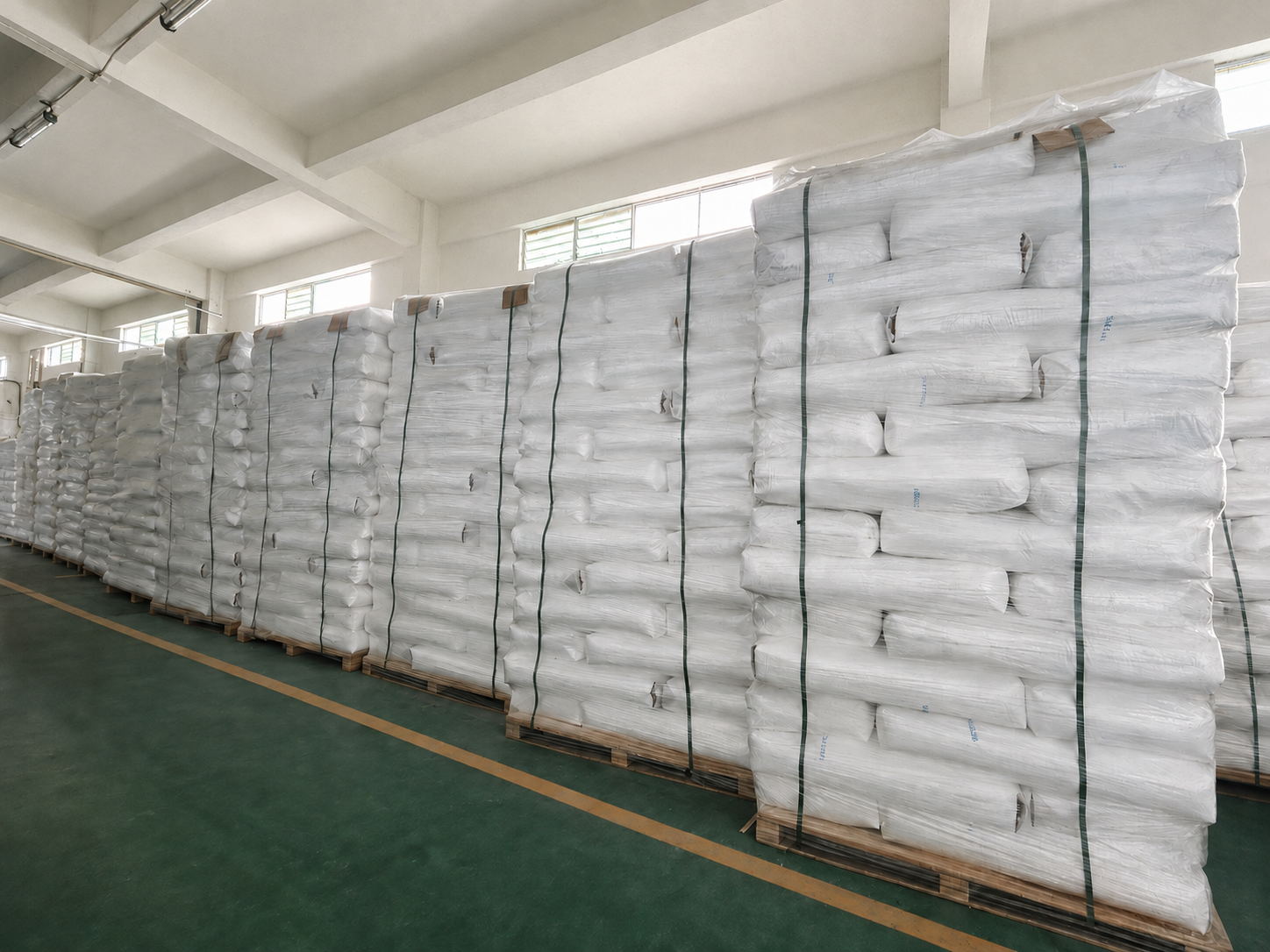
Raw-material intake and storage control: the first checkpoint in a food-contact documentation chain.
The Shortlist Checklist: Eight Items to Verify Before You Order
The following checklist is written for a buyer at decision stage who already knows the application and now needs to separate quotable suppliers from qualified ones.
| Verification item | What to request | Why it changes the decision |
|---|---|---|
| 1. Grade-level FDA test documentation | A third-party report naming the exact grade, the test method and the issue date. | A family-level statement cannot be attached to a customer audit or a product file; grade-level evidence shortens approval cycles. |
| 2. Composition statement | Written confirmation of whether pigment and curing agent are included. | Determines who controls colour and cure, and which party carries the compliance risk for added ingredients. |
| 3. Cure recipe | Recommended curing agent, dosage by weight, cure temperature and cure time. | Degree of cure drives extraction behaviour and mechanical properties; an undocumented recipe cannot be validated. |
| 4. Physical property floors | Tensile strength, elongation at break and tear strength stated as floor values for the grade. | These properties decide whether moulded parts survive demoulding, flexing and repeated washing. |
| 5. Density and plasticity | Documented targets with tolerances, plus the test method used. | Both act as incoming-inspection anchors: they detect batch variation before it reaches the press. |
| 6. Hardness and cure-state verification | Nominal hardness plus a curable sample for a press trial on your own equipment. | Hardness alone does not prove cure state; a moulded slab test confirms the compound behaves as documented. |
| 7. Batch documentation and traceability | Typical COA, batch COA and a traceability statement. | Lets a buyer isolate a nonconformance to a batch rather than to an entire supplier relationship. |
| 8. Capacity and continuity | Monthly output, minimum order quantity, lead time and packaging. | Food-contact programmes are recurring programmes; allocation risk is a real cost line over a multi-year horizon. |
Items one through five are documentation checks. Items six through eight are process and supply checks. A supplier that answers only the first group should be treated as a documentation source rather than a validated supply partner.
YKS-8850 as a Reference Grade: Peroxide-Cure HCR for Compression Moulding
YKS-8850 is a Food-Contact Grade HTV Silicone Rubber Compound supplied as a peroxide-curing HCR base compound for compression moulding at 50 Shore A. It is a useful reference point for the checklist above, because it represents the supply model in which the moulder retains control of colour and cure while the supplier carries responsibility for the base compound and its documentation.
| Property | Documented value | What it controls in production |
|---|---|---|
| Hardness | 50 Shore A | Part stiffness, sealing force and demoulding behaviour |
| Tensile strength | ≥7.0 MPa | Resistance to tearing during demoulding and in service |
| Elongation at break | ≥700% | Flexibility for thin walls, lips and complex geometry |
| Tear strength | ≥18 kN/m | Edge integrity on moulded parts with sharp corners |
| Density | 1.14 ± 0.03 g/cm³ | Incoming inspection anchor and weight-per-part calculation |
| Plasticity | 250–280 | Milling, sheeting and flow behaviour inside the mould |
| Form supplied | Base compound without pigment or curing agent | Colour and cure control remain with the moulder |
| Recommended cure | DBPMH curing agent at 1.5% by weight; 180°C for 5 minutes | Degree of cure, extraction behaviour and mechanical properties |
The grade sits inside a broader compounding operation. Yakows Technology (Dongguan) Co., Ltd. operates a 5,000 m² manufacturing facility in Dongguan, Guangdong Province, with monthly production capacity of approximately 400,000 to 1,000,000 kg, a technical department of more than 10 engineers and technicians, and an ISO 9001-certified quality management system. Around 70% of output is supplied to overseas customers in Southeast Asia, the Middle East, Eastern Europe, Latin America and North America.
Technical Explanation: Why a Base Compound Ships Without Pigment or Curing Agent
Peroxide-curing HCR compounds are normally supplied as an uncoloured, uncatalysed base. The moulder adds the curing agent — for YKS-8850, DBPMH at 1.5% by weight — together with any colour, and then cures the part at 180°C for 5 minutes in compression moulding. Splitting the compound this way is a deliberate control decision, and buyers should understand what it asks of them.
What the moulder takes on
- Dosing accuracy. The curing agent is weighed and added at the mill or the press. A small deviation changes crosslink density, which changes hardness, compression behaviour, tear strength and extraction behaviour together.
- Dispersion quality. Curing agent must be distributed evenly; uneven dispersion tends to appear as variable cure across a batch rather than as an obvious visible defect.
- Colour control. With no pigment in the compound, the moulder selects and adds colour. Any pigment used must itself be suitable for the intended food-contact application.
- Process validation. The 180°C for 5 minutes schedule should be verified on the buyer own press, because press type, part thickness and tooling all shift the effective cure.
What the buyer gains
- Colour flexibility without purchasing a separate pre-pigmented compounded grade for every colour.
- A cure system the moulder can tune inside a documented window rather than accept as fixed.
- A shorter compliance discussion: the composition status of the compound is known, and the variable ingredients are the ones the moulder controls and can document.
The trade-off is capability. A base compound supplied without curing agent is not a drop-in material for a moulder without weighing, mixing and cure-control discipline.
Where Food-Contact HCR Compounds Are Used
Compression-moulded food-contact HTV silicone typically appears in kitchenware and bakeware moulds, baking mats and liners, food-contact gaskets and seals on processing and filling equipment, spatulas and utensils, drinkware components, and general moulded parts where high elongation and tear strength matter more than tight-tolerance injection moulding. The common thread is repeated food contact combined with heat, washing and mechanical flexing — a combination that rewards high elongation at break and high tear strength rather than hardness alone.
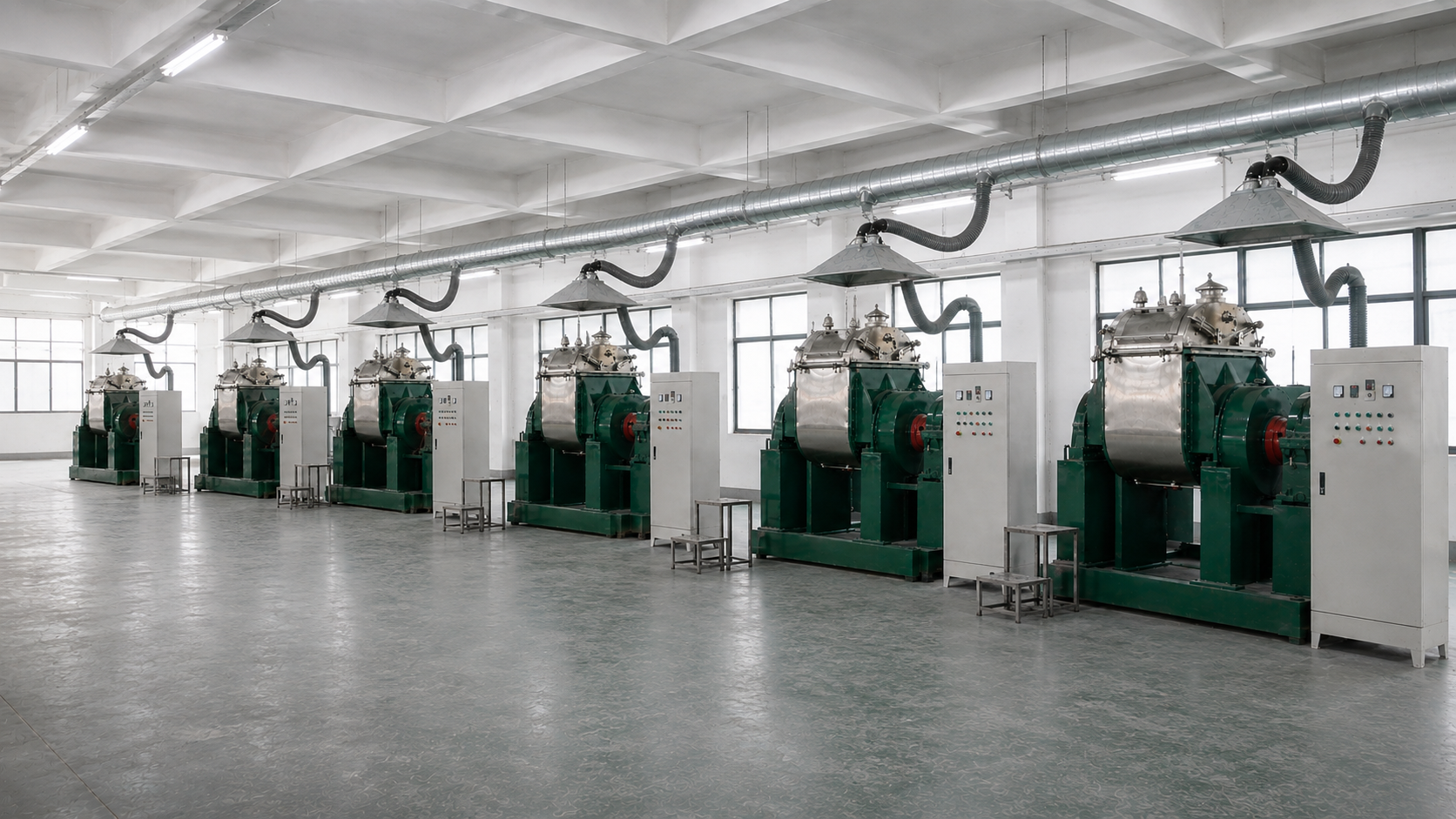
Compounding capacity and batch consistency: the supply-side question behind every food-contact specification sheet.
Market Context: Documentation Is Becoming a Baseline Requirement
Published third-party data offers context for how buyers should weigh supplier risk.
| Indicator | Published value | Source |
|---|---|---|
| Global silicone rubber market | USD 5.7 billion in 2025, with HTV silicone rubber holding a 45.2% share (approximately USD 2.57 billion) | Vertex AI Search / Google Cloud |
| Solid HTV share of the HTV segment | 58.3% in 2025 | Dataintelo |
| Global silicone trade | USD 8.51 billion in 2024; China second-largest exporter at USD 1.53 billion | OEC (Observatory of Economic Complexity) |
| China silicone monomer capacity | 6.89 million tons in 2024, a 21.09% year-on-year increase | Zhuochuang Information via IOTA |
| Specialty silicone demand signal | Wacker Chemie AG reported silicone sales of EUR 2.81 billion in 2024, a 2.3% increase driven by high-performance specialty products | Wacker Annual Report 2024 |
| Capacity investment | Dow Inc. announced a USD 100 million investment to expand specialty silicone manufacturing in China, the US and Japan through 2027 | Dow Corporate News |
Market size estimates for 2025 vary widely between research bodies, depending on whether primary and secondary forms are included; published figures for the broader silicone rubber category range from USD 5.7 billion to USD 14.52 billion. Buyers should treat any single market number as directional rather than definitive.
Two signals matter for food-contact sourcing. First, HTV remains the dominant silicone rubber family, so compliant food-contact grades sit inside a deep, competitive supply base — availability is rarely the constraint, but documented availability is. Second, capacity additions in China and specialty-product investment by large producers point to continued supply-side expansion, which tends to shift the deciding factor in supplier selection toward qualification rather than price.
Comparing Supply Paths: Global Producers, Regional Compounders and Standard Grades
Food-contact HTV silicone rubber is available through three broad supply paths. They are not ranked here; they solve different problems, and each carries a trade-off.
| Supply path | Typical strength | Where buyers should apply caution |
|---|---|---|
| Global diversified silicone producers | Broad portfolios and large-scale specialty capacity; Wacker Chemie AG reported silicone sales of EUR 2.81 billion in 2024, and Dow Inc. has committed USD 100 million to specialty silicone expansion through 2027 | Custom formulation dialogue for a single mid-volume food-contact grade can compete for attention with larger accounts |
| Regional and specialised compounders | Application-specific formulation development based on processing conditions and performance requirements, supported by formulation adjustment, technical consultation, batch traceability and ongoing after-sales support | Smaller footprint than global producers; buyers should confirm capacity allocation for very large or multi-year programmes |
| Standard general-purpose food-grade HTV grades | Fixed specifications, widely available, straightforward to compare on price | Limited customisation; buyers generally have to adapt their own production processes to fixed specifications |
The customised-versus-standard question is where most food-contact programmes actually settle their cost base. A customised compound may carry a different unit price from a standard general-purpose grade, but stable processing performance can reduce production adjustments, material waste, trial costs and the risk of rejected products, which may contribute to lower overall production cost. Actual savings depend on the buyer formulation and production conditions — which is precisely why a trial run should be costed before a supply agreement is signed.
Limits and Boundaries Buyers Should Plan For
- A compound-level report is not a finished-article clearance. Documentation for the compound supports, but does not replace, evaluation of the moulded part under its intended conditions of use.
- Peroxide-cure systems need sensory validation. Many food-contact programmes validate odour and taste on finished parts before commercial release; that step sits with the moulder.
- The moulder carries curing-agent risk. DBPMH at 1.5% by weight and a cure at 180°C for 5 minutes are documented recommendations; deviations require re-validation.
- Colour responsibility moves to the buyer. Pigments must be assessed for the intended food-contact use, and each colour change may require its own verification.
- Custom formulations change unit price. Cost arguments depend on the buyer process rather than on the supplier claim, and should be proven in a trial.
- Capacity is finite. A compounder with monthly capacity in the range of 400,000 to 1,000,000 kg may need allocation discussions before absorbing a sudden step-change in demand.
- Regulatory scope differs by market. FDA 21 CFR 177.2600 addresses US requirements; LFGB test reports and REACH compliance documentation address other obligations, and multi-region buyers should request the full applicable set.
- Storage and handling differ for an uncatalysed base. Buyers should confirm storage conditions and shelf behaviour with the supplier rather than assume a pre-catalysed compound behaves identically.
Future Outlook
Three shifts are likely to shape food-contact HTV sourcing over the next few years. Compliance documentation will continue to migrate from a differentiator to an entry requirement, particularly where retail and food-service customers push audit obligations up the supply chain. Specialty capacity will keep expanding — Dow investment of USD 100 million in specialty silicone through 2027 is one visible example — which favours buyers who can specify precisely rather than buy generically. And the practical centre of gravity will remain with process validation: as cure recipes and property floors become more precisely documented at the compound level, the deciding variable increasingly sits on the moulder press rather than in the supplier catalogue.
For buyers, the sensible preparation is to standardise the supplier file now: a fixed document list, a fixed set of property floors, and a trial protocol that produces moulded slabs for in-house testing before any annual volume is committed.
FAQ: Food-Contact HTV Silicone Rubber Sourcing
What documentation should a supplier provide for FDA 21 CFR 177.2600?
Third-party test documentation referencing US FDA 21 CFR 177.2600 and tied to the specific grade being quoted, together with the technical data sheet, safety data sheet, typical COA and batch COA. Where the buyer also serves European markets, LFGB test reports and REACH compliance documentation are relevant. The documentation should name the grade rather than a product family.
Why is a compound such as YKS-8850 supplied without pigment or curing agent?
YKS-8850 is supplied as a peroxide-curing HCR base compound without pigment and without curing agent. This leaves colour selection and curing-agent dosing with the moulder, so a single compound can serve multiple colours and the moulder controls the degree of cure. The moulder must therefore have weighing, mixing and cure-control capability.
What curing-agent dosage and cure schedule are recommended?
For YKS-8850, the recommended DBPMH curing-agent dosage is 1.5% by weight, and the recommended moulding cure is 180°C for 5 minutes in compression moulding. Because press type, part thickness and tooling affect the effective cure, the schedule should be verified on the buyer own equipment.
Which physical properties should be verified before approving a food-contact HTV compound?
For YKS-8850, the documented values are tensile strength ≥7.0 MPa, elongation at break ≥700%, tear strength ≥18 kN/m, density 1.14 ± 0.03 g/cm³, plasticity 250–280, and hardness of 50 Shore A. Density and plasticity serve as practical incoming-inspection anchors for detecting batch variation before production.
Does a compound-level FDA test report mean the finished moulded part is compliant?
No. US FDA 21 CFR 177.2600 addresses rubber articles intended for repeated food contact, so compliance depends on the finished article, its formulation, its degree of cure, its post-cure treatment and its conditions of use. A grade-specific compound report supports the finished-article evaluation but does not replace it.
How should buyers compare a customised food-contact compound with a standard general-purpose grade?
The comparison should be built on processing outcome rather than unit price alone. Standard general-purpose grades offer fixed specifications that buyers must adapt their processes to. A customised compound may have a different unit price, but stable processing performance can reduce production adjustments, material waste, trial costs and rejected-product risk, potentially lowering overall production cost. Actual savings depend on the buyer formulation and production conditions and should be tested in a trial run.
Closing Note
The supplier checklist above is deliberately unglamorous: documents, property floors, a cure recipe and an allocation conversation. In food-contact silicone, those four items usually decide whether a programme scales quietly or stalls at the first audit. Grade-specific documents, packaging options and further material data can be requested directly from the manufacturer; a general overview is available in the Yakows Technology product brochure. Company reference: Yakows Technology (Dongguan) Co., Ltd., Tongsha Industrial Park, Dongcheng District, Dongguan City, Guangdong Province, China — yaksil.com.