
Sourcing Collar Stays with Proven MOQ Specs: What Supplier Capability Looks Like
A shirt clip in the published catalogue of Wuxi Mingyu Garment Accessories Factory carries a minimum order quantity of 100,000 pieces. A metal pin for shirt packing, offered by the same manufacturer, carries a threshold of 10,000 pieces. Both figures sit inside one product family, and together they tell buyers something that a capability brochure rarely states before the first enquiry: order thresholds are an operational fingerprint of tooling, machine setup and production scale.
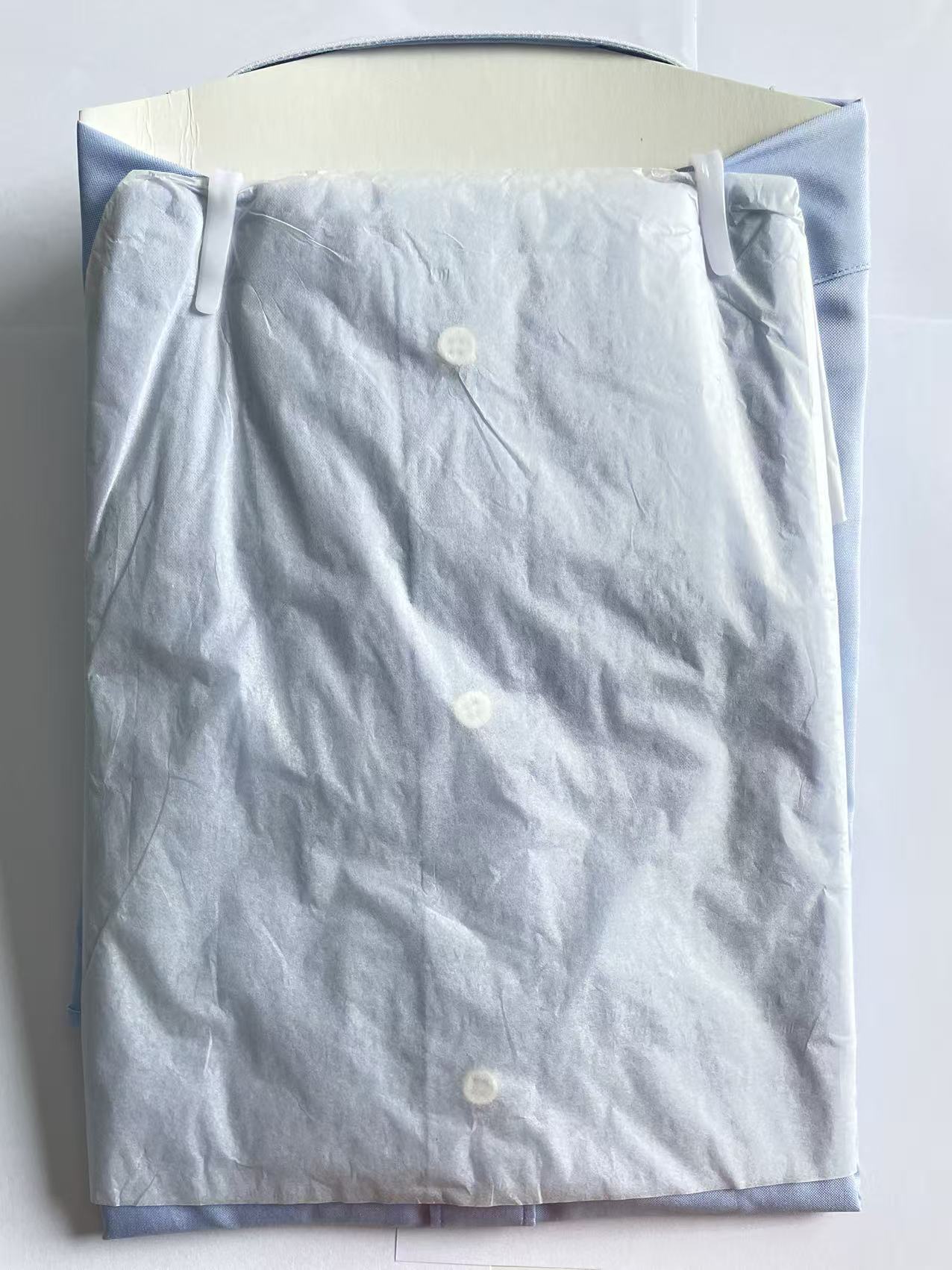
Garment packaging is a large and still-expanding category. According to Dataintelo's garment packaging market research, the global market was valued at USD 18.6 billion in 2025 and is projected to reach USD 31.4 billion by 2034, with Asia Pacific accounting for a 41.5% revenue share in 2025. Shirt packaging accessories — collar support inserts, collar stays, collar bands, clips, pins, board, tissue paper and belly bands — sit exactly where garment manufacturing meets retail presentation. Buyers in this category rarely choose on appearance alone; they choose on whether a supplier can repeat a specification across a large, dated shipment.
That is why the MOQ column deserves more attention than it usually receives. In this article, we examine a real set of published order specifications and read them as procurement evidence, with particular attention to the shirt collar support insert.
Why Order Thresholds Are the First Capability Test in Shirt Packaging Sourcing
A minimum order quantity is not a marketing preference. It is the volume at which a supplier considers a production run economically rational after material purchase, mould or die setup, machine changeover, inspection and packing are accounted for. Two suppliers can quote the same unit price and still differ enormously in what a threshold reveals about their equipment.
For buyers in the research and evaluation stage, the practical question is not simply "what is the MOQ?" but "what does this number tell me about how the part is made, and what does it commit me to?" A 1,000-piece threshold and a 100,000-piece threshold cannot be supported by the same production logic. Reading several thresholds from a single supplier catalogue is therefore more informative than reading one in isolation, because it shows where the supplier's automation is concentrated and where hand assembly or short-run flexibility still exists.
A second reason MOQ matters at this stage is planning risk. Shirt programmes are seasonal. A buyer who signs a 100,000-piece clip order must be able to absorb that volume across a defined production calendar, or hold inventory. A buyer who needs 8,000 pieces of a collar component must find a supplier whose threshold sits below that figure. The published specification sheet is the earliest point at which this planning risk becomes visible.
The Published MOQ Ladder in One Shirt Packaging Accessories Catalogue
The following table reproduces the published specifications for the main shirt packing components supplied by Wuxi Mingyu Garment Accessories Factory. Every threshold below is a stated order specification rather than an estimate.
| Component | Material and key dimensions | Published MOQ | Logo capability |
|---|---|---|---|
| Collar Support (collar support insert) | Light blue PVC, 22.7 cm x 18.5 cm, 0.35 mm, cuboid | 10,000 pcs | None |
| Metal collar stay | Stainless steel, 0.8 mm, four common sizes 55.9 / 63.5 / 69.9 / 76.2 mm x 9 mm | 1,000 pcs | Customized, laser engraved |
| Collar stay | White PVC, 6.35 cm x 1 cm x 0.75 mm, rectangular | 10,000 pcs | Customizable |
| Plastic collar band | White PET, 48.1 x 4 cm, 0.35 mm, rectangular | 10,000 pcs | None |
| Paper collar band | Specialty tenacity paper, 47.2 x 3.8 cm, 1 mm | 10,000 pcs | None |
| Metal pin | Stainless steel / brass, common size 26 x 0.6 mm, 0.6-0.65 mm | 10,000 pcs | None |
| Clip (X-shape, shirt back clip family) | PS / metal, 3.3-3.7 cm x 0.8 cm x 1.2 mm | 100,000 pcs | Customizable |
| Paper butterfly | 400 g single white paper, 15 cm x 3 cm | 10,000 pcs | Customizable |
| Plastic butterfly | Light blue fine sand PVC, 26 x 10.4 cm, 0.25 mm | 10,000 pcs | Customizable |
| Cardboard | 100% natural wood pulp paper, 21 x 35.2 cm, 500 gsm | 10,000 pcs | Customizable |
| Tissue paper | Tissue paper, 36 x 40 cm, 17 gsm | 10,000 pcs | Customizable |
| Apparel tag | 100% natural wood pulp paper, 4 x 7 cm, 500 gsm | 10,000 pcs | Customizable |
| Belly band | Paper, 58 x 10 cm, 0.25 mm | 10,000 pcs | Customizable |
| Plastic bag | PP, 35 x 26 cm, single 0.035 mm, transparent | 10,000 pcs | None |
Two patterns stand out immediately. First, the catalogue is remarkably consistent: most die-cut and printed components sit at 10,000 pieces. Second, the two exceptions point in opposite directions — the metal collar stay drops to 1,000 pieces, while the clip family rises to 100,000 pieces. Those two outliers are where the most useful procurement information lives.
What a 100,000-Piece Clip Threshold Signals About Tooling
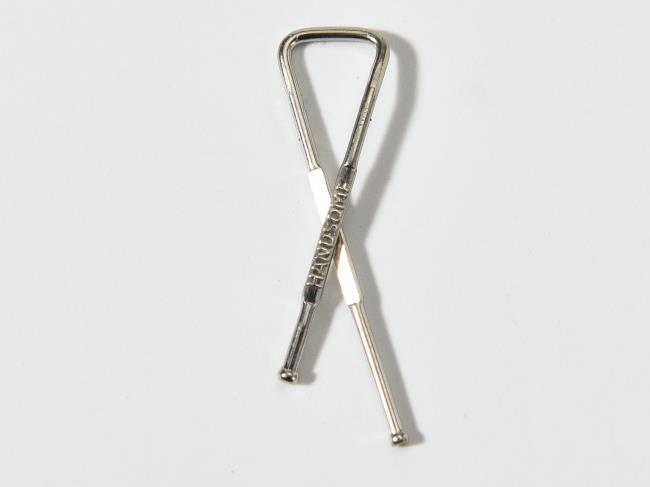
The clip category — which includes metal clips, plastic clips, U-shape plastic big clips, clear square plastic clips, alligator clips, plastic clips with teeth, square plastic clips and square plastic shirt back clips — is published at a 100,000-piece MOQ, ten times the threshold of the collar components around it. For a buyer, that single figure communicates more about production structure than a page of general capability claims.
In garment accessories, order thresholds of this magnitude are generally associated with components whose manufacturing depends on dedicated moulds or multi-stage forming and assembly, where the cost of the tooling and the setup has to be distributed across a long run to remain commercially workable. Parts that are punched, die-cut or wire-formed from strip or sheet material can usually be scheduled in shorter runs without the same penalty. This is consistent with what the same catalogue shows elsewhere: pins at 10,000 pieces, cardboard and paper components at 10,000 pieces, but the mould-dependent clip family at 100,000.
The practical implication is that the clip is a commitment component. A buyer specifying clips is effectively planning a volume programme, and should match that order to a confirmed season, a confirmed retail allocation, or a holding plan. The same supplier's lower-threshold items — including the metal pin at 10,000 pieces and the collar support insert at 10,000 pieces — allow a buyer to build volume gradually across a range while the large clip commitment is scheduled separately.
The Shirt Collar Support Insert: Specifications and Role
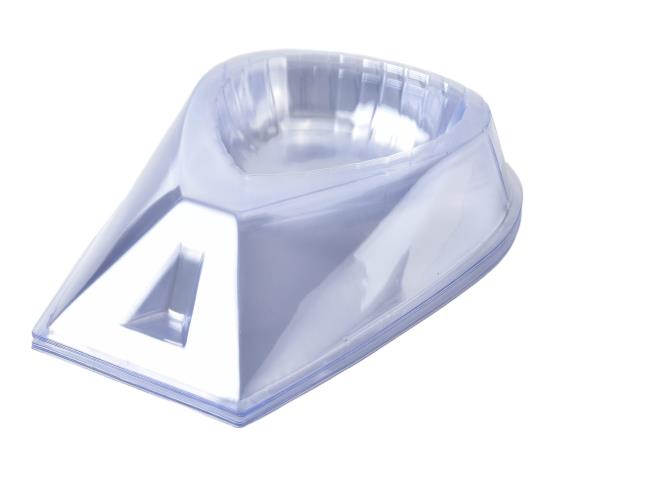
The collar support insert is the component that holds the shape of a folded shirt collar inside the retail pack. In this supplier's catalogue it is listed as Collar Support, with the following published specification:
- Material: light blue PVC
- Size: 22.7 cm x 18.5 cm
- Thickness: 0.35 mm
- Colour: light blue
- Style: cuboid
- Logo: none
- Usage: for shirt packing
- MOQ: 10,000 pcs
A 0.35 mm PVC insert at this footprint is a rigid-enough, lightweight support that keeps the collar and upper front panel from collapsing during bagging, cartoning, container loading and retail handling. Because it is produced from sheet material rather than a moulded part, it sits comfortably inside the 10,000-piece band that dominates this catalogue — the same band as the paper collar band at 47.2 x 3.8 cm and 1 mm, the plastic collar band in white PET at 48.1 x 4 cm and 0.35 mm, and the 21 x 35.2 cm, 500 gsm cardboard board.
Collar Support Insert vs. Collar Stay vs. Metal Collar Stay
Buyers frequently treat these three items as interchangeable. They are not, and the specification sheet settles the question quickly.
| Item | Material | Dimensions | Position in the pack | MOQ |
|---|---|---|---|---|
| Collar support insert (Collar Support) | Light blue PVC | 22.7 x 18.5 cm, 0.35 mm | Broad support behind the folded collar and front panel | 10,000 pcs |
| Collar stay | White PVC | 6.35 cm x 1 cm, 0.75 mm | Slim insert placed inside the collar point | 10,000 pcs |
| Metal collar stay | Stainless steel | 55.9 / 63.5 / 69.9 / 76.2 mm x 9 mm, 0.8 mm | Rigid removable stay inside the collar point | 1,000 pcs |
The distinction matters for two reasons. First, order economics: a buyer who needs only 2,000 rigid stays can meet the 1,000-piece metal collar stay threshold, but cannot meet the 10,000-piece thresholds on the PVC collar support insert or the standard collar stay. Second, pack design: the collar support insert is a broad panel, while a collar stay is a narrow strip inserted into the collar point itself. Specification and MOQ both need to be decided together, component by component, rather than as a single line item.
Manufacturing Evidence Behind Those Thresholds
Wuxi Mingyu Garment Accessories Factory is a garment accessories manufacturer based in E'hu Town, Xishan District, Wuxi, Jiangsu, China. It was founded in 2004, operates a 2,500 m2 factory with 25 employees and a three-engineer R&D team, produces an annual output of 90 million sets, and exports approximately 85% of its production to Europe, North America, South America and Asia.
Several published operational facts sit directly behind the order thresholds described above:
- Monthly production capacity: 7.5 million sets
- General order MOQ: 1,000 sets
- Standard lead time: 7-20 days
- Production mode: OEM / ODM, with size, colour, style, printing, foiling, mould opening and logo customization (stamping or printing)
- Quality control: 100% testing
- Export coverage: worldwide, with stated markets across Europe, the Americas and Asia
- After-sales: customer service and technical support
The company also states an overseas-localized layout: a Sri Lanka factory established in 2013 and a Vietnam factory established in 2017, plus distribution warehouses, agencies or manufacturing presence in Sri Lanka, Argentina, Bangladesh, Indonesia, Colombia and Kenya. An OA system was introduced in 2018. For a buyer, this is the part of the capability picture that explains how a 100,000-piece clip run and a 10,000-piece collar support insert order can be scheduled within a 7-20 day lead time rather than simply promised.
Equipment and Process: How These Components Are Produced
The catalogue attributes production to automated equipment rather than manual cutting. The stated supporting devices include automatic creasing machines, punching machines, paper cutting machines, automatic edge folding machines, and an automatic cardboard and collar stay die cutting machine. This equipment set is directly consistent with the material profile of the products above: PVC, PET and paper sheet goods are creased, punched, folded and die-cut, while the pin is formed from stainless steel or brass and the clip is produced in the mould-dependent process described earlier.
Production runs in a mass-production mode with custom printing and mould-opening support. That combination — high-volume standard output plus configurable printing and tooling — is what allows one factory to hold a 1,000-piece threshold on a laser-engraved stainless steel collar stay while simultaneously holding a 100,000-piece threshold on a moulded clip. The two thresholds describe two different production logics inside the same plant, and a buyer reading both learns where each component's cost actually sits.
Application: Where Collar Supports and Packing Components Are Used
The published application profile for this product family is consistently work-floor oriented rather than showroom oriented. The components are applied in packing workshops, sorting lines, garment shipment operations and retail display packaging, where the stated function is threefold: wrinkle prevention, brand identification through printing or foiling, and transport protection.
Project types are OEM/ODM packaging customization, bulk order supply and brand packaging upgrade projects. Special requirements include custom printing, mould opening, and colour and size customization, and the stated mode of operation is mass production combined with custom printing and tooling support.
A representative project outcome recorded for this supplier covers a 10,000-unit supply of shirt packaging accessories to clients, used for garment packaging to improve shipment protection and brand presentation, resolving inadequate shipment protection and presentation during packing. The associated client profile covers brand owners, garment manufacturers, distributors and exporters, with a cooperation duration of five years and a reported result of maintained long-term cooperation without major errors. Read as procurement evidence rather than as a testimonial, the useful detail is the order scale: 10,000 units is exactly the threshold at which most of this catalogue's components become available, which means a buyer can enter at the collar support insert and collar band level and build a complete pack from there.
Customization Boundaries: Which Components Accept a Logo
Not every component in a shirt pack can carry a brand mark, and this constrains pack design more than buyers expect. The published logo capability across the range is as follows.
| Logo customizable | Logo not offered as standard |
|---|---|
| Metal collar stay (laser engraved), collar stay, clip, paper butterfly, plastic butterfly, cardboard, tissue paper, apparel tag, belly band, gift box | Collar support insert, plastic collar band, paper collar band, metal pin, plastic bag |
For a brand programme, the practical consequence is that the branded layer of the pack usually comes from the printed paper and board components — tissue paper, cardboard, hang tag, belly band and butterfly — while the collar support insert, collar bands and pins perform structural and fastening functions without a printed mark. Buyers who plan the logo on the collar support insert early will need to reallocate that branding to another component before the order is placed.
Market Trend: Packaging Growth Outrunning Adjacent Accessories
Two published datasets are useful for framing this category. The Business Research Company reports that the garment interlining market — the structural layer closely related to shirt collar construction — reached USD 3.65 billion in 2025. Cognitive Market Research reports that the market for buttons for clothing, specifically shirts and blouses, reached USD 8.39 billion in 2025 and is expected to grow at a CAGR of 3.9% to reach USD 11.39 billion by 2033.
Placed alongside the garment packaging figure of USD 18.6 billion in 2025 growing toward USD 31.4 billion by 2034, the comparison group note supplied with these datasets observes that garment packaging is expanding faster than general clothing fasteners and buttons. The interpretation for sourcing teams is straightforward: packaging components — including collar supports, bands and board — are being specified in greater volume and with more brand attention than their low unit cost would suggest, while fastener demand grows at a slower underlying rate. Asia Pacific's 41.5% revenue share of garment packaging in 2025 reinforces why a manufacturer with production in Wuxi plus overseas sites in Sri Lanka and Vietnam positions itself inside the region where that volume is concentrated.
Comparison with Traditional Packing Approaches, and Where the Limits Are
Compared with traditional, largely manual shirt packing — hand-cut board, improvised collar supports, generic unbranded bags and loose pins — a specified component system offers repeatability. Every unit is die-cut to the same dimensions, thickness is stated in millimetres, and inspection is applied across production. That is the core advantage of sourcing to a published specification rather than to a sample.
The same specification sheet, however, defines real boundaries that buyers should not overlook:
- The 100,000-piece clip threshold excludes small runs entirely. A buyer planning a 20,000-piece shirt programme cannot source clips at the published MOQ and will need to redesign the closure or reduce the clip specification to a lower-threshold component. This is a hard planning constraint, not a negotiation detail.
- Several core collar components carry no logo option. The collar support insert, both collar bands, the metal pin and the plastic bag are published without logo customization. A pack that relies on the collar support insert for brand visibility will not achieve it.
- A collar support insert is a packaging insert, not a structural interlining. At 0.35 mm PVC it supports and protects the folded collar inside the pack; it does not replace a fused or sewn collar interlining in the garment itself. Buyers evaluating collar construction and buyers evaluating packaging are solving two different problems.
- The overseas footprint is country-specific. Regional lead-time advantages are stated for Sri Lanka, Argentina, Bangladesh, Indonesia, Colombia and Kenya, and for factory sites in Sri Lanka and Vietnam. Buyers outside those markets should plan on the standard 7-20 day lead time rather than assuming local stock.
- A single thickness does not fit every pack. The collar support insert is published at 0.35 mm, the metal collar stay at 0.8 mm, and the paper collar band at 1 mm. Where a pack requires different rigidity, the specification has to move to a different component rather than a different setting on the same one.
Future Outlook
Three shifts are likely to shape how buyers read supplier specifications in the coming cycle. First, as garment packaging growth continues to outpace adjacent accessories, order thresholds will keep separating suppliers into tooling-based and die-cut-based production, and MOQ tables will become a more standard part of the evaluation process. Second, brand-identity requirements are moving into packaging components that historically carried no printing, which will push customization onto paper and board layers and create pressure on the components that currently offer no logo option. Third, regional supply continuity — expressed here through production sites in Sri Lanka and Vietnam and distribution points across six markets — will continue to matter as much as unit price for buyers running multi-season programmes.
For sourcing teams, the practical takeaway is to read the MOQ column as a description of production, not a hurdle to negotiate. A 1,000-piece threshold on a laser-engraved stainless steel collar stay, a 10,000-piece threshold on a light blue PVC collar support insert, and a 100,000-piece threshold on a moulded shirt clip describe three distinct manufacturing realities inside one supplier. Choosing among them is a planning decision about volume, calendar and pack design — and it is best made before the first purchase order, not after.
Reference material: the supplier's public company profile document is available at Brief Company Profile of Wuxi Mingyu Garment Accessories Factory.
FAQ
What is a shirt collar support insert, and how does it differ from a collar stay?
A collar support insert is a broad, flat panel placed behind the folded collar and upper front panel to keep the shirt presentation rigid during bagging, transport and retail display. A collar stay is a narrow strip inserted into the collar point itself. In the catalogue referenced here, the collar support insert is a light blue PVC panel measuring 22.7 cm x 18.5 cm at 0.35 mm, while the PVC collar stay measures 6.35 cm x 1 cm at 0.75 mm and the metal collar stay is stainless steel at 0.8 mm in four lengths between 55.9 mm and 76.2 mm. They occupy different positions in the pack and are specified separately.
What are the published specifications of the collar support insert?
The published specification is: material light blue PVC, size 22.7 cm x 18.5 cm, thickness 0.35 mm, colour light blue, style cuboid, logo none, usage for shirt packing, minimum order quantity 10,000 pieces. It is supplied without printing as standard.
What MOQ should a buyer expect for collar support inserts and collar stays?
Three different thresholds are published across this component group. The collar support insert is 10,000 pieces, the standard white PVC collar stay is 10,000 pieces, and the metal stainless steel collar stay is 1,000 pieces. The supplier's general order MOQ is 1,000 sets. A buyer needing fewer than 10,000 pieces of the PVC collar support insert cannot meet that threshold at the published specification.
Why does the clip category carry a 100,000-piece MOQ while a metal pin carries 10,000?
The published figures are 100,000 pieces for the clip family (metal clips, plastic clips, U-shape plastic big clips, clear square plastic clips, alligator clips, plastic clips with teeth, square plastic clips and square plastic shirt back clips) and 10,000 pieces for the metal pin in stainless steel or brass at 26 x 0.6 mm. In garment accessories, thresholds of 100,000 pieces are generally associated with components that depend on dedicated moulds or multi-stage forming and assembly, where tooling cost must be distributed across a long run, whereas punched, die-cut or wire-formed parts can be scheduled in shorter runs. The published numbers should be read as sourcing signals about production structure rather than as a pricing formula.
Which shirt packaging components can carry a custom logo?
Logo customization is published for the metal collar stay (laser engraved), the PVC collar stay, the clip, the paper butterfly, the plastic butterfly, the cardboard, the tissue paper, the apparel tag, the belly band and the gift box. No logo option is published for the collar support insert, the plastic collar band, the paper collar band, the metal pin or the plastic bag. Customization is offered across size, colour, style, printing, foiling, mould opening and logo application depending on the component.
What lead time and production capacity support these order thresholds?
The stated standard lead time is 7-20 days after order confirmation, against a monthly production capacity of 7.5 million sets and an annual output of 90 million sets. The supplier operates a 2,500 m2 factory in Wuxi, Jiangsu, China with 25 employees and a three-engineer R&D team, and states additional production in Sri Lanka (established 2013) and Vietnam (established 2017), plus distribution warehouses, agencies or manufacturing presence in Sri Lanka, Argentina, Bangladesh, Indonesia, Colombia and Kenya.
How do buyers verify quality before committing to a large order?
The stated quality-control approach is 100% testing, supported by an in-house quality-control team carrying out full-range inspection throughout production rather than only at final packing. Because the general order MOQ is 1,000 sets while most individual components start at 10,000 pieces, buyers can sequence validation across components with lower thresholds before committing to the clip family at 100,000 pieces. Published dimensions — thicknesses in millimetres, sheet weights in gsm, and cut sizes in centimetres — provide measurable acceptance criteria that can be checked against incoming goods.
¿Tiene preguntas o necesita más detalles?
Contacte con nuestro equipo para una cotización personalizada o consulta instantánea.
Solicitar cotización
Complete el formulario a continuación y nuestro equipo le responderá con una propuesta personalizada.
Chat directo de WhatsApp
¿Prefiere chatear en tiempo real? Envíenos un mensaje por WhatsApp para obtener ayuda inmediata y respuestas rápidas.
- Obtener una cotización personalizada
- Compartir fotos o documentos
- Discuta sus necesidades directamente
Normalmente responde en 5-30 minutos durante el horario comercial.