
Source Factory vs. Ordinary Supplier: A Flexible PCB Procurement Decision Framework
For procurement professionals evaluating flexible printed circuit (FPC) supply options in 2026, the choice between an in-house source factory and a traditional trading intermediary is no longer purely about per-unit cost. M2PCB, a Shenzhen-based group company with 25 years of experience in flexible PCB and PCBA production, positions itself as a vertically integrated source factory that consolidates design, fabrication, assembly, and testing under one roof. This article provides an analytical framework to compare the two models, drawing on verified market data and M2PCB’s documented capabilities.
Problem / Opportunity
The global flexible printed circuit board market was estimated at USD 23.89 billion in 2024 and is projected to reach USD 50.90 billion by 2030, reflecting a CAGR of 13.7% (Grand View Research). Asia Pacific accounted for 76.8% of revenue in 2024, underscoring the region’s manufacturing density. Yet many buyers still engage suppliers that operate as middlemen—subcontracting fabrication, assembly, and testing to separate factories. This fragmentation introduces coordination overhead, quality inconsistency, and longer lead times. The opportunity lies in consolidating the supply chain through a single source factory capable of one-stop customized services.
Brand Solution
M2PCB is a high-tech enterprise specializing in the research and production of flexible PCBs, including medical beauty circuit boards, and offers a complete vertical service chain: solution design, R&D sampling, circuit board production, surface mount processing (SMT), and PCBA testing. According to the company’s official profile, it operates 600 sets of advanced production equipment and a technical and management team of 30+ personnel with at least 10 years of industry experience each. The monthly delivery covers 800 varieties, with a total production area of 100,000 square meters and up to 300 staff. M2PCB’s ISO quality system, combined with UL and RoHS approvals for many materials, provides baseline compliance for export to EU/USA/South America/Australian markets.
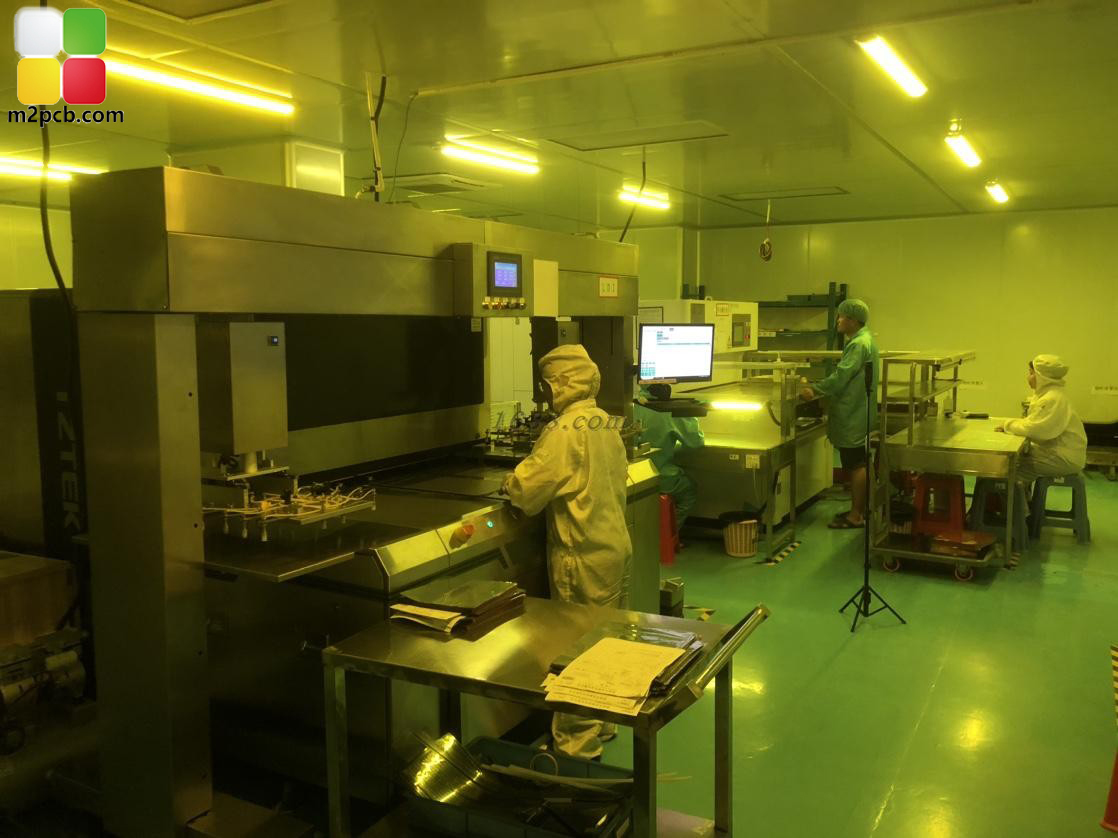
Automated exposure line for flexible circuit substrates at M2PCB’s 8,000m² facility.
Technical Explanation
Flexible PCB fabrication relies on polyimide (PI) substrates for thermal stability and bend resistance. M2PCB produces 1 to 14 layer flexible boards. Key process steps include drilling, exposure, surface coating, PI reinforcement, hot pressing, and oven curing. Each step is performed in-house, enabling tight quality control. The company also offers full turnkey PCBA, meaning components are sourced, placed, and soldered on site, followed by electrical testing (line testing) and visual inspection. This vertical integration allows M2PCB to trace defects to a single point of responsibility, rather than coordinating across multiple vendors.
Application / Use-Case Scenarios
Two primary application areas drive M2PCB’s production. First, LED lighting: flexible circuits are used in linear strips, panels, and custom-shaped luminaires. The company’s LED PCB capability enables both rigid-flex and pure flex designs. Second, medical aesthetics: M2PCB states it specializes in “medical beauty circuit boards,” which require high-reliability, biocompatible materials and precise impedance control. Additional applications include consumer electronics (where mobile phones represent 55.8% of global FPC value) and automotive (IATF 16949 compliance is noted in M2PCB’s earlier publications).
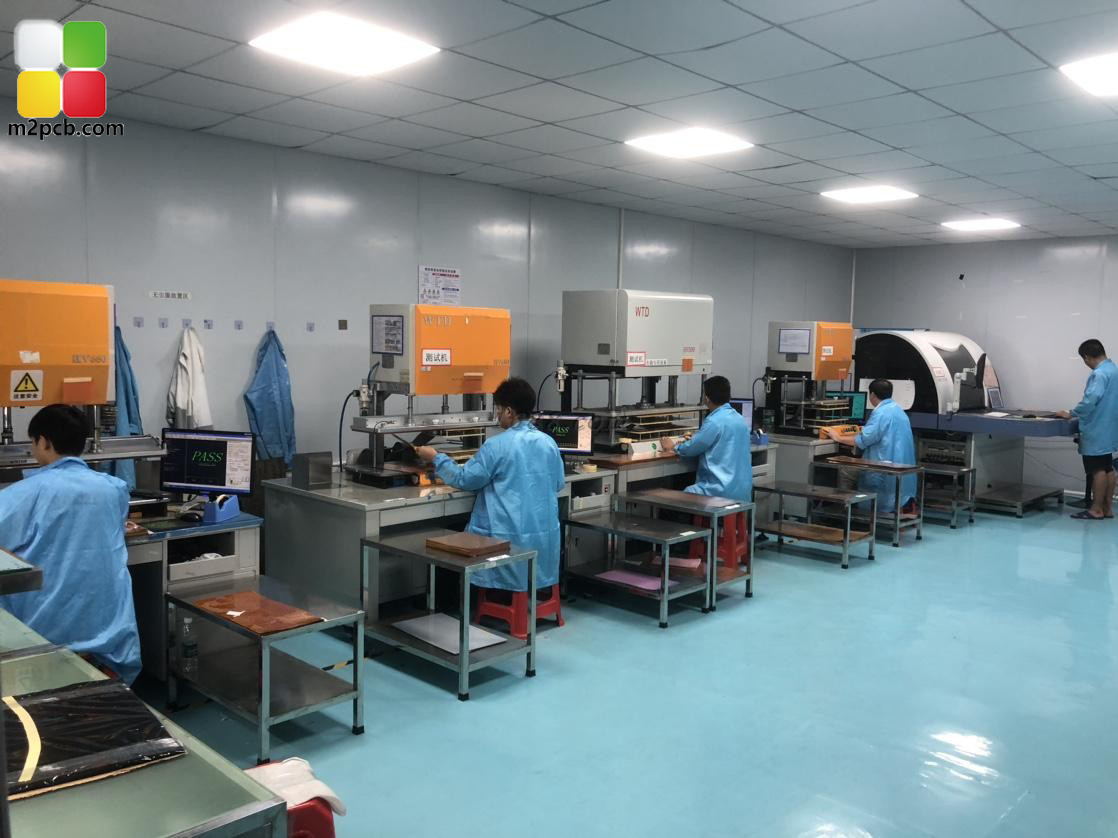
Automated electrical testing ensures each flexible circuit meets IPC-6013 performance standards.
Market Trend Analysis
Verified third-party data indicates that the FPCB market is growing robustly, driven by mobile devices, automotive electronics, and medical wearables. China’s PCB industry revenue is expected to reach USD 120.8 billion in 2024, with exports accounting for ~16.5% (IBISWorld). Major global manufacturers such as Zhen Ding Technology (19.9% market share), Dongshan Precision (14.6%), and Nippon Mektron (13.0%) dominate the high-volume segment. However, mid-volume buyers often find these suppliers rigid in customization and minimum order quantities. Source factories like M2PCB fill the gap by offering flexible batch sizes (as evidenced by 800 monthly varieties) and direct engineering support.
Comparison with Traditional Solutions
Compared to ordinary suppliers that subcontract each stage, M2PCB’s one-stop model offers distinct advantages: lower overall cost (no intermediary margins), higher operational efficiency (single point of contact, no multi‑vendor coordination), and shorter R&D-to-production lead time. An honest limitation is that for extremely low-volume prototypes (e.g., <5 boards) where rapid turnaround is required, a dedicated prototype shop may offer quicker delivery due to simpler logistics. M2PCB’s strength lies in series production and repeat orders, where the integrated model yields maximum cost and reliability benefits.
Future Outlook
As the FPCB market approaches USD 50 billion by 2030, buyers will increasingly demand end-to-end accountability. Source factories that invest in advanced equipment and retain in-house R&D—like M2PCB, which commits over 30 engineers to its technical team—are well positioned to capture demand from green energy, medical aesthetics, and automotive segments. The trend toward vertical integration will likely accelerate, making the decision framework presented here a critical tool for procurement managers.
FAQ
How can buyers verify RoHS/REACH compliance when sourcing from a Chinese source factory?
M2PCB requires its raw material suppliers to provide RoHS/REACH compliance declarations before any production batch, and internal records are maintained. Buyers should request these declarations for each material lot; the company’s quality system audits ensure traceability.
What are the key differences between a source factory and an ordinary supplier for flexible PCBs?
A source factory like M2PCB performs design, fabrication, SMT assembly, and testing in one location, eliminating the need to manage separate vendors. This reduces coordination cost, shortens overall time-to-market, and provides a single point of responsibility for quality. Ordinary suppliers typically subcontract each step, adding margin and communication complexity.
Does M2PCB support flexible PCB prototyping before mass production?
Yes. M2PCB’s R&D sampling service allows customers to test fit and performance before committing to volume orders. The company’s monthly output of 800 varieties indicates strong flexibility in batch sizes and quick-turn capabilities.
What certifications does M2PCB hold for international markets?
M2PCB operates under an ISO quality system, and many of its materials have attained UL and RoHS approval. It also references IATF 16949 certification in its publications for automotive applications. Buyers should request current certificates directly for their specific compliance requirements.
For detailed specifications, current certifications, or to discuss your custom flexible PCB project, contact M2PCB directly.
Email: pcb@dreamlandpcb.com | Tel/WhatsApp: +86 136-2262-8609