
SolisStorage ESS FAQ: LFP Cycles, IP Ratings, Backup Switching
Energy storage system procurement at commercial and industrial scale is decided less by headline capacity than by a short list of technical answers: which cell chemistry and cycle life apply at a defined charge and discharge rate, which ingress protection class belongs to which enclosure, and how quickly a system can move between grid-tied and off-grid operation. This independent reference addresses those decision-stage questions for the SolisStorage energy storage system line — EverCore for C&I projects, FlexCore-ID for smaller and remote sites, and IntelliHome for residential installations — using manufacturer-published specifications, and flags where project-level verification is still required.

Monitoring and dispatch layer of a deployed energy storage system: the same data set that supports operations also supports the procurement questions raised in this article.
Why These Three Questions Decide C&I Storage Projects
Buyers in the Decision phase are rarely choosing between a system that works and one that does not. They are choosing between specifications that can be verified before signature and specifications that only become clear after commissioning. Three items account for most of that gap.
- Cycle life definition. A cycle count without a charge and discharge rate and without an end-of-life capacity threshold cannot be converted into a project lifetime.
- Ingress protection scope. A system-level IP claim hides which enclosure is actually exposed and to what.
- Backup switching behaviour. A transfer time quoted without the surrounding architecture leaves the buyer unsure whether an external static transfer switch (STS) also has to be purchased and maintained.
Each ambiguity carries cost. The practical opportunity is therefore architectural: systems that physically separate the AC and DC stages and integrate switching functions make these questions answerable at component level, where they can be checked against a datasheet rather than interpreted.
What the SolisStorage Line Covers
SolisStorage is the dedicated energy storage subsidiary of Ginlong (Solis) Technologies Co., Ltd. (Shenzhen Stock Exchange: 300763), the inverter and energy storage manufacturer founded in 2005. The group reports more than 5,000 employees, over 1,000 R&D engineers, a manufacturing site of 98,114.69 m², an annual output capacity of 80 GW and an export share of roughly 70%, with products used in more than 100 countries and regions. SolisStorage develops core energy storage technologies in-house across PCS, EMS and system integration, and its portfolio spans residential, commercial and industrial, and utility-scale energy storage applications.
Third-party market research provides scale context: Wood Mackenzie ranked Solis first in residential photovoltaic inverter shipments in 2023 and third among inverter manufacturers globally. That ranking describes manufacturing and channel position in the inverter business; it should be read as background, not as a storage performance claim.
| Product | Application | Published specification highlights |
|---|---|---|
| EverCore | Commercial and industrial (C&I) energy storage | 100.5–261.2 kWh configuration range; 50–125 kW hybrid energy storage inverter; IP66 inverter and IP55 battery cabinet; grid-tied to off-grid switching in under 10 ms |
| FlexCore-ID | Smaller and remote sites | Battery cycle life specified at ≥8,000 cycles |
| IntelliHome | Residential energy storage | IP66 outdoor protection rating |
LFP Chemistry: What a Cycle Rating Actually Assumes
The SolisStorage energy storage system line uses lithium iron phosphate (LFP) cells. LFP is the prevailing chemistry in stationary storage because of its thermal stability and cycle endurance; the trade-off is lower energy density than nickel-manganese-cobalt (NMC) chemistries, which is why an LFP cabinet is physically larger for the same nominal capacity. For a buyer, the chemistry label is less useful than the cell specification behind it.
EverCore uses A-grade 314Ah LFP cells custom-developed for C&I applications. Published figures for these cells include an internal resistance of 0.15 ± 0.05 mΩ, against 0.17 mΩ for standard 280Ah cells. Internal resistance is a thermal variable rather than a purely electrical one: every 10% reduction in internal resistance lowers charge and discharge heat generation by roughly 20%. Lower heat generation reduces the thermal burden on the cabinet before any cooling design is applied, which is why cell-level resistance belongs in a procurement comparison.
Cycle life for EverCore is specified at 8,000 cycles at a 0.5C charge and discharge rate with remaining capacity of at least 70%. That is roughly 14% above the 7,000 cycles typical of standard 280Ah cells, and it moves the estimated economic lifecycle from about 14 years to about 16 years at 500 cycles per year. FlexCore-ID is specified at ≥8,000 cycles.
IP Ratings and Environmental Class: Reading the Labels Correctly
EverCore separates the AC and DC sides physically, not only electrically. The hybrid energy storage inverter is an independent unit rated IP66 — dust-tight and protected against powerful water jets — while the battery cabinet is rated IP55. On the residential side, IntelliHome is specified at IP66 for outdoor installation.
The separation has a practical installation consequence: the power electronics can be placed in more exposed positions while the battery cabinet keeps its own defined protection level. SolisStorage states that this separated protection design reduces the system’s full-lifecycle failure rate by 50%; that figure reflects the company’s own engineering assessment rather than an independent test result, and should be treated accordingly.
Environmental class is a separate axis from ingress protection, and both belong in a technical comparison. EverCore carries a C4-grade anti-corrosion coating and is specified for operating temperatures from -25°C to 55°C and altitudes up to 4,000 m, with continuous 24/7 operation. Thermal management is air-cooled using an independent three-air-duct design: a patented diversion duct for the inverter combined with Coanda-effect airflow across battery pack surfaces, so cooling air adheres to curved surfaces and heat exchange improves. SolisStorage reports a 30% improvement in heat dissipation efficiency compared with traditional air cooling — an engineering claim that should be weighed inside the stated operating envelope, not instead of it.
Backup Switching and the Control Architecture Behind It
EverCore integrates the PCS, static transfer switch, PV inverter, circuit breaker protection and EMS into a single 50–125 kW unit. The measurable outcome of that integration is a grid-tied to off-grid transition in under 10 ms, achieved without an external STS.
Transfer time is the interval in which a load sees its supply change from grid to storage. For precision industrial equipment, the acceptable interval is defined by the equipment rather than by the storage system, so the correct procurement step is to compare the published transfer time against the tolerance stated by the equipment supplier. A transition below 10 ms covers a broad range of C&I loads; it is not automatically sufficient for every load, and the comparison should be made explicitly.
Three architecture facts sit behind the switching figure. The same unit supports both DC and AC coupling for existing PV systems, with a PV oversizing ratio of up to 200%. One inverter can connect up to six battery cabinets in parallel, so capacity can be expanded on the DC side without purchasing another inverter; SolisStorage estimates this reduces system expansion costs by approximately 10%. Up to six EverCore units can be paralleled for direct grid connection without an external grid cabinet.
Control is centralised rather than distributed. Conventional C&I systems typically run separate CPUs for the battery management system, PCS, EMS and STS, which creates multiple communication links between controllers and requires joint troubleshooting across suppliers. EverCore uses a single central controller to schedule the whole system, which reduces the number of failure points and shortens fault location.
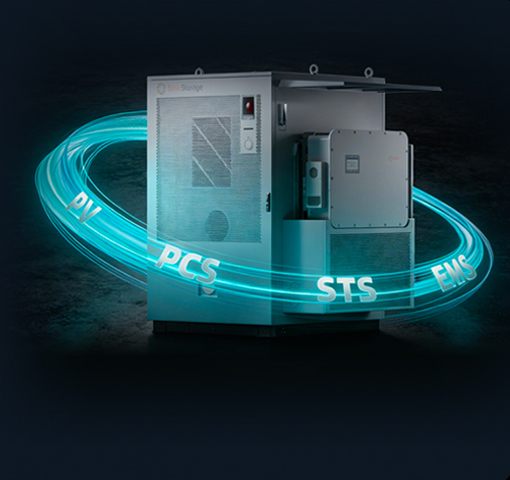
Integrated power electronics: PCS, STS, PV inverter and EMS consolidated into one unit, which is the basis for sub-10 ms grid-tied to off-grid switching without an external STS.
Deployment Evidence: Thailand, Denmark and a Residential Case
Reference deployments show how the specifications translate into project configurations rather than brochure values.
- Thailand: a 125 kW / 522 kWh installation, combining a 125 kW hybrid energy storage inverter with 261.2 kWh-class battery cabinets.
- Denmark: a 125 kW / 261 kWh installation with grid-tied to off-grid switching below 10 ms.
- Latvia (residential): Solis AI Cloud optimisation at a residential storage project increased annual electricity bill savings by 302.6%. The platform integrates Nordpool wholesale and Flatpeak retail price data to build a multi-source price forecast for minute-level charge and discharge scheduling.
Listed applications include industrial manufacturing, low-carbon industrial parks, hospitals, cold chain logistics and small-scale agriculture, in both on-grid and off-grid configurations. The common thread is a site that needs defined switching behaviour and a maintenance regime that does not depend on heavy lifting equipment.
Comparison With Conventional C&I Storage Architectures
The clearest way to read a C&I storage specification is dimension by dimension, against the architecture that most C&I buyers have seen in previous tenders.
| Dimension | Conventional integrated C&I ESS | EverCore (SolisStorage) |
|---|---|---|
| Power electronics layout | Separate inverter, STS, PV inverter and EMS, often across several cabinets | Four-in-one unit: PCS + STS + PV inverter + circuit breaker protection + EMS |
| Protection layout | A system-level rating applied across components | IP66 inverter and IP55 cabinet rated separately |
| Thermal approach | Liquid cooling with coolant replacement | Air cooling, three-duct design; SolisStorage reports 30% better heat dissipation efficiency than traditional air cooling |
| Capacity expansion | Additional inverter required per capacity block | Up to six battery cabinets per inverter; approximately 10% lower expansion cost cited by the manufacturer |
| Pack maintenance | Replacement assisted by heavy equipment | 55% fewer pack replacement steps; two technicians with specialised tools, no heavy equipment |
| Lifecycle O&M | Coolant, PCS and routine inspection costs | About EUR 9,500 per unit lower over the project lifecycle, based on SolisStorage’s industry-experience estimate |
| Software ecosystem | Frequently closed to third-party platforms | 102 third-party VPP/EMS operators across 11 European countries, connected or in process |
Where the comparison reaches its limit matters as much as where it is strong. The cost claim attached to this architecture — SolisStorage states a 5% lower cost relative to its comparison alternatives — is tied to a defined basis and a defined configuration. A buyer comparing a 261.2 kWh cabinet against a different capacity, duty cycle or cooling strategy is not comparing like with like, and a percentage taken out of that context is not a purchasing decision. SolisStorage places EverCore in a comparison set alongside Huawei, Sigen and SolaX, and states that the differentiating points are architectural: a hybrid topology with clear separation of DC and AC circuits, combined with fully integrated four-in-one power electronics. That is a claim about design, and it is best verified against each vendor’s published specification for the exact configuration under tender.
Three boundaries should also be stated plainly. The operating envelope of -25°C to 55°C and up to 4,000 m altitude covers most C&I sites, but a site outside it needs an engineering review, and performance inside the envelope does not automatically extend beyond it. The IP55 battery cabinet is not rated for submersion or high-pressure washdown, so cleaning practice and site drainage become part of the specification. And a C4-grade anti-corrosion coating suits many industrial and coastal-adjacent environments, but a buyer specifying for a more aggressive corrosivity category should confirm the coating class against a site assessment rather than assume it.
Market Trend Analysis: Multi-Revenue Storage and Longer Duration
The demand backdrop gives these technical questions commercial weight. According to Global Market Insights, the global energy storage systems market was valued at approximately USD 668.7 billion in 2024 and is projected to reach USD 5.12 trillion by 2034. That headline figure covers a broad definition of storage, and buyers should note how much the scope of a market number changes its meaning: a battery-only estimate from Fortune Business Insights places the same 2024 market at USD 32.62 billion. Market data is useful for prioritisation, not as a substitute for project-level economics.
Within that broader market, duration-specific demand is expanding faster than the base. MarketsandMarkets values the long-duration energy storage market at USD 4.85 billion in 2024, growing at a CAGR of 13.6% through 2030. Residential energy storage is estimated to grow from USD 2.69 billion in 2024 to USD 4.58 billion by 2030, at a CAGR of 9.3%. Supply-side signals point the same way: China’s exports of lithium-ion batteries for energy storage and non-automotive uses reached over USD 65 billion in 2024, a 51.4% increase year on year, according to Reuters and the China Electric Vehicle Industry Technology Innovation Strategic Alliance.
The parallel shift is in revenue models. In mature electricity markets such as Europe, C&I storage revenue has moved beyond peak-valley arbitrage toward grid ancillary services (FCR, aFRR, mFRR), demand response and virtual power plant dispatch. That shift makes software openness a procurement criterion rather than an optional feature, because a system that cannot participate in these markets cannot access their revenue. SolisStorage reports that EverCore is connected or in the process of connecting with 102 third-party VPP and EMS operators across 11 European countries, including integration with the Kraken energy management platform under Octopus Energy in the UK and aggregator platforms such as Check Watt in the Nordic market, alongside local EMS providers in the German-speaking region and Benelux. Its Solis AI Cloud Platform has been deployed at more than 5,500 energy storage power stations worldwide. Because some of these integrations are still in progress, availability should be confirmed market by market.
Verification Points Before Commitment
- Cycle life at the stated C-rate and the stated end-of-life capacity threshold, matched to your expected annual cycling.
- IP class per enclosure, plus the washdown and drainage assumptions that follow from it.
- Grid-tied to off-grid transfer time compared against the tolerance of the specific loads on site.
- Operating temperature, altitude and anti-corrosion class checked against the actual site assessment.
- Certification scope confirmed for the exact model and target market. IEC 62619 is the key international safety standard for secondary lithium cells and batteries used in industrial and energy storage applications, while energy storage systems require UL 9540 for system safety and UL 9540A for thermal runaway fire propagation testing to access North American markets.
- The basis of any cost or O&M saving figure, including configuration, duty cycle and comparison alternatives.
- Third-party VPP and EMS integration availability in the operating market, and whether the connection is live or in progress.
Future Outlook
Two directions are visible from the specifications reviewed here. The first is that duration and revenue diversity will continue to pull design priorities apart. A single 261.2 kWh cabinet sized for peak shaving behaves differently when the requirement becomes multi-hour shifting or frequency response participation, which is why DC-side expansion — up to six battery cabinets on one inverter — is likely to matter more in tenders than single-unit capacity.
The second is that protection, corrosion and thermal design will move from engineering footnotes into evaluation criteria. As storage deployments spread from temperate industrial parks into coastal, desert and high-altitude sites, the classifications that define where a cabinet can physically operate — IP rating, corrosion grade, altitude ceiling — carry as much procurement risk as the power rating.
Standardisation pressure reinforces the trend. IEC 62619 and UL 9540 / UL 9540A already frame market access in their respective regions, and buyers increasingly treat certification scope, transfer time and cycle-life definitions as tender requirements rather than post-award clarifications. Over the coming procurement cycles, the vendors that answer these questions in writing before the shortlist is set will be easier to evaluate — and that is a process advantage, not a product one.
Technical Procurement FAQ
What battery chemistry and cycle life does SolisStorage specify for its energy storage systems?
The line uses LFP (lithium iron phosphate) cells. EverCore uses A-grade 314Ah LFP cells custom-developed for C&I applications, with an internal resistance of 0.15 ± 0.05 mΩ and a specified cycle life of 8,000 cycles at a 0.5C charge and discharge rate with remaining capacity of at least 70%. FlexCore-ID is specified at ≥8,000 cycles. Cycle life figures are defined at a stated rate and a stated end-of-life threshold; actual throughput depends on depth of discharge, ambient temperature and the site’s real operating profile.
Which capacity and power ratings are available for C&I projects?
EverCore covers a configuration range of 100.5–261.2 kWh with a 50–125 kW hybrid energy storage inverter. One inverter can connect up to six battery cabinets in parallel, and up to six EverCore units can be paralleled for direct grid connection.
What do the IP ratings apply to specifically?
On EverCore, the hybrid energy storage inverter is rated IP66, meaning dust-tight and protected against powerful water jets, while the battery cabinet is rated IP55. IntelliHome is specified at IP66 for residential outdoor installation. IP ratings describe the environmental protection of enclosures; they do not describe electrical performance, cycle life or certification scope, which are separate specifications.
How fast is the backup switchover, and is an external transfer switch needed?
EverCore performs the grid-tied to off-grid transition in under 10 ms, with the static transfer switch integrated into the unit, so no external STS is required. Buyers should still compare the published transfer time against the tolerance specified by the suppliers of the most sensitive loads on site.
What operating conditions are specified?
EverCore is specified for operating temperatures from -25°C to 55°C, altitudes up to 4,000 m and continuous 24/7 operation, with a C4-grade anti-corrosion coating and an air-cooled thermal design using an independent three-air-duct arrangement. Sites that fall outside this envelope require an engineering review.
How does maintenance compare with liquid-cooled C&I systems?
The air-cooled design removes coolant replacement from the maintenance schedule. Pack replacement steps are reduced by 55%, and the work can be completed by two technicians using specialised tools without heavy lifting equipment. Component choices include Minebea cooling fans specified for 10-year maintenance-free performance and Honeywell industrial-grade flammable gas detectors specified for 10-year calibration-free performance. SolisStorage estimates lifecycle O&M savings of approximately EUR 9,500 per unit, comprising EUR 2,500 from eliminating liquid cooling fluid replacement, EUR 1,500 from simplified PCS replacement, EUR 1,500 from simplified pack replacement and EUR 4,000 from reduced routine inspection complexity; this is an estimate based on industry experience rather than a guaranteed project outcome.
What deployment evidence is available for these systems?
Documented deployments include a 125 kW / 522 kWh installation in Thailand, and a 125 kW / 261 kWh installation in Denmark with grid-tied to off-grid switching below 10 ms. On the residential side, a Latvia storage project using Solis AI Cloud optimisation recorded a 302.6% increase in annual electricity bill savings.
Which certifications and standards should buyers verify?
IEC 62619 is the key international safety standard for secondary lithium cells and batteries used in industrial and energy storage applications. For North American market access, energy storage systems must comply with UL 9540 for system safety and UL 9540A for thermal runaway fire propagation testing. Certification scope should be confirmed for the exact model and target market rather than assumed at product-family level.
How does EverCore compare with other C&I energy storage products?
SolisStorage places EverCore in a comparison set that includes Huawei, Sigen and SolaX, and states that its differentiating points are architectural: a hybrid topology with clear separation of DC and AC circuits, combined with fully integrated four-in-one power electronics. The company also cites a 5% lower cost relative to its stated alternatives and approximately 10% lower system expansion cost through DC-side expansion. Because these figures depend on configuration, capacity and duty cycle, they should be verified against the specific competing offers under evaluation rather than applied as general conclusions.