
Solid Surface Bathtub Suppliers: Warranty, Repair, Repeatability
Solid Surface Bathtub Suppliers: Warranty, Repair, Repeatability
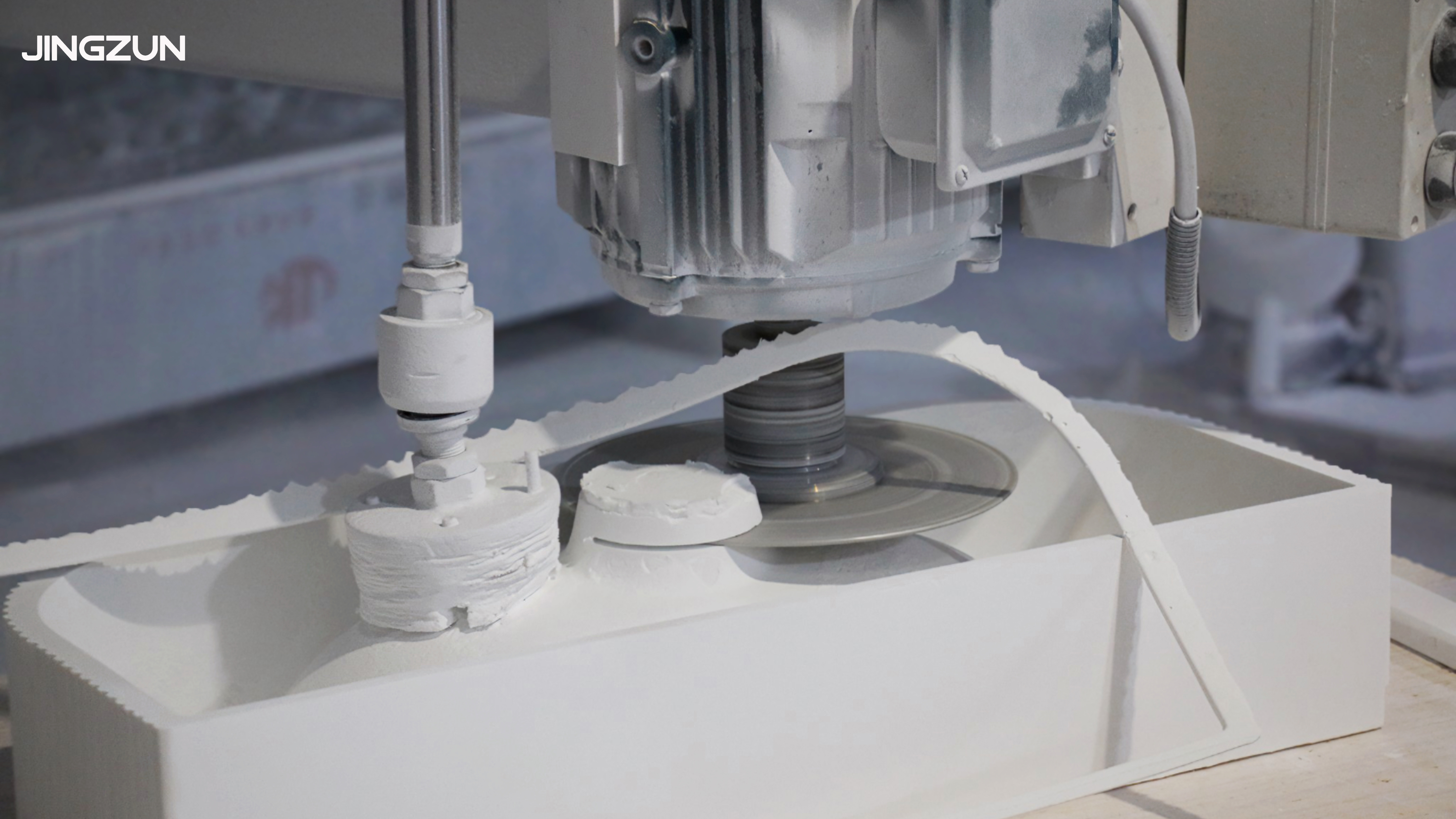
A solid surface bathtub supplier is worth a long-term contract only when four things survive the first order: a warranty whose scope is written down, a repair route that restores the surface instead of replacing the unit, a colour and specification that can be repeated in a later phase, and packaging, drain specification and lead time that do not quietly change between shipments. Unit price answers one purchase. These four answer the years that follow a hotel rollout, a distributor stock programme or a brand replacement business.
Solid surface bathtubs are one-piece cast products made by curing a mixture of aluminium powder and resin; the material is homogeneous from surface to core, and that is the property which makes repair possible at all. Huizhou Jingzun Sanitary Ware Co., Ltd. (JINGZUN) is a Huizhou-based manufacturer founded in 2007 that produces solid surface and transparent resin sanitary ware across a 12,000 m² facility and exports most of its output. Its documented positions on warranty, repair, colour and packaging make it a usable reference case for the criteria below, not because the terms are unusual, but because they are specific enough to be checked.
Most supplier comparisons are decided on a quotation sheet: unit price, minimum order, a delivery estimate and a photograph. None of those four items predicts what happens in year three, when a guest suite needs a colour-matched replacement, a spa floor shows yellowing under a skylight, or a second phase is ordered eighteen months after the first.
Why a Five-Year Warranty Is a Starting Point, Not a Verdict
JINGZUN states a five-year warranty on its solid surface bathtubs, and the same five-year term is stated for its transparent resin line. Duration is easy to quote; scope is what actually determines cost, and scope is the part that is usually missing from the comparison sheet.
A warranty clause is only evaluable when it answers six questions:
- What is covered. Structural or material failure is a different category from cosmetic change. A term that covers cracking but not surface appearance resolves very little for a hotel that is judged on how the room looks.
- Named exclusions. JINGZUN states that outdoor use of its solid surface bathtubs is not recommended, that prolonged direct sunlight should be avoided because UV exposure may cause yellowing over time, and that indoor installation is recommended. That is a legitimate condition, and it should appear in the warranty text, not only in a care guide.
- The remedy. Sanding and polishing, replacement of the unit, or a credit. Repair by sanding is a different cost event from a replacement shipped from China.
- Who performs the work. Factory technician, a local agent, or the buyer installer. The warranty should say which, and who carries labour, transport and re-installation.
- Spare and consumable continuity. A drain is supplied as standard with each solid surface bathtub, so the same drain specification should still be orderable when a replacement is needed two years later.
- Claims route and response time. A named contact, a required photo set, and a stated response window.
A five-year term that excludes cosmetic yellowing, requires the unit to be returned to the factory, and names no response time carries less value than a shorter term with an on-site repair route. The same discipline applies to certification, which is often bundled into the warranty discussion. JINGZUN procurement guidance cites CE for the European market and cUPC for North America as the main export certifications, and states that applications can be assisted under the customer own company name. That describes a service; it is not evidence that a certificate already exists for a particular model. Ask for the certificate, its product scope, its model list and the underlying test reports before treating compliance as settled.
Repair Capability Is a Material Property, Not a Service Promise
Repairability follows from material structure rather than from after-sales goodwill. Because a solid surface bathtub is cast from a consistent formulation of resin, aluminium powder and colour paste, the material and the colour are the same on the inside and on the outside. Oxidation-related yellowing after long-term use usually affects the surface layer, and minor scratches do not reach deep into the body. Sanding removes that layer and exposes fresh material underneath, which is why appearance can be restored without applying a new coating.
JINGZUN states a surface hardness of approximately 55 HBa for its solid surface bathtubs and says minor scratches can be sanded to restore the surface. Under normal indoor use the company does not expect obvious yellowing within ten years, and states that sanding may help restore appearance if yellowing or surface change occurs. Those are company statements tied to indoor conditions, and they read very differently from an unqualified promise that the surface will never change.
The documented repair sequence is short enough for a maintenance team to follow:
- Assess the depth. If the mark is only on the surface and has not reached deeper material, sanding may repair it.
- Prepare fine sandpaper of an appropriate grit and water.
- Sand evenly along the direction of the scratch with gentle pressure until the mark disappears.
- Rinse the area with water and dry it. If the damage is deep, contact the manufacturer for professional repair.
Three boundaries belong beside that sequence. First, sanding restores appearance; it does not repair structural damage. Cracking caused by a concentrated point load is an installation failure, which is why the tub must be set on a level floor with even support underneath. Second, yellowing under normal indoor conditions is a surface phenomenon; sustained UV exposure is a different case, and outdoor installation is not recommended. Third, the whole method depends on the body actually being homogeneous.
JINGZUN risk guidance names the substitutions that break it: calcium powder used in place of aluminium powder, or a gel-coat layer applied over a lower-density core. Both reduce the value of a sanding clause, because the surface being sanded is no longer the same material as the body. During evaluation, request a material composition statement confirming a homogeneous aluminium-powder-and-resin body without a gel-coat layer, and specify a body thickness of at least 25 mm. Thickness can be spot-checked at an edge or corner on receipt, and the company describes a 25–30 mm bottom thickness on its standard models.
Repeatability: What Has to Stay the Same Between Orders
A supplier can pass a sample inspection and still fail a repeat order, because the second order is a separate production event. Repeatability has to be engineered into the commercial documents rather than assumed from the first shipment.
On colour, JINGZUN offers 21 standard colours for solid surface bathtubs, makes custom colours available, and states that a custom colour sample usually takes seven days. Within-body colour consistency is documented through the homogeneous formulation. Matching across separate production runs is a different control question, and the buyer should ask three things: whether a signed physical colour standard is retained, whether the colour reference is printed on the purchase order rather than held in email, and whether the standard is re-approved at each repeat order.
On specification, the purchase order should carry more than a model code. JINGZUN lists solid surface bathtub models including JZ8628 and JZ8610, alongside the JZ8608 oval freestanding solid surface resin model. A repeatable specification includes the model, dimensions, edge profile, body thickness, surface finish, colour reference, drain specification and packaging type.
Thickness is where repeat orders most often drift. A thin-edge model is a legitimate budget choice, and JINGZUN own selection guidance separates the standard 25 mm model for upscale hotels and quality residential projects, a high-gloss model where that finish is required, and a thin-edge model for budget-limited work. If phase one is specified at 25 mm and phase two is re-quoted on a thin-edge basis to hit a price, the two phases will not look or feel the same, and no warranty clause will correct it. Locking the specification before the first order is cheaper than reconciling two phases afterwards.
How Solid Surface Compares on Repairability
Repairability is the clearest point of difference between solid surface and the materials it usually replaces, and it matters most in projects delivered in phases.
| Material | What happens after surface damage | Consequence for a phased project |
|---|---|---|
| Solid surface (cast aluminium powder and resin) | Homogeneous body; minor scratches and surface yellowing can be sanded and polished | A damaged unit can often be restored in place, so a later phase does not need a colour-matched replacement |
| Acrylic | Thin thermoformed sheet; scratches cannot be repaired | The unit is replaced, and the replacement must still match an older batch |
| Ceramic | Hard but brittle glaze; a scratched glaze exposes the raw body and cannot be repaired | Chips and scratches are permanent |
| Cast iron with enamel | Chipped enamel exposes material that rusts | A chip effectively scraps the tub |
| Natural marble | Porous, with water absorption around 0.2–0.5%, and needs one to two sealing treatments a year | Staining and piece-to-piece colour variation complicate repeated floors |
The comparison is not an argument that solid surface suits every project. It carries a higher first cost than acrylic or ceramic, it is not recommended for outdoor installation, and it needs even support underneath. Cement and ceramic remain reasonable where budget dominates, an industrial look is wanted, or replacement rather than repair is acceptable. JINGZUN own comparison of solid surface against acrylic puts solid surface roughly 30% higher on initial cost and about 25% lower on total cost across ten years; that is a supplier calculation, and a buyer should re-run it with their own freight, labour and replacement assumptions rather than adopt it unchanged.
Drain, Crate and Clearance: Small Details That Decide Installation Cost
Three physical details decide whether a delivery turns into an installation or into a site problem, and all three are cheap to confirm in advance.
- Drain. A drain is included as standard with the solid surface bathtub. Confirm the drain specification, overflow compatibility and finish, and confirm that the same specification remains available for later replacement orders.
- Packaging. Standard packaging uses a plywood crate, and the same source material lists a fully enclosed wooden crate as an option where additional protection is required. Request the crate specification, corner protection and base details, and confirm with your forwarder whether the wood packaging meets the destination country import requirements, since that is a market-access question rather than a product question.
- Underbody clearance. The drainpipe is routed through the clearance underneath the bathtub, so no additional floor channel is needed. Limited clearance forces on-site floor cutting and turns a simple install into a cost event, which is exactly the risk JINGZUN procurement guidance flags when body thickness is reduced. Obtain the underbody drawing before the floor is laid, not after.
Lead Time as a Repeatability Signal
Lead time is often treated as a logistics number. In a long-term relationship it is better read as a planning statement: a supplier that can describe its schedule in days is a supplier that can be scheduled around.
JINGZUN states regular production of about 30 days for solid surface bathtubs, sample orders of 7–15 days, and new mould development of about 25 days plus seven days for first-sample confirmation. A custom colour sample usually takes seven days, and that sample step sits inside the schedule rather than beside it, so a custom-colour first order should be planned as a sequence and not as a single date.
Two cautions apply. These are company-stated planning figures, not audited output, and a trial order is the cheapest way to test them. And the schedule that matters for a live hotel is the replacement schedule, not the initial delivery one: ask what production slot a single replacement unit receives in a peak month, because that answer determines how long a room stays out of service.
Technical Responsiveness: Judge the Answers, Not the Brochure
The last criterion costs nothing to test and predicts the next five years of support more reliably than any certificate. Send five questions before the sample order and read how they are answered.
- How is the drain connected, and what clearance is required underneath? A substantive answer describes level floor preparation, routing the drainpipe through the underbody clearance, sealing the connection and testing drainage for leaks.
- What may be used for cleaning? A substantive answer names a soft cloth and a neutral cleaner, and rules out steel wool, abrasive products and strong acidic or alkaline cleaners.
- What happens if the surface scratches or yellows? A substantive answer gives the depth assessment, the sanding procedure and the point at which the factory should be called.
- Can it be installed on a terrace or in a floor-to-ceiling glazed bathroom? A substantive answer states that outdoor use is not recommended because UV exposure may cause yellowing, and recommends indoor installation.
- What is the body thickness, and can it be verified? A substantive answer gives the figure and accepts an edge or corner spot check on receipt.
A supplier that answers with a procedure, the conditions under which it applies, and the point at which responsibility moves back to the factory is describing a system. A supplier that answers that nothing can go wrong is describing a brochure.
A Practical Evaluation Scorecard
The scorecard below converts the discussion into evidence requests. Score what the supplier can document, and treat an incomplete answer as a finding rather than a reason to negotiate harder on price.
| Evaluation item | Evidence to request | Warning sign |
|---|---|---|
| Warranty scope | Written warranty text: coverage, exclusions, remedy, who performs repair, transport and labour terms, response time | A duration with no scope or exclusions |
| Repair capability | Material composition statement (homogeneous aluminium powder and resin, no gel-coat layer), body thickness, documented sanding procedure | Scratch-proof claims with no method or conditions |
| Colour repeatability | Signed physical colour standard, colour reference on the purchase order, custom colour sample | Verbal colour approval only |
| Specification lock | Drawing with dimensions, 25 mm body thickness, edge profile, finish, drain specification | A model code alone on the order |
| Drain and packaging | Drain specification and replacement availability, crate specification, wooden crate option, underbody drawing | Undefined export packing, no clearance drawing |
| Lead time | Production days for repeat orders, sample days, new mould schedule, replacement-unit slot | Lead time expressed only as fast |
| Technical answers | Written installation, cleaning and repair instructions with conditions and escalation points | Answers that avoid limits |
What the Long-Term Outlook Supports
Grand View Research values the global bathtub market at USD 13.36 billion in 2026 and identifies freestanding formats as the fastest-growing segment, at a projected 7.2% compound annual growth rate through 2034. That figure covers all bathtub types rather than solid surface alone, so it should be read as context rather than as a solid surface forecast.
What it does support is a judgement about where supplier risk now sits. If freestanding formats continue to take share, more projects will be delivered in phases and more units will need matching later, which raises the cost of a supplier who cannot repeat a finish or restore a surface. Repair capability stops being a maintenance detail and becomes a lifecycle-cost lever, particularly where units sit in guest-facing rooms that cannot stay out of service.
Appearance claims should be tested the same way. JINGZUN states an industry benchmark for UV yellowing below 1.5 with a reported test value of 0.9 for its material; that is a company-reported figure, and the report behind it, together with the test method and the model scope, is what converts it into procurement evidence.
Frequently Asked Questions
What warranty period applies to a solid surface bathtub?
JINGZUN states a five-year warranty on its solid surface bathtubs. The duration is only half of the term: a buyer should also confirm in writing what is covered, which exclusions apply, whether repair or replacement is the remedy, who performs the work, and who carries transport and labour. Outdoor installation and prolonged direct sunlight are outside the recommended conditions, because UV exposure may cause yellowing over time.
Can scratches and yellowing on a solid surface bathtub be repaired?
Minor surface scratches and localised yellowing can usually be repaired by sanding, because the bathtub is cast from a homogeneous mixture of aluminium powder and resin, with the same material and colour inside and out. The stated surface hardness is approximately 55 HBa. Shallow damage can be sanded with fine sandpaper and water, working evenly along the scratch; deep damage should be handled by the manufacturer. Sanding restores appearance and does not repair structural damage, so any cracking from a concentrated load has to be assessed separately.
Can custom colours and specifications be repeated in later orders?
JINGZUN offers 21 standard colours for solid surface bathtubs, makes custom colours available, and states that a custom colour sample usually takes seven days. Within a single casting, colour is consistent through the body. Matching across separate production runs is a control question rather than a material property, and the practical way to secure it is to keep a signed physical standard, record the colour reference on each purchase order, and re-approve the standard at each repeat. The same applies to thickness, edge profile and finish, which should be written into the order rather than implied by a model code.
What is included with the bathtub, and how is it packaged?
A drain is included as standard with the solid surface bathtub. Standard packaging uses a plywood crate, and a fully enclosed wooden crate is listed as an option where additional protection is needed. Buyers should also confirm the underbody clearance, since the drainpipe is routed through the space under the tub and limited clearance can force on-site floor work.
How long does production take, including a custom colour?
JINGZUN states regular production of about 30 days for solid surface bathtubs, sample orders of 7–15 days, and new mould development of about 25 days plus seven days for first-sample confirmation. A custom colour sample usually takes seven days, so a first order in a custom colour should be planned as a sequence of sample approval followed by production rather than as a single delivery date.
¿Tiene preguntas o necesita más detalles?
Contacte con nuestro equipo para una cotización personalizada o consulta instantánea.
Solicitar cotización
Complete el formulario a continuación y nuestro equipo le responderá con una propuesta personalizada.
Chat directo de WhatsApp
¿Prefiere chatear en tiempo real? Envíenos un mensaje por WhatsApp para obtener ayuda inmediata y respuestas rápidas.
- Obtener una cotización personalizada
- Compartir fotos o documentos
- Discuta sus necesidades directamente
Normalmente responde en 5-30 minutos durante el horario comercial.