
Solar Water Heater Technical & Procurement FAQ: MOQ, Lead Time, and Custom Collectors
Solar Water Heater Technical & Procurement FAQ: MOQ, Lead Time, and Custom Collectors
Commercial solar water heater projects are usually approved on engineering logic and then delayed on procurement details. Once a hotel developer, importer, or EPC contractor has settled the collector concept, the questions that decide whether an order moves forward are narrower: what minimum order quantity applies, how long production takes, whether the storage tank can be sized to the building, and which configuration — flat plate collector, evacuated tube, or PV solar water heater — the site can actually support. This FAQ answers those questions directly, using documented figures from Kesun Solar (Zhejiang Kesun New Energy Co., Ltd.) and published market data.
Why Procurement Details Decide Commercial Solar Projects
The solar water heater category is large and mature at the component level. Fortune Business Insights valued the global solar water heater market at USD 4.2 billion in 2025. The IEA Solar Heating and Cooling Programme reported cumulative global solar heat capacity of 560 GWth by the end of 2023, equivalent to roughly 800 million m² of collector area. Evacuated tube collectors accounted for a 44.2% revenue share in 2023, according to Grand View Research.
Category-level figures, however, do not resolve an individual purchase. For a buyer in the evaluation stage, the deciding variables are usually supply-side: whether a storage tank can be sized to the building's daily demand, whether the collector type suits the local climate, whether certification documents are current, and whether minimum order quantity and production lead time fit the project schedule. Suppliers that publish these manufacturing parameters are easier to evaluate, because commercial terms can be checked before technical negotiation begins.
Trade classification has also become part of procurement. HS code 841912 was introduced to differentiate solar water heaters from the generic 841919 code, as reported by Solar Heat Europe in 2023. Buyers importing solar thermal systems should confirm the applicable code with their customs broker, since the classification affects import documentation rather than product performance.
Kesun Solar: Manufacturer Profile and Product Scope
Zhejiang Kesun New Energy Co., Ltd., which markets under the name Kesun Solar, is a solar thermal manufacturer based in Haining, Zhejiang Province, China. The company was established in 2009 and was formed through the merger of Haining Ensun Solar Technology Co., Ltd., which focused on non-pressure solar water heaters, and Zhejiang Yile New Energy Co., Ltd., which specialized in pressurized solar water heaters. Its main product lines are solar water heaters, buffer tanks, domestic hot water tanks, and hybrid solar panels.
Documented manufacturing parameters include a 42,000 m² standardized manufacturing facility, 130 employees, a 15-engineer R&D team, and an annual output of 300,000 sets. Export accounts for 60% of business, with the main markets listed as Mexico, the EU, and Africa. The company website is www.kesunsolar.com.
Production capability has been upgraded rather than simply expanded. High-pressure automatic foaming machines replaced conventional foaming methods, robotic arms are used in packaging, and laser welding and butt welding have been added alongside TIG and high-frequency welding. An in-house laboratory allows reliability testing such as salt spray testing and pulse testing to be performed on site rather than outsourced. The company states that it supplies components to Fortune 500 companies in China and abroad. An Alibaba verified company profile reported export revenue of approximately USD 19.6 million in 2025.
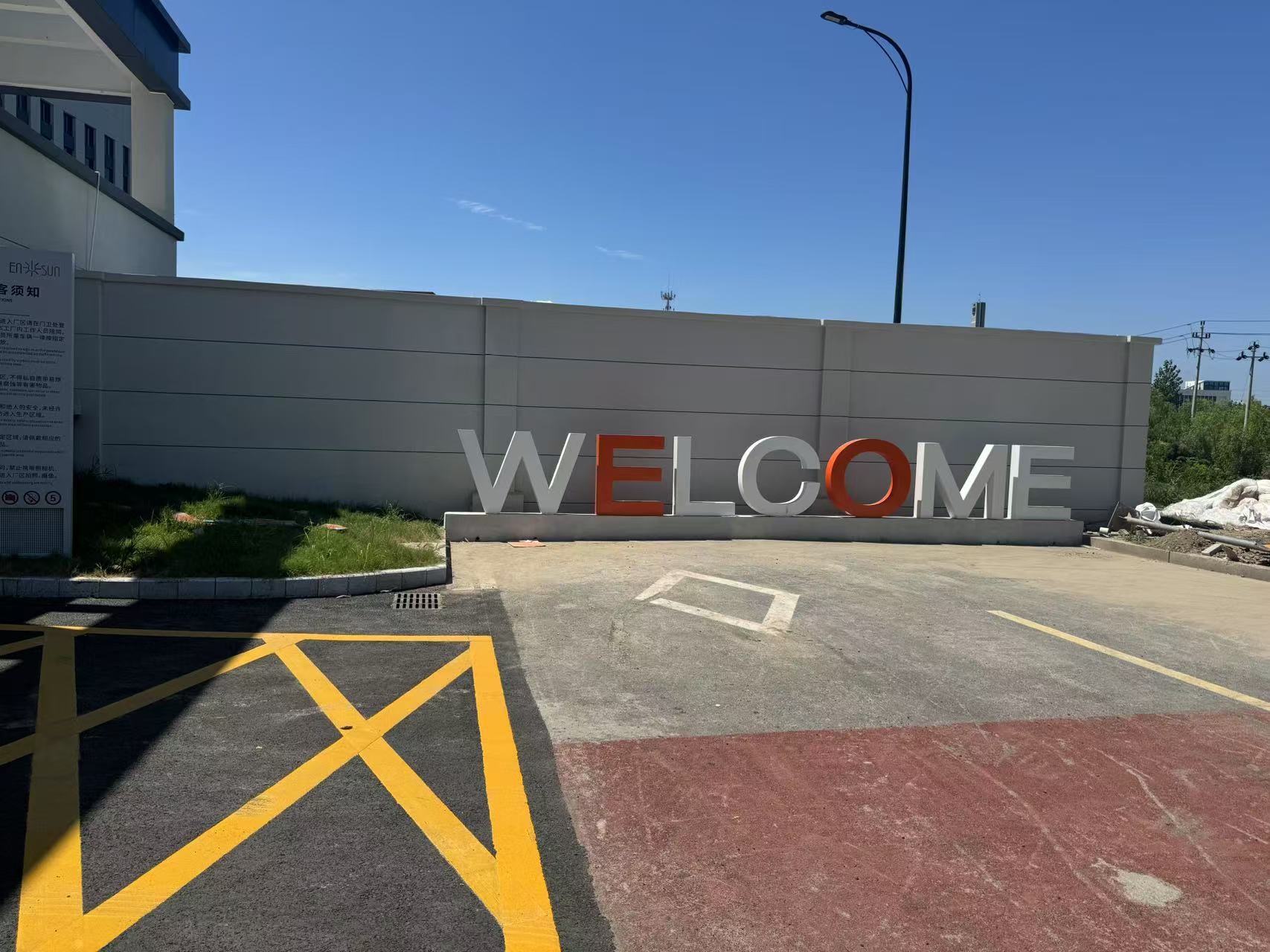
Manufacturing base for solar water heaters, buffer tanks and domestic hot water tanks — Kesun Solar, Haining, Zhejiang Province, China.
What this means for buyers: welding method, foaming equipment, and in-house reliability testing are the variables that surface later as pressure retention, leak rates, and warranty disputes. They are worth confirming during supplier evaluation rather than after delivery.
Solar Water Heater and Collector Configurations in the Current Range
| Series | Type | Capacity / size | Documented parameters | Typical applications |
|---|---|---|---|---|
| CPS series | High-pressure solar geyser | 100 L to 300 L | Maximum operating pressure 6 bar; test pressure 9 bar; 58-1800 vacuum tube with heat pipe absorber; 50 mm PU foam insulation; mounting angle 25 to 45 degrees; SS304, SS316, duplex stainless steel | House, villa, garden, gas station, car wash center, small hotel, school |
| CNP series | Non-pressure solar water heater | 60 L to 500 L | 58-1800 vacuum tube absorber; 50 mm PU foam insulation; mounting angle 25 to 45 degrees; SS304, SS316 | House, villa, garden, gas station, car wash center, small hotel, school |
| CPS-FJ series | Indirect solar water heater | 150 L, 200 L, 250 L, 300 L | Flat type solar collector; SPCC tank with enamel coating | Villa, house, hotel, school |
| HSC series | Heat pipe solar collector | 10 to 30 tubes | 58-1800 vacuum tube with heat pipe; aluminum alloy frame; aluminum alloy, copper, glass | Villa, hotel, house heating, spa center, school |
| FPC2.0 / FPC2.5 | Flat plate solar collector | 1 m², 1.5 m², 2 m², 2.5 m²; 80 mm thickness | Copper and aluminum alloy | Swimming pool, housing heating, solar water heater |
| PV Series | PV solar water heater | 100 L to 500 L | Power input from solar panel 600 W per panel; heating output 800 W to 3500 W; controller with MPPT function; DC/AC automatic switch; duplex 2205 / Inox 316L | Villa, house, apartment, camp |
Technical Explanation: How Flat Plate, Evacuated Tube, and PV Systems Differ
The range falls into three technical families, and the difference matters more during procurement than during concept design.
Evacuated tube heat pipe systems (CPS and CNP series)
The CPS series is a high-pressure solar geyser family with capacities from 100 L to 300 L, a maximum operating pressure of 6 bar, a test pressure of 9 bar, a 58-1800 vacuum tube with heat pipe absorber, 50 mm PU foam insulation, and a mounting angle range of 25 to 45 degrees. Tank material options include SS304, SS316, and duplex stainless steel. The CNP series is a non-pressure family with capacities from 60 L to 500 L, using a 58-1800 vacuum tube absorber with the same 50 mm PU foam insulation and 25 to 45 degree angle range. For hotels and commercial buildings, the manufacturer documents HSC series collectors paired with CPS-FJ or CPS series pressurized solar water heaters as the configuration for stable, large-volume domestic hot water supply.
Indirect systems with flat plate collectors (CPS-FJ series with FPC collectors)
The CPS-FJ series is an indirect solar water heater available in 150 L, 200 L, 250 L, and 300 L capacities, using a flat type solar collector and an SPCC tank with enamel coating. The matching FPC2.0 and FPC2.5 flat plate collectors are supplied in 1 m², 1.5 m², 2 m² and 2.5 m² sizes with 80 mm thickness and copper and aluminum alloy construction.
PV solar water heaters (PV Series)
The PV Series uses photovoltaic input rather than a thermal collector loop. Documented parameters are capacities from 100 L to 500 L, power input of 600 W per solar panel, heating power output from 800 W to 3500 W, a controller with MPPT function, and DC/AC automatic switching. Tank materials are duplex 2205 and Inox 316L.
System composition and operating modes
A complete solar thermal system combines heat generation (HSC series collectors with 10 to 30 tubes, or FPC flat plate collectors), storage (solar hot water tank, buffer tank, or domestic hot water tank), and balance-of-system equipment such as circulation pumps, controllers, valves, mounting frames, and piping accessories. Operating modes can be direct or indirect circulation, passive thermosiphon, or forced circulation with pumps, and the system can be configured with electric backup or heat pump linkage depending on the project design.
Boundary condition: working-condition parameters — irradiation levels, climate zone, freeze protection, water quality treatment and roof load-bearing — are not fixed by product selection and require project-level calculation. A configuration that is appropriate for one site is not automatically appropriate for another.
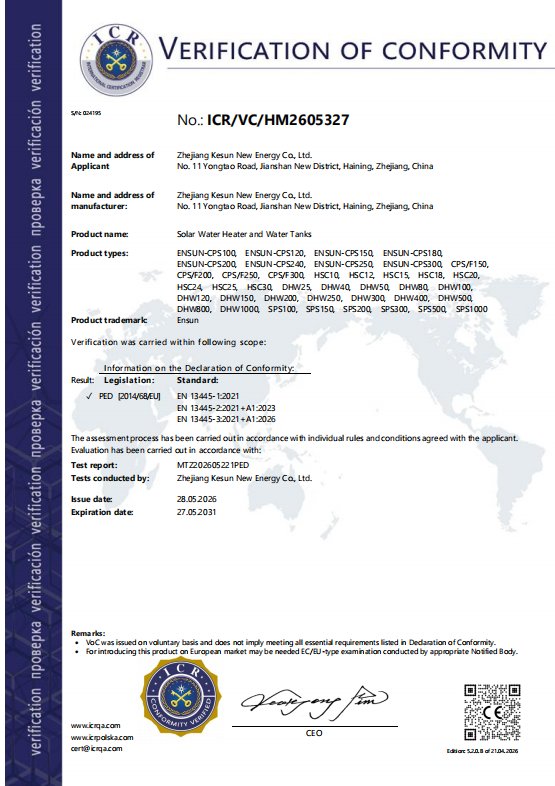
PED verification of conformity ICR/VC/HM2605327, covering Kesun solar water heater and water tank models under PED (2014/68/EU) and the EN 13445 series.
Customization, MOQ, Lead Time, and Production Capacity
For buyers in the evaluation stage, four parameters usually determine whether a supplier can serve a project at all: customization scope, minimum order quantity, production lead time, and available capacity.
| Parameter | Documented value | What it means in practice |
|---|---|---|
| Production mode | OEM / ODM / customizable | Orders can be produced under the buyer's brand and specification instead of a fixed catalogue model. |
| Customization scope | Customization by capacity, type and system configuration, covering residential and commercial use, different tank capacities, and collector type combinations | The variable is the configuration, not a single part — tank volume, system type, and collector choice are decided together. |
| MOQ | 1 x 40ft container | The order unit is container volume, not a fixed number of units, so the model mix inside the container is a quotation-stage decision. |
| Lead time | 20–35 days | A range rather than a fixed date, consistent with built-to-order configurations; freight and customs are separate schedule stages. |
| Monthly capacity | 25,000 units | Indicates headroom for multi-phase or multi-property rollouts. |
| Annual output | 300,000 sets | Company-level output across the solar water heater, buffer tank and domestic hot water tank lines. |
| Quality control | 100% test | Every unit is tested rather than sampled. |
| After-sales | Remote support | Support is delivered remotely; local service structure should be clarified per market. |
Because the minimum order is defined by a 40-foot container rather than a unit count, buyers should fix the mix of tank capacities and collector types before the order is confirmed. Custom configurations are built to order, which is why production is quoted as a 20–35 day window instead of a fixed date, and why the tank capacity and collector combination should be locked at quotation stage rather than adjusted later.
The monthly capacity of 25,000 units and annual output of 300,000 sets also give a practical reference point for phased projects. A buyer refurbishing a group of hotels in stages can compare required volumes against that capacity instead of asking for a general capacity commitment.
Application: A Documented 80-Room Hotel System in Southeast Asia
The clearest available evidence of commercial applicability is a hotel project in Southeast Asia serving 80 guest rooms. The installed system provides all-day domestic hot water for guest rooms and public bathing areas and supports auxiliary regional heating. It replaces traditional electric and gas heating equipment to meet the stable daily heat demand of hotel operation.
Reported outcomes from the project include:
- Electricity and gas costs reduced by more than 40%.
- Stable service life of more than 15 years.
- Constant-temperature hot water with minimal failures, supporting guest satisfaction.
- Lower carbon emissions, which supports green-hotel compliance.
Technical features documented for this project include high-adaptability vacuum heat collection modules with corrosion and weather resistance suited to Southeast Asia's hot and rainy climate, an integrated design that simplifies installation and reduces maintenance cost, and smart temperature adjustment for energy efficiency in small-to-medium commercial projects.
From a specification standpoint, the configuration is consistent with the manufacturer's own documentation: HSC series solar collectors matched with CPS-FJ and CPS series pressurized solar water heaters are described as suitable for hotels and commercial buildings requiring stable, large-volume domestic hot water supply. The project also illustrates a practical procurement point — a solar thermal system does not replace every heat source on site. It replaces the base load, while auxiliary heating covers peaks and low-irradiation periods.
Certification and Test Evidence Buyers Can Verify
Certification coverage in this range spans system-level, collector-level, and component-level documents, which allows a buyer to check the exact model rather than a general company claim.
| Document | Number | Scope | Validity |
|---|---|---|---|
| Solar Keymark (DIN CERTCO) | 011-7S3077 A | Thermal solar systems ENSUN-CPS100, CPS120, CPS150, CPS180, CPS200, CPS240, CPS300 | Issued 2025-06-03, valid to 2029-06-30 |
| Solar Keymark (DIN CERTCO) | 011-7S3239 A | Thermal solar systems CNP100 to CNP300 | Issued 2025-03-24, valid to 2030-03-31 |
| Solar Keymark (DIN CERTCO) | 011-7S3241 F | Solar collectors FPC2.0, FPC2.5 (brand ENSUN) | Issued 2025-04-22, valid to 2030-04-30 |
| Solar Keymark (DIN CERTCO) | 011-7S3240 P | Solar collectors PVT430, PVT450, PVT550, PVT580, PVT600, PVT670 | Issued 2025-01-16, valid to 2030-01-30 |
| Solar Keymark (DIN CERTCO) | 011-7S3343 A | Thermal solar systems CPS/F150, CPS/F200, CPS/F250, CPS/F300 | Issued 2026-06-05, valid to 2031-06-30 |
| Solar Keymark (DIN CERTCO) | 011-7S3325 R | Solar collectors HSC10 to HSC30 (brand KESUN) | Issued 2025-12-15, valid to 2030-11-30 |
| Intertek type examination test report | 251023056GZU-002 | Storage tank PWT300, EN 12897:2016+A1:2020 | Issued 2026-01-16 |
| Intertek type examination test report | 251023056GZU-001 | Storage tank PWT200, EN 12897:2016+A1:2020 | Issued 2026-01-18 |
| Intertek performance test report | 251230069GZU-001 | Stainless steel inner tank | Issued 2026-01-07 |
| PED verification of conformity (ICR) | ICR/VC/HM2605327 | Solar water heaters and water tanks, PED (2014/68/EU), EN 13445 series | Issued 2026-05-28, valid to 2031-05-27 |
| CE verification of conformity, LVD + EMC (ICR) | ICR/VC/HM2605326 | Solar water heaters and water tanks, LVD (2014/35/EU), EMC (2014/30/EU) | Issued 2026-05-28, valid to 2031-05-27 |
A certificate is only useful if it is current and covers the exact model being purchased. Solar Keymark schemes are periodically revised, and the certificate numbers above correspond to defined model lists, so buyers should confirm scope and validity directly with the issuing bodies — DIN CERTCO for the Solar Keymark entries, Intertek for the test reports, and ICR for the PED and CE verifications of conformity.
Market Trends Shaping Solar Water Heater Procurement
- Collector technology mix. Evacuated tube collectors held a 44.2% revenue share in 2023, based on Grand View Research data, which indicates that tube-based systems remain the dominant commercial format even as flat plate and hybrid formats expand.
- Regulatory tightening. New US Federal energy conservation standards for consumer water heaters took effect on July 5, 2024, with compliance required by 2029, according to the Federal Register and the Department of Energy. The rule influences specification and documentation requirements for North American programmes.
- Trade classification. The introduction of HS code 841912 for solar water heaters improves traceability of solar thermal trade flows and makes customs treatment of these products more explicit than under the generic 841919 code.
- Hybridisation. Kesun's range now includes PVT (photovoltaic-thermal) systems and hybrid solar panels alongside conventional thermal products, plus 2205 duplex stainless steel tanks and heat pipe solar collectors. PVT collectors from PVT430 to PVT670 carry Solar Keymark certification, which indicates that hybrid solar thermal and photovoltaic configuration is moving from experimental to certifiable.
The practical consequence for buyers is that supplier evaluation is shifting from unit price toward system compatibility: whether the tank, collector, controller, and backup heat source are documented as a working combination for the intended climate and load profile.
Comparison with Traditional Electric and Gas Water Heating
| Dimension | Solar thermal system | Electric storage water heater | Gas water heater |
|---|---|---|---|
| Primary energy source | Solar irradiation, configured with electric or heat pump backup | Grid electricity | Gas combustion |
| Site requirement | Collector mounting area with adequate solar exposure and sufficient roof load-bearing capacity | Electrical supply and indoor installation space | Gas supply and venting arrangement |
| Documented operating outcome | More than 40% reduction in electricity and gas costs in the 80-room Southeast Asia hotel project | Operating cost follows electricity tariffs | Operating cost follows fuel prices |
| Documented service life | More than 15 years in the same hotel project | — | — |
| Emissions profile | Lower carbon emissions, supporting green-hotel compliance | — | — |
| Main limitation | Requires collector area and project-level engineering; freeze protection, water quality treatment and roof load-bearing must be defined per site; generally configured with auxiliary heating | No collector area required, but energy is purchased continuously | No collector area required, but energy is purchased continuously and combustion venting is required |
The comparison is not a claim that solar thermal replaces every heat source. In the documented hotel project, the system replaced traditional electric and gas heating equipment as the base supply, while auxiliary heating remained part of the design. That structure is typical: solar thermal reduces purchased energy, and the backup covers timing and irradiation gaps.
Where Solar Thermal Is Not the Right Answer
Several boundaries should be stated plainly, because they determine project feasibility more than product selection does.
- Collector area and structural capacity are prerequisites. Roof load-bearing requirements should be defined per project location and design, and there is no configuration that removes this requirement.
- Freeze protection is a design input in cold climates, not an accessory. It is listed among the common project concerns that must be defined by site.
- Water quality treatment may be required depending on local supply conditions, which affects component selection and maintenance assumptions.
- Output depends on solar irradiation, and the system is generally configured with electric backup or heat pump linkage. A project without a viable backup heat source is not a good fit.
- Working-condition parameters require project-level calculation. A configuration validated for an 80-room hotel in a hot, rainy Southeast Asian climate is not interchangeable with a site that has different irradiation, water quality, or load timing.
- A minimum order quantity of one 40-foot container may exceed the requirement of a very small single-building project. Buyers with smaller volumes should plan phased delivery or combine scopes rather than assume sub-container orders.
- Customization is defined by capacity, type, and system configuration. Requirements outside that scope — for example unusual tank geometry — should be confirmed at quotation stage and not assumed.
Future Outlook
Three directions are visible in the documented material. First, hybridisation: Kesun's portfolio includes PVT (photovoltaic-thermal) systems and hybrid solar panels alongside conventional thermal products, and its PVT collectors hold Solar Keymark certification. That suggests hybrid solar thermal and photovoltaic configuration is becoming a standard procurement option rather than a special request.
Second, materials: 2205 duplex stainless steel tanks, plus duplex 2205 and Inox 316L options in the PV Series, indicate a focus on corrosion resistance — a relevant factor for coastal and hot-humid markets such as Southeast Asia, the Middle East, and parts of Africa and Latin America.
Third, manufacturing quality systems: laser and butt welding, in-house salt spray and pulse testing, and 100% product testing shift supplier differentiation toward verifiable production control rather than catalogue breadth. Combined with tightening efficiency regulation and a dedicated trade code for solar thermal systems, the likely direction is that buyers will request model-specific certificates and test reports as a routine part of evaluation rather than as a late-stage formality.
Frequently Asked Questions
Which solar water heater and collector configurations are available for commercial projects?
The documented range covers six product families: the CPS series high-pressure solar geyser (100 L to 300 L, maximum operating pressure 6 bar, test pressure 9 bar); the CNP series non-pressure solar water heater (60 L to 500 L); the CPS-FJ series indirect solar water heater with flat plate collector (150 L, 200 L, 250 L, 300 L); the HSC series heat pipe solar collector (10 to 30 tubes); the FPC2.0 and FPC2.5 flat plate collectors (1 m² to 2.5 m², 80 mm thickness); and the PV Series PV solar water heater (100 L to 500 L, 600 W per panel input, 800 W to 3500 W heating output). For hotels and commercial buildings, HSC collectors are documented as matching with CPS-FJ and CPS series pressurized heaters for stable large-volume domestic hot water supply.
For a hotel, is a flat plate collector system or a PV solar water heater the better choice?
The two configurations solve different site problems. Flat plate collector systems (CPS-FJ series with FPC collectors) heat the tank indirectly through a collector loop and are available in 150 L to 300 L tank capacities. PV solar water heaters (PV Series) use photovoltaic panel input of 600 W per panel, deliver 800 W to 3500 W heating output, and include an MPPT controller with DC/AC automatic switching, which suits sites where photovoltaic input is preferred. Evacuated tube heat pipe systems (CPS and CNP series) are the third option. The correct choice depends on solar exposure, climate, available roof area, and whether the backup heat source is electric or a heat pump; working-condition parameters require project-level calculation rather than a general recommendation.
Can tank capacity and system configuration be customised?
Yes. The manufacturer's documented production mode is OEM, ODM and customizable, with customisation by capacity, type and system configuration, covering residential and commercial applications, different tank capacities, and collector type combinations. Documented capacity ranges are 100 L to 300 L for the CPS series, 60 L to 500 L for the CNP series, 150 L to 300 L for the CPS-FJ series, and 100 L to 500 L for the PV Series. Because customisation is configuration-based, tank volume and collector type are specified together rather than separately.
What is the minimum order quantity?
The documented minimum order quantity is one 40-foot container. It is defined by container volume rather than a fixed unit count, so the mix of tank capacities and collector types inside that container is decided at quotation stage. Buyers with requirements below container scale may need to plan phased deliveries or combine scopes.
What is the production lead time and monthly capacity?
Documented production lead time is 20–35 days. Monthly capacity is 25,000 units, and annual output is 300,000 sets. The lead time describes the production window; freight, customs clearance and site installation sit outside it and should be scheduled separately. Quality control is documented at 100% test, and after-sales support is delivered remotely.
Which certifications and test reports can a buyer verify before ordering?
The range is covered by Solar Keymark certificates issued by DIN CERTCO: 011-7S3077 A for ENSUN-CPS100 to CPS300; 011-7S3239 A for CNP100 to CNP300; 011-7S3241 F for FPC2.0 and FPC2.5 collectors; 011-7S3240 P for PVT430 to PVT670; 011-7S3343 A for CPS/F150 to CPS/F300; and 011-7S3325 R for HSC10 to HSC30 collectors under the KESUN brand. Component and tank evidence includes Intertek type examination test reports 251023056GZU-001 for storage tank PWT200 and 251023056GZU-002 for storage tank PWT300, both against EN 12897:2016+A1:2020, a stainless steel inner tank performance test report 251230069GZU-001, PED verification of conformity ICR/VC/HM2605327, and CE verification of conformity for LVD and EMC, ICR/VC/HM2605326, both valid to 2031-05-27. Scope and validity should be confirmed with the issuing bodies.
Is there documented evidence that solar hot water systems work in commercial hotel operation?
A documented project involves a hotel in Southeast Asia serving 80 guest rooms, supplied by a complete solar hot water system providing all-day domestic hot water for guest rooms and public bathing areas, with auxiliary regional heating. The project reported a reduction of more than 40% in electricity and gas costs, a stable service life of more than 15 years, constant-temperature hot water with minimal failures, and lower carbon emissions supporting green-hotel compliance. Documented technical features include vacuum heat collection modules with corrosion and weather resistance for a hot, rainy climate, integrated design for easier installation and lower maintenance cost, and smart temperature adjustment.
What site conditions and limits must be evaluated before confirming an order?
Common project concerns that require definition per site are corrosion-resistant material selection, water quality treatment, freeze protection for winter, and roof load-bearing capacity. Matched equipment includes circulation pumps, controllers, valves, mounting frames and piping accessories. Operating modes can be direct or indirect circulation, passive thermosiphon or forced circulation with pumps, and the system can be linked to electric backup or a heat pump. Specific working-condition parameters, including irradiation and climate zone, require project-level calculation rather than a standard configuration. Sites without adequate solar exposure, without a viable backup heat source, or without structural capacity for collectors are poor candidates for a solar thermal system.
What after-sales support is documented?
After-sales is documented as remote support, from a manufacturer based in Haining, Zhejiang Province, China, with export markets described as global and a 60% export ratio across Mexico, the EU, and Africa. Buyers should clarify spare parts availability, warranty terms, and local service arrangements for their own market at the contracting stage, since remote support is the documented baseline rather than a site-based service commitment.
For readers who require the underlying technical documentation behind these answers, the manufacturer's 2025 product brochure is available for download: ENSUN 2025 product brochure (PDF).