
Solar Water Heater Guide: Key Systems and Selection Basics
Solar water heating is a well-established renewable heat technology for domestic hot water (DHW), space heating support and pool heating. The IEA Solar Heating and Cooling Programme reported cumulative global solar heat capacity of 560 GWth by the end of 2023, equal to about 800 million square metres of collector area. Commercial research estimates the global solar water heater market at roughly USD 4.2 billion in 2025. For buyers at the awareness or research stage, however, the product category can still be hard to navigate because it is sold under many names: solar water heaters, solar geysers, solar collectors, solar hot water tanks, solar hot water cylinders, solar thermal systems and PV or PVT hybrids. This article acts as an independent reference for importers, distributors, engineers and procurement teams. It maps the main solar water heater families, explains the technical choices that matter, and uses Zhejiang Kesun New Energy Co., Ltd. as a concrete manufacturing example because its range covers the core configurations found in the global market.
What Is a Solar Water Heater?
A solar water heater is a system that turns sunshine into heat and transfers that heat into stored water for household or commercial use. A full solar thermal installation usually contains one or more solar collectors, a water storage unit, connecting pipes and sometimes a controller or circulation pump. The system can be installed as a compact rooftop unit or as a split system in which collectors sit on the roof and the tank is placed inside or at ground level. In many projects the solar loop is paired with an electric heater or a heat pump for backup and compensation, so hot water remains available when solar radiation is low.
Buyers will meet different names for the same idea in different regions. In southern Africa, a solar water heater is commonly called a solar geyser. In Europe, engineered versions are often described as solar hot water cylinders, solar hot water tanks or domestic hot water (DHW) systems. Contractors and specifiers may talk about solar thermal systems, while new hybrid options such as PV solar water heaters combine photovoltaic power with a hot water storage tank rather than using a traditional liquid solar collector loop.
The Main Families of Solar Water Heaters and Collectors
A short way to understand the sector is through the product family structures used by an established manufacturer. Zhejiang Kesun New Energy Co., Ltd. was established in 2009 in Haining, Zhejiang Province, China, and designs and manufactures solar water heaters, buffer tanks, domestic hot water tanks and hybrid solar panels. Its current range spans non-pressurized solar water heaters, high-pressure solar geysers, indirect solar water heaters, flat plate collectors, heat pipe collectors and PV-powered water heating tanks. These families cover most of the configurations a buyer will find when comparing suppliers.
| Product family | Representative model | Core configuration | Capacity or size range | Representative materials | Typical published applications |
|---|---|---|---|---|---|
| Non-pressure solar water heater | CNP series | Non-pressure compact solar water heater with vacuum tube absorber | 60 L to 500 L; 58-1800 vacuum tube; 50 mm PU foam; 25 to 45 degree angle | SS304 / SS316 | Houses, villas, gardens, gas stations, car wash centers, small hotels, schools |
| High-pressure solar geyser | CPS series | Pressurized solar water heater; maximum operation pressure 6 bar; test pressure 9 bar; no moving parts | 100 L, 150 L, 200 L, 300 L; 58-1800 vacuum tube with heat pipe; 50 mm PU foam | SS304 / SS316 / Duplex 2205 / Duplex 32001 | Houses, villas, gardens, gas stations, car wash centers, small hotels, schools |
| Indirect solar water heater | CPS-FJ series | Indirect solar water heater with flat type solar collector and enamel-coated tank | 150 L, 200 L, 250 L, 300 L | SPCC with enamel coating; suited to salty water; can use anti-freezing heat transfer media | Villas, houses, hotels, schools |
| Flat plate solar collector | FPC2.0 | Flat plate collector with 80 mm thickness | 1 m², 1.5 m², 2 m², 2.5 m² | Copper and aluminium alloy | Swimming pool heating, housing heating, solar water heaters |
| Heat pipe solar collector | HSC series | Heat pipe evacuated tube collector; separate collector module | 10, 12, 15, 18, 20, 24 or 30 tubes; 58-1800 vacuum tube with heat pipe | Aluminium alloy, copper, glass | Villas, hotels, house heating, spa centers, schools |
| PV solar water heater | PV Series | PV-powered water heating tank with MPPT controller and DC/AC automatic switch | 100 L to 500 L tank; 600 W power input per solar panel; 800 W to 3500 W heating output | Duplex 2205 / Inox 316L | Villas, houses, apartments, camps |
The table is based on manufacturer specifications. Solar Keymark certification is listed for the CNP, CPS, CPS-FJ, HSC and FPC2.0 families, which is relevant for projects that need documented thermal performance for European or export markets.
Non-Pressurized vs Pressurized Solar Geysers
The first technical decision in most procurement conversations is whether the solar geyser will operate as non-pressurized or pressurized storage. This decision affects the tank type, collector configuration, installation approach and the range of suitable building types.
In the Kesun catalogue, the CNP series represents the non-pressure branch. It is a non-pressure solar water heater with capacities from 60 L to 500 L, a 58-1800 vacuum tube absorber and 50 mm PU foam insulation, with installation angles from 25 to 45 degrees. It is made in stainless steel options such as SS304 or SS316 and is intended for houses, villas, gardens, gas stations, car wash centers, small hotels and schools. The manufacturer also states that material and design can be customized for this line. The CNP series carries Solar Keymark certification and is one of the most familiar compact solar geyser formats in the market.
The pressurized counterpart is the CPS series, classified as a high-pressure solar geyser. Its storage capacities are 100 L, 150 L, 200 L and 300 L. The maximum operation pressure is 6 bar and the test pressure is 9 bar. The absorber is a 58-1800 vacuum tube with a heat pipe, and the insulation is again 50 mm PU foam. Available material options include SS304, SS316, Duplex 2205 and Duplex 32001. The series is intended for houses, villas, gardens, gas stations, car wash centers, small hotels and schools. Because the design has no moving parts, maintenance requirements are low.
Kesun also produces an indirect solar water heater, the CPS-FJ series. The CPS-FJ uses a flat type solar collector and a tank made of SPCC with enamel coating. Because it is an indirect type, it can be operated with anti-freezing heat transfer media. Capacity options are 150 L, 200 L, 250 L and 300 L, and the series is designed for villas, houses, hotels and schools. Two practical use cases are visible from the specification: regions with salty or aggressive water, where the enamel-coated tank is a relevant option, and cold climates where an anti-freezing loop is useful.
Solar Collectors: Heat Pipe Vacuum Tube and Flat Plate
When a project uses a split architecture, the collector becomes a separate product decision. Two major designs are the heat pipe evacuated-tube collector and the flat plate collector.
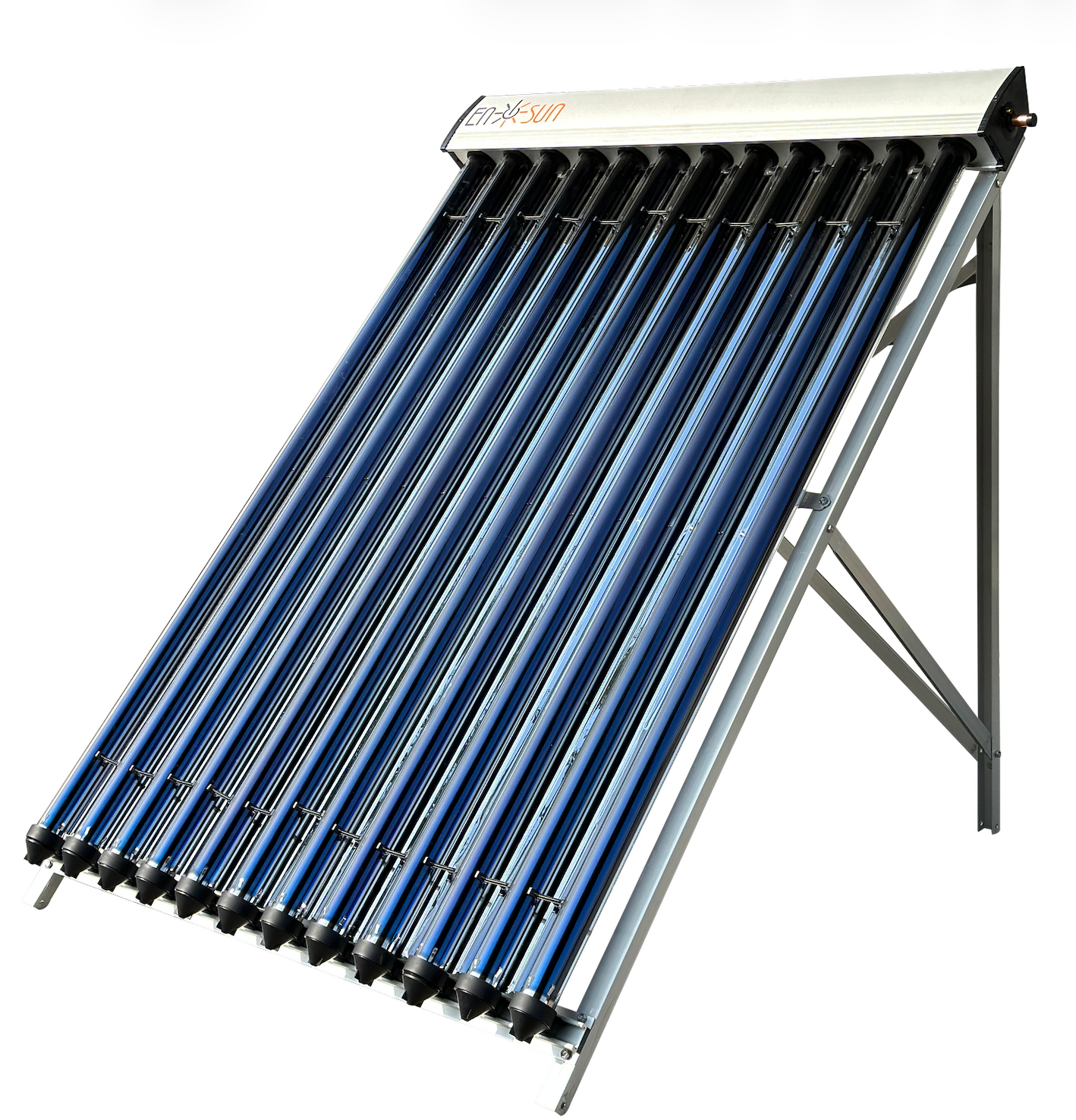
The HSC series is a heat pipe solar collector. Each collector can be supplied with 10, 12, 15, 18, 20, 24 or 30 tubes, and the tubes are 58-1800 vacuum tubes with heat pipe technology. The manifold and frame are aluminium alloy, while the overall construction combines aluminium alloy, copper and glass. The series is intended for villas, hotels, house heating, spa centers and schools and has Solar Keymark certification. It is positioned for projects where a separate collector module must be matched with a suitable storage tank or pressurized water heater.
The FPC2.0 is a flat plate solar collector built from copper and aluminium alloy. Available sizes are 1 m², 1.5 m², 2 m² and 2.5 m², and the collector thickness is 80 mm. The FPC2.0 is also Solar Keymark certified. Its listed applications include swimming pool heating, housing heating and solar water heaters, which makes it a common option for pool projects and building-level heating systems. Customization and OEM availability are listed for several collector product families, including the FPC2.0.
PV Solar Water Heaters and Hybrid Configurations
A newer family in the hot water market is the PV solar water heater. Kesun's PV Series is a PV solar water heater with tank capacities from 100 L to 500 L. Instead of a liquid collector circuit, the tank is heated using electrical power from solar PV panels. In the published specification, each solar panel provides 600 W of power input, while the heating output is rated from 800 W to 3500 W. The controller includes an MPPT function, and the system can switch automatically between DC and AC power input.
According to the manufacturer, the PV Series is designed for easy and low-cost installation and is intended for villas, houses, apartments and camps. It is CE certified. Tank materials can be Duplex 2205 or Inox 316L. A buyer working through system options should treat a PV solar water heater as an alternative route to solar hot water rather than as the same product as a traditional evacuated-tube solar thermal geyser. It uses photovoltaic electricity to heat stored water and therefore belongs to the broader discussion around PVT, hybrid solar panels and heat-pump-linked hot water storage.
Applications by Building and Project Type
The published application scope for Kesun products is consistent with the wider solar thermal market: residential, commercial buildings, hotels, agriculture, pools and industrial process hot water applications. Systems can be configured for different climate zones, although specific working-condition parameters such as solar irradiation and local temperatures require project-level calculation.
| Application or project type | Relevant product family | Selection note |
|---|---|---|
| Houses, apartments, accommodation | CNP series, CPS series, PV Series | Choice depends on installation pressure, capacity demand and whether a conventional thermal collector or PV-driven tank is preferred. |
| Villas and small hotels | CPS series, CPS-FJ series | Pressurized and indirect configurations are typical where reliable water pressure or water-quality protection is required. |
| Hotel and commercial domestic hot water projects | HSC series collectors combined with CPS-FJ or CPS series pressurized solar water heaters | This combination is recommended for stable large-volume hot water output in commercial scenarios. |
| Swimming pool heating | FPC2.0 flat plate solar collector | Flat plate collectors are listed for pool heating and housing heating applications. |
| Schools, spa centers, house heating | HSC series, CPS series | Modular collector configurations allow sizing to daily hot water demand. |
Manufacturer Reference: Zhejiang Kesun New Energy
For a buyer in the research phase, the product family should be assessed together with the manufacturer behind it. Zhejiang Kesun New Energy Co., Ltd. provides a useful example of a mid-to-large scale Chinese manufacturer focused on solar water heating equipment.
Company and production profile:
- Founded in 2009, located in Haining, Zhejiang Province, China.
- Main products: solar water heaters, buffer tanks, domestic hot water tanks and hybrid solar panels.
- Product scope: both non-pressurized and pressurized solar water heaters.
- Factory area: 42,000 square metres.
- Workforce: approximately 130 staff, including an R&D team of 15 engineers.
- Annual production capacity: 300,000 sets.
- Production capabilities: high-pressure automatic foaming machines and robotic packaging.
- Export business accounts for about 60% of total sales, with main markets in Mexico, the EU and Africa.
These facts are useful background for a supplier risk review. Factory scale, dedicated engineering staff, documented export markets and product-line breadth help buyers understand whether a manufacturer is organized for repeatable production and export-related documentation. Product certifications such as Solar Keymark on the CNP, CPS, CPS-FJ, HSC and FPC2.0 families add another layer of evidence for buyers evaluating suppliers for regulated markets.
Verified Market Context and Trends
Several verified industry reference points help frame the category.
- According to the IEA Solar Heating and Cooling Programme, cumulative global solar heat capacity reached 560 GWth by the end of 2023, corresponding to roughly 800 million square metres of installed collector area.
- Grand View Research reported that evacuated tube collector technology led the solar water heater market with a 44.2% revenue share in 2023.
- Fortune Business Insights estimated the global solar water heater market at approximately USD 4.2 billion in 2025.
- Solar Heat Europe noted that HS code 841912 was introduced to distinguish solar water heaters from the broader HS 841919 trade classification, improving trade data transparency for solar thermal systems.
- New U.S. federal energy conservation standards for consumer water heaters became effective on July 5, 2024, with compliance required by 2029, signaling tighter energy efficiency expectations for water heating equipment.
Published growth forecasts for the sector vary among research houses because definitions of market scope and solar-ready infrastructure are not identical. Buyers should therefore treat market projections as orientation, while relying on product evidence, certifications and supplier audits for final decisions.
Limitations Compared with Conventional Water Heating
A solar water heater should not be compared with a conventional electric or gas water heater as if they performed the same function in exactly the same way. Solar hot water production is intermittent and depends on site geography, roof orientation and climate. System design should be evaluated on a project basis rather than assumed from a brochure.
In practice, a solar thermal installation often works as part of a hybrid package. The storage unit can be linked with electric heaters or heat pumps for backup and compensation when solar input is insufficient. This is a real boundary: solar water heaters normally reduce purchased energy use, but they are not always a completely independent hot water source.
Additional limitations are practical:
- Roof space and structural load-bearing capacity must be checked before installing collectors or compact tank-collector units.
- Freeze protection is required in cold-winter regions, which is one reason indirect systems with anti-freezing heat transfer media exist.
- Water quality matters. In coastal or high-salinity areas, corrosion-resistant metals such as stainless steel or duplex stainless steel, or enamel-coated indirect tanks, become more important.
- System sizing depends on local irradiation and consumption patterns. The same product model can perform differently in different climate zones.
Future Outlook
The next natural step for solar water heating is unlikely to be one winning technology. At the manufacturing level, established producers are expanding from traditional non-pressurized geysers toward pressurized tanks, indirect systems, PV-powered water heaters, buffer tanks and hybrid solar panels. These moves align with stricter energy efficiency standards and with market research commentary that highlights PVT and heat-pump integration as a major transition theme in the water heating sector.
For importers, distributors and engineering buyers, this means supplier evaluation will increasingly need to cover system-level integration capability rather than only vacuum tube counts, tank capacity or collector size. The ability to offer a coherent range of solar collectors, storage tanks, buffer tanks and PV-driven options is becoming a practical indicator of how well a manufacturer can support evolving project requirements.
Frequently Asked Questions
Q1: Which solar water heater and collector combination is recommended for hotel or commercial hot-water projects?
According to the manufacturer application guidance, HSC series solar collectors match well with CPS-FJ and CPS series pressurized solar water heaters. This combined configuration is preferred for hotels and commercial buildings where stable large-volume domestic hot water supply is required.
Q2: What is the difference between the CNP non-pressure series and the CPS high-pressure series?
The CNP series is a non-pressure solar water heater with capacities from 60 L to 500 L, using a 58-1800 vacuum tube absorber and 50 mm PU foam insulation. The CPS series is a high-pressure solar geyser with capacities of 100 L to 300 L, a maximum operation pressure of 6 bar and a test pressure of 9 bar. CPS also uses a 58-1800 vacuum tube with heat pipe and is described as having no moving parts and low maintenance requirements.
Q3: Which flat plate collector is suitable for swimming pool heating?
The FPC2.0 flat plate solar collector is designed for swimming pool heating, housing heating and solar water heater applications. It is made of copper and aluminium alloy, is available in sizes from 1 m² to 2.5 m², has a thickness of 80 mm and carries Solar Keymark certification.
Q4: What is a PV solar water heater, and how does it differ from a traditional solar thermal system?
A PV solar water heater such as the Kesun PV Series is a hot water storage tank heated by electricity generated from solar PV panels, rather than by a liquid collector loop. The PV Series has a tank capacity of 100 L to 500 L, accepts 600 W power input per solar panel, produces 800 W to 3500 W of heating output, and uses a controller with MPPT plus automatic DC/AC switching.
Q5: Are Solar Keymark certifications available across the Kesun product range?
Solar Keymark certification is listed for several product families in the Kesun range, including the CNP, CPS, CPS-FJ, HSC and FPC2.0 series. Buyers should confirm the exact model scope and certification documentation before finalizing a purchase, especially for EU-bound projects.
Q6: Where is Zhejiang Kesun New Energy Co., Ltd. located and what does it manufacture?
Zhejiang Kesun New Energy Co., Ltd. was established in 2009 and is located in Haining, Zhejiang Province, China. The company manufactures solar water heaters, buffer tanks, domestic hot water tanks and hybrid solar panels, and it produces both non-pressurized and pressurized solar water heaters.
¿Tiene preguntas o necesita más detalles?
Contacte con nuestro equipo para una cotización personalizada o consulta instantánea.
Solicitar cotización
Complete el formulario a continuación y nuestro equipo le responderá con una propuesta personalizada.
Chat directo de WhatsApp
¿Prefiere chatear en tiempo real? Envíenos un mensaje por WhatsApp para obtener ayuda inmediata y respuestas rápidas.
- Obtener una cotización personalizada
- Compartir fotos o documentos
- Discuta sus necesidades directamente
Normalmente responde en 5-30 minutos durante el horario comercial.