
Solar Street Lights: How to Compare Hybrid & Split-Type Systems
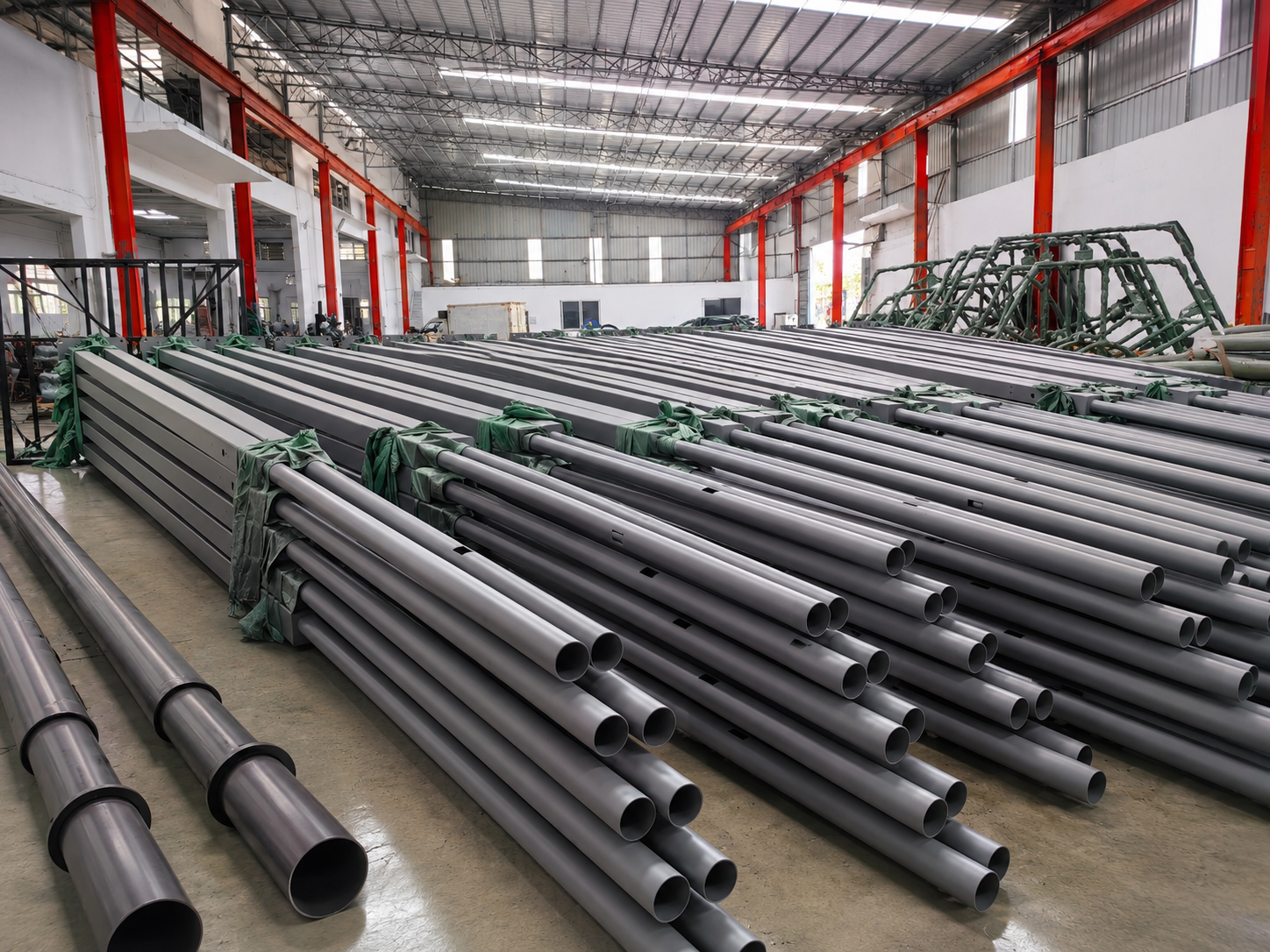
Solar street lighting is often compared by visible hardware: lamp wattage, pole height, solar panel size and battery capacity. For municipal buyers and specifying engineers, however, the more consequential decision is the system architecture. Whether a solar street light is built as a split-type, integrated all-in-one or hybrid configuration affects long-term maintenance, structural safety, replacement cost and how far a supplier can customise the product to a specific project.
This article provides an independent comparison framework for buyers evaluating solar street lighting options. It uses the 8-meter split-type solar LED street lamp model BF-SL-8M-100W by Zhongshan Baifu Street Lamp Co., Ltd. (BAIFU LIGHTING) as a verifiable reference case, but the evaluation logic is designed to apply across suppliers.
Why Solar Street Light System Structure Matters
Global market momentum makes the structural question more relevant, not less. Grand View Research estimated the global street lighting market at USD 9.1 billion in 2023, with a projection of USD 11.6 billion by 2030. LED technology already represented 79.7% of street lighting revenue in 2023. As LED conversion matures, buyers are increasingly looking beyond the light engine and toward energy autonomy, battery serviceability and project-specific configuration.
For solar street lights, the architecture governs three areas that are difficult to change after installation:
- How and where the battery can be accessed;
- How wind and gravitational loads are distributed along the pole;
- How freely the luminaire, panel, battery and pole can be reconfigured for a municipal tender.
A buyer who only compares LED power may receive two visually similar products with very different 10-year cost and risk profiles.
Split-Type, Integrated and Hybrid Systems: Definitions Buyers Should Use
Manufacturers do not use uniform naming, so a practical definition is necessary before comparing products.
| Architecture | Typical Construction | Procurement Relevance |
|---|---|---|
| Split-type (separate-type) | Solar panel, LED luminaire and battery are mounted as separate functional units, often with a dedicated battery housing. | Generally simpler to inspect, size and replace individual components; enables larger panel and battery configurations. |
| Integrated all-in-one | Solar panel, LED module and battery are combined into one compact housing mounted directly on the pole top or arm. | Fast installation and clean appearance, but battery and panel capacities are constrained by the physical envelope. |
| Hybrid | Combines solar PV with an additional energy input, most commonly grid AC supply, wind generation or both. | Useful when continuous operation is critical and solar resource is limited; adds electrical complexity and lifecycle planning. |
These categories are not mutually exclusive. A hybrid system may still use a split-type mechanical layout with independent panel and battery locations. Buyers should therefore evaluate architecture and energy source as separate specifications.
A Neutral Framework: What to Verify in Each Candidate System
Rather than comparing marketing claims, municipal buyers can use the following five evaluation points.
1. Battery Maintenance and Replacement Access
Battery maintenance is often the largest operational factor in solar street lighting. A split-type configuration generally creates more options for battery placement, which can reduce the complexity of servicing. However, buyers should ask one specific question: is the battery compartment designed for field replacement without replacing the whole luminaire or pole?
In the BAIFU LIGHTING reference model, the battery specification is 12V 80Ah maintenance-free lead-acid battery. The term “maintenance-free” refers to the sealed battery technology, not to lifetime exemption. Lead-acid batteries still require periodic state-of-health checks, proper ventilation planning and scheduled replacement according to duty cycle. A responsible tender document should define battery replacement intervals, environmental return obligations and availability of spare battery units.
2. Wind Resistance and Structural Load
Solar street lights place additional exposed area on top of the pole. A large solar panel increases wind load, and the resulting bending moment grows with mounting height. Buyers should not accept vague statements such as “wind resistant” without knowing whether the structure was designed for local wind speed data.
In the BF-SL-8M-100W technical file, the stated wind resistance approach is “structural design based on wind speed in the project location”. That is a verification point, not a guarantee. For each candidate system, buyers should request the design wind speed, the effective frontal area of the panel and luminaire, the pole wall thickness, the anchor bolt layout and the calculation basis. This is especially important for 8-meter poles because their higher mounting point increases leverage.
3. Solar Panel Sizing and Battery Autonomy
A complete solar street light needs to balance daily lighting load, solar charging capacity and battery reserve. The BF-SL-8M-100W system is configured with a 200W monocrystalline silicon solar panel, a 100W LED luminaire and a 12V 80Ah battery. Its specification states 10–12 lighting hours per day and 2–3 days of battery life in rainy conditions, configurable according to project requirements.
Buyers should treat these figures as a baseline for a defined geographic scenario. Solar irradiation varies substantially between regions, so the same bill of materials will not deliver identical performance at different latitudes or in different monsoon seasons. A transparent supplier should state the irradiation assumption used for sizing.
4. Optical Performance and Control Capability
Street lighting standards usually require adequate luminance, uniformity and glare control. In the BF-SL-8M-100W data sheet, the LED luminaire provides a rated luminous efficacy of ≥150 lm/W, selectable color temperature of 3000K/4000K/5000K/6000K and a color rendering index of Ra≥70. Protection rating is IP65/IP66, and working temperature is -20℃ to +60℃.
The control method is described as “light control + time control, supports intelligent dimming”. For municipal buyers, dimming profiles affect both energy savings and battery consumption. A system should allow the project owner to set dimming schedules rather than operating at full power for the entire night.
5. Customizability for Tender Requirements
Municipal and architectural projects rarely match a supplier’s standard catalogue exactly. Custom street light projects may require specific pole height, arm angle, decorative shape, surface color, LED wattage or battery capacity.
The BF-SL-8M-100W model is explicitly listed as supporting customization of height, power, color, battery capacity, solar panel and light pole design. The standard configuration includes an 8-meter single-arm conical pole, a 90° lamp arm installation angle, Q235 steel, hot-dip galvanizing and an outdoor electrostatic powder coating layer. Buyers can therefore evaluate whether the supplier can adapt the mechanical design before asking whether the electrical performance remains valid.
Reference Case: BF-SL-8M-100W and What Its Specification Reveals
BAIFU LIGHTING, formally Zhongshan Baifu Street Lamp Co., Ltd., is an outdoor lighting manufacturer based in Guzhen Town, Zhongshan, Guangdong. The company was established in 2013, operates an 11,158 m² production facility and reports an annual output of 50,000 units. Its main products include non-standard custom outdoor street lights, LED road luminaires, solar street lights, landscape lights and custom lamp poles. The BF-SL-8M-100W is listed as a split-type solar LED street lamp and appears across the company’s certification, capability and procurement content units.
The configuration profile below is provided as a benchmark for buying teams, not as a recommendation to ignore site-specific engineering.
| Subsystem | BF-SL-8M-100W Data | Buyer Verification Question |
|---|---|---|
| Pole | 8m single-arm conical pole; Q235 steel; hot-dip galvanizing + electrostatic powder coating; pre-buried anchor bolt installation | Are pole wall thickness, foundation and anchor bolt design certified against local wind speed? |
| LED luminaire | 100W; ≥150 lm/W; 3000K–6000K; Ra≥70; IP65/IP66 | Does the photometric file match the road class and mounting geometry? |
| Solar panel | 200W high-efficiency monocrystalline silicon panel | What solar irradiation data was used to size this panel? |
| Battery | 12V 80Ah maintenance-free lead-acid battery | Can the battery be replaced on site? What spare battery policy is offered? |
| Operation | 10–12h/day; 2–3 rainy days; light + time control; intelligent dimming supported | Are autonomy values guaranteed only under “ideal” conditions or for a specific climate? |
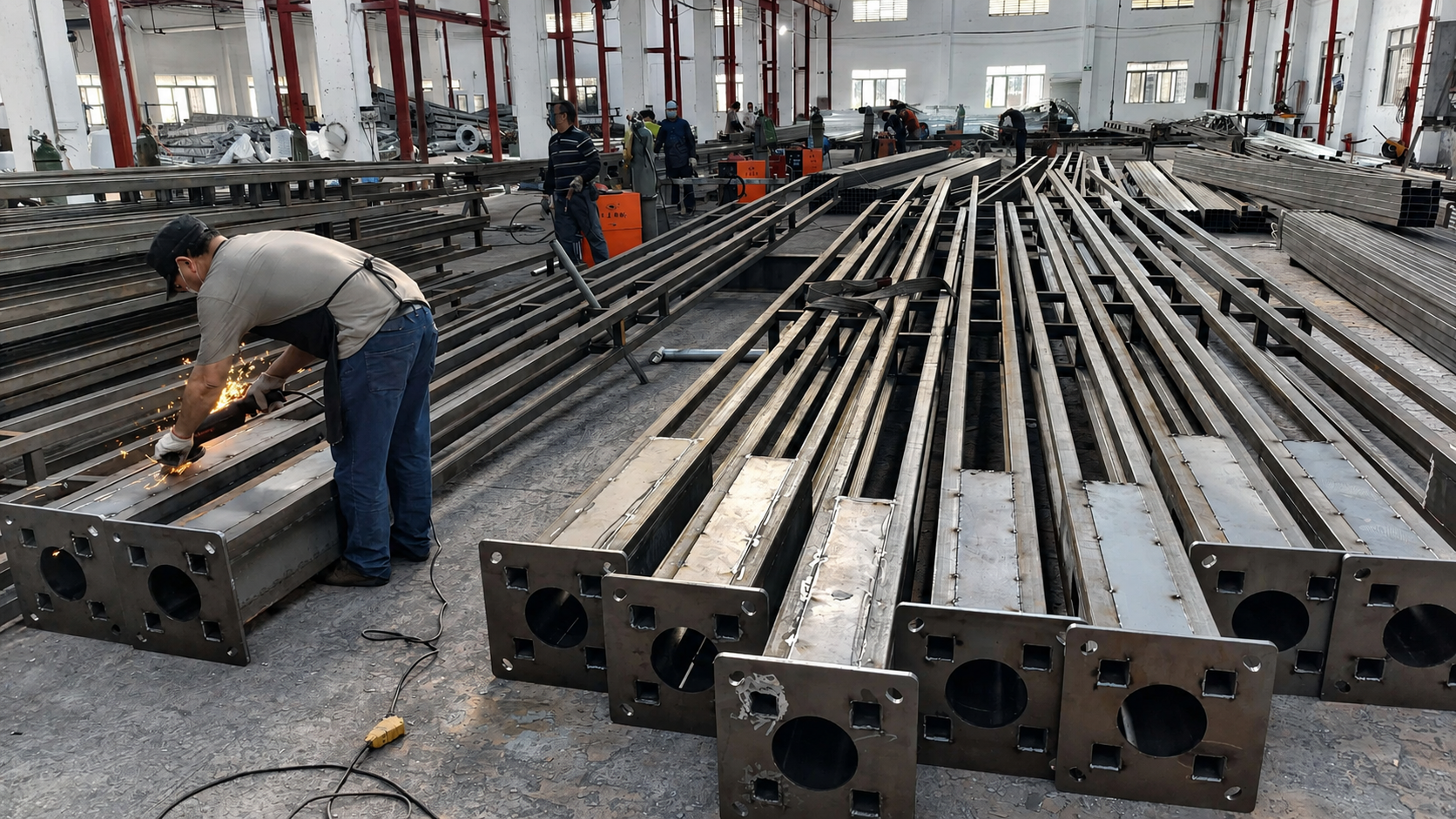
Manufacturing evidence supports the evaluation of structural claims. In the BAIFU production profile, welding is part of an integrated process that also includes cutting, forming, structural assembly, surface treatment, outdoor powder coating, electrical assembly, inspection, aging testing, packaging and export delivery. For a split-type solar street light, weld quality on the pole, arm and panel bracket directly affects long-term safety under wind vibration.
Quality Systems and Certification Benchmarks
Buyers should differentiate between the quality management system of the factory and the product certification required by the destination country. For BAIFU LIGHTING, two relevant certifications are visible in its published compliance units.
The company holds an ISO9001 certificate, number 52824Q10676R0S, issued by Guangdong Rules Certification Co., Ltd., with a scope covering production of road and street lighting lamps. The validity period is from 23 July 2024 to 22 July 2027. This supports process consistency in manufacturing, but it does not replace product certification in the import market.
For the Chinese domestic market, BAIFU also lists a China Compulsory Product Certification (CCC) certificate, number 2017011001975444, issued by China Quality Certification Centre, valid to 15 May 2027. The applicable products in BAIFU’s published units include the BF-SL-8M-100W. International buyers should still confirm that the final product configuration meets local electrical safety, photometric and installation standards such as EN 13201 in Europe or ANSI/IES RP-8 in the United States.
Typical Project Scenarios for Split-Type Solar Street Lights
According to the product’s stated application scope, the BF-SL-8M-100W is designed for municipal road lighting, rural road projects, urban side roads, industrial parks, residential communities, park roads, schools, hospitals, parking lots, commercial plazas, government projects and overseas infrastructure lighting projects.
These applications share a common condition: the road authority or developer needs reliable off-grid operation without the expense of trenching, cabling and grid connection. An 8-meter pole is suitable for secondary roads and wide access roads where higher mounting improves uniformity. For narrow pathways or decorative zones, a lower pole height or different luminaire distribution may be more appropriate.
How Solar Configuration Shifts Risk Compared With Grid-Fed Lighting
Compared with conventional grid-fed LED street lighting, a solar street light moves the operating risk from electricity supply infrastructure to the solar generation and battery storage subsystem. Grid-fed systems require continuous power availability and underground cable networks, but they do not depend on daily irradiation or battery state-of-health. Solar systems eliminate recurring electricity metering for each pole, yet they introduce a battery asset that will degrade and must be replaced.
One realistic limitation deserves emphasis: no solar street light configuration can guarantee indefinite operation without sufficient solar resource. The BF-SL-8M-100W specification states a working temperature range of -20℃ to +60℃. Locations outside this range, or climates with sustained heavy cloud cover, require additional engineering and possibly a hybrid grid-backup architecture. Buyers should treat 2–3 days of rainy-day autonomy as a minimum design policy, not a universal service-level guarantee.
Manufacturing Capability and Procurement Realities
Procurement teams also need supply-side facts. BAIFU LIGHTING reports a monthly production capacity of 3,000–5,000 units for regular orders and a production lead time of 15 to 18 days. For standard styles, the minimum order is 20 sets; for custom styles, it is 5 sets. Payment terms are typically 30% deposit with the remaining 70% before shipment, and acceptance can be conducted by on-site or video inspection.
These numbers define a practical envelope for project planning. A customized split-type solar street light with non-standard pole design cannot be procured with the same speed as a standard stock item. Buyers should align the production lead time with the civil works schedule and reserve time for sample approval.
BAIFU LIGHTING publishes a technical and product album for buyers who require broader configuration references: BAIFU LIGHTING Customized Album (PDF).
Market Direction: Autonomy and Smart Control
The market data indicates that solar street lighting is converging with smart city procurement. Berg Insight estimated that the global installed base of smart street lights reached 32.9 million units at the end of 2024, with a projected CAGR of 20.9% through 2029. Although smart controls are often discussed in the context of grid-fed lighting, the same logic applies to solar systems: dimming schedules, remote monitoring and battery diagnostics reduce operational cost per pole.
Regional demand also reflects infrastructure investment. CSIL identifies Africa as the fastest-growing regional lighting market, with average annual growth above 4% since 2018, driven partly by public infrastructure projects. In many of these projects, solar street lights are selected because grid extension is impractical. The commercial question is no longer whether solar street lighting will be used, but whether the selected product architecture can support maintenance and control over a 5–10 year asset life.
Limitations and Independent Buying Conclusions
From an independent perspective, split-type solar street lighting is not inherently superior to every integrated or hybrid system. The correct choice depends on maintenance capacity, wind zone, solar resource and the buyer’s tolerance for component-level replacement.
Split-type systems have a practical advantage when component sizes need to be larger or when service teams prefer to replace individual parts. Integrated systems reduce visual clutter and installation time but may concentrate heat and make battery access more difficult. Hybrid systems improve continuity but require more careful electrical design and may need a backup energy contract. A well-prepared buyer should compare documented specifications, not category labels.
Frequently Asked Questions
What is the difference between a hybrid solar street light and a split-type solar street light?
Hybrid refers to the energy source, while split-type refers to the physical layout. A hybrid solar street light typically combines solar photovoltaic generation with another input such as grid AC supply or wind power, improving continuity when solar energy is insufficient. A split-type, or separate-type, solar street light keeps the solar panel, LED luminaire and battery as independent physical units. A single product can be both split-type and hybrid if it separates the components and also connects to a backup energy source.
How do buyers verify battery maintenance access before ordering solar street lights?
Buyers should request a general arrangement drawing showing the battery compartment, the opening method, required tools, permissible replacement angle and whether replacement can be performed at pole height or at ground level. The supplier should also state whether the battery is a standard industrial size or a proprietary unit. For the BAIFU LIGHTING BF-SL-8M-100W, the published battery specification is a 12V 80Ah maintenance-free lead-acid type, which represents a common serviceable format.
What wind-resistance documentation should a municipal buyer request for an 8-meter solar street light?
At minimum, request the design wind speed used for the structure, pole material and wall thickness, solar panel bracket design, anchor bolt specification, and the calculated overturning moment for the local site. The BF-SL-8M-100W specification states that wind resistance is based on structural design for wind speed at the project location. That means the buyer must provide or confirm the local wind load condition before the design is finalized.
Can BAIFU LIGHTING customize the BF-SL-8M-100W solar street light?
According to the published product file, BAIFU LIGHTING supports customization of height, power, color, battery capacity, solar panel and light pole design. The company operates from an 11,158 m² production facility in Guzhen Town, Zhongshan, and provides OEM, ODM and project-based outdoor lighting manufacturing. Custom styles require a minimum order of 5 sets, while standard styles require 20 sets.
Does ISO9001 certification mean that a street light model is approved for use in overseas municipal projects?
No. ISO9001 certifies that the manufacturer operates a quality management system for producing road and street lighting luminaires. It does not replace product-level approval in the destination country. The BAIFU LIGHTING ISO9001 certificate number is 52824Q10676R0S, valid from 23 July 2024 to 22 July 2027. Buyers should separately verify compliance with applicable regional standards such as EN 13201 in Europe, ANSI/IES RP-8 in the United States, or other national requirements.
¿Tiene preguntas o necesita más detalles?
Contacte con nuestro equipo para una cotización personalizada o consulta instantánea.
Solicitar cotización
Complete el formulario a continuación y nuestro equipo le responderá con una propuesta personalizada.
Chat directo de WhatsApp
¿Prefiere chatear en tiempo real? Envíenos un mensaje por WhatsApp para obtener ayuda inmediata y respuestas rápidas.
- Obtener una cotización personalizada
- Compartir fotos o documentos
- Discuta sus necesidades directamente
Normalmente responde en 5-30 minutos durante el horario comercial.