
Solar-Plus-Storage BESS Compliance Dossier: Export Limits to Fire Safety
A solar-plus-storage project is rarely delayed because the battery is undersized. It is delayed because nobody can produce the file that proves the system will operate inside the limits set by the network operator, the fire authority and the lender at the same time.
That file — the compliance dossier — is what turns a containerized battery energy storage system from a purchased asset into an accepted project. Its scope is wider than a datasheet: PV generation assessment, export limitation requirements, grid-code compliance, backup-load assessment and coordinated PV–battery control, followed by the approvals that sit at the boundary between developer and authority — grid-connection approval, protection coordination and fire-safety sign-off.
This industry reference explains what belongs in that dossier, how the pieces are normally sequenced, and how buyers should read supplier documentation during the research and evaluation stage. It also examines the supply-chain evidence layer — verified BloombergNEF Tier 1 cell sourcing and a minimum 7-year cell warranty — that now appears in bankability review for storage-backed generation assets.
ENTITY Xupernova New Energy Technology Co., Ltd. (Xupernova) is a China-based energy storage manufacturer founded in 2015. It operates a 700,000 m² production base with 500+ employees, 150+ R&D engineers and 5GWh+ annual capacity, and exports 90% of its output to Europe, North America, South America, the Middle East and Asia.
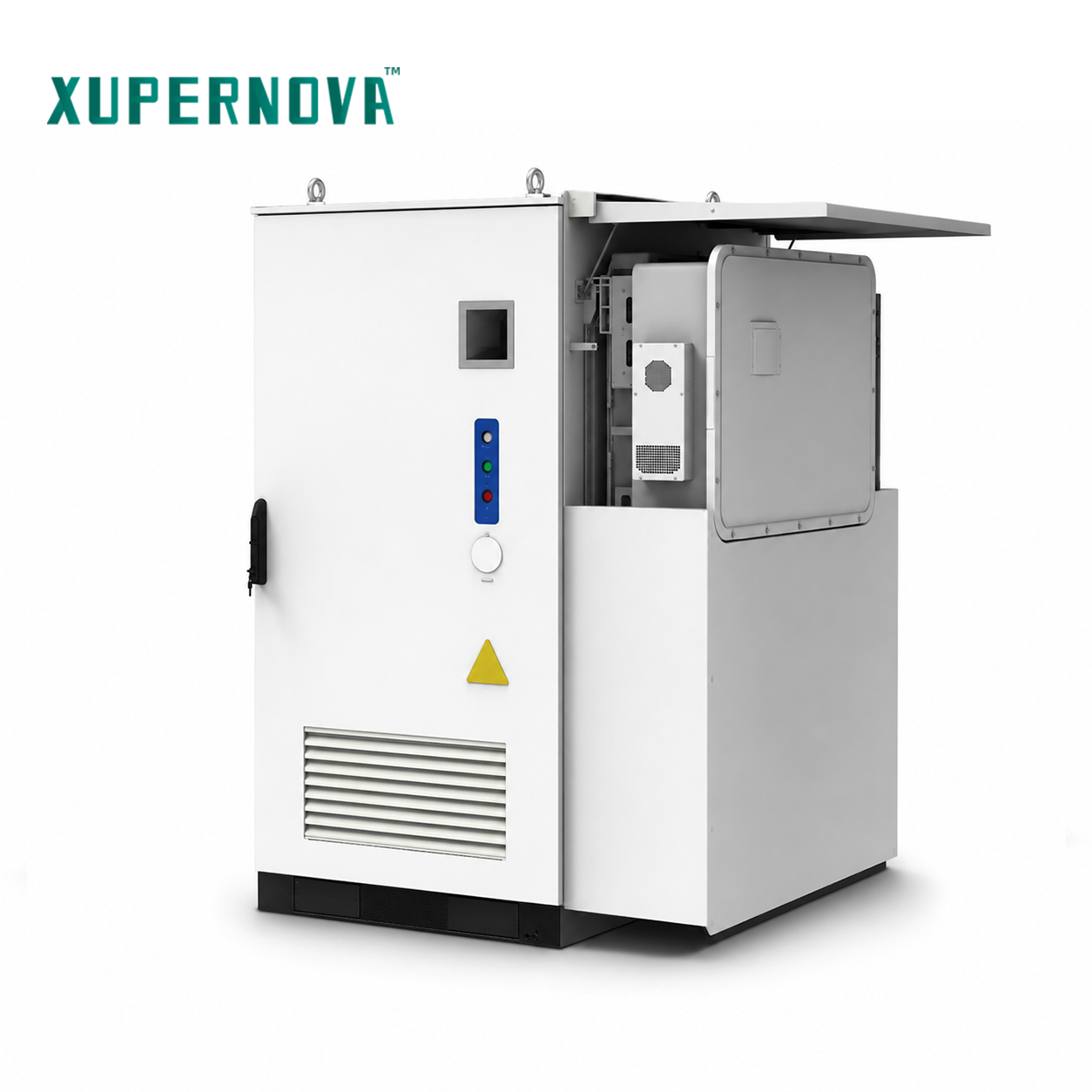
A solar-plus-storage cabinet platform. The compliance dossier describes how hardware like this behaves under export limits, grid-code settings and fire-safety requirements on one specific site.
Why the compliance dossier decides project acceptance
Solar-plus-storage spans two regulatory objects at once. The PV array is a generator. The battery is a bidirectional asset that can import, export and island. A project therefore has to satisfy generation-interconnection rules and storage-specific safety rules simultaneously, and the same cabinet can be acceptable in one market and incomplete in another.
The manufacturer's own scenario documentation makes the required inputs explicit. For solar-plus-storage and photovoltaic self-consumption projects — solar farms, industrial parks and commercial buildings operating under intermittent photovoltaic generation, daytime surplus energy and evening peak demand — the listed special requirements are: PV generation assessment, export limitation requirements, grid-code compliance, backup-load assessment and coordinated PV–battery control. Supporting equipment typically includes PV modules, a PV inverter or hybrid PCS, a combiner box, a smart meter, an EMS, a transformer where required, STS/EPS for backup applications, and communication cables.
Those five items are also the five most common gaps in a submitted dossier. Each is a study or a configuration decision; none is delivered by a product datasheet alone.
The five technical qualification files
1. PV generation assessment
An assessment establishes the site's generation profile across seasons and times of day, and identifies how much surplus energy the load cannot absorb. In a self-consumption design the storage system's role is to store excess photovoltaic energy, increase onsite solar consumption, reduce grid imports and provide optional backup power. Because the system runs in automatic PV, battery, load and grid coordination — daytime solar charging with scheduled or demand-based discharging — the assessment has to be built on an hourly profile rather than an annual yield figure.
2. Export limitation requirements
Where the point of common coupling is capped, surplus generation must be stored, consumed or curtailed. The dossier needs three statements: the limit value and how it is measured, the enforcement point (inverter, PCS or EMS), and the behaviour when the battery reaches full state of charge while the array keeps generating. Export limiting is a control obligation rather than a feature label, and it should be validated during commissioning rather than assumed from a specification table.
3. Grid-code compliance
Grid-code compliance is a property of a configuration, not of a product family. The same battery platform is normally adapted per market through PCS settings, protection functions, dispatch and communication interfaces and, at utility scale, cybersecurity provisions. In utility-scale renewable integration projects the requirement list expands to grid impact study, local grid-code compliance, protection coordination, dispatch-interface requirements, cybersecurity, fire safety and environmental assessment — matched by PCS, medium-voltage transformer, MV switchgear, AC collection system, substation equipment, protection and control systems, SCADA and plant-level EMS.
4. Backup-load assessment
A backup claim is only as good as the load list behind it. Critical-load backup and energy resilience projects require a critical-load assessment, a defined required backup duration, islanding protection, a black-start strategy, an emergency response plan and fire-safety compliance. Supporting equipment includes an STS or EPS cabinet, critical-load distribution panel, grid-forming PCS, transformer where required, switchgear, UPS for zero-interruption loads, EMS and an optional diesel generator. Islanded backup operation is available when the system is configured with grid-forming PCS and STS/EPS — a design decision, not a default.
5. Coordinated PV–battery control
The control layer sets the order of operations: charge from PV first, serve load, hold the export limit, and reserve a defined state of charge for backup. The dossier should document the priority logic and the conditions under which each mode changes, because this is where a project either respects its export cap under all irradiance conditions or quietly breaches it on a clear spring afternoon.
Table 1 — Technical qualification files and their failure modes
| Dossier file | Core question it answers | Typical failure mode |
|---|---|---|
| PV generation assessment | How much surplus energy does the site produce, and when? | Annual yield used instead of an hourly profile; backup reserve never sized. |
| Export limitation study | Where is the export cap enforced, and what happens at full state of charge? | Limit stated but no control evidence; no curtailment fallback. |
| Grid-code compliance matrix | Which code clauses apply to this configuration in this jurisdiction? | Certificate for a different configuration presented as project compliance. |
| Backup-load assessment | Which loads, for how long, with what switching arrangement? | Backup duration promised without a critical-load list or islanding design. |
| Coordinated PV–battery control | What is the operating priority between PV, battery, load and grid? | Parallel operation assumed; export cap and backup reserve conflict. |
From study work to sign-off: the acceptance documents
Grid-connection approval
For commercial and industrial peak shaving and time-of-use arbitrage projects — manufacturing sites, industrial parks and commercial facilities with fluctuating loads, high peak demand and time-of-use tariffs — the documented application requirements are load-profile assessment, time-of-use tariff analysis, grid-connection approval, protection coordination and fire-safety compliance. Supporting equipment includes a grid-connection cabinet, transformer where required, switchgear, smart meter, CTs, plant-level EMS, power cables and communication cables.
Protection coordination
Protection coordination confirms that the storage asset's protection settings discriminate correctly with upstream devices, so that a fault inside the plant does not trip the wider network and a network event does not damage the battery system. It is a study, not a purchase item, and it is one of the reasons a project can pass factory testing and still fail at energisation.
Fire-safety compliance
Fire safety is listed as a special requirement in every application family described by the manufacturer — commercial and industrial peak shaving, critical-load backup, solar-plus-storage self-consumption, utility-scale renewable integration and EV charging capacity support. That repetition is a signal for buyers: fire safety is the requirement most likely to move a project schedule. Fire protection system, IP rating and corrosion protection also sit inside the configurable scope, which means fire-safety documentation has to be assembled configuration by configuration rather than copied from a generic certificate.
Table 2 — Acceptance documents and who depends on them
| Acceptance document | Primary interest | Dependency |
|---|---|---|
| Grid-connection approval | Network operator | Load profile, TOU tariff analysis, protection coordination, fire-safety compliance. |
| Protection coordination study | Operator and EPC | PCS settings, switchgear, CTs, EMS control logic. |
| Fire-safety sign-off | Authority having jurisdiction | Fire protection configuration, enclosure and site layout, emergency response plan. |
| Commissioning and FAT records | Owner and lender | Functional, electrical safety and aging tests; third-party inspection where required. |
Where Xupernova's product range fits a solar-plus-storage qualification file
Xupernova supplies 20-ft liquid-cooled battery containers, liquid-cooled all-in-one ESS cabinets, 10-ft liquid-cooled ESS containers, solar-plus-storage cabinets and air-cooled solar-plus-storage cabinets for different-scale energy-storage projects. For a solar-plus-storage dossier, the relevant platforms are the ones with documented PV input and backup options.
| Model | Type | Rated parameters | Typical solar-plus-storage role |
|---|---|---|---|
| XA-H0064-A1 | Air-cooled Solar-plus-storage Cabinet | 25–50 kW / 64.54 kWh, 0.5P/1P/2P | Small-scale commercial and industrial solar-plus-storage |
| XA-H0261-L1 | Liquid-cooled Solar-plus-storage Cabinet | 261 kWh, 0.5P/1P/2P | Commercial and industrial solar-plus-storage, microgrids |
| XA-C0261-L1 | Liquid-cooled All-in-one ESS Cabinet | 125 kW / 261.25 kWh, 0.5P/1P/2P | Commercial and industrial peak shaving, PV self-consumption |
| XA-X1044-L1 | 10-ft Liquid-cooled All-in-one ESS Container | 500 kW / 1044 kWh, 0.5P/1P/2P | Commercial and industrial storage, microgrids, backup power |
| XA-X2170-L2 | 20-ft Liquid-cooled All-in-one ESS Container | 1125 kW / 2170.3 kWh, 0.5P/1P/2P | Commercial and industrial, grid-side energy storage |
| XA-V5015-L1 | 20-ft Liquid-cooled Battery Container | 5.015 MWh, 0.5P/1P/2P | Power generation, grid energy storage, large C&I |
All listed platforms operate across a −30–55°C ambient scope and use Grade A LFP lithium-ion cells from BloombergNEF Tier 1 energy-storage cell manufacturers. Optional semi-solid-state, solid-state and sodium-ion battery technologies are offered subject to project requirements, technical validation and availability — they are not drop-in equivalents of a qualified LFP configuration today.
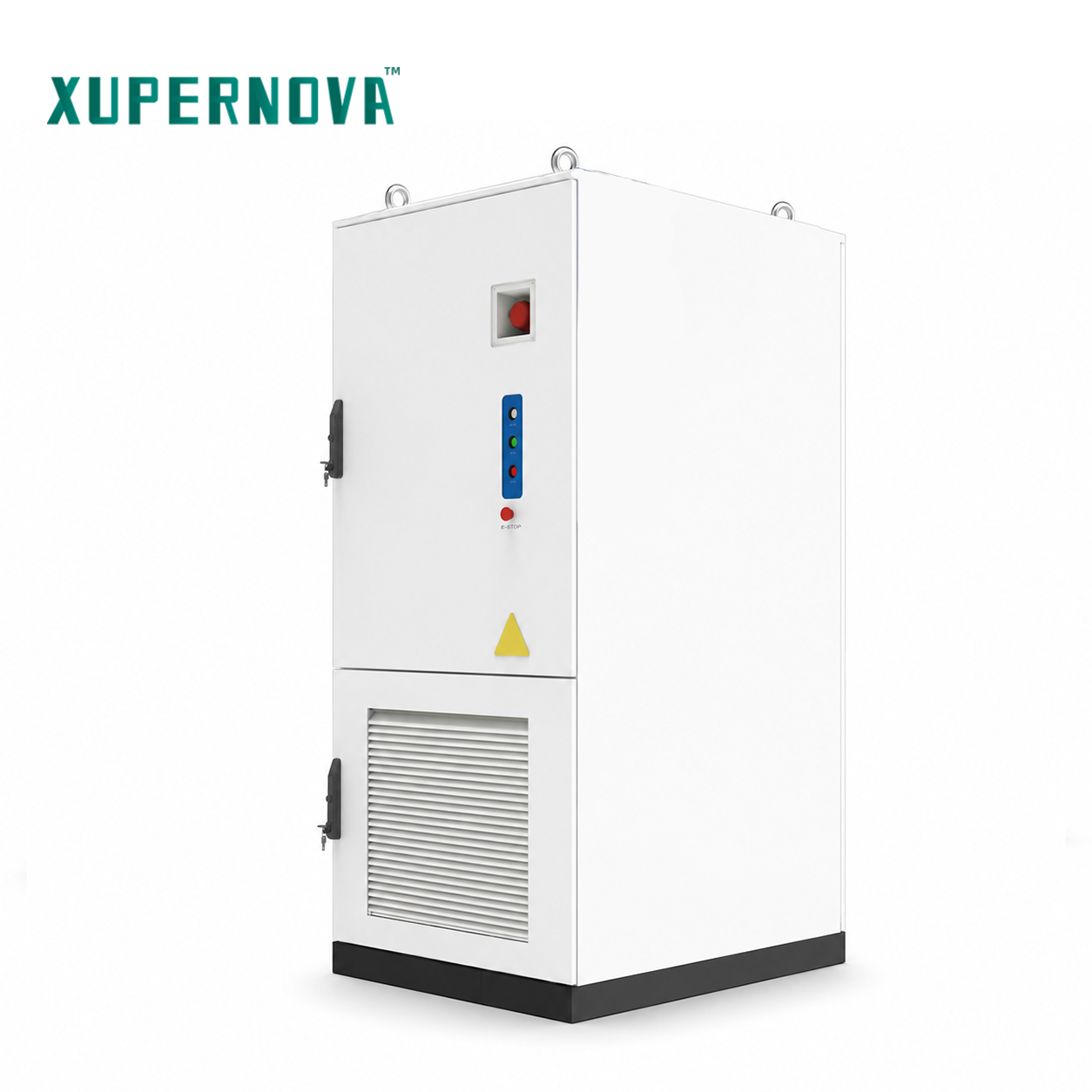
An all-in-one liquid-cooled cabinet configuration. Documentation scope follows the configuration: grid code, communication protocol and fire protection are specified per project.
Configuration flexibility matters to the dossier because grid code, communication protocols, transformer and switchgear configuration, PV input and solar-plus-storage arrangement, on-grid or off-grid operation, STS/EPS backup function, cooling system, fire protection system, IP rating and corrosion protection are all part of the customizable scope under Xupernova's OEM/ODM model. Production capacity reaches up to 500 MWh per month, with lead times of 25–35 days for standard BESS and 35–60 days for customized projects, and a minimum order quantity of one unit.
Quality documentation supports the acceptance file: 100% factory acceptance testing, electrical safety testing, functional testing, aging testing, and third-party inspection available on request. After-sales scope covers 24/7 remote support, commissioning, training, diagnostics, spare parts and optional onsite service.
The bankability layer: Tier 1 cell sourcing and warranty term
Lenders and owners increasingly treat cell sourcing as a qualification item rather than a purchasing preference. The reason is scale. Global new battery storage deployment reached 108 GW in 2025 according to the IEA's Global Energy Review 2026, and LFP chemistry accounted for approximately 90% of those deployments. In the same period, all-in CAPEX for long-duration (4h+) utility-scale projects reached $125/kWh in markets outside China and the United States, based on Ember's analysis. At that cost base, the dominant risk in a project finance model is no longer cell price — it is whether the supplier will still be delivering the same cell quality in year seven.
That is why qualification files now typically include two specific evidence points: cell sourcing tiering, and the warranty term attached to the cells rather than to the enclosure. Xupernova's supplier qualification documentation references Grade A LFP lithium-ion cells from BloombergNEF Tier 1 energy-storage cell manufacturers and a minimum 7-year cell warranty as supply-chain evidence. For a bankability reviewer, the pairing matters: tiering addresses who makes the cell, and the warranty term addresses who stands behind it over the operating period.
Independent verification of a project's as-built state is the third leg. 100% factory acceptance testing with aging tests, plus the option of third-party inspection, gives the owner a documented record that can be attached to the acceptance file rather than reconstructed after energisation.
Application evidence: what the dossier had to prove
Retail and supermarket portfolio — 125 kW / 261.248 kWh, 50 units
A global supermarket and retail facility operator deployed 50 compact units for peak shaving, time-of-use arbitrage and photovoltaic self-consumption. The documentation highlight was compatibility with Italian grid requirements, combined with single-unit deployment, low onsite installation workload and remote monitoring. The project was completed within one year and delivered stable daily operation, reduced peak electricity demand and improved onsite solar energy utilisation. For dossier readers, this is a case where grid-code compliance and site-level installation logistics were the binding constraints, not storage capacity.
Solar EPC deployment — 500 kW / 1.044 MWh with up to 1 MW PV input, 32 units
A commercial facility and solar EPC contractor installed a liquid-cooled solar-plus-storage configuration with a wide PV input range, modular expansion, plant-level EMS and remote monitoring, applied to PV self-consumption, peak shaving, time-of-use arbitrage and emergency power support. The relevant dossier lesson is that PV input range and expansion headroom were specified as project requirements up front, which is what allows the same qualification file to cover later phases.
Industrial park microgrid — 1 MW / 2.088 MWh, 12 units
A commercial and industrial park operator used an integrated STS for seamless grid-connected and off-grid switching, with photovoltaic and diesel generator interfaces and centralised energy management. Results were improved critical-load power continuity, higher solar utilisation and reduced diesel generator operating time. This is the clearest example of why islanding protection and black-start strategy belong in the backup-load assessment rather than in a commissioning addendum.
Industrial manufacturing site — 1 MW / 2.09 MWh, 20 units
An industrial manufacturing enterprise deployed 20 units across a two-year project for peak shaving, time-of-use arbitrage and demand management, with an all-in-one liquid-cooled design, plant-level EMS, modular deployment, IP55 protection and compatibility with German grid requirements. The project achieved stable automatic operation, reduced peak grid demand and optimised electricity costs.
Renewable developer platform — 2 MW / 4.176 MWh, 7 units
A renewable energy project developer used a compact 10-ft container design with integrated PCS, BMS and EMS, liquid cooling and multi-source access, declared compatible with G99 grid-code requirements, for renewable energy shifting, grid balancing, peak shaving and backup power.
EV charging and mining microgrid scenarios
In EV charging stations, logistics parks and fleet depots, the documented special requirements are charging-load forecast, transformer-capacity assessment, dynamic power allocation, grid-connection approval and fire-safety compliance, with the storage system coordinating grid power, PV, battery and charging loads through an EMS. In mining, remote industrial sites and off-grid facilities, the requirement set shifts to site load study, motor-starting analysis, spinning-reserve strategy, high-temperature and dust protection, black-start capability and remote O&M. Same platform family, materially different dossier.
Comparison with traditional approaches — and the limits of this route
| Approach | Strongest at | Weakest at | Dossier burden |
|---|---|---|---|
| Diesel-only backup | Long-duration outage coverage with familiar service models | Runtime cost, emissions, start-up delay | Fuel storage and emissions compliance |
| PV-only | Daytime generation and lowest equipment count | No evening coverage, no export-limit buffering | Interconnection and export approval only |
| BESS-only (grid-charged) | Peak shaving, TOU arbitrage, demand management | No onsite generation, full exposure to tariff changes | Load profile, protection coordination, fire safety |
| Solar-plus-storage BESS | Self-consumption, export compliance, optional backup | Highest documentation complexity per MW | All five technical files plus three acceptance documents |
Honest boundaries matter more than advantages here. First, an export limitation caps the value of surplus generation: if the site cannot consume or store what the array produces, curtailment is the only remaining lever, and additional battery capacity may not recover it. Second, backup duration is bounded by usable energy and by the islanding configuration — islanded operation requires grid-forming PCS and STS/EPS, and a system ordered without them will not island regardless of capacity. Third, grid-code compliance is jurisdiction- and configuration-specific: the same cabinet can require different PCS settings, protection settings and documentation in different markets. Fourth, lead time is a real schedule constraint — 25–35 days for standard BESS and 35–60 days for customized projects. Fifth, multi-vendor assemblies of container, PCS and EMS add coordination work in protection and control, and the dossier becomes harder to close. Finally, supplier documentation supports the file but never replaces the local engineer of record and the authority having jurisdiction.
Market trend analysis
Three structural trends are pushing compliance documentation from an administrative task to a selection criterion.
Volume. Global new battery storage capacity deployment reached 108 GW in 2025 (IEA, Global Energy Review 2026), and U.S. utility-scale battery storage capacity growth was projected at 19.6 GW for 2025 (EIA, Preliminary Monthly Electric Generator Inventory). Higher project counts mean more projects passing through the same interconnection and fire-safety review capacity, which lengthens approval queues and rewards developers whose files arrive complete.
Chemistry standardisation. LFP accounted for approximately 90% of global battery storage deployments in 2025 (IEA). A single dominant chemistry makes cell sourcing and warranty terms comparable across suppliers, which is precisely what allows buyers to make them qualification criteria.
Cost pressure and definitional noise. All-in CAPEX of $125/kWh for long-duration utility-scale projects (Ember, late 2025) raises the stakes on any compliance-driven redesign. Meanwhile, market size estimates diverge widely — one commercial research estimate places the global BESS market at $50.81 billion in 2025, while other providers publish materially lower figures, largely because scope differs between battery cells, turnkey systems, utility-scale and commercial and industrial segments. Buyers should treat any single market size figure as a scoped estimate, not a settled fact. On the trade side, BESS units fully encased in housing are classified under U.S. HTS 8507.60.00.90, which is a practical input to import planning and landed-cost modelling.
Future outlook
Three shifts are likely over the next procurement cycles. Export limitation enforcement will migrate deeper into the EMS and hybrid PCS layer, so the control evidence in a dossier becomes testable rather than descriptive. Grid-code configuration will be treated as an explicit procurement line item alongside capacity and cooling, with the compliance matrix issued at quotation stage. And fire-safety sign-off will move earlier into design, because a configuration-level approval cannot be retrofitted after the enclosure and site layout are fixed.
Warranty disclosure is likely to follow the same path: cell tiering and warranty term will appear in tender documents as standard fields rather than as differentiators, because lenders require them for the model to close. Suppliers whose documentation already anticipates that format will spend less time in qualification and more time in delivery.
FAQ
What must a solar-plus-storage BESS compliance dossier contain?
At minimum, five technical files — PV generation assessment, export limitation requirements, grid-code compliance, backup-load assessment and coordinated PV–battery control — supported by PV modules, a PV inverter or hybrid PCS, combiner box, smart meter, EMS, transformer where required, STS/EPS for backup applications and communication cables. Three acceptance documents complete the file: grid-connection approval, protection coordination and fire-safety compliance.
How is an export limitation actually enforced in a solar-plus-storage system?
The limit is enforced by control logic rather than by hardware sizing. The system operates in automatic PV, battery, load and grid coordination, charging from solar during the day and discharging on schedule or on demand, so surplus generation is absorbed by the battery before it reaches the point of common coupling. The dossier should state the limit value, the enforcement point and the curtailment behaviour when the battery reaches full state of charge.
Which grid-code requirements apply to a solar-plus-storage project?
It depends on market and configuration. Manufacturer case records include systems deployed with compatibility to Italian grid requirements, German grid requirements and G99 requirements, which illustrates that the same platform is configured per jurisdiction through PCS settings, protection functions and communication protocols. At utility scale, requirements broaden to grid impact study, local grid-code compliance, protection coordination, dispatch interface, cybersecurity, fire safety and environmental assessment.
What backup load can a battery energy storage system support?
Backup capability is defined by the critical-load assessment, the required backup duration and the switching arrangement — not by nameplate capacity alone. Islanded backup operation is available when the system is configured with grid-forming PCS and STS/EPS, maintaining supply to selected critical loads; supporting equipment can include a critical-load distribution panel, UPS for zero-interruption loads and an optional diesel generator.
Does fire-safety compliance differ between commercial and utility-scale projects?
The requirement appears in every documented application family — commercial and industrial peak shaving, critical-load backup, solar-plus-storage self-consumption, utility-scale integration and EV charging support — but the evidence package differs by enclosure type, site layout and local authority. Because fire protection system, IP rating and corrosion protection sit inside the configurable scope, fire-safety documentation is assembled per configuration rather than reused across projects.
Why do Tier 1 cell sourcing and a 7-year cell warranty appear in bankability review?
They address different risks. Cell sourcing tiering answers who manufactures the cell; the warranty term answers who stands behind it over the operating period. With LFP representing roughly 90% of global storage deployments in 2025 and utility-scale CAPEX around $125/kWh for long-duration projects, lenders treat both as supply-chain qualification evidence rather than as commercial preferences.
¿Tiene preguntas o necesita más detalles?
Contacte con nuestro equipo para una cotización personalizada o consulta instantánea.
Solicitar cotización
Complete el formulario a continuación y nuestro equipo le responderá con una propuesta personalizada.
Chat directo de WhatsApp
¿Prefiere chatear en tiempo real? Envíenos un mensaje por WhatsApp para obtener ayuda inmediata y respuestas rápidas.
- Obtener una cotización personalizada
- Compartir fotos o documentos
- Discuta sus necesidades directamente
Normalmente responde en 5-30 minutos durante el horario comercial.