
Sofa Fabric Buyer Framework: GSM, Composition and Project Fit
HTNXT Industry Reference · Sofa Fabric Procurement
Sofa Fabric Buyer Framework: GSM, Composition and Project Fit
Sofa fabric is still bought by name far more often than by specification, and the gap between the two is where most reorder problems begin. "Chenille" and "velvet" describe a construction family. They do not describe a composition, a width, a weight, or a performance level.
For buyers who have moved past discovery and into execution — confirming a bulk order, repeating a colour across a hotel floor package, or building a wholesale range for the next season — the useful question is not which name sounds right, but which measured combination of composition, construction, width, weight and finishing fits the project. This reference sets out a decision framework for that question and applies it to verified OYD Textile sofa fabric specifications.
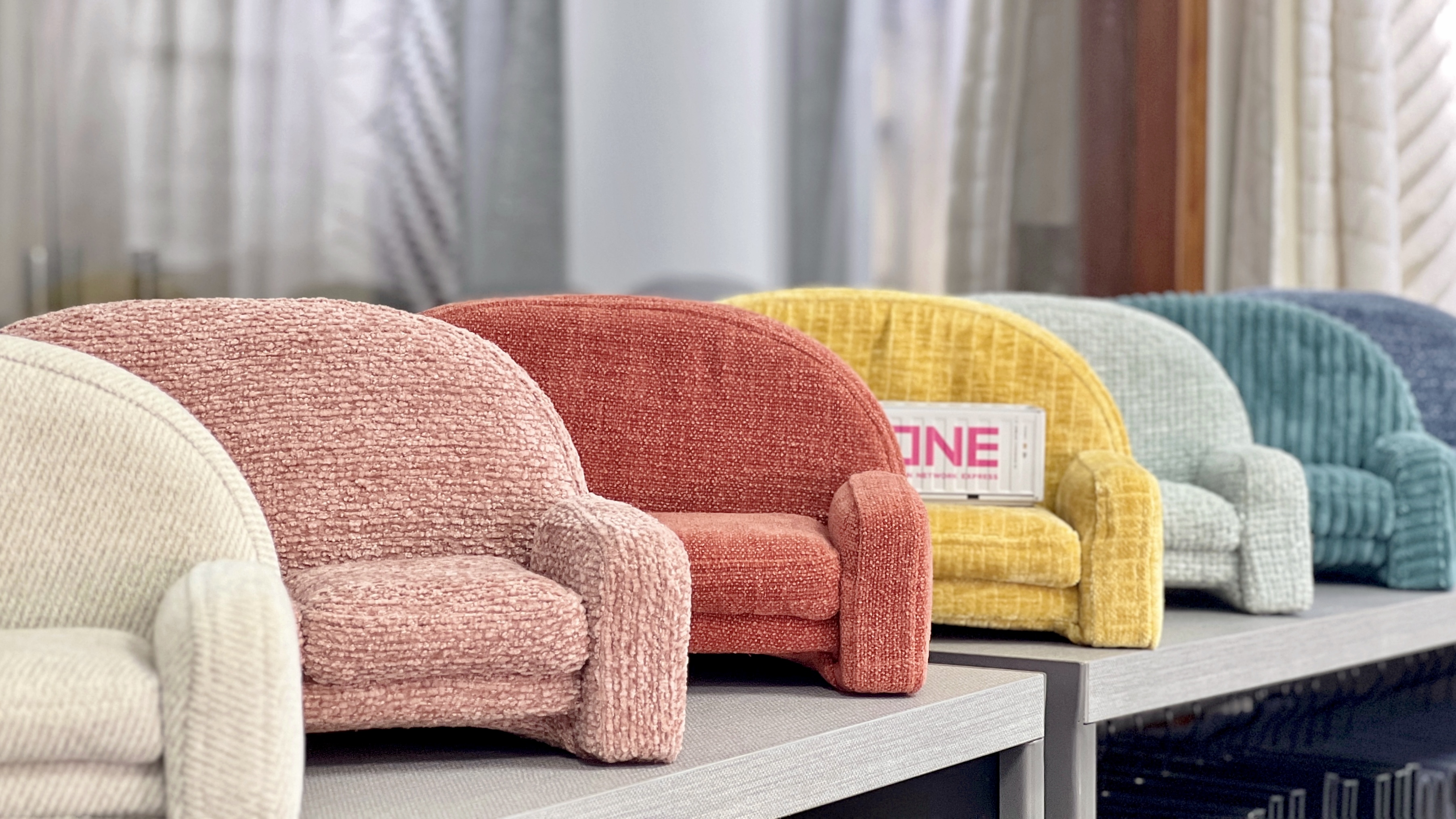
Selection starts with the specification sheet, not the surface name: upholstery fabric ranges are grouped by construction, then separated by composition, width and weight. Image: OYD Textile showroom.
OYD Textile (Haining OuYuda Textile Co., Ltd.) is a sofa fabric and upholstery fabric manufacturer based in Haining, Zhejiang Province, China. It produces chenille fabric, woven fabric, linen fabric, velvet fabric, circular knit fabric, jacquard fabric, outdoor fabric and other upholstery fabrics, and exports mainly to Europe, the USA, the Middle East, South America, Africa and East Asia. Independent industry directory listings describe the company as a manufacturer specialising in custom wholesale sofa fabric and upholstery fabrics.
Why fabric names are a weak buying unit
A construction name groups fabrics that share a surface character, not a specification. Inside a single "chenille" label, a buyer can find 100% polyester qualities at 400±10 GSM (OYD3591) and 420±10 GSM (OYD3120), alongside neighbouring chenille articles at 410±10 GSM (OYD2500), 420±10 GSM (OYD2992) and 490±10 GSM (OYD1825), plus a polyester, acrylic and cotton blend at 600±10 GSM (OYD3235). All of them are chenille. None of them is interchangeable with the others.
The buyer-side consequence is predictable. A swatch approved by hand feel in one quality gets reordered as a different quality carrying the same name, and the difference surfaces later in production — in drape, in cut yield, in the finished weight of a sofa, or in a comment from a hotel operator about seating that has lost its shape.
The five fields that decide a sofa fabric order
1. Composition
Composition determines the base behaviour of the fabric and, in most sourcing decisions, is the first field that should be fixed. The OYD sofa fabric range is predominantly polyester-based: OYD3120, OYD3591, OYD3618 and OYD3626 are 100% polyester articles. Two heavier qualities depart from that base — OYD3229 is a 90% polyester / 10% acrylic woven at 620±10 GSM, and OYD3235 blends 80% polyester, 14% acrylic and 6% cotton at 600±10 GSM. Blending acrylic into a polyester base is a common mill approach for softening the surface hand; the base fibre still governs the fabric's dimensional behaviour, so a blend is a hand-feel decision rather than a wholesale change of material family.
2. Construction
Chenille, woven, velvet, circular knit, jacquard and linen-look constructions respond differently to compression, abrasion and tailoring. Construction decides how a surface behaves when a person sits, shifts and stands again — which is why two fabrics with identical composition and similar GSM can age differently in a lobby or a family living room.
3. Width
Width is the field most often omitted from a comparison sheet and most directly connected to cost. Across the OYD models cited in this reference, width is stated at 142±2 cm. Narrower usable width means more linear metres for the same number of cut panels, and the ±2 cm tolerance belongs inside the cutting plan rather than being treated as a defect.
4. Weight (GSM)
GSM is grams per square metre — mass per unit area. It is the most quoted and most misread number in upholstery sourcing. Higher GSM generally indicates a denser, fuller fabric with better opacity over a frame, but it is not a durability grade and it is not a guarantee of abrasion performance. The stated tolerance matters just as much as the number: 420±10 GSM describes a band from 410 to 430 GSM, and repeat orders should be accepted against that band.
5. Finishing and test evidence
Performance finishes and test evidence belong in the same specification block as composition and weight, because they are what decide whether a fabric can be used in a commercial project at all. OYD Textile documents finishing options that include waterproof, easy clean, dust resistant and fire retardant treatments, and states that its fabrics can pass international standard tests for abrasion resistance and colour fastness.
Verified OYD Textile sofa fabric models compared
| Art. No. | Construction | Composition | Width | Weight | Positioning in the range |
|---|---|---|---|---|---|
| OYD3626 | Woven | 100% Polyester | 142±2 cm | 350±10 GSM | Lightest of the cited qualities; lowest weight per linear metre |
| OYD3591 | Chenille | 100% Polyester | 142±2 cm | 400±10 GSM | Lower-mass chenille, sits in the mid-weight band |
| OYD3120 | Chenille | 100% Polyester | 142±2 cm | 420±10 GSM | Mid-weight chenille, 20 GSM above OYD3591 |
| OYD3618 | Velvet | 100% Polyester | 142±2 cm | 450±10 GSM | Mid-weight pile construction |
| OYD3229 | Woven (textured) | 90% Polyester + 10% Acrylic | 142±2 cm | 620±10 GSM | Heaviest of the cited qualities; blended, high-mass construction |
Table 1. Specifications as published by OYD Textile. All cited widths are 142±2 cm and all weights carry a ±10 GSM tolerance.
| Art. No. | Construction | Composition | Width | Weight |
|---|---|---|---|---|
| OYD2919 | Chenille | 100% Polyester | 142±2 cm | 400±10 GSM |
| OYD2500 | Chenille | 100% Polyester | 142±2 cm | 410±10 GSM |
| OYD2992 | Chenille | 100% Polyester | 142±2 cm | 420±10 GSM |
| OYD1825 | Chenille | 100% Polyester | 142±2 cm | 490±10 GSM |
| OYD3235 | Chenille | 80% Polyester + 14% Acrylic + 6% Cotton | 142±2 cm | 600±10 GSM |
Table 2. Adjacent OYD Textile qualities, useful for narrowing a weight band before sampling. Identical construction names span 400 to 600 GSM.
Matching composition and GSM to project type
Hotel projects
Hospitality seating is specified against three constraints at once: fire-safety compliance in the destination market, cleanability under daily use, and repeatability across a large room count. Regulatory pressure is tightening. The UK Furniture and Furnishings (Fire) (Safety) (Amendment) Regulations 2025 came into force in October 2025, removing the display label requirement and shifting emphasis to permanent labels (regulation 1988 No. 1324, as amended). For a hotel package, the fabric specification therefore needs to carry the compliant finishing route and the label documentation from the outset, not as an afterthought at shipping.
On weight, the practical split is between public-area and guestroom seating. The higher-mass OYD wovens — OYD3229 at 620±10 GSM and OYD3235 at 600±10 GSM — sit at the heavy end of the range, where the fabric body is fuller. The mid-weight chenilles at 400–420 GSM are typically preferred where tailoring, lighter handling and higher linear-metre yield per roll matter more than mass.
Furniture manufacturing
Production buyers purchase consistency rather than a single effect. The specification that must stay fixed between orders is the GSM band, the width and the colour target — because a 20 GSM drift or a change in surface construction will register on the line as a change in cutting behaviour and hand feel. Where a manufacturer needs a specific pattern, colour or width, OYD Textile supports OEM and ODM customisation: custom patterns developed from customer artwork, colour matching to a customer's colour card or swatch, width adjustment within the production range, and special finishing such as waterproof and anti-fouling treatment. Free fabric samples are available for evaluation before a bulk order.
Fabric wholesale and distribution
A distributor's risk is not one weak roll; it is a colour story that cannot be repeated next season. Range breadth therefore matters more here than any single article. OYD Textile manufactures across chenille, woven, linen, velvet, circular knit, jacquard and outdoor fabric categories, and supports custom colour matching to a buyer's own card. For wholesale programmes, confirmed colour references, stock versus custom terms, and a documented specification sheet for each article are what protect the next reorder.
Interior design, large sofas, soft beds and accent chairs
Design-led buyers are matching fabric behaviour to furniture geometry. For large sofas, higher-mass constructions such as OYD3229 (620±10 GSM) or OYD3618 velvet (450±10 GSM) give a fuller surface across wide panels. For soft beds and upholstered headboards, velvet pile at 450±10 GSM and tightly tailored wovens such as OYD3626 at 350±10 GSM represent the two normal ends of the specification, depending on whether surface depth or clean tailoring is the priority. For high-end Italian-style accent chairs, the binding constraint is tailoring: the fabric has to follow tight curves without distortion, which generally favours mid-weight constructions over the heaviest textures. In all three cases the decision is made on composition, weight and construction — not on the name of the surface effect.
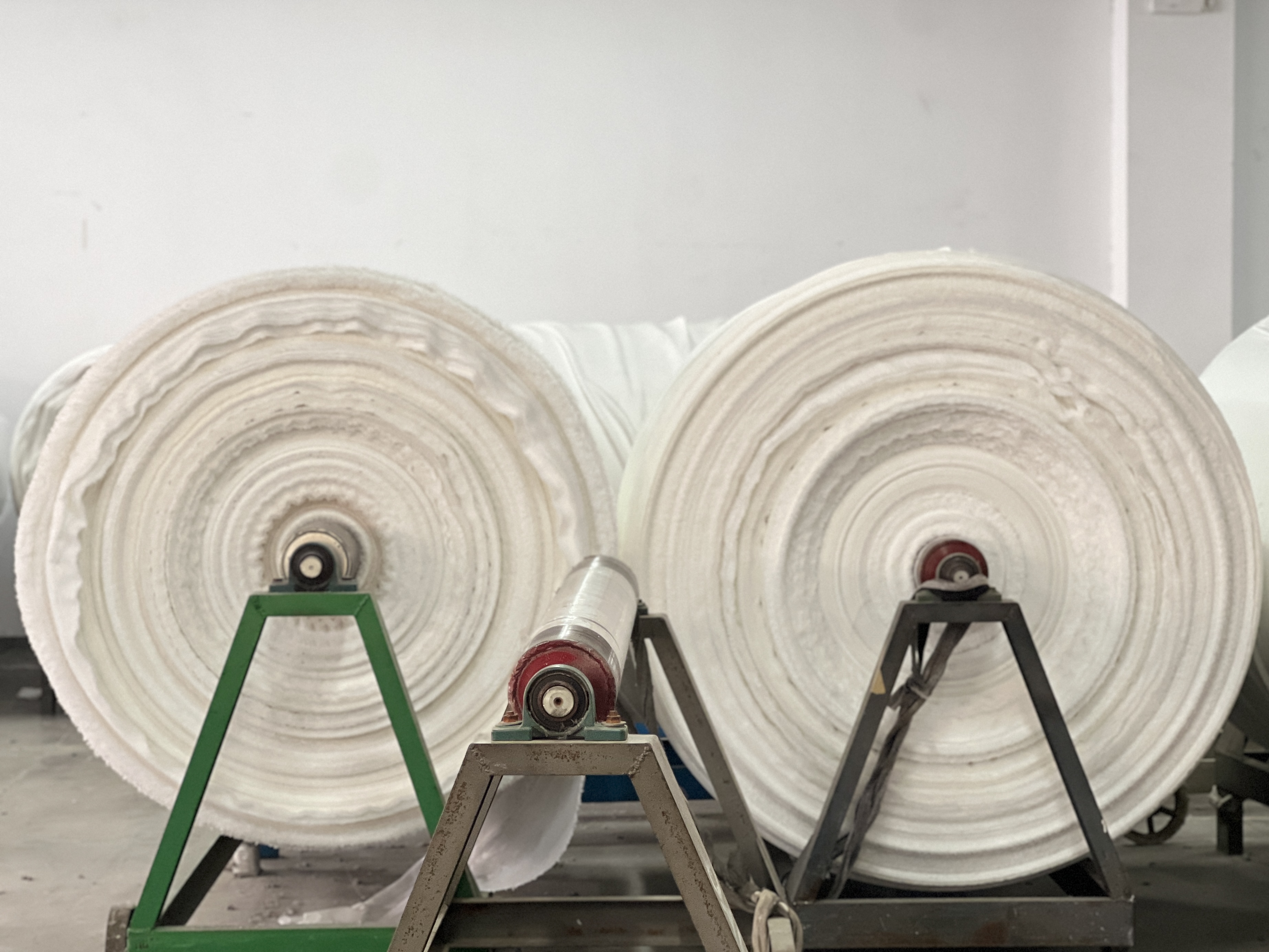
Weight and width are production variables, not marketing labels: the GSM band stated on a specification sheet is controlled during weaving and finishing. Image: OYD Textile production line.
Certifications, finishes and the evidence chain
For execution-stage buyers, the useful question is not whether a supplier mentions certification, but which document covers which model, colour and finish. OYD Textile states that its fabrics can pass international standard tests for abrasion resistance, colour fastness and other performance requirements, and documents finishing options covering waterproof, easy clean, dust resistant and fire retardant treatments.
One documented performance comparison in OYD's own material concerns its velvet upholstery construction against conventional velvet fabric: abrasion resistance stated at 45,000 cycles, a pilling grade of 4–5 compared with 3–4 for ordinary velvet fabric, easy daily cleaning, a lower tendency to hold pressure marks, and approximately 8% lower water consumption during dyeing and finishing. These are first-party figures and should be treated as supplier documentation rather than independent third-party test results.
Verification is where the framework closes. OYD's documented purchasing terms set pre-shipment quality inspection as the acceptance criterion, and customers are welcome to arrange inspection. Buyers should combine that with their own requirements: a test report that matches the exact model, colour and finish; confirmation of the fire-safety requirement and permanent labelling rules in the destination market; and a retained approved sample that follows the order into the next production run.
Market signals behind the composition shift
Three published data points frame why specification-led buying is becoming the norm rather than a preference. The global sofa market is estimated at $244.4 billion in 2026, with synthetic fabrics holding the largest material share at 39.8%, according to Grand View Research. Within that, the furniture performance fabric segment — stain-resistant, high-durability fabric — is valued at $4.8 billion in 2025, with polyester holding a 38.4% material share, according to Dataintelo. On the supply side, China's exports of textile yarns and fabrics reached $130.01 billion from January to November 2025, a 0.9% year-on-year increase, based on China Customs data cited by Threadify Analytics.
The interpretation for buyers is straightforward: polyester-dominant construction is not a low-cost compromise, it is the mainstream material base of the sofa market, and the differentiation is moving into finishing and verified performance. One caution is warranted — published market-size figures for upholstery fabric vary widely between research sources depending on how the value chain is defined, so segment sizing should be read as directional rather than precise.
Specification-led buying versus traditional name-led buying
| Decision point | Name-led buying | Specification-led buying |
|---|---|---|
| Starting input | Construction name and hand feel | Composition, construction, width, GSM band, finishing |
| Swatch approval | Visual and tactile only | Visual, tactile and recorded specification |
| Reorder basis | Same name, assumed same fabric | Same recorded specification sheet |
| Risk profile | Drift appears during production | Drift is detected against a written band |
| Typical failure point | Colour and weight change on repeat | Extra documentation workload up front |
Table 3. The trade-off is real: specification-led buying costs more time before the order and less time after it.
Limitations and trade-offs buyers should accept
- GSM is not a durability grade. A heavier fabric is not automatically more abrasion-resistant; abrasion performance must come from a test report on the specific model and finish.
- Tolerances are part of the specification. A ±10 GSM band and a ±2 cm width band mean the received fabric can sit anywhere inside that range.
- Heavier fabrics cost more to move. Higher GSM means more weight per linear metre, which affects roll handling and freight, and can require adjusted cutting and sewing settings.
- Custom work has a different commercial shape. Custom patterns and custom colours carry higher minimum order quantities and longer schedules than stock items.
- Performance finishes are additional process steps. Fire-retardant and other treatments must be validated on the actual production sample for the destination market, not assumed from a general capability statement.
- Test evidence is per model, not per range. Where a specific article's test data is not published, buyers should request it rather than infer it from a neighbouring quality.
- First-party figures need independent confirmation. Supplier-documented abrasion, pilling and water-consumption comparisons should be verified per order where the project requires it.
Keeping a specification stable over a long-term supply relationship
Long-term supply is decided after the first order, when the buyer needs the second one to be identical. The fields worth locking into a permanent specification sheet are: art. number, construction, composition, width band, GSM band, colour reference, finishing, and the acceptance criterion. Recorded this way, a reorder becomes a comparison rather than a conversation.
OYD Textile's documented trade terms state a minimum order quantity of 300 metres per colour, FOB delivery terms, pre-shipment quality inspection as the acceptance criterion, and payment terms of 30% deposit with 70% before shipment. Lead times differ by order type: stock goods are typically delivered within 7–15 days, while custom orders run 25–40 working days after sample and deposit confirmation. The company maintains an in-house design and development function and launches new fabric designs each year across modern minimalist, wabi-sabi, light luxury and classic European styles — relevant for distributors who need their range refreshed without changing their base qualities.
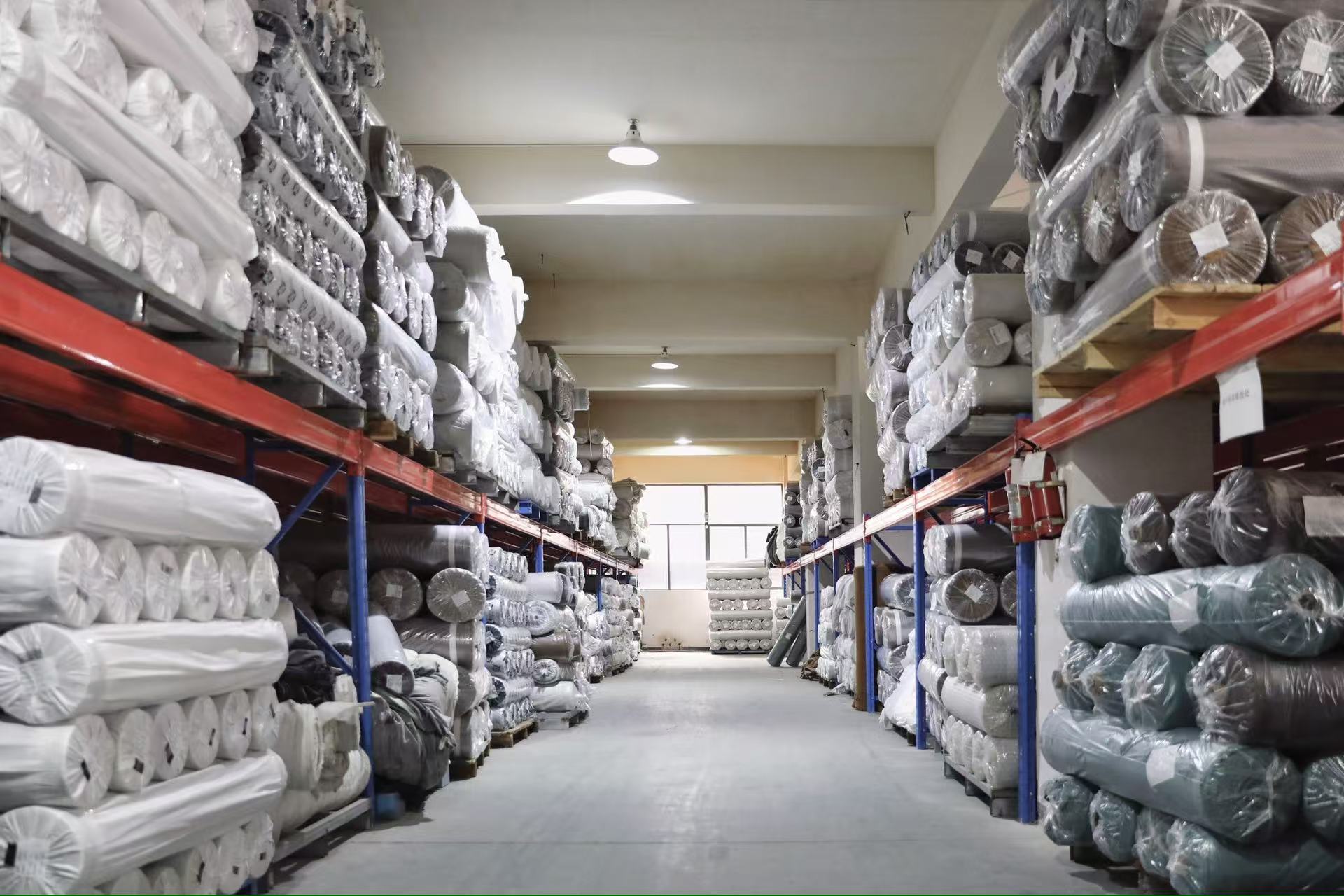
Repeatability is an inventory question as much as a production one: stock depth determines how quickly a distributor can service a second order in the same quality. Image: OYD Textile warehouse.
Future outlook
Through 2026 and beyond, three movements are likely to shape sofa fabric sourcing. First, performance finishing is shifting from an upgrade to a baseline expectation in commercial furniture, which pushes specification conversations towards cleanability and fire safety rather than surface appearance. Second, with synthetic fabrics already holding the largest material share of the sofa market, the competitive ground moves to verified performance and colour continuity rather than fibre substitution. Third, regulation is becoming more document-oriented: the UK's move from display labels to permanent labels in October 2025 is a signal that traceability of what is inside a sofa will matter more, not less, which increases the value of suppliers who can produce model-level test documentation on request. Buyers who standardise on specification sheets now will carry a smaller compliance burden later.
Buyer checklist before confirming a sofa fabric order
- Confirm composition and base fibre against the intended end use.
- Fix the GSM band, not a single number, and write the tolerance into the order.
- Confirm the width and build the cutting plan around the lower end of the tolerance.
- Match construction to the piece: tailored accent seating, large sofas, soft beds, public-area seating.
- Request abrasion resistance and colour fastness test reports for the exact model and finish.
- Confirm the fire-retardant requirement and permanent labelling rules for the destination market.
- Confirm cleanability options — waterproof, easy clean and dust resistant finishing — where daily-use conditions apply.
- Check the available colour range and the colour-matching process against your own colour card or swatch.
- Separate stock items from custom items for MOQ, lead time and price.
- Agree the acceptance criterion up front, including pre-shipment quality inspection.
- Approve samples before bulk production and retain the approved sample as the reference standard.
- Record everything on one specification sheet that follows the fabric into the next order.
FAQ
What does GSM mean in sofa fabric, and does a higher number mean higher quality?
GSM is grams per square metre, a measure of mass per unit area. It indicates how dense or full a fabric is, and higher GSM generally means better opacity over a frame and a fuller surface. It is not a quality grade or a durability guarantee. Abrasion resistance and pilling performance are separate properties confirmed by test results. Published weights also carry tolerances: OYD sofa fabric articles are stated with a ±10 GSM tolerance, so a 420±10 GSM quality can legitimately arrive anywhere between 410 and 430 GSM.
How do composition differences — for example 100% polyester versus a polyester and acrylic blend — affect the buying decision?
Most OYD sofa fabric articles are 100% polyester, including OYD3120 (420±10 GSM chenille), OYD3591 (400±10 GSM chenille), OYD3618 (450±10 GSM velvet) and OYD3626 (350±10 GSM woven). Blended qualities include OYD3229 at 620±10 GSM (90% polyester, 10% acrylic) and OYD3235 at 600±10 GSM (80% polyester, 14% acrylic, 6% cotton). Blends are generally selected for surface hand and weight characteristics, while the polyester base continues to govern the fabric's general behaviour. Composition should always be confirmed on the order sheet rather than inferred from the construction name.
Which specifications should stay fixed to keep repeat orders consistent?
Five fields should remain unchanged between orders: art. number, composition, construction, width and weight band. Width across the cited OYD models is 142±2 cm, and the weight band should be recorded with its tolerance so incoming goods can be checked against a range rather than a single figure. Colour reference and finishing should be recorded in the same block, because changes to finishing can alter surface appearance even when composition and GSM are identical. A specification sheet that travels with the order is the most reliable protection against drift.
How do minimum order quantity and lead time differ between stock and custom sofa fabric?
Documented OYD Textile purchasing terms state a minimum order quantity of 300 metres per colour, FOB delivery terms, pre-shipment quality inspection as the acceptance criterion, and payment terms of 30% deposit with 70% before shipment. Lead time depends on order type rather than on fabric type: stock goods are typically delivered within 7–15 days, while custom orders require 25–40 working days after samples and deposit are confirmed. Buyers should expect custom patterns and custom colours to require a higher minimum order quantity than stock qualities, and should confirm the exact schedule against their own order quantity.
What certification and finishing evidence can a buyer request before shipment?
OYD Textile states that its fabrics can pass international standard tests for abrasion resistance, colour fastness and other performance requirements, and it documents finishing options including waterproof, easy clean, dust resistant and fire retardant treatments. Buyers should request test documentation that names the specific art. number, colour and finish, since evidence is model-specific rather than range-wide. OYD's documented acceptance criterion is pre-shipment quality inspection, and customers are welcome to arrange inspection. For velvet-type constructions, OYD's own comparison documentation states abrasion resistance at 45,000 cycles and a pilling grade of 4–5 against 3–4 for ordinary velvet fabric; this is supplier documentation and can be independently verified per order.
Which fire-safety requirements apply to upholstered furniture in the United Kingdom?
The UK Furniture and Furnishings (Fire) (Safety) (Amendment) Regulations 2025 came into force in October 2025 under regulation 1988 No. 1324, as amended. The amendment removed the display label requirement and shifted the emphasis to permanent labels on the furniture. For buyers specifying sofa fabric for the UK market, this means the fire-retardant route and the permanent labelling requirement should be confirmed with the fabric supplier and the furniture maker before production, and the supporting documentation should be tied to the specific fabric model and finish used.
A specification-led approach does not make sourcing more complicated; it moves the complexity from production and claims to the order sheet. Composition, construction, width, GSM band and finishing evidence are the five fields that decide whether a sofa fabric performs in a hotel lobby, a furniture production line, a wholesale catalogue or a living room.