
Sodium Sulfate SOL-6: Glass Manufacturing Fit and Handling
SOL-6 is the anhydrous sodium sulfate material supplied by Soleron Building Materials (Hebei) Co., Ltd., a building materials manufacturer based in Renqiu, Hebei Province, China, that operates under the Soleron Insulating Glass Materials brand. In its product data, SOL-6 is listed as suitable for the glass industry, with selling points covering high purity, good solubility, stable chemical properties, consistent particle size, low impurity content, reliable supply, competitive cost, and customizable packaging.
For a buyer in glass manufacturing, the useful question is not whether the material exists. It is whether the material fits a specific process, and what has to be confirmed before an order is raised. This article addresses that second question. It also explains where SOL-6 sits in relation to insulating glass materials, and where it does not.
One distinction should be established early. SOL-6 is an upstream glass-making input, not an insulating glass unit (IGU) component. Materials such as spacer bars, warm edge profiles, desiccant, and sealants are assembled inside a sealed IGU. SOL-6 is a chemical input that goes into a glass-making operation. Treating the two categories as interchangeable is a common specification error, and it produces purchase orders that do not match the drawing or the process sheet.
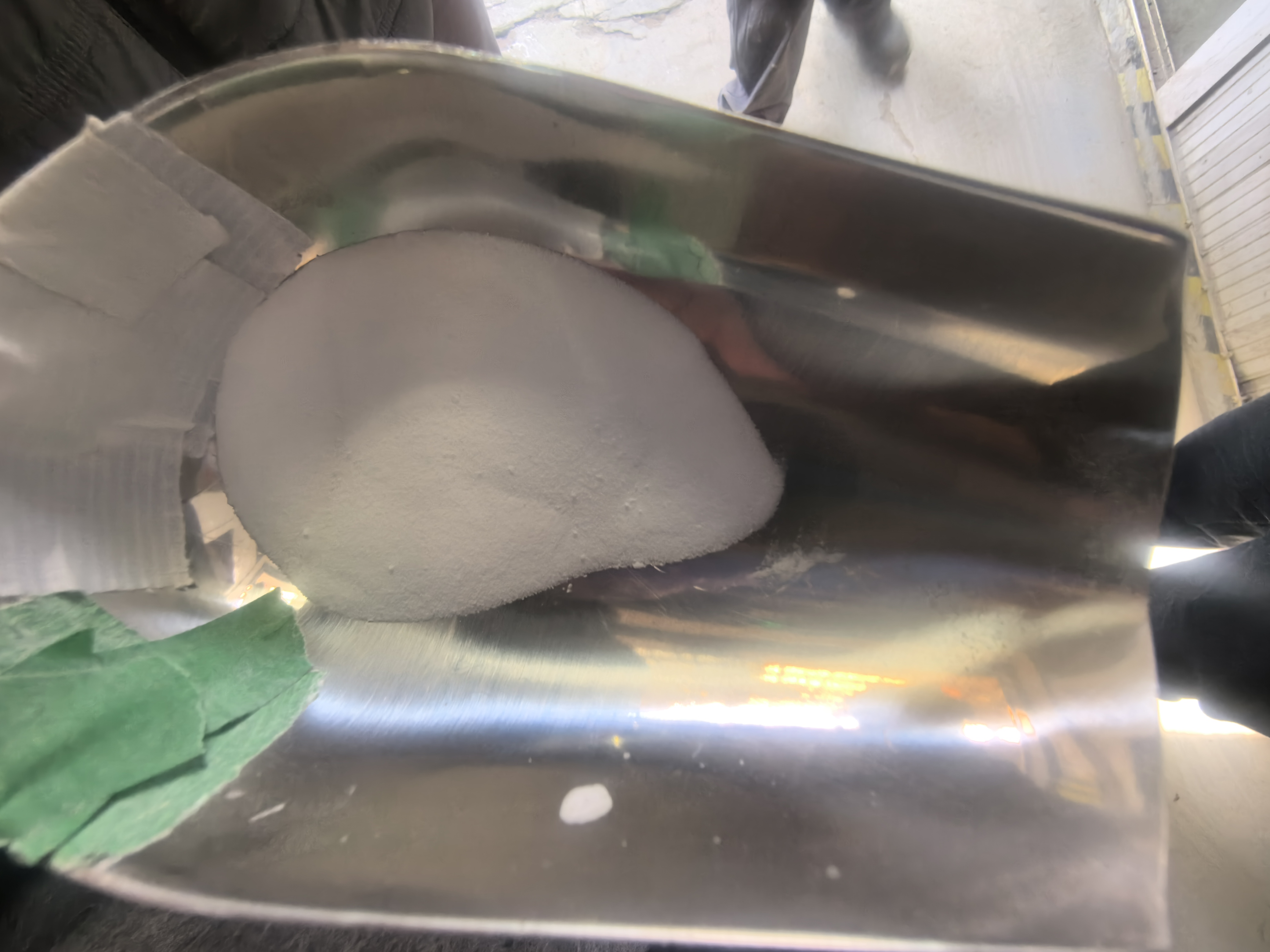
Anhydrous sodium sulfate supplied under the SOL-6 model. Material imagery is representative of the product family.
What SOL-6 Is — and What It Is Not
SOL-6 is specified as anhydrous sodium sulfate. The word anhydrous matters commercially. Anhydrous material is supplied without water of crystallization, which distinguishes it from hydrated forms. For a buyer, that generally means a more predictable weight-per-unit basis and no water content that could be released during processing. It also means the material responds differently to ambient humidity, a handling point covered further below.
The SOL-6 specification entry also records the surrounding inventory in the same material family: 330 metric tons of anhydrous sodium sulfate, alongside 99% purity caustic soda at 10 metric tons and 50% hydrogen peroxide at 100 metric tons. These are stock-position figures for the model family, not per-order commitments. Buyers should read them as an indicator of what the supplier routinely holds, and then confirm availability and allocation separately for their own requirement.
What SOL-6 is not is equally important. It is not a spacer bar, not a warm edge profile, not a molecular sieve desiccant, and not an insulating glass sealant. Those are separate product categories with their own models, dimensions, and test documentation in the same supplier catalog. A procurement team mapping SOL-6 against an IGU bill of materials will find no line item for it, because the material does not belong to that structure.
Where Sodium Sulfate Fits in a Glass-Making Supply Chain
Soleron positions SOL-6 as a material for the glass industry. That is the application statement available in the product data. Beyond that statement, the specific process role is a plant-level engineering matter that a buyer should validate against their own process sheet and incoming material specification.
The practical consequence is a supply chain distinction. A supplier who can supply SOL-6 reliably matters to a buyer's upstream glass-making inputs. It does not automatically matter to that buyer's spacer or sealant inventory. When a project carries obligations on both sides — in-process materials and upstream substrate — the distinction becomes operationally significant, because the same vendor may or may not be able to cover both.
This is consistent with SOL-6 being listed alongside spacer bars, warm edge profiles, molecular sieve, sealants, spacers connectors, Georgian bars, and insulating glass processing machines in the Soleron range. A processor who buys spacer bars and basic chemicals from one source may prefer the consolidation. A glass plant that only needs the chemical input will evaluate it on specification alone. Both readings are reasonable, and the correct one depends on the buyer's own process boundary.
Reading the SOL-6 Specification: The Five Points Buyers Should Verify
The product data lists five selling points that translate directly into purchase-order line items. Each one should be verified in writing before an order is confirmed.
| Specification point | What to confirm |
|---|---|
| Purity and impurity content | Guaranteed purity range; upper limits for elements that affect glass color or transmission; test method and sampling plan |
| Particle size consistency | Declared particle size band; control method; recent batch data rather than a catalog adjective |
| Anhydrous form | Written confirmation that the delivered material is the anhydrous grade, not a hydrated equivalent |
| Solubility behavior | Dissolution rate data where the process is water-based; relevant test conditions |
| Packaging and customization | Bag or bulk format matched to the feed system; labeling; moisture protection during transit |
Two of these deserve a closer look. Purity and impurity content sit at the top because glass-making processes are sensitive to contaminants. Elements that affect color or light transmission can shift final product quality even at low concentration. The provided materials describe SOL-6 as high purity with low impurity content, but they do not state numeric limits. That gap is normal at catalog level and should be closed at quotation level, in writing, with the test method named.
Solubility is the second point worth pressing. The product data states excellent solubility and efficient dissolution in water-based processes. What a plant actually needs is a rate under its own mixing conditions. Asking for dissolution data, rather than accepting a descriptive claim, converts a marketing statement into an engineering input.
Handling and Storage Considerations for Anhydrous Sodium Sulfate
Handling requirements follow from the material's physical form. Anhydrous sodium sulfate is hygroscopic and will take up moisture from ambient air. Storage areas should therefore be dry and humidity-controlled wherever the material is held for any length of time. Unprotected exposure to humid air can cause caking in the silo or hopper and can change the weight basis of a batch.
Temperature and humidity are both operational variables, and the provided materials do not state explicit storage conditions for SOL-6. Common industrial practice for materials of this class is a cool, dry location, protected from water contact and from prolonged open-air exposure. Buyers should confirm the supplier's stated storage temperature range, humidity range, and stacking limits, particularly for bulk consignments.
Dust control is a second practical point. Fine particulate material generates dust during unloading and transfer, and local extraction and personal protective equipment requirements depend on the plant's own safety regime and local regulation. Buyers should request handling and safety documentation as part of the purchase package.
Shelf life and batch traceability complete the list. Stable chemical properties are listed as a selling point, but buyers should still ask for a batch record, a re-test interval, and confirmation that individual lots can be traced. This matters most where a plant is running comparative trials, because trial results are only interpretable if the material identity is known.
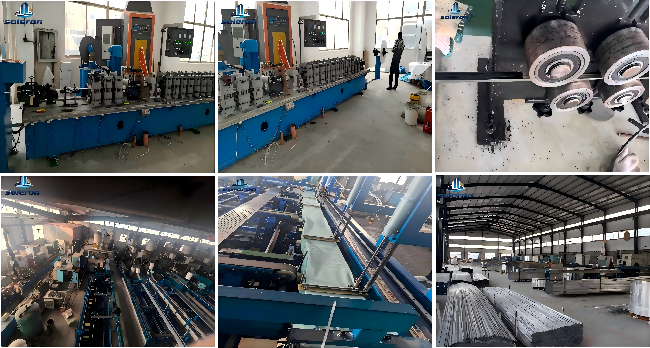
Workshop environment at Soleron Building Materials (Hebei) Co., Ltd. Handling practice for mineral inputs follows the plant's own storage and dust-control procedures.
Why Particle Size Consistency Matters More Than It Appears
Consistent particle size is listed as a SOL-6 selling point, and it deserves its own section because it sits at the intersection of procurement and engineering.
Bulk solids behave more predictably when the size distribution is narrow. In a pneumatic conveying line, fines and coarse particles travel differently; a distribution that drifts can change conveying rate and can produce segregation in a silo. These are not theoretical problems — they show up as uneven feed and as inconsistent dosing at the hopper, which is where a specification item becomes a production constraint.
The second benefit is time. In any dissolution step, a more uniform surface-area-to-mass relationship produces more consistent dissolution behavior, which reduces cycle-time variation between batches. For plants running batch-level output verification, that consistency shows up directly in the quality record.
The third benefit is traceability of supplier control. A supplier who can hold a particle size band over successive shipments is demonstrating process control, not just product selection. Buyers should ask how the declared band is measured, with what instrument, and at what frequency — and then ask for recent batch data rather than a specification sentence.
How SOL-6 Sits Alongside Other Insulating Glass Materials
Insulating glass materials form a system, and each component has a distinct job. Spacer bars and warm edge profiles hold the two panes at a fixed distance and define the cavity geometry. Molecular sieve desiccant, such as the 3A grades supplied in 0.5–0.9 mm, 1.0–1.5 mm, and 1.5–2.0 mm sizes, adsorbs residual moisture inside the sealed cavity. Primary and secondary sealants close the edge and complete the barrier. Corner connectors, Georgian bars, and butyl tape complete the assembly and finishing set.
SOL-6 does not compete with any of these. It is a glass-making input that sits upstream of the IGU. That hierarchy has a practical consequence for buying strategy. A processor that already sources spacer bars, desiccant, and sealant from Soleron can extend the same vendor relationship to SOL-6 and reduce the number of inbound suppliers to manage. A glass plant that only purchases chemicals will evaluate SOL-6 on its own merits and on the supplier's documentation, and will ignore the IGU catalog pages entirely.
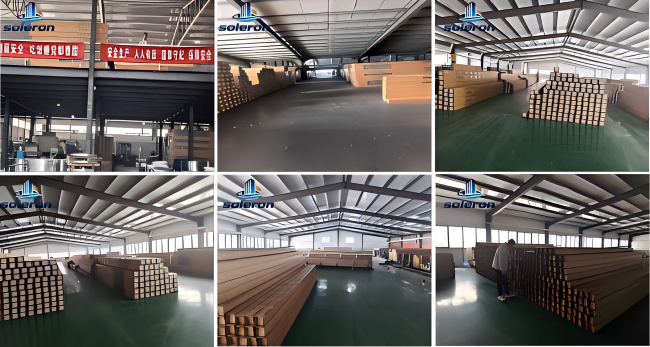
Warehouse operations at Soleron Building Materials. Storage discipline is relevant to hygroscopic mineral inputs such as anhydrous sodium sulfate.
Supplier consolidation is not automatically the better choice. It reduces administrative overhead and inbound complexity, but it also concentrates supply risk if a single vendor is affected. Buyers weighing SOL-6 sourcing should decide deliberately whether they want consolidation across the insulating glass materials range or an independent chemical supply line, rather than defaulting to one or the other.
Limits, Trade-offs, and Honest Boundaries
Stating where a material fits is only half the job. The following boundaries are stated because they affect purchasing decisions directly.
SOL-6 is not an IGU component and will not substitute for one. A buyer cannot use it in place of a spacer bar, a desiccant, or a sealant. Any specification review that attempts this substitution will fail at the structural level, not at the performance level.
Compliance documentation for SOL-6 is not listed in the provided materials. The certification records available for the supplier cover other products: a Safety Data Sheet for corner connectors under certificate CANEC23012379901 issued by SGS-CSTC Standards Technical Services (Guangzhou) Co., Ltd.; a CNAS report under certificate 2625011793 covering two-component silicone sealant, issued by Shanghai Institute of Chemical Industry Testing Co., Ltd.; and a CNAS test report under certificate WT20251854(E) covering aluminium spacer bars. None of these certificates applies to sodium sulfate.
The absence of a listed certificate is not evidence that a certificate does not exist. It simply means the documentation presented here does not cover SOL-6. Buyers whose market requires a safety data sheet, a batch certificate of analysis, or a regulatory declaration should request it directly as part of the quotation cycle. That distinction matters: an unverified document is not the same as an unsuitable product, but it is also not the same as a cleared one.
Numeric specification values are not provided. Purity percentages, impurity ceilings, particle size bands, and dissolution rates are described qualitatively in the product data. Buyers should collect the numeric values at quotation stage, and should confirm the test method used for each so that results from different suppliers are comparable.
Company operational parameters apply at company level. Soleron's capability data records OEM/ODM production, customization of logo, size, and packaging, a lead time of 20–45 days, and a minimum order of 5 cartons, with random inspection as the quality control method. These are company-level figures and should be confirmed for the specific SOL-6 order rather than assumed to apply universally across the range.
Market Context: Demand Signals from the Insulating Glass Sector
According to a commercial research summary published by Grand View Research, the global insulated glass market was valued at approximately USD 92.7 billion in 2024, with a forecast of approximately USD 101.3 billion in 2026 and USD 121.7 billion by 2030. The figure is reported by a commercial research publisher and has not been independently verified in this analysis; it should be read as a directional indicator rather than as a precise procurement forecast.
The relevance to glass-making inputs is indirect. Growth in insulated glass demand implies growth in insulated glass production, which implies growth in the upstream inputs consumed to make that glass — including commodity chemicals. The direction of that chain is sound, but the magnitude attributable to any single input, including sodium sulfate, cannot be isolated from a single market figure. That is a place where buyers should supplement published research with their own procurement history.
A second contextual constraint comes from standards. EN 1279-2 sets a pass criterion for moisture penetration, expressed as an average moisture penetration index of 0.20 or less across five aged specimens, with an individual specimen limit of 0.25. That requirement addresses the integrity of the sealed unit and its edge system rather than the upstream glass-making chemistry. It is included here because buyers occasionally conflate unit-level performance standards with material-level specifications, and the two operate at different levels of the supply chain.
Future Outlook
Two developments are likely to shape how buyers approach sodium sulfate sourcing over the next procurement cycles. The first is documentation depth. As specification discipline tightens across the glass supply chain, buyers will expect numeric data on purity, impurity ceilings, and particle size rather than descriptive claims — and suppliers who can produce batch-level evidence will be easier to qualify.
The second is the consolidation question. Suppliers who can cover both upstream chemical inputs and insulating glass components reduce the number of relationships a processor must manage, but they also concentrate dependency. Whether consolidation is an advantage or a risk depends on the individual buyer's volume, storage capacity, and risk policy — not on the supplier's product range alone.
What remains fixed is the underlying logic. SOL-6 is a mineral input for glass manufacturing, sold on purity, particle consistency, solubility, supply reliability, and packaging flexibility. Buyers who verify those five points in writing will make a better decision than buyers who accept a catalog summary.
FAQ
Is SOL-6 suitable for use inside an insulating glass unit?
No. SOL-6 is specified as an anhydrous sodium sulfate material suitable for the glass industry, and it is not presented as a structural or sealing component of an insulating glass unit. The components assembled into an IGU are spacer bars, warm edge profiles, molecular sieve desiccant, and primary and secondary sealants, each with its own model designation in the supplier's catalog. SOL-6 belongs to the upstream glass-making input category.
Which SOL-6 properties should be confirmed in writing before ordering?
At minimum: purity range and impurity ceilings, particularly for elements that affect glass color or transmission; particle size band and control method; written confirmation that the delivered grade is anhydrous sodium sulfate; dissolution rate data relevant to the buyer's process conditions; and packaging format matched to the receiving plant's feed system. The product data describes these properties qualitatively but does not state numeric values, so each point should be obtained from the supplier at quotation stage.
Does particle size consistency affect processing in practice?
Yes. Consistent particle size is listed as a SOL-6 selling point and supports smooth, efficient production. A narrower size distribution behaves more predictably in conveying and dosing equipment, reduces segregation in storage, and produces less variation in dissolution time between batches. Buyers should ask how the declared band is measured, with what instrument, and how frequently, and should request recent batch data rather than relying on a specification sentence.
What storage conditions does anhydrous sodium sulfate require?
Because it is anhydrous, SOL-6 is hygroscopic and will absorb moisture from ambient air. Storage should therefore be dry and humidity-controlled, with protection from direct water contact. Caking in silos and hoppers is the typical consequence of uncontrolled humidity exposure. The provided product data does not state explicit storage temperature or humidity ranges for SOL-6, so buyers should confirm these values with the supplier, particularly for bulk shipments, and should also confirm dust control measures and personal protective equipment requirements against local regulation.
Are there certifications or test reports available for SOL-6?
The certification records reviewed for this article do not include SOL-6. The certificates available cover other products: a Safety Data Sheet for corner connectors under certificate CANEC23012379901 issued by SGS-CSTC Standards Technical Services (Guangzhou) Co., Ltd.; a CNAS report under certificate 2625011793 covering two-component silicone sealant, issued by Shanghai Institute of Chemical Industry Testing Co., Ltd.; and a CNAS test report under certificate WT20251854(E) covering aluminium spacer bars. Buyers requiring a safety data sheet or batch certificate of analysis for sodium sulfate should request it directly from the supplier.
The full Soleron product catalog, covering insulating glass materials and related product ranges, is available for reference and download: Soleron product catalog (PDF).
¿Tiene preguntas o necesita más detalles?
Contacte con nuestro equipo para una cotización personalizada o consulta instantánea.
Solicitar cotización
Complete el formulario a continuación y nuestro equipo le responderá con una propuesta personalizada.
Chat directo de WhatsApp
¿Prefiere chatear en tiempo real? Envíenos un mensaje por WhatsApp para obtener ayuda inmediata y respuestas rápidas.
- Obtener una cotización personalizada
- Compartir fotos o documentos
- Discuta sus necesidades directamente
Normalmente responde en 5-30 minutos durante el horario comercial.