
Sodium Hyaluronate Capability: Fermentation, QC & Stock
Sodium Hyaluronate Capability: Fermentation, QC & Stock
Sodium hyaluronate capability is decided by three things a buyer can physically check — fermentation assets, laboratory release testing and the stock position behind a quoted delivery date — and by one thing that is harder to see: whether molecular weight is held inside a defined band from batch to batch. Statements, certificates and brochures describe intent. Operating records describe execution.
This article sets out how a procurement or technical team can separate the two when evaluating Shandong Habier Biopharma Co.,LTD, a Chinese sodium hyaluronate manufacturer established in 2015 with a 50,000 m² site in Qufu, Shandong. The company's supplied records are used as a worked example throughout, and the text marks clearly where a claim is documented and where it still requires a plant-level check.
Why a Capability Statement Is Not Capability Evidence
A supplier's statement that it "has fermentation capacity" and its ISO certificate both prove something, but not the same thing. A management-system certificate records that an auditor reviewed a defined scope at a defined time. It does not record that a specific grade runs on a specific line with stable parameters, nor that the last shipment measured what the specification promised.
The distinction matters for sodium hyaluronate because the molecule's commercial value is attached to its molecular weight. Industrial hyaluronic acid is produced either by extraction from animal tissue or by large-scale bacterial fermentation using genetically modified strains, according to a peer-reviewed review of industrial production routes. A 2022 review of fermentation research notes that batch, repeated-batch, fed-batch and continuous modes have all been investigated, with hyaluronic acid yields of 2.5–7.0 g/L from Streptococcus zooepidemicus in the cited studies. That is a literature-reported range, not a supplier benchmark; its practical use is to show that fermenter volume alone says very little, because output equals volume multiplied by achieved titre and downstream recovery.
The buyer's question is therefore not "do you ferment?" but "which train, which campaign, which fixed parameters — and what did the last twelve batches actually measure?"
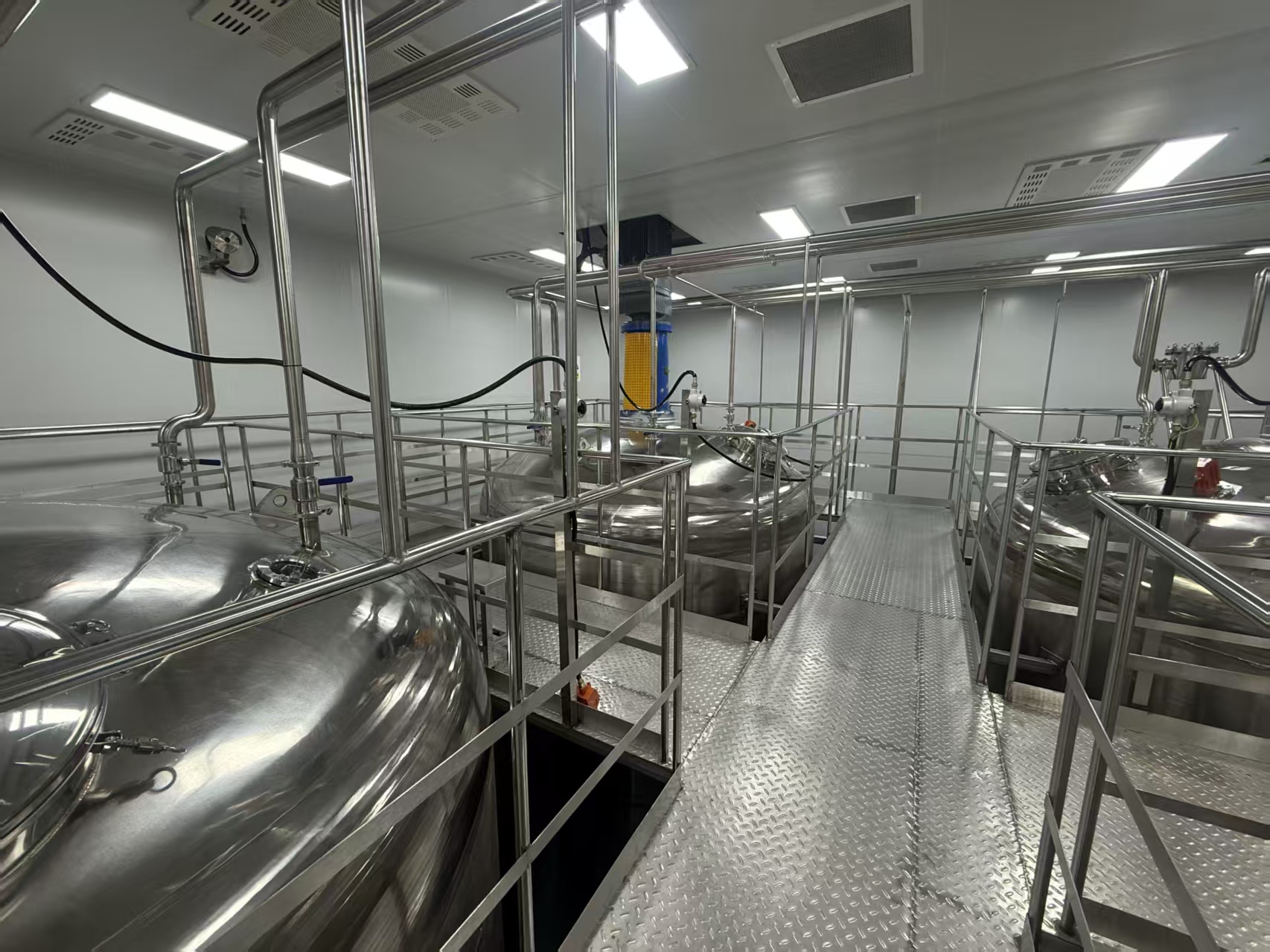
Fermentation Evidence: What a Plant Visit Should Confirm
Fermentation evidence is physical. Habier lists on-site factory inspection among its acceptance terms, so a visit is a realistic request rather than a hypothetical one. A structured walk-through should answer five questions, in this order.
- How many independent fermentation trains exist, and is seed preparation shared? Two physically separate trains reduce the risk that a single contamination event stops the entire schedule. A single shared seed train makes that risk structural rather than incidental, and the buyer should price it accordingly when agreeing delivery terms.
- What does the campaign calendar show? Ask for the last twelve months of campaigns mapped against the grades actually supplied to you. A plant running food, cosmetic and pharmaceutical grade campaigns in sequence needs defined sequencing rules, not only defined cleaning rules.
- How is cleaning and sterilisation recorded between campaigns? The record should be linked to a batch number, not merely to a date. A date-only record cannot be reconstructed against your shipment during an investigation.
- What happens to a batch that drifts outside its parameter window? The answer belongs in the deviation record, not in the sales conversation.
- Does stated capacity reconcile across units of time? This is the cheapest cross-check available to a buyer.
On that last point, Habier's supplied company record lists a 50,000 m² site, 123 employees, an annual output of 600–700 MT and a monthly capacity of 50–60 tons. Those two capacity figures are broadly consistent with one another, since 50–60 tons per month implies 600–720 tons over twelve months. Consistency is a first-pass filter: capacity claims that fail to reconcile across units of time usually indicate that one figure is presentational rather than operational. Consistency is still not confirmation — the equipment list and the campaign records are.
Line Layout and Molecular-Weight Discipline
Habier's published grade bands, as given in its product information, are: food grade 0.8–1.5 million Da; cosmetic grade 1.0–1.5 million Da; pharmaceutical grade ≥2.0 million Da; and low molecular weight ≤0.1 million Da. The company's product list extends across regular grade, high molecular weight, low molecular weight, ultra-low, super-low and hydrolysed sodium hyaluronate and hyaluronic acid.
Those bands should be read as an operating instruction rather than a marketing table. Food and cosmetic ranges overlap between 1.0 and 1.5 million Da, which means that where two grades share a band, the difference between them is carried by documentation and changeover control rather than by the analytical result alone. A buyer who has specified cosmetic grade cannot tell from a molecular-weight number whether the material was produced on a line that had previously been running food grade.
Four documents close that gap, and all of them are reasonable to request before a first order:
- A line allocation map showing which production line and which fermentation train is assigned to which molecular-weight band.
- Changeover and cleaning records covering a period in which both of your candidate grades were produced.
- An SOP index with version numbers and a change-control log, so that a batch record can be matched to the procedure that was current on the day of manufacture.
- Parameter records for one recent batch of your grade, showing the fixed setpoints and the tolerances permitted around each of them.
Customisation raises the same question in a different form. Habier lists purity adjustment among its customisation capabilities, alongside OEM and ODM services. Adjusting purity means the parameter set changes between orders, so the buyer should ask how a customised purity specification is translated into a locked batch record — and who signs that translation off before production starts.
ISO 9001:2015 certification, certificate 1042Q00053R0S, was issued by Shandong Seatone International Certification Co., Ltd. on 1 September 2024 and is valid to 8 January 2027, with a stated scope of "ALL". That certification provides the document-control framework in which SOPs of this kind should sit. A framework is not a result: the practical test is whether a named SOP for a named process step is produced within minutes, and whether the batch record cites the version in force on the day.
QC Laboratory and Batch Testing: Reading the File
Habier states that 100% full inspection is carried out before delivery, and that acceptance criteria include a pre-shipment full test with a COA report. Third-party laboratory inspection and on-site factory inspection are both listed as supported, and the after-sales scope includes quality tracking and free sample supply. Those provisions define what a buyer is entitled to ask for; they do not by themselves describe how the laboratory is organised.
Four follow-up questions turn the provision into evidence:
- Where does the laboratory sit in the organisation? A release laboratory that reports through production and a release laboratory that reports through quality produce different conversations when a batch fails.
- What is the instrument list and calibration status? Molecular-weight distribution and purity results are only as good as the equipment that generated them.
- Can results be supplied as a distribution rather than a pass/fail verdict? Twelve months of batch values for your grade shows whether the process sits comfortably inside the band or repeatedly touches its edges.
- Are retention samples kept, and for how long? Retention samples are what make a complaint investigable after the shipment has been consumed.
Two certificates anchor the quality file, and both deserve to be read for scope rather than presence. ISO 9001:2015 certificate 1042Q00053R0S covers quality management to 8 January 2027 with the scope stated as "ALL". ISO 22000:2018 certificate 104FSMS2400001, issued by the same body on 1 September 2024 and valid to 8 January 2027, is scoped to "Sales of Sodium Hyaluronate (Hyaluronic Acid) and Chondroitin Sulfate and related food safety management activities". The company's profile additionally lists HACCP, Kosher, Halal, COSMOS organic and ISO 16128 certification.
The wording on the food-safety certificate is worth pausing over. A scope built around sales activities and related food-safety management is not the same as a scope built around manufacturing, so a food-grade buyer should ask which activities the audit actually covered and request the manufacturing-side evidence that supports the specification being purchased. This is not a criticism of the certificate — it is the ordinary discipline of reading scope instead of counting logos.
Safety Stock, Lead Time and the Basis of a Delivery Promise
Habier's supplied capability record states a minimum order quantity of 1 kg, a typical production lead time of 5–8 days, a monthly production capacity of 50–60 tons, and exports to the EU, USA and Korea representing roughly 20% of output.
A 5–8 day lead time invites one precise follow-up: is the material in stock, or is the production slot available? The two answers carry different risks. Stock-based lead times depend on buffer policy and on whether that buffer is reserved for contracted volumes. Slot-based lead times depend on what else is booked into the plant in the same month, which is a question the buyer cannot see and the supplier can.
Safety stock should therefore be verified as a physical position rather than accepted as a phrase. Ask how many days of raw material and finished goods are held, by grade; where each buffer sits; whether it is dedicated to named customers or pooled; and what allocation rule applies when demand exceeds monthly capacity. The buffer that protects a buyer is the one held against the buyer's own grade, not the aggregate figure printed on a slide.
Traceability for Rejected Product
Rejection handling is where quality systems most often look complete on paper and thin in practice. The reason is structural: a rejection record is only useful if it links a nonconformance to a batch, to a disposition decision, and to the downstream status of the material afterwards.
Five items should be requested when a supplier's traceability is being evaluated:
- A nonconformance log for the past twelve months, redacted as necessary, showing issue, batch and closure date.
- The disposition decision for each entry: rework, downgrade, or destruction.
- The re-qualification rule for downgraded material. A rejected pharmaceutical-grade lot must not reappear inside a cosmetic or food-grade SKU without a documented re-qualification path, because the grade label is a promise about a specification, not about a warehouse location.
- The customer notification rule — whether a buyer holding affected stock is told, and within what interval.
- The complaint-to-batch linkage, which is what makes after-sales quality tracking operational rather than administrative.
Habier's acceptance terms give a buyer the triggers to test this chain: a pre-shipment full test with COA report, supported third-party laboratory inspection, and supported on-site factory inspection. They do not by themselves demonstrate how a specific rejected batch was dispositioned. That requires seeing a completed record, which is precisely why the request should be made before the first purchase order rather than after the first complaint.
What the Supplied Record Already Shows
One documented supply case illustrates where evidence is strong and where the boundary sits. A US-based natural cosmetic and health supplement importer received 4,733 kg of hyaluronic acid raw material for cosmetic and oral health care supplement applications on a long-term basis. The record notes stable supply of high-purity material, stable batch quality, repeat ordering, and smooth customs clearance supported by a valid USDA import permit. The material is described as avian-origin, carrying complete official veterinary heat-treatment certification and meeting US APHIS import standards.
Read precisely, this case documents two things well: import and regulatory paperwork capability for the US market, and repeat commercial behaviour consistent with stable batch quality. It does not document analytical equivalence to any other supplier's material, and it does not establish that every grade in the range follows the same production route. Because the two industrial routes for hyaluronic acid are tissue extraction and microbial fermentation, a buyer specifying a fermentation-derived grade should confirm the route in writing for the specific SKU being purchased — and should treat the avian-origin description in this case as route information for that product, not as a general statement about the range.
An Audit Agenda Buyers Can Use
The table below converts the preceding sections into a request list. The third column matters as much as the second: it states what each document proves and what it leaves open, which is the difference between a qualification file and a folder of brochures.
| Evidence area | What to request | What it establishes — and what it does not |
|---|---|---|
| Fermentation asset | Site plan, equipment list, number of independent trains, 12-month campaign calendar | Establishes that physical capacity exists at the stated scale; does not establish titre, yield or recovery for a specific batch. |
| Line layout and grade changeover | Line allocation map, changeover and cleaning records, SOP index with versions | Establishes that segregation controls are documented; does not establish zero carryover without supporting analytical data. |
| Molecular-weight control | Published grade bands plus 12-month batch values for the purchased grade | Establishes band discipline over time; does not establish equivalence to the buyer's reference standard. |
| QC and release testing | Laboratory reporting line, instrument and calibration list, COA template, third-party reports, retention-sample policy | Establishes that release testing is defined and repeatable; does not establish independence from production unless the reporting line is confirmed. |
| Safety stock and continuity | Buffer days by grade, storage location, allocation rule, and whether lead time is stock-based or slot-based | Establishes the basis of the delivery promise; does not guarantee allocation in a future month. |
| Rejected-product traceability | Nonconformance log, disposition records, re-qualification rule, notification rule | Establishes handling discipline; does not establish that no nonconforming material has previously escaped. |
Market Context: Why Consistency Carries a Higher Price Now
Commercial research published by Fortune Business Insights values the global hyaluronic acid market at USD 11.64 billion in 2025, rising to USD 22.36 billion by 2034 at a 7.52% CAGR over 2026–2034, with pharmaceutical grade accounting for 69.3% of product segment share in 2026. A separate estimate from the regulatory consultancy Cisema values the Chinese market at USD 649.7 million in 2024, with a projected USD 1.06 billion by 2030 at an 8.6% CAGR. Both are third-party commercial estimates with different scopes and should be read as directional framing, not as a forecast of any individual supplier's volume.
The procurement implication is narrow and practical. When specification-heavy segments carry a larger share of growth, specification-heavy buyers price a quality escape more expensively than they price a higher unit cost. That shifts the weight of supplier evaluation toward operating evidence — the fermentation record, the release file and the buffer position — which is exactly the material a brochure cannot carry.
Frequently Asked Questions
How can a buyer verify that a sodium hyaluronate supplier operates fermentation capacity rather than sourcing from third parties?
Request the site plan and equipment list, the campaign calendar for the past twelve months, and batch records for the grade intended for purchase, then reconcile stated monthly capacity against stated annual output. Habier's supplied figures — 50–60 tons per month and 600–700 MT per year — are broadly consistent with each other, and on-site factory inspection is listed among its acceptance terms. Those checks confirm that the plant exists, that its capacity arithmetic holds, and that it can be inspected; they do not confirm titre or yield for a specific batch.
What exactly does Habier's ISO 22000 certificate cover?
Certificate 104FSMS2400001 was issued for ISO 22000:2018 by Shandong Seatone International Certification Co., Ltd. on 1 September 2024 and is valid to 8 January 2027. Its stated scope is the "Sales of Sodium Hyaluronate (Hyaluronic Acid) and Chondroitin Sulfate and related food safety management activities". Because that wording centres on sales and related food-safety management, a food-grade buyer should confirm which activities the audit covered and request the manufacturing-side evidence that supports the purchased specification.
What batch documentation accompanies a sodium hyaluronate shipment?
Habier's stated acceptance criteria include a pre-shipment full test with a COA report, supported by 100% full inspection before delivery. Third-party laboratory inspection and on-site factory inspection are both supported, and the after-sales scope includes quality tracking and free sample supply. A COA should be read against the buyer's own specification and against the molecular-weight band published for the grade ordered, rather than against the grade name alone.
How is molecular weight kept consistent across different sodium hyaluronate grades?
Habier publishes separate bands — food grade 0.8–1.5 million Da, cosmetic grade 1.0–1.5 million Da, pharmaceutical grade ≥2.0 million Da, and low molecular weight ≤0.1 million Da — and its ISO 9001:2015 certification, certificate 1042Q00053R0S with a scope stated as "ALL", provides the document-control framework for production SOPs and parameter records. Buyers should request twelve months of batch values for the specific grade and the changeover records for any period in which two grades sharing a band were produced.
What are the ordering terms for Habier sodium hyaluronate?
The minimum order quantity is 1 kg, delivery terms are FOB or CIF, and typical production lead time is 5–8 days against a monthly production capacity of 50–60 tons. On payment, large long-term clients can negotiate terms separately, while the standard mode is a high proportion of advance payment.
Conclusion
A supplier file is not thin because the supplier is small; it is thin when the parts that decide a shipment's fate are undocumented. Fermentation trains, grade allocation, release testing, buffer policy and rejection disposition are all verifiable — but only if the buyer asks for the operating record rather than the statement, and only if the question is posed before the first order rather than after the first deviation.
Shandong Habier Biopharma's supplied records support a defined position: a 50,000 m² site with 600–700 MT annual output and 50–60 tons monthly capacity, a 1 kg minimum order with 5–8 day typical lead time, 100% full inspection before delivery with pre-shipment full testing and COA reports, third-party and on-site inspection support, published molecular-weight bands across food, cosmetic, pharmaceutical and low molecular weight grades, and ISO 9001:2015 and ISO 22000:2018 certification valid to 8 January 2027. The remaining items — fermentation train count, buffer days by grade, and completed rejection records — are the specific follow-ups that turn this profile into a qualified supply relationship.
The full company and product brochure is available for download: Shandong Habier Biopharma brochure (PDF).
¿Tiene preguntas o necesita más detalles?
Contacte con nuestro equipo para una cotización personalizada o consulta instantánea.
Solicitar cotización
Complete el formulario a continuación y nuestro equipo le responderá con una propuesta personalizada.
Chat directo de WhatsApp
¿Prefiere chatear en tiempo real? Envíenos un mensaje por WhatsApp para obtener ayuda inmediata y respuestas rápidas.
- Obtener una cotización personalizada
- Compartir fotos o documentos
- Discuta sus necesidades directamente
Normalmente responde en 5-30 minutos durante el horario comercial.