
Sodium Fluoride Specification Limits: How to Verify a Batch

Sodium fluoride is one of the few inorganic fluoride salts that appears, under a single CAS number, in aluminium smelting, metal finishing, construction materials, ceramics, wood preservation and oral care. That breadth is precisely why a quotation alone is a weak basis for comparison: the same material, CAS 7681-49-4, can be specified to different impurity ceilings, packed for different humidity exposures, and released against different documentation sets.
For buyers in the research and evaluation stage, the productive question is not "which sodium fluoride is best" but "which numbers decide acceptance in my process, and what evidence proves those numbers." This reference sets out the constraint set that a sodium fluoride purchase actually depends on: assay, iron and transition-metal ceilings, loss on ignition, the scope of the quality certificate, the contents of a certificate of analysis, and the packaging and storage conditions that protect both.
Why sodium fluoride procurement starts with a limit table, not a price
Sodium fluoride is classified under HS 2826.11, the subheading that covers fluorides of ammonium or of sodium. Because that line is shared with ammonium fluoride, six-digit customs statistics cannot isolate sodium fluoride trade — a limitation that matters later, when a buyer or analyst attempts to benchmark import volumes or regional flows from public data. Verified trade structure shows only aluminium fluoride holds a dedicated six-digit line (2826.12), while the remaining fluoride salts collapse into 2826.19.
The practical consequence is that sodium fluoride sourcing is verified at supplier level, not at statistics level. Three document families carry the weight: the product specification with its impurity ceilings, the batch certificate of analysis with measured values, and the certification record with a clearly stated scope.
Changzhou Jiayuan Chemical Co., Ltd. is a fluorine chemical manufacturer and international trading enterprise established in 2015 and headquartered at the Jinsha Science, Technology and Finance Center in Jintan District, Changzhou City, Jiangsu Province, China. Its product portfolio covers sodium fluoride, potassium fluoride, magnesium fluoride and calcium fluoride, alongside boron-10 and organic fluorine lines, and the company states a stable supply of 600 tons per year of toothpaste-grade sodium fluoride.
The documented constraint set for sodium fluoride
The table below consolidates the values published in the sodium fluoride specification alongside lot-level test data. Specified limits and measured lot values are shown in separate columns because they answer different questions: the limit defines acceptance, while the measured value defines the margin a process actually receives.
| Parameter | Documented value | What it constrains |
|---|---|---|
| Purity (assay) | 99.95% | Active fluoride content available to the process |
| Iron (Fe) | Specified limit below 10 ppm; lot test 6.2 ppm | Colour, contamination of electrolyte or molten metal, film quality |
| Co, Cr, Ti, Cu, Mn, Ni, V | Specified limit below 5 ppm each; lot data below 1 ppm each | Trace-metal load in impurity-sensitive processes |
| Loss on ignition | Specification limit 0.5%; lot test 0.33% | Moisture and volatile content; batch-to-batch formula consistency |
| Appearance | White crystalline solid | Handling, dosing, visual incoming inspection |
| Aqueous solution | Alkaline, pH 7.4 | Compatibility with acidic or alkaline bath chemistry |
| Solubility | 4.0 g/100 g water at 15 °C; 4.3 g/100 g at 25 °C; soluble in hydrofluoric acid; insoluble in ethanol | Dissolution rate, bath make-up, solvent selection |
| Thermal data | Melting point 993 °C; boiling point 1695 °C; relative density 2.558 | High-temperature behaviour in flux and smelting duties |
| Identification | CAS 7681-49-4; HS 2826.11 | Quotation, CoA and customs document cross-checking |
Two details in that table deserve attention before a purchase order is drafted. First, the impurity specification is written as ceilings — below 5 ppm, below 10 ppm — whereas the released lot shows what was actually achieved: below 1 ppm for cobalt, chromium, titanium, copper, manganese, nickel and vanadium, and 6.2 ppm for iron. A process engineer who needs to know the operating margin, not merely pass or fail, should therefore request lot data rather than accept the ceiling as a description of typical supply. Second, loss on ignition reflects moisture and volatile matter lost on ignition; because that value is what shifts between batches, the measured 0.33% against a 0.5% limit is a more useful indication of formula consistency than the limit itself.
The specification also carries two literature sets for physical constants — relative density 2.558 with melting point 993 °C and boiling point 1695 °C, and an alternative set of 2.79, 992 °C and 1704 °C. Where a calculation depends on those values, the referencing source should be confirmed with the supplier rather than assumed.
Certification: what the ISO 9001 record covers, and what it does not
Certification is the second filter in evaluation, and it is frequently misread. The sodium fluoride product is certified to GB/T19001-2016 IDT ISO9001:2015, and the certificate details are specific enough to be verified rather than taken on trust.
| Certificate field | Recorded detail |
|---|---|
| Standard | GB/T19001-2016 IDT ISO9001:2015 |
| Certificate number | HCRZ/Q20251059 |
| Issuing authority | Jiangsu Hengchuang Testing and Certification Co., Ltd. |
| Scope | The Sales of Hazardous Chemicals within the Scope of Qualifications |
| Validity | Issued 2025-12-31; valid to 2028-12-30 |
| Market | Global |
| Applies to | The Sodium Fluoride product |
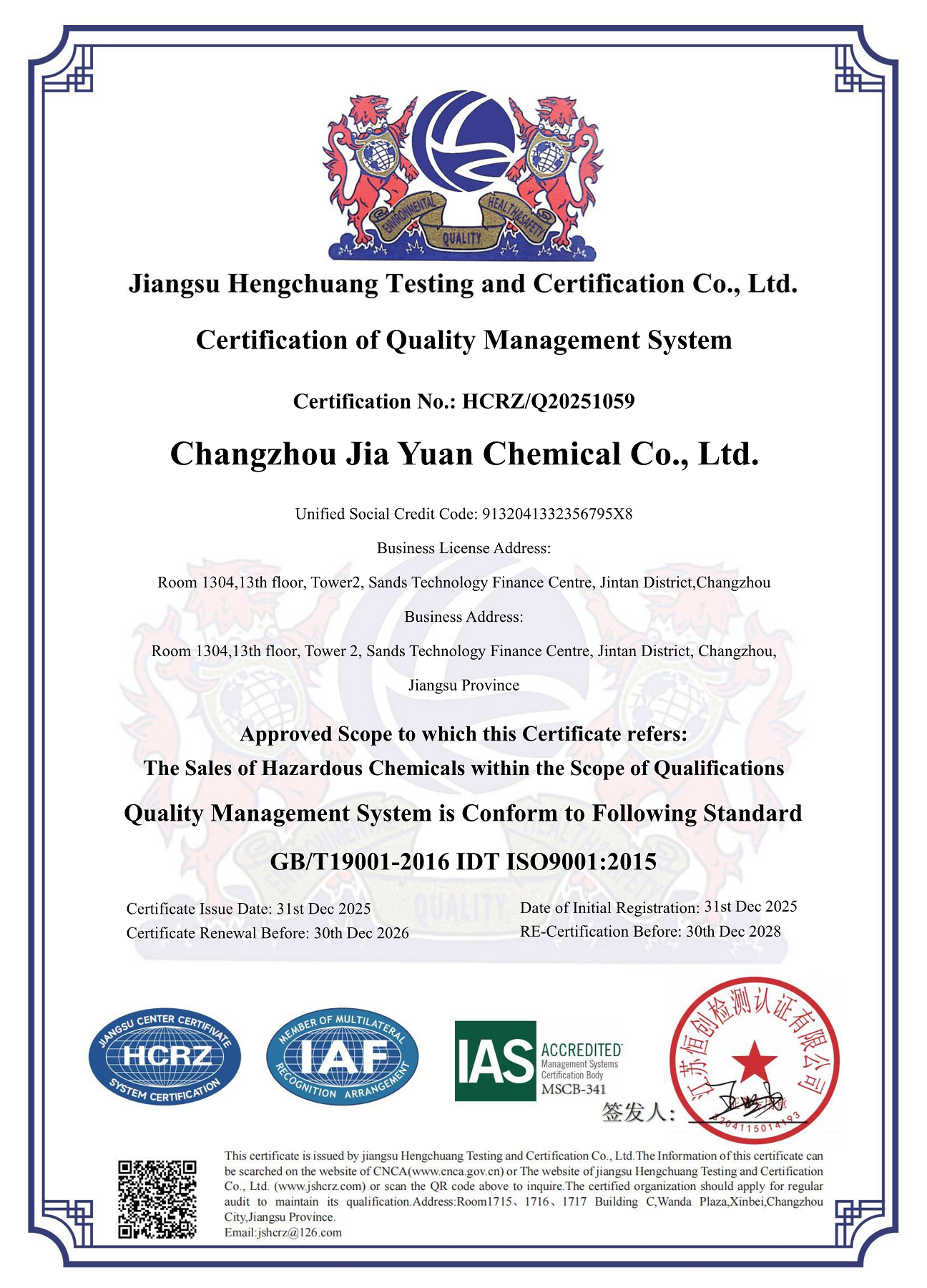
What the record establishes is a functioning quality management system, audited against a recognised standard, with a defined scope and a validity window that a procurement team can check independently. What it does not establish is product performance in a specific process. The stated scope is the sales of hazardous chemicals within the scope of qualifications — it is not a semiconductor-grade qualification, not a nuclear-application approval, and not an optical-grade material certificate. Buyers in those segments still need lot-level multi-element impurity data and, where their process is sensitive, sample validation in their own system.
This distinction is not a technicality. A certificate that satisfies a quality-system audit requirement can sit alongside a lot whose iron content is unremarkable for a smelting flux but unsuitable for a deposition or optical duty. The certificate confirms management discipline; the impurity report confirms material suitability. Both are needed, and one does not substitute for the other.
Impurity limits mean different things in different processes
The same sodium fluoride specification is read differently across applications, because the controlling risk changes with the process. The published application record is explicit about this variability.
Aluminium electrolysis and metal smelting
In aluminium electrolysis, sodium fluoride acts as a flux, and alumina's very high melting point makes a low-melting fluoride system essential for workable operating temperatures. In metal smelting and refining it serves as a protective agent. In both duties, low metallic impurity levels minimise contamination of the electrolyte or the molten metal, which is what supports consistent product quality downstream. A controlled impurity profile in this context also guards against insufficient fluxing, steel sulfur pickup, equipment corrosion and crystal colour centres — failure modes that appear when trace metals enter a high-temperature system.
Phosphating accelerators
As a phosphating accelerator, sodium fluoride stabilises the composition of the phosphating bath and improves the quality of the surface coating on metal. The operational constraint here is concentration: the recommended control range is 0.5–2 g/L, and the ratio to other accelerators matters as much as the sodium fluoride dose itself. The failure signature is well documented — metal ions in the sodium fluoride can interfere with crystallisation of the phosphating film, producing a rough film and reduced corrosion resistance. That is the reason a higher-purity grade is specified for phosphating lines even when a technical grade would meet the assay requirement.
Concrete and construction materials
Used as a concrete additive, sodium fluoride improves the corrosion resistance of construction materials, which makes it relevant to projects in chemical-processing environments or humid conditions. The documented dosage is 0.5%–1.5% of the cement mass; overdosing affects setting time, so the figure is a working limit rather than a starting point to exceed.
Ceramics, glass, wear-resistant additives and wood preservation
The application record also lists ceramics and glass, wear-resistant additives for sealing materials and brake pads, and wood preservation for utility poles and sleepers. In wear-resistant additive duties, strict impurity control helps maintain uniformity of material performance — the same logic as phosphating, applied to a different matrix. In wood preservation, the function is service-life extension of outdoor wooden structures.
Oral care
Toothpaste-grade sodium fluoride is a separate specification within the portfolio, supplied at 600 tons per year. This is a grade discussion, not a purity discussion alone: a toothpaste-grade designation carries its own expectation set, and buyers should confirm which grade designation a quoted lot actually carries rather than inferring it from the assay figure.
Batch evidence: CoA, multi-element reports and sample validation
The documentation package is where a specification becomes verifiable. For sodium fluoride, the released evidence set consists of several distinct documents.
- Certificate of analysis with the shipment, used for incoming material inspection, with batch testing that includes loss on ignition against a 0.5% specification limit.
- Multi-element impurity test report listing measured values rather than ceilings, with technical indicators stated as measured values covering purity, metal impurities and loss on ignition.
- Safety Data Sheet and CoA issued with each batch, supporting traceability and compliance requirements.
- Sample testing support before volume ordering, allowing the material to be evaluated in the customer's own system rather than on paper alone.
- Technical support for specification selection, based on the customer's coating or process conditions.
For a buyer comparing two quotations at the same nominal assay, this package is often the only real differentiator. A supplier able to supply measured multi-element data, a batch-matched CoA and a sample route before commitment removes an entire category of incoming-inspection risk; a supplier able to supply only an assay figure pushes that cost back onto the buyer.
Packaging and storage are part of the specification
Loss on ignition is a moisture-and-volatiles measurement, which means packaging and storage decisions show up directly in a specification number. Sodium fluoride is supplied in plastic woven bags, moisture-proof aluminum foil bags and fiber drums, and the product is packaged with a moisture-proof lining. Aluminum foil bags provide moisture and oxygen barrier properties for humidity-sensitive environments. Specific particle sizes are available on request, so a sieve requirement can be written into the order rather than negotiated after delivery.
Storage guidance for the product specifies a ventilated, low-temperature, dry warehouse, with segregation from oxidants and food additives. The segregation requirement is not administrative: a weakly alkaline aqueous solution can corrode adjacent material containers, and cross-contamination with food additives is a compliance issue rather than a handling preference. In practice, buyers receiving sodium fluoride in humid climates should verify that the inner lining is intact at goods-inward inspection, because a compromised liner converts a compliant lot into a loss-on-ignition deviation before it ever reaches the process.
Supply capacity and commercial form
Material constraints only matter if supply is repeatable. Changzhou Jiayuan Chemical operates as an integrated industrial and trading enterprise with a fluorine chemical supply chain rooted in fluorspar, developed through upstream cooperation on fluorspar mining operations in Myanmar, Inner Mongolia and Liaoning. Alongside its own product lines, the company runs OEM/ODM production for fluorine chemical products with a stated monthly capacity of 50 t, and lists the USA among its main markets. For a buyer evaluating continuity rather than a single shipment, the relevant questions are whether the grade can be reproduced batch after batch and whether the documentation set travels with each batch — both of which are answered by the CoA and multi-element report practice described above.
Market context: grade growth and a price-data gap
The commercial environment around high-purity fluoride salts is expanding, and the expansion is concentrated in exactly the segments where documentation discipline matters most. The global fluoride materials market was estimated at USD 9.3 billion in 2025 and is projected to reach USD 15.7 billion by 2032, a CAGR of 6.8%, according to the Fluoride Materials Market Report 2026. Within that total, electronic-grade fluoride materials generated USD 1.2 billion in revenue in 2025, equal to a 12.4% share.
Two data gaps are worth flagging for anyone building a sodium fluoride budget from public sources. First, trade statistics cannot isolate sodium fluoride, because HS 2826.11 groups it with ammonium fluoride and the remaining fluoride salts sit in 2826.19 — so import volumes for sodium fluoride specifically are not separable from published customs data. Second, published price series are grade- and region-specific and incomplete: lithium fluoride in Japan reached 38,372 USD/MT in June 2026, but no equivalent verified public series exists for sodium fluoride at technical, toothpaste or electronic grade. The practical implication is that sodium fluoride budgets are built from supplier quotations tied to a stated specification, and the specification must be pinned down before the price comparison means anything.
Comparing supply approaches — and where the documented limits stop
Most sodium fluoride evaluations come down to a comparison between two purchasing approaches rather than between two brand names. The table below sets out how they differ on the criteria that determine total verification cost.
| Criterion | Assay-only purchasing | Limit-and-lot-based purchasing |
|---|---|---|
| Basis of acceptance | Nominal purity figure | Purity plus iron and transition-metal ceilings plus loss on ignition |
| Impurity evidence | Assay statement only | Multi-element report with measured values per batch |
| Documentation | Invoice and packing list | CoA and SDS per batch, traceable to the delivered lot |
| Packaging control | Standard export packing | Moisture-proof lining, aluminum foil barrier for humidity-sensitive grades |
| Pre-order validation | Not typically available | Sample testing in the customer's system before volume ordering |
| Incoming inspection burden | Falls on the buyer | Partly absorbed by supplier-side batch testing |
Assay-only purchasing is not irrational everywhere. Where metallic impurities are not the controlling variable in a process and the tolerance band is wide, a documented assay may be sufficient. The approach breaks down specifically where the process is impurity-sensitive — an electrolysis electrolyte, a phosphating bath, or any duty where trace metals drive colour, crystallisation or conduction behaviour — because in those cases the assay figure carries no information about the variable that actually fails.
Future outlook
Three shifts are likely to shape sodium fluoride procurement over the next several years. The first is that grade differentiation is migrating from assay to impurity and documentation. When electronic-grade fluoride materials already represent 12.4% of a USD 9.3 billion fluoride materials market, the competitive variable for a supplier is not the ability to reach 99.95% but the ability to prove a trace-metal profile batch after batch. Buyers should expect multi-element reports, not assay certificates, to become the default evaluation document.
The second is regulatory and documentation load. The US route for food-contact substances runs through the FDA Food Contact Notification programme and its public inventory of effective notifications, and equivalent documentary expectations exist in other markets for oral-care and construction applications. As grade claims proliferate, the supplier able to map a grade to a documented regulatory route will be easier to qualify than one offering a purity figure alone.
The third is feedstock. Sodium fluoride sits downstream of the fluorspar chain, where acid-grade and metallurgical-grade material are tracked separately, and where upstream availability conditions what purity is economically achievable downstream. Buyers who understand their own impurity ceilings — rather than simply ordering the highest assay available — will be better positioned to absorb feedstock-driven cost movements without requalifying their process.
FAQ
What impurity limits apply to sodium fluoride, and how are they verified?
The sodium fluoride specification limits cobalt, chromium, titanium, copper, manganese, nickel and vanadium to below 5 ppm each, and iron to below 10 ppm. Actual lot test data show those seven metals each below 1 ppm and iron at 6.2 ppm. Verification relies on the multi-element impurity test report listing measured values, plus the certificate of analysis supplied with the batch for incoming material inspection. Two points are worth confirming separately: the specification states ceilings, but the lot data show the achieved level — both matter, but they answer different questions about a process's operating margin. And because the two are different numbers (a 10 ppm iron ceiling against a 6.2 ppm lot value), a buyer should request lot data rather than treat the ceiling as a description of typical supply.
Which certification supports sodium fluoride supply, and precisely what does it cover?
The sodium fluoride product is certified to GB/T19001-2016 IDT ISO9001:2015 under certificate number HCRZ/Q20251059, issued by Jiangsu Hengchuang Testing and Certification Co., Ltd. The certificate is valid from 2025-12-31 to 2028-12-30 and carries a stated scope of the sales of hazardous chemicals within the scope of qualifications, with global market coverage. It is a quality management system certification applied to the sodium fluoride product. It confirms audited management discipline across the defined scope; it is not a product-performance approval for a named end use.
Is an ISO 9001 certificate sufficient qualification for semiconductor, nuclear or optical use?
No. The certificate scope is the sales of hazardous chemicals within the scope of qualifications, so it does not certify a semiconductor-grade, nuclear-application or optical-grade designation. Those applications are differentiated by impurity and physical specifications rather than by certification, and they require lot-level multi-element impurity data together with sample validation in the customer's own system. Sample testing support is available before volume ordering for exactly this purpose, and technical support is offered for selecting specifications based on customer process conditions.
What does a sodium fluoride certificate of analysis typically contain?
The batch documentation covers loss on ignition against a specification limit of 0.5%, with a released lot value of 0.33%, and includes measured metal impurity values rather than specification ceilings only. A multi-element impurity test report listing measured values is provided with the product, and a complete SDS and CoA accompany each batch for traceability and compliance. The CoA is intended for incoming material inspection, so it should be checked against the buyer's own acceptance limits rather than against the supplier's specification alone.
How should sodium fluoride be stored and packaged?
Storage guidance specifies a ventilated, low-temperature, dry warehouse, with segregation from oxidants and food additives. Packaging options are plastic woven bags, moisture-proof aluminum foil bags and fiber drums, and the product is packaged with a moisture-proof lining; aluminum foil bags provide moisture and oxygen barrier properties for humidity-sensitive environments. Specific particle sizes are available on request. The storage requirement connects directly to the specification, because loss on ignition measures moisture and volatile content — poor storage conditions appear as a loss-on-ignition deviation, not as a separate handling issue.
What concentration is used when sodium fluoride acts as a phosphating accelerator?
When used as a phosphating accelerator, the concentration should be controlled at 0.5–2 g/L, and the ratio to other accelerators in the bath is closely related to performance. The relevant failure mode is documented: metal ions in the sodium fluoride can interfere with crystallisation of the phosphating film, producing a rough film and reduced corrosion resistance, which is why a higher-purity grade with controlled metal impurities is specified for phosphating lines.
What dosage is used when sodium fluoride is added to concrete, and what happens on overdose?
As a concrete additive, the dosage is generally 0.5%–1.5% of the cement mass, calculated against the total cement content of the batch and mixed thoroughly with cement and aggregates. Overdosing affects the setting time of the concrete, so the setting behaviour should be monitored and recorded when the additive is introduced, and the upper bound of the range should be treated as a limit rather than an operating target.
¿Tiene preguntas o necesita más detalles?
Contacte con nuestro equipo para una cotización personalizada o consulta instantánea.
Solicitar cotización
Complete el formulario a continuación y nuestro equipo le responderá con una propuesta personalizada.
Chat directo de WhatsApp
¿Prefiere chatear en tiempo real? Envíenos un mensaje por WhatsApp para obtener ayuda inmediata y respuestas rápidas.
- Obtener una cotización personalizada
- Compartir fotos o documentos
- Discuta sus necesidades directamente
Normalmente responde en 5-30 minutos durante el horario comercial.