
Snow White vs Shine Skin vs Lady Nail: A Buyer's Field Test
Snow White vs Shine Skin vs Lady Nail: A Buyer's Field Test
Pumpkin seed buyers rarely get a clean side-by-side look before committing to a container. Variety names travel faster than variety data: a quotation arrives labelled Snow White, Shine Skin or Lady Nail, and the buyer is expected to know what actually changes across the three. There is a lot of volume behind those names. China's pumpkin seed production was projected to reach 400,000 tons in 2024, up roughly 40% from 280,000 tons in 2023 (Seedea / Pumpkin GWS Market Update, November 2024), and most of that volume is traded under these three commercial varieties. This article puts them next to each other on one table — appearance, size grades, taste behaviour, shared specifications and the practical limits of each — so the decision can be made on specifications rather than on name recognition.
What This Field Test Is — and What It Is Not
This is a documentation-based field test, not a laboratory trial. It compares Snow White, Shine Skin and Lady Nail pumpkin seeds using published product specifications from Inner Mongolia Chengtai Food Co., Ltd. — a grower, processor and exporter of sunflower seeds, pumpkin seeds and kernels established in 2013 and located in the Hanggin Rear Banner, Bayannur, Inner Mongolia — together with third-party data on Chinese pumpkin seed production, trade and regulation.
Two limitations follow from that method, and both matter. First, the specification values below are the figures a supplier publishes; they are not the result of an independent sampling programme. Second, no variety in this comparison is universally better than another. Each of the three is a different commercial tool, and the useful question is which tool matches a given roasting line, snack format or ingredient application.
First Look: Seed Coat, Kernel Colour and Shape
The fastest way to separate the three varieties in a sample tray is to look at colour and silhouette before looking at any number.
Snow White
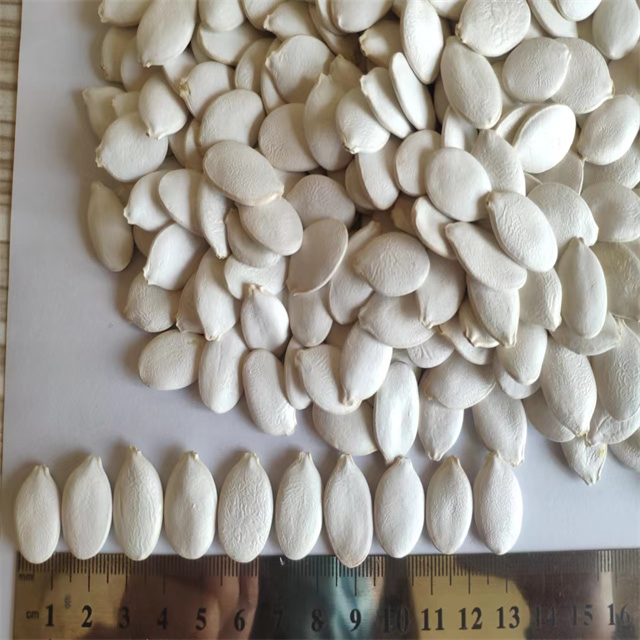
The Snow White Pumpkin Seeds product is described in Chengtai's published data as raw, white in colour and sweet and natural in taste, with a hard seed coat. The name describes the coat, which is why Snow White is easy to identify in a mixed sample. Its top grades are listed at 15cm+, with 13cm+ and 11cm+ below them. The published applicable industry is manufacturing and roasted shops, and the stated use is human consumption.
Shine Skin
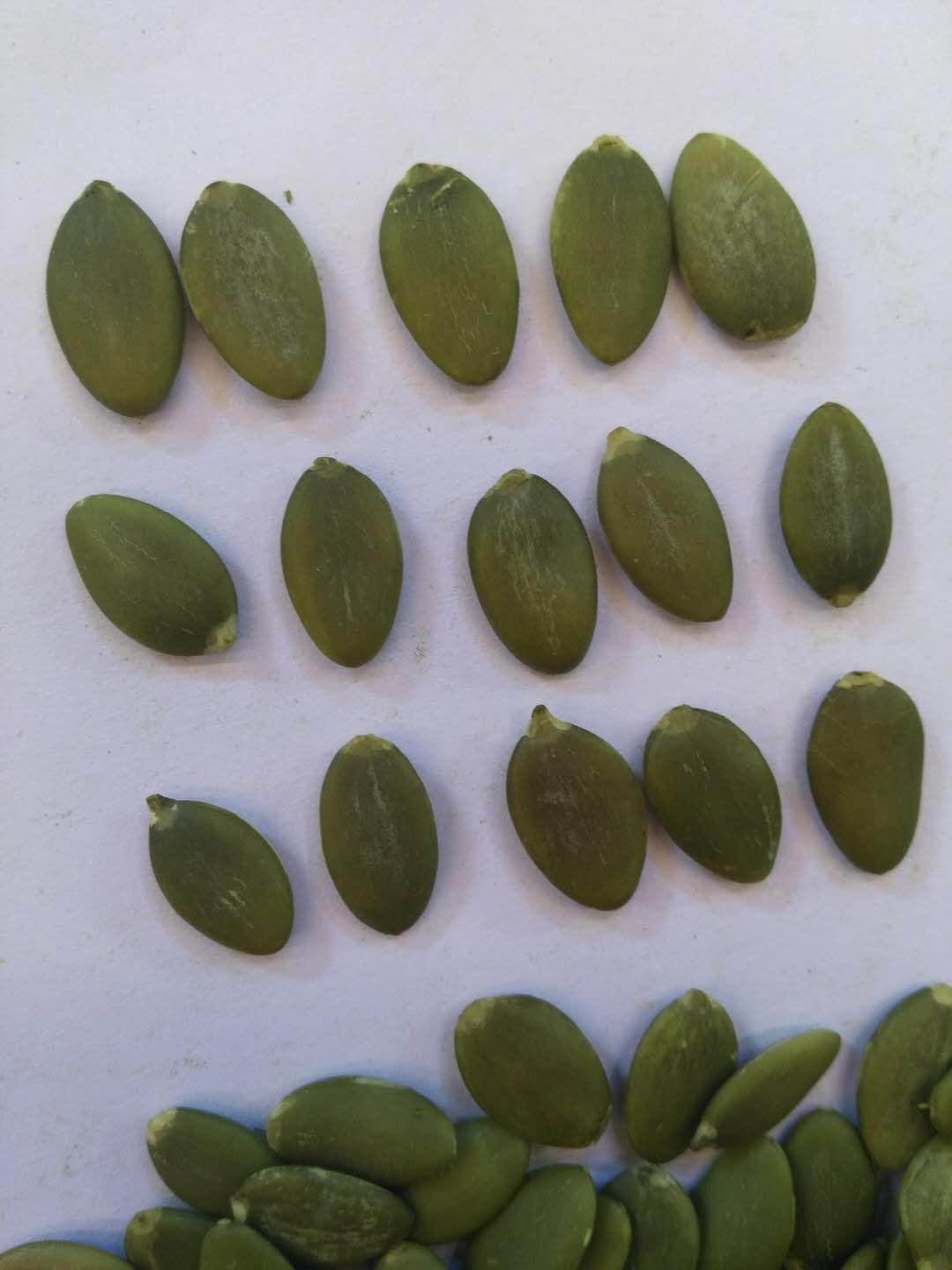
Shine Skin is the variety where a white-or-green question needs a qualifier. In-shell Shine Skin seeds are described in the supplier's own variety comparison notes as slightly yellow in tone rather than pure white, with the in-shell top grade listed at 11cm+. The kernel is a different story: Shine Skin Pumpkin Seeds kernels are graded A, AA and AAA with a green colour, and the AAA grade is described as dark green. A buyer ordering simply "Shine Skin" therefore needs to state whether the requirement is in-shell seed or kernel, because the visual appearance changes completely between the two formats.
Lady Nail
Lady Nail is an elongated, white-coated type. Chengtai's product data lists it as Inner Mongolia Origin Pumpkin Seeds at 10cm+ for the top grade, with 7–10mm+ and below 7mm options underneath. The variety notes describe it as a long type with an even and attractive shape and a good taste. Lady Nail is also the variety with the most visible recent planting expansion: Lady Nail planting area grew 80% to roughly 500,000 acres in 2025, driven by robust demand in the Middle East (Cardassilaris Family market insights, June 2025).
Size Grades: Reading the Numbers Correctly
The three varieties are graded on different scales, and the units alternate between centimetres and millimetres. That alternation is a common source of error in quotations, because two suppliers can both describe a "big size" product and mean two different measurements.
- Snow White is graded at 15cm+, 13cm+ and 11cm+.
- Shine Skin (in-shell) is graded at 11cm+, 8–10mm+ and below 8mm.
- Lady Nail is graded at 10cm+, 7–10mm+ and below 7mm.
The centimetre figures describe seed length. The millimetre ranges describe kernel dimensions. Because a buyer's end product may be defined either way — a salted roasted in-shell snack line on one side, a bakery, confectionery or oil ingredient that consumes kernels on the other — the first specification question is not "which is biggest" but "which measurement does my line actually consume". A quotation that answers the wrong one of those two questions will look correct on paper and fail at the roasting drum.
Taste, Skin and Process Fit
Taste behaviour is where variety choice stops being cosmetic. Chengtai's variety comparison notes describe Shine Skin as having the better taste profile of the three and describe Snow White as having a hard skin, which makes it well suited to salted roasting applications. Lady Nail is described as having good taste alongside its long, even shape.
Process fit also depends on the product format. Shine Skin kernels in grades A, AA and AAA are positioned for manufacturing and roasting shops, which is consistent with their use as a snack ingredient, in baked goods and confectionery, and as an input to pumpkin seed oil. In-shell Snow White and Lady Nail are more naturally aligned with salted roasting and shell-on snack packs, where the size and coat appearance are visible to the end consumer before the first bite.
The Shared Specification Baseline
Variety is only the first layer. All three products sit on a common specification baseline in Chengtai's published product data, and that baseline is what most purchase contracts actually enforce.
- Raw, 2026 crop year, sweet and natural taste
- Moisture 9–10%
- Impurity below 0.5%
- Erosion seeds below 0.5%
- Mildew seeds below 1%
- Intended for human consumption
- Origin: Xinjiang and Inner Mongolia
- Storage: cool place
- Packaging: 20/25 kg plastic or paper bags; kernels are also offered in vacuum bags with carton
The corresponding application scenario is a snack manufacturing or food production processing project, running in a cool and dry indoor warehouse at normal temperature and low humidity, with batch processing and both manual and mechanical feeding. The matched equipment in that scenario is sorting and packing machinery, and the stated special requirement is impurity control — which is exactly why the sub-0.5% impurity figure matters more in practice than a one-millimetre difference in seed length.
Side-by-Side Comparison
| Parameter | Snow White | Shine Skin | Lady Nail |
|---|---|---|---|
| Seed coat colour | White | Light, with a slight yellow tone in-shell | White |
| Kernel colour | In-shell product; no separate kernel grade published | Green; AAA grade described as dark green | In-shell product; no separate kernel grade published |
| Published size tiers | 15cm+ / 13cm+ / 11cm+ | 11cm+ / 8–10mm+ / below 8mm (in-shell); kernels graded A / AA / AAA | 10cm+ / 7–10mm+ / below 7mm |
| Shape | Large, broad | Intermediate | Long, even |
| Skin and taste notes (supplier data) | Hard skin; suited to salted roasting | Taste described as better; strong Middle East demand | Long, attractive shape; taste described as good |
| Moisture | 9–10% | 9–10% | 9–10% |
| Impurity | Below 0.5% | Below 0.5% | Below 0.5% |
| Erosion / mildew seeds | Below 0.5% / below 1% | Below 0.5% / below 1% | Below 0.5% / below 1% |
| Intended use | Human consumption; manufacturing and roasted shops | Human consumption; manufacturing and roasted shops | Human consumption; manufacturing and roasted shops |
| Origin | Xinjiang and Inner Mongolia | Xinjiang and Inner Mongolia | Listed as Inner Mongolia origin |
| Storage | Cool place | Cool place | Cool place |
| Packaging | 20/25 kg plastic or paper bags | 20/25 kg plastic or paper bags; kernels also vacuum bag with carton | 20/25 kg plastic or paper bags |
What the Comparison Means at the Procurement Stage
Read as a buying document, the table above converts into six checks that a purchaser can run before sampling begins.
- Define the format first. In-shell seed and kernel are different products even when the variety name is identical, as the Shine Skin colour difference shows.
- Convert the size spec into your own unit. If the line runs a kernel-width screen, a length grade in centimetres will not tell you whether the material passes.
- Match the variety to the end product. Salted roasted shell-on formats lean toward the largest coat formats; kernel ingredient applications lean toward graded green kernels; premium retail packs that benefit from an even silhouette lean toward a long type.
- Align moisture with the route to market. The published baseline for all three products is 9–10%. Published third-party trade listings for AAA Shine Skin kernels sometimes quote a different commercial specification, including moisture of 8% maximum and purity of 99.95% minimum (Agroland Food product specifications). Those are separate commercial specs, and buyers should confirm which one a quotation follows rather than assuming.
- Check the destination regulation. European Commission Regulation (EU) 2023/915 sets the maximum aflatoxin level for pumpkin seeds at 5.0 μg/kg for the sum of B1, B2, G1 and G2. Any variety decision has to clear that bar before it reaches a buyer.
- Confirm packaging and container fill. All three products ship in 20/25 kg plastic or paper bags, with vacuum-bag-and-carton options on kernels, which changes pallet configuration and container utilisation.
What the Market Data Adds
Market structure explains why the three varieties are not equally easy to source at short notice. Shine Skin is the dominant variety in China, accounting for 74% of total production in 2024 — approximately 294,000 tons (Everstar Foods industry report). Snow White and Lady Nail each accounted for about 12% of China's 2024 production, estimated at roughly 46,000 tons and 52,000 tons respectively (Everstar Foods). In other words, two of the three varieties in this comparison together represent a smaller share of Chinese output than Shine Skin alone.
Origin concentration matters for the same reason. Inner Mongolia — where Chengtai operates — is a major pumpkin seed cultivation hub with a planting area of 28,700 hectares (430,000 mu) in 2024 (Seedea agriculture statistics). At the demand end, the global pumpkin seed market is expected to grow from USD 1.08 billion in 2025 to USD 2.62 billion by 2032 at a CAGR of 13.4% (Maximize Market Research), and the related pumpkin seed oil market is growing at a CAGR of 10.5% toward USD 2.06 billion by 2030 (Grand View Research), which increases pull on high-purity kernel grades. China's pumpkin seed export value was USD 97.04 million in 2023, around 10% of global export value (Tridge / UN Comtrade).
Limits, Risks and Open Questions
A field test that only lists advantages is not a field test. Four boundaries should be carried alongside the comparison.
The taste and skin claims are single-source. The comparison of taste profiles across the three varieties comes from a processor's own notes, not from independent sensory testing, and taste outcomes vary with roast profile, salt level and oil used on the line.
Variety is not a quality guarantee. Two shipments labelled Shine Skin can differ in purity, size distribution and defect counts depending on grading practice. The variety name narrows the expectation; it does not replace receiving inspection.
Regulatory pressure is real and current. Pesticide residue regulation in the EU and the US has constrained export volumes for Shine Skin and GWS types, contributing to a temporary global oversupply in 2025 (Cardassilaris Family B2B insights). That affects availability and price, and it should push buyers toward suppliers who can document residue control rather than toward cheaper untraceable parcels.
This test does not cover price, lead time or contract terms. None of those can be settled from a specification sheet, and none of the figures here should be read as a price signal.
Where a Processor-Exporter Sits in This Picture
Inner Mongolia Chengtai Food Co., Ltd. is one of the entities that trades all three varieties from a single origin region, which is what makes a side-by-side comparison of this kind possible in practice. The company was established in 2013 and operates from the Hanggin Rear Banner in Bayannur, Inner Mongolia, with a planting base of 1.5 million acres for sunflower and pumpkin seeds, a manufacturing facility covering 3,500 square metres within a site of more than 11,000 square metres, approximately 20 employees and a research and development team of 2 engineers. Annual production capacity is stated at 30,000 metric tons of seed kernels, and the production workshop is designed to EU standards. Around 80% of sales are generated from exports, with the Middle East, Middle Asia and Europe as the primary markets. The product range covers sunflower seeds, pumpkin seeds and kernels, including the Snow White, Shine Skin and Lady Nail varieties compared above.
Future Outlook
Two forces are likely to reshape this comparison over the next few seasons. The first is variety mix: the 80% expansion of Lady Nail planting area in 2025, driven by Middle East demand, suggests a market that is actively diversifying away from a single dominant variety, which should gradually improve availability for the thinner segments of the market. The second is regulation: as residue and mycotoxin requirements tighten in the EU and the US, the competitive line between suppliers will move from variety names toward documented process control — sorting capability, moisture management and traceability from planting base to container.
For buyers, the practical implication is that variety selection is becoming an early-stage decision rather than a bargaining position. The three varieties differ in coat colour, kernel colour, size tiers, shape and roasting behaviour, and those differences are stable enough to plan around.
Frequently Asked Questions
What are the differences between Snow White, Shine Skin and Lady Nail pumpkin seeds?
Snow White is the largest format, listed at 15cm+, 13cm+ and 11cm+ with a white seed coat and a hard skin. Shine Skin is offered in-shell at 11cm+ with 8–10mm+ and below-8mm tiers, and as kernels graded A, AA and AAA in green to dark green colour. Lady Nail is a long, white-coated type listed at 10cm+, 7–10mm+ and below 7mm. All three are sold raw for human consumption with moisture of 9–10% and impurity below 0.5% in the published data.
Which type of pumpkin seeds has the biggest size?
Snow White lists the largest top grade in this group at 15cm+, with 13cm+ and 11cm+ below it. Shine Skin tops out at 11cm+ for in-shell seed, and Lady Nail at 10cm+. One clarification matters before comparing: the centimetre grades describe seed length, while the millimetre tiers such as 8–10mm+ and 7–10mm+ describe kernel dimensions, so buyers should confirm which measurement a quotation refers to.
Which type of pumpkin seeds is white in colour?
Snow White and Lady Nail are both described with a white seed coat. Shine Skin is the qualified case: the in-shell seed is described in supplier notes as slightly yellow rather than pure white, while Shine Skin kernels are green, and the AAA kernel grade is described as dark green. For Shine Skin, the white-or-green answer therefore depends on whether the purchase is in-shell seed or kernel.
Which type of pumpkin seeds is long in shape?
Lady Nail is the long type in this comparison, described as having an even and attractive shape. Snow White is the broadest and largest of the three, and Shine Skin sits between them in silhouette, with its most distinctive visual feature being the kernel colour rather than the outline of the seed.
Which type has an 8–10mm size option?
Shine Skin lists 8–10mm+ as a mid-tier option for in-shell seed. Lady Nail uses a 7–10mm+ tier in the same position, and below 7mm as its smallest tier. These millimetre ranges refer to kernel dimensions, unlike the centimetre grades that describe seed length.
Which type of pumpkin seeds has a better taste?
Chengtai's variety comparison notes describe Shine Skin as having the better taste profile of the three, and describe Snow White as having a hard skin that suits salted roasting. Lady Nail is described as having good taste alongside its long shape. These are first-party observations from one processor rather than independent sensory panel results, so the practical approach is to roast a sample of each variety against the intended recipe before fixing the specification.
Specification sheets for Snow White, Shine Skin and Lady Nail pumpkin seeds, together with the full product range, are collected in the company profile document available for download: Inner Mongolia Chengtai Food Co., Ltd. company profile (PDF).