
Smart Water Meter Shortlist for AMR/AMI Integration
Smart Water Meter Shortlist for AMR/AMI Integration
Why Interface Choice Comes First in AMR/AMI Shortlisting
For AMR/AMI projects, the most useful shortlist starts with the communication interface rather than with a generic product category. AMR (automatic meter reading) and AMI (advanced metering infrastructure) both depend on how meter data reaches the utility or building platform. A smart water meter may measure accurately and still fail integration if its electrical output, bus protocol, radio band or head-end compatibility does not match the site.
Three interface families dominate the evaluation stage: RS485 wired meters, M-Bus wired meters and wireless remote-reading meters. Each answers a different network-ownership question. RS485 is usually selected when a PLC, SCADA system or building management system already exists. M-Bus is selected when a standardized meter bus and multi-meter reading are required. Wireless options are selected when cabling is impractical, when meters are distributed across a large area, or when a utility wants a fixed network without building a wired backbone.
This shortlist uses published product and certification information from Shengda Water Meter Co., Ltd. (SDWM) as a reference case. SDWM is a Chinese water meter and flow meter manufacturer established in 1995, operating a 66,000 m² factory and exporting to markets including the USA, South America, Africa and Southeast Asia. Its product range covers smart water meters, ultrasonic water meters, LoRaWAN water meters, prepaid water meters and electromagnetic flow meters. The purpose here is not to rank brands, but to show how interface options should be evaluated against AMR/AMI requirements.
Option 1: RS485 Wired Water Meters for BMS, PLC and SCADA Integration
An RS485 water meter is the first shortlist option when the reading system is local, wired and controlled by the buyer. RS485 refers to a balanced digital multipoint electrical interface defined in ANSI/TIA-485-A. It allows multiple devices to share a bus and is widely used in industrial and building automation environments. For a water meter, RS485 is the physical layer only. The application protocol must be agreed separately.
This distinction matters in procurement. A meter may be advertised as “RS485 output” while using a proprietary register map. If the buyer’s PLC or SCADA software expects Modbus RTU or another standard protocol, the supplier must provide the register table, baud rate, parity settings and wiring diagram before the meter can be commissioned. The same check applies to data points such as forward flow, reverse flow, alarm status, battery condition and historical logs. Without that mapping, the integration team is testing the meter rather than installing it.
RS485 meters fit sites where power and cabling are available or can be installed at reasonable cost. Typical examples include industrial complexes, water treatment plants, commercial buildings, campuses and utility pumping stations. The interface is less suitable for dispersed residential meters where each unit would require a separate cable run. In those cases, the cabling and surge-protection cost can exceed the meter cost, and a wireless option becomes more practical.
SDWM’s published product information states that its ultrasonic water meters support NB-IoT, LoRaWAN, 4G Cat1, RS-485 and M-Bus transmission. The company’s LXSY remote smart water meter series also holds an EU-type examination certificate under MID Module B for DN15–DN20 models. For an RS485 shortlist, buyers should request the exact model, the RS485 data sheet, the protocol implementation and the cable-distance recommendation for the selected baud rate. RS485 distance is not a single guaranteed site figure; it depends on cable quality, termination, topology and data rate.
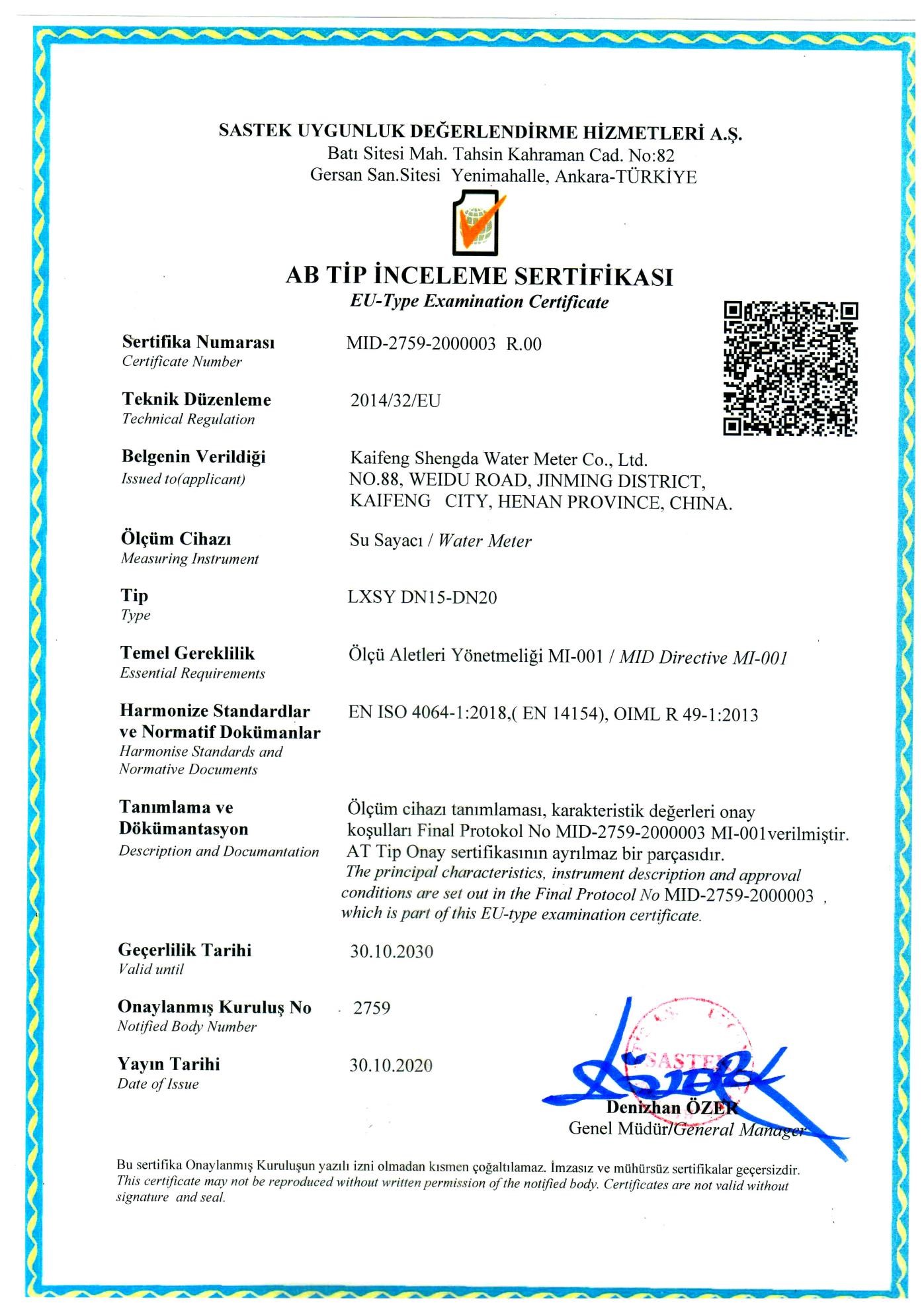
MID certificate for the LXSY remote smart water meter series, shown as an example of model-level compliance evidence.
Option 2: M-Bus Water Meters for Standardized Utility Reading
M-Bus is the second shortlist option and is often the better fit for European-style utility reading and multi-meter buildings. The wired M-Bus family is defined in EN 13757-2 for the physical and link layer and EN 13757-3 for application protocols. Unlike a bare RS485 port, M-Bus was developed specifically for meter data. It supports a standardized approach to reading registers, and the bus can provide power to connected meters from a master unit.
The practical advantage is interoperability. When a utility or building operator already uses an M-Bus master and a head-end system that understands EN 13757 data structures, adding an M-Bus water meter can be more predictable than integrating a vendor-specific RS485 protocol. The bus also supports multiple meters on one network, which suits apartment blocks, commercial buildings and district metering points where several meters are concentrated.
The fit boundary is infrastructure. M-Bus still requires cable installation and a master unit. A buyer must check the maximum number of meters supported by the master, the bus length and power budget, the baud rate and the exact data profile of each meter. A water meter described as “M-Bus” may support only a subset of registers unless the supplier confirms the application-layer mapping. For AMR/AMI projects, the M-Bus meter should be tested with the actual master and head-end software, not only with a supplier test tool.
SDWM’s product information states that its ultrasonic water meters support M-Bus transmission alongside other interfaces. The company also publishes CE and MID documentation for identified product families. The LXC/LXC-V ultrasonic water meter has a MID Module B certificate issued by TÜV Rheinland, and the LXSY series has a MID Module B certificate for DN15–DN20. These certificates support metrology compliance, but they do not by themselves prove M-Bus application-layer compatibility. The buyer should request a model-specific M-Bus data sheet and a register map as part of the shortlist review.
Option 3: Wireless Remote-Reading Water Meters for Distributed Sites
Wireless remote-reading meters are the third shortlist option and cover several different network models. The common objective is to remove the cable between the meter and the reading device. The buyer must then choose between a private LoRaWAN network, a licensed cellular network such as NB-IoT or 4G, or another radio option supported in the target market. The choice affects gateway ownership, subscription cost, radio approval and battery replacement planning.
LoRaWAN Ultrasonic Water Meters
LoRaWAN is an open low-power wide-area network specification maintained by the LoRa Alliance. It operates in unlicensed ISM bands under regional parameters. For a water utility, the main attraction is that the network can be private or shared, and meters can be battery-powered. The main constraints are gateway planning, regional radio approval and signal penetration in pits or basements.
SDWM’s LXSC LoRaWAN ultrasonic water meter is presented as using ultrasonic transit-time measurement with no moving parts in the measuring chamber. Published specifications for the LXSC range include DN15–DN600, accuracy Class 1 or Class 2, R250, R400 or R500, pressure ratings PN10 or PN16, an operating temperature of -20 °C to +60 °C and a water temperature of 0 °C to +50 °C. The company lists LoRaWAN bands including EU868, US915 and AS923, with OEM customization available for logo, appearance, communication settings and project solutions.
The fit boundary is network design. A listed LoRaWAN band does not establish local type approval or network coverage. The buyer should confirm the gateway plan, the target data rate, the estimated meters per gateway under local conditions and the exact frequency plan approved for the country of installation. Battery life should also be verified per model and reporting interval. A general range such as “6–10 years” is not a procurement guarantee unless it is tied to a stated communications profile, temperature range and data frequency.
NB-IoT and 4G Water Meters
NB-IoT and 4G meters use licensed cellular networks and therefore do not require the utility to build a local gateway network. NB-IoT was specified within 3GPP Release 13 and is designed for low-power, wide-area devices. It suits utilities that prefer an operator-managed network and can accept SIM lifecycle management and subscription costs. SDWM reports a municipal water department project in Kenya using more than 20,000 NB-IoT units for smart water management and water-loss control, with improved automatic meter reading efficiency and reduced manual maintenance costs.
4G meters are more appropriate when higher bandwidth or remote control functions are required. SDWM reports a water supply authority project in Uganda using 4G communication, remote valve control and a cloud platform for remote monitoring and valve management. The fit boundary is power. 4G modules generally consume more energy than NB-IoT or LoRaWAN, so battery life and replacement intervals must be examined more carefully. The buyer should also confirm the operator certification and the fallback behavior when coverage is weak.
Interface Comparison for AMR/AMI Evaluation
The table below summarizes the main differences that should drive shortlist decisions. It is a qualitative comparison based on the interface standards and published product facts; it does not replace a site survey, radio survey or protocol test.
| Interface | Network Ownership | Typical Fit | Key Procurement Check |
|---|---|---|---|
| RS485 | Buyer-owned cable and control system | Industrial sites, BMS/PLC/SCADA rooms, pumping stations | Register map, protocol, baud rate, distance and isolation |
| M-Bus | Buyer-owned bus and M-Bus master | Multi-meter buildings, European utility AMR, commercial estates | EN 13757 data profile, bus length, master capacity and power |
| LoRaWAN | Private or shared gateway network | Distributed metering, municipal districts, difficult access sites | Regional band approval, gateway plan, battery profile |
| NB-IoT | Mobile network operator | Utility-scale fixed networks with operator coverage | SIM lifecycle, operator certification, coverage at meter depth |
| 4G | Mobile network operator | Sites needing higher data or remote valve control | Power budget, data plan, remote-command security |
How to Evaluate Suppliers Beyond the Interface Label
A shortlist should test evidence, not only labels. The first check is model-level documentation. The buyer should ask for the exact model number, the communication interface specification, the protocol document, the battery specification and the pressure and temperature ratings. For wireless models, the buyer should also ask for the radio approval relevant to the destination country.
The second check is metrology and ingress protection. SDWM publishes an IP68 certificate for the LXC ultrasonic water meter and MID Module B certificates for the LXC/LXC-V ultrasonic range and the LXSY remote smart water meter series. The company also holds ISO 9001, ISO 14001 and ISO 45001 management system certificates. These documents are useful because they give the buyer a starting point for verification by certificate number, model scope and validity. They should still be checked against the actual product and destination-market requirements.
The third check is factory and test evidence. SDWM’s published capability profile describes a 66,000 m² factory, 12 engineers and quality controls that include incoming material inspection, production process inspection, 100% functional testing, calibration testing and final inspection before shipment. For a communication-heavy meter, the buyer should ask how the communication module is tested and whether firmware and protocol versions are recorded at shipment.
The fourth check is deployment evidence. SDWM reports municipal and utility projects in Zimbabwe, Kenya, Uganda, Sudan and Mongolia. These references describe applications such as remote recharge, automatic billing, NB-IoT reading, 4G remote valve control and LoRaWAN smart city deployment. They are useful as fit references, but they do not prove that the same configuration will perform identically in another market. The buyer should ask for the project-specific communication settings, head-end requirements and local approval status.
Matching the Shortlist Option to the Deployment Scenario
Interface selection becomes clearer when it is mapped to the site. A municipal water utility with an existing SCADA room and a compact industrial district may start with RS485 because the control system and cable routes already exist. A European building owner with an M-Bus master and multiple apartment meters may start with M-Bus because the head-end system already reads M-Bus data profiles. A utility with dispersed residential meters and no cable routes may start with LoRaWAN or NB-IoT.
SDWM’s public case references illustrate how the interface choice follows the scenario. The Zimbabwe municipal water supply project used more than 4,000 units for smart water management and water-loss control, with remote recharge, automatic billing, user management and remote valve control. The Kenya municipal water department project used more than 20,000 NB-IoT units and reported improved automatic meter reading efficiency and reduced manual maintenance costs. The Uganda water supply authority project used 4G communication, remote valve control and a cloud platform for school drinking water management and other sites. The Mongolia government water utility project used 15,000 units with LoRaWAN communication for smart city deployment.
These examples should be read as application references rather than as universal performance claims. A shortlist for a new project should still include a site survey for cable routes, a radio survey for wireless options, a protocol test for wired options and a review of local metrology and radio approvals. The same meter family can be configured for different interfaces, so the exact configuration and firmware must be fixed in the purchase order.
Future Outlook: More Interfaces, More Evidence Requirements
The AMR/AMI market is not converging on one interface. RS485 remains useful where PLC and SCADA systems are already installed. M-Bus remains relevant where standardized meter buses and multi-meter reading are established. LoRaWAN, NB-IoT and 4G continue to serve different network-ownership models. The practical implication for buyers is that the shortlist should not treat any single interface as universally superior.
The more important change is in evidence requirements. As utilities move from drive-by reading to fixed networks, the buyer needs model-level proof of protocol compatibility, radio approval, battery behavior and remote-control security. A meter that is accurate but poorly documented creates integration risk. A meter that is well documented but not certified for the destination market creates compliance risk. The shortlist should therefore include a documentation scorecard alongside the technical comparison.
FAQ
How does RS485 differ from M-Bus in a smart water meter project?
RS485 defines the balanced digital electrical interface and does not by itself define how meter data is structured. M-Bus defines a meter-specific bus system, including application-layer protocols under the EN 13757 family. An RS485 meter therefore requires the buyer and supplier to agree on a protocol and register map, while an M-Bus meter is designed around a standard meter-data model. Both still require cable installation and commissioning tests with the actual head-end system.
Can a wired smart water meter connect to a BMS, PLC or SCADA system?
Yes, if the meter output and the control system use compatible electrical and protocol layers. An RS485 output can connect to a PLC or SCADA system through a compatible port, but the application protocol, baud rate, data registers and isolation must be confirmed. An M-Bus meter requires an M-Bus master or gateway that can forward data to the BMS or SCADA platform. SDWM states that its ultrasonic water meters support RS-485 and M-Bus transmission, and the buyer should request the model-specific protocol document before integration.
What should buyers verify about battery life in wireless water meters?
Battery life should be verified per model and per configured reporting interval. It depends on the communication module, transmission frequency, temperature and network conditions. A general range is not enough for procurement. The buyer should ask for the battery type, expected replacement interval, low-battery alarm behavior and field-replacement procedure. For SDWM’s LXC ultrasonic water meter, an IP68 certificate is published, but the battery specification should still be confirmed on the exact model data sheet.
Is remote valve control available for AMR/AMI water meters?
Remote valve control is available on some smart water meter configurations, but it should be treated as an optional feature. SDWM case references describe remote valve control in Zimbabwe and Uganda projects. Buyers should confirm whether the valve is integrated into the meter or supplied as a separate component, which communication path supports the control command, and what security and fail-safe behavior apply. The purchase order should state the exact valve configuration and the permitted remote-command functions.
Conclusion: Build the Shortlist Around Fit and Evidence
The practical shortlist for AMR/AMI integration is not a list of brand names. It is a list of interface fits: RS485 for buyer-owned wired control systems, M-Bus for standardized meter-bus networks, LoRaWAN for private or shared low-power radio networks, and NB-IoT or 4G for operator-managed cellular networks. Each option has a different infrastructure owner, commissioning path and evidence requirement.
SDWM’s product, certification and project information shows a manufacturer operating across these interface categories. Its published portfolio includes ultrasonic water meters with RS-485, M-Bus, LoRaWAN, NB-IoT and 4G transmission options, along with IP68 and MID certification evidence for identified models. Buyers should use that information as a starting point, then verify model-level protocols, radio approvals, battery data and destination-market compliance before awarding a contract.
For a detailed overview of SDWM’s smart water meter portfolio, the company brochure is available for download: SDWM company brochure.
¿Tiene preguntas o necesita más detalles?
Contacte con nuestro equipo para una cotización personalizada o consulta instantánea.
Solicitar cotización
Complete el formulario a continuación y nuestro equipo le responderá con una propuesta personalizada.
Chat directo de WhatsApp
¿Prefiere chatear en tiempo real? Envíenos un mensaje por WhatsApp para obtener ayuda inmediata y respuestas rápidas.
- Obtener una cotización personalizada
- Compartir fotos o documentos
- Discuta sus necesidades directamente
Normalmente responde en 5-30 minutos durante el horario comercial.