
Smart Water Meter Capability Audit: 66,000 m², 3M Units, 12 Engineers
Smart Water Meter Capability Audit: 66,000 m², 3M Units, 12 Engineers
Capability figures become procurement evidence only when a buyer can convert them into something to request, inspect or test. Shengda Water Meter Co., Ltd. (SDWM) is a Chinese manufacturer of water meters and flow meters, established in 1995, whose range covers smart water meters, ultrasonic water meters, LoRaWAN and NB-IoT water meters, prepaid water meters, and electromagnetic and magnetic flow meters. For buyers moving from evaluation into execution, the company publishes four operating figures that can be checked directly rather than accepted as marketing copy: a 66,000 m² factory, 3 million units of annual production capacity, a workforce of 100–200 people, and a 12-engineer R&D team.
Each figure answers a different question in a supplier qualification file — physical scope, scheduling headroom, process automation and customization depth — and each one also has a boundary that a purchase order should test rather than assume. This audit works through all four, then connects them to the product, standard and certificate evidence a buyer would normally review before releasing a tooling payment or a first production order.
Why these four numbers belong in the qualification file
At the evaluation-to-execution transition, supplier capability stops being a shortlisting criterion and becomes a contracting variable. Three risks dominate that stage: whether the supplier can allocate production capacity to your delivery schedule, whether it can absorb the customization in your brief without breaking validation, and whether it can produce conformity documentation for the destination market. The 66,000 m² site and 3 million-unit capacity address the first; the 100–200-person workforce addresses how the process is actually run; the 12 engineers address the second.
A practical discipline is to record every capability figure together with its source and date, then attach the document or site observation that would confirm it. Treated that way, a capacity claim is not a persuasion device — it is a placeholder in an audit trail that either gets filled or stays open. Buyers who skip that step usually discover the gap later, when a customized housing, a firmware variant or a market-specific certificate turns out to sit on a longer critical path than the quotation implied.
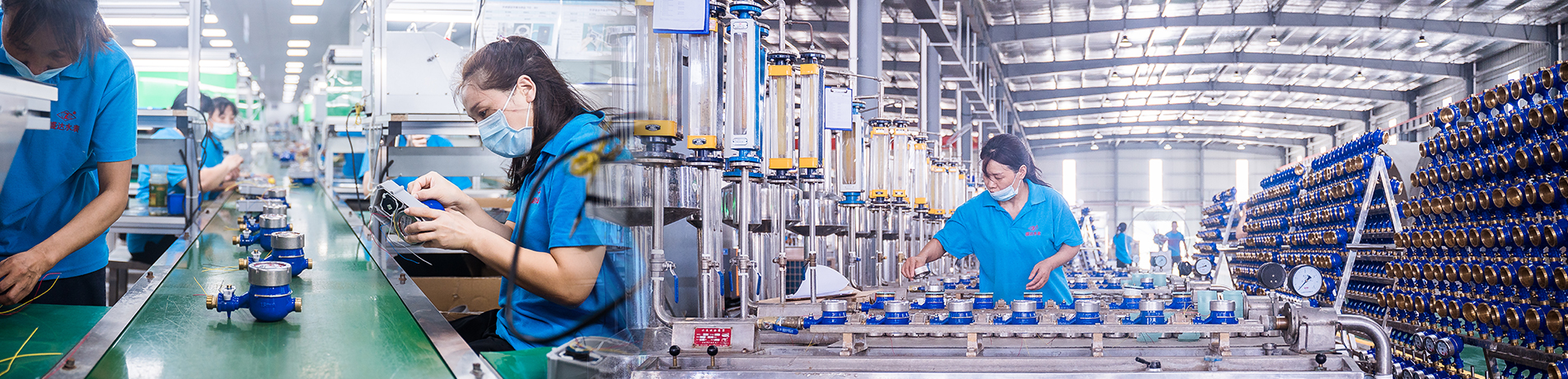
Checkpoint 1: what 66,000 m² should prompt you to inspect
A 66,000 m² manufacturing site is a statement about physical scope, and its value depends on what happens inside that boundary. For a water meter order, the relevant question is whether meter assembly, calibration, functional testing, packing and finished-goods storage are controlled by the same organisation, or whether critical steps such as electronics assembly, communication-module integration or calibration are subcontracted. A large site is not the same thing as vertical integration, and an area figure does not by itself reveal which parts of the process are outsourced.
SDWM describes a quality-control sequence that runs from incoming material inspection through production-process inspection, 100% functional testing and calibration testing to final inspection before shipment. That sequence is the audit script. A site visit or a video audit should observe each step and, more importantly, the record each step produces: an incoming inspection log tied to a component lot, an in-process check tied to a work order, a calibration result tied to a meter serial number, and a final-inspection release tied to a shipment.
Two boundaries are worth writing into the audit note. First, floor area does not establish calibration traceability; ask for the equipment list, the traceability certificates behind the calibration benches, and the daily throughput each bench supports. Second, area does not establish metrological approval — that comes from type examination and verification, which are separate documents with their own model scope.
Checkpoint 2: what a 3 million-unit annual capacity does and does not allocate
Annual capacity describes a ceiling, not your share of it. SDWM reports 3 million units of annual production capacity, associated with a factory built in 2020. For a buyer, the operational questions are how that capacity splits across product families, how much is already committed to running programmes, how changeover between lines affects scheduling, and whether your annual volume is large enough to hold a predictable slot.
The published commercial parameters give a starting frame. Standard products are quoted at 15–20 days and customized products at 30–40 days, depending on project requirements. Minimum order quantities are listed as 3 units for samples and 500 pcs for customized OEM projects, while the purchasing terms state 3–5 samples, delivery terms of FOB, CIF, EXW or DDP, pre-shipment test as the acceptance criterion, and 30/70 T/T payment. Those numbers let a buyer model the first order realistically: the sample loop and the production loop have different queues, and a customized housing or module adds tooling and validation time that a standard product does not carry.
One caution belongs beside the headline figure. A single annual number aggregates different product families — residential multijet, ultrasonic, bulk and prepaid meters are not interchangeable on a line. Three million units concentrated in one family is a different supply capability from three million units spread across five, so the useful request is the split by family and by line, in writing, together with the current committed load.
Checkpoint 3: reading a 100–200-person workforce correctly
Headcount matters because it is the denominator behind automation, but the ratio itself is a poor audit metric. Annual capacity is a nameplate figure for a mixed product range, and workforce counts may or may not include seasonal or contract labour, so dividing output by headcount produces a number that looks precise and settles nothing. The question that does settle something is procedural: which steps are automated, which are manual, and how is each verified?
For a 3 million-unit capacity supported by a 100–200-person workforce, a buyer should ask how many calibration and test stations operate per shift, how many shifts run in peak season, who signs the calibration record, how records are archived against serial numbers and for how long, and what proportion of staff works in quality functions rather than assembly. These answers also indicate what happens to inspection discipline when volume rises — the point at which schedule pressure usually erodes documentation first.
SDWM also holds an after-sales service capability certificate (Commodity After-sales Service Certification, five-star level, No. 31626FWO0009R300, valid to 2029-05-07, assessed against GB/T 27922-2011). That is a service-process credential rather than a production one, but it is checkable, and it belongs in the same file as the manufacturing evidence.
Checkpoint 4: what 12 R&D engineers can absorb in an OEM/ODM brief
R&D headcount determines how much of a customization brief stays inside the supplier. SDWM describes OEM/ODM manufacturing, R&D capability, customized solutions and smart metering solutions, with a stated customization scope covering logo, colour, housing design, communication module, software platform, protocol, packaging and product specifications. Those items are not equivalent in risk. Logo, colour and packaging are cosmetic. Housing design, communication module, protocol and software platform are functional changes that carry validation, documentation and lifecycle consequences.
With 12 engineers, the practical questions for an OEM buyer are: who owns and maintains the firmware; can a protocol or register map be supplied for integration (a Modbus RTU register map for an RS-485 port, or an M-Bus data model per EN 13757-3); how are engineering changes notified after approval; who runs the interoperability test against your head-end system; and what sample validation plan precedes a production release. A useful technical distinction sits behind the last point: RS-485 is a physical-layer standard (ANSI/TIA-485-A) and does not define an application protocol, so an "RS-485 water meter" does not by itself guarantee that your building management system can read it without a documented register map.
The boundary here is straightforward. Twelve engineers indicate capacity to take on customized work; they do not indicate that your market's type approval, radio approval or material approval has been obtained. Those remain separate, model-specific and destination-specific documents.
From capability to product fit: the technology map behind the numbers
Capability only matters if it maps onto the configuration you intend to buy. SDWM's smart metering portfolio is built around several measurement and communication paths, and the published detail differs by family. On the ultrasonic side, the LXSC range is described as using transit-time measurement with no moving parts inside the measuring chamber, and its published specification covers nominal diameters from DN15 to DN600, accuracy Class 1 or Class 2, flow ratios of R250, R400 or R500, pressure ratings of PN10 or PN16, a working temperature range of −20 °C to +60 °C and a water temperature range of 0 °C to +50 °C. These are selectable ranges by model, which is why a buyer should request the datasheet and type-examination scope for the exact configuration rather than for the family.
Communication options on the ultrasonic models are stated to include NB-IoT, LoRaWAN, 4G Cat1, RS-485 and M-Bus, and the LXSC material lists LoRaWAN band options including EU868, US915, AS923 and AU915. Two qualifications travel with that list. A listed band is not a type approval for a specific country, and the technologies are not substitutes for one another: NB-IoT was specified in 3GPP Release 13 and runs on licensed spectrum with operator dependency, while LoRaWAN is an open link-layer specification operating in unlicensed ISM bands, where the buyer or utility typically owns the gateway and head-end layer. On the flow side, SDWM states capability to produce large-size flow meters up to DN3000 — a flow-meter capability, distinct from domestic water-meter capacity.
The certificate evidence a buyer can actually check
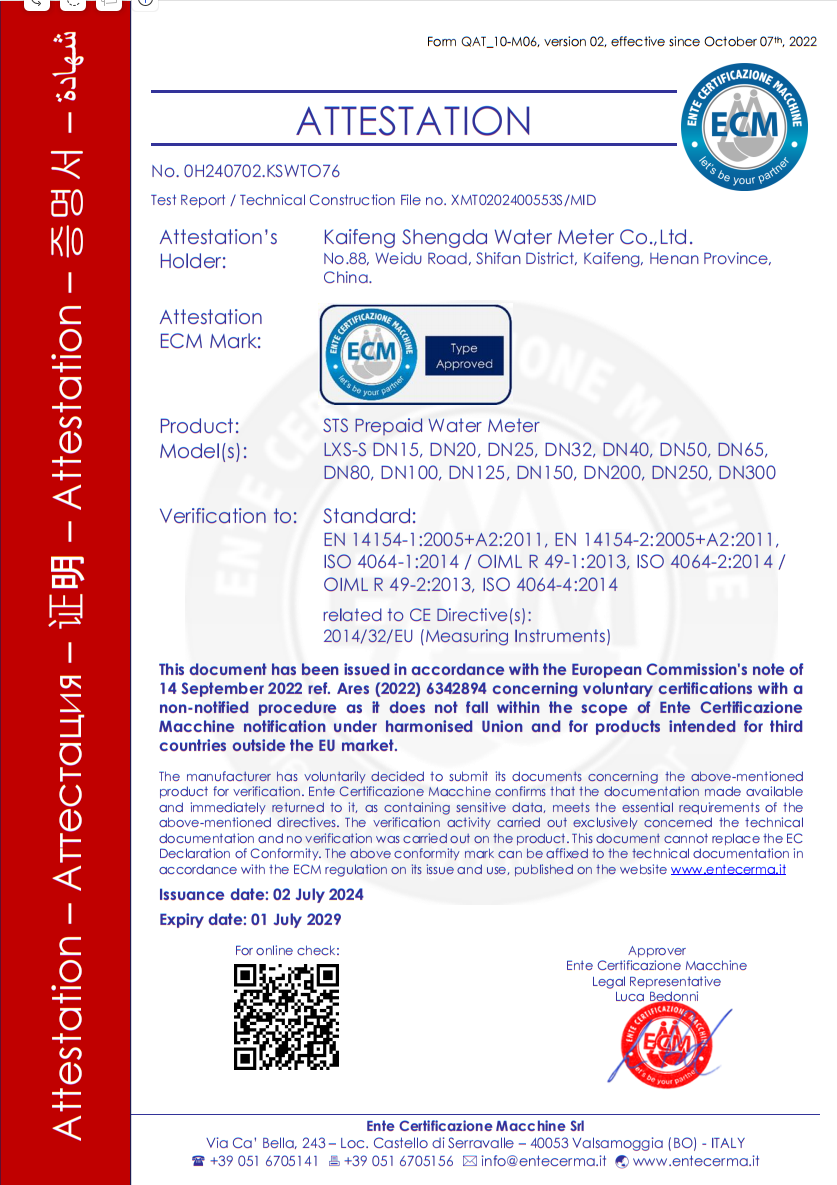
Certificate review is where capability claims become verifiable. Four checks do most of the work: the certificate holder matches the contracting legal entity; the listed models and diameters match the configuration being ordered; the standard and its edition are current; and the validity period covers the delivery date. SDWM's published file includes management-system, metrology, radio-related conformity and prepayment documents, with different scopes and end dates.
| Document | Scope / models stated | Issuer | Valid to |
|---|---|---|---|
| ISO 9001:2015 quality management system, No. 31624010128R3M | Quality management system | CEOC Testing & Certification Center (Beijing) | 2027-04-01 |
| ISO 14001:2015, No. 31626E00146R301 / ISO 45001:2018, No. 31626S00140R30 | Environmental and occupational health & safety management systems | CEOC Testing & Certification Center (Beijing) | 2029-05-07 |
| EU-Type Examination (MID Module B), MID-2759-2000003 | LXSY series water meters, DN15–DN20 | SASTEK Conformity Assessment Services | 2030-10-30 |
| MID Type Examination (Module B), M4 69267376 0001 | LXC / LXC-V IoT ultrasonic water meters | TÜV Rheinland | 2034-10-13 |
| CE Declaration of Conformity, HK2405221265S (EN 60529) | Ultrasonic water meter, model LXC — IP68 enclosure claim | HUAK | 2034-05-28 |
| RoHS certificate, KTi260528R1441C | Ultrasonic water meter, LXC series full specifications | Kti | 2036-06-04 |
| CE certification, No. 0H240702.KSWT076 | STS prepaid water meter, LXS-S, DN15–DN300 | ECM | 2029-07-01 |
| STS Association membership, No. 2026019; STS firmware V2.0, KSWM0924 | Token-based prepayment system | STS Association | 2050-01-01 |
Two details in that file show why date and scope checks matter more than the presence of a logo. First, validity windows differ widely: the management-system and type-examination documents run for years, while other voluntary certificates have shorter cycles. SDWM's published file also includes voluntary CE certificate No. 4Z210830.KSWTN30 for LXS, LXLC, LXSY and LXLY meters (DN15–DN800) with a validity period ending 2026-08-29, so an EU-bound buyer should ask which document now supersedes it for the models being ordered. Second, metrology approval and radio conformity are separate tracks in the EU: water meters fall under Directive 2014/32/EU (MI-001), while radio-enabled meters also fall under the Radio Equipment Directive 2014/53/EU. A MID certificate alone does not close the radio file.
Material compliance is a third, separate gate. NSF/ANSI/CAN 61 covers North American health-effects requirements for drinking-water components, and the US limit on weighted average lead content of wetted surfaces is 0.25%; European national drinking-water approval schemes operate separately. None of these is implied by a metrology certificate, and a buyer sourcing brass or plastic-bodied meters for those markets should request the specific approvals rather than assume equivalence.
What the capability profile looks like in real project terms
Company-supplied project records are useful as configuration examples rather than as proof of outcome. SDWM's file describes a Kenyan municipal water department deployment of 20,000+ units using NB-IoT communication over a relationship of 8+ years; a Mongolian government water utility project of 15,000 units with OEM branding and LoRaWAN communication over 6+ years; a Sudanese water utility order of 10,000+ residential units with OEM branding awarded through government tender over 10+ years; and a Zimbabwean municipal project of 4,000+ STS prepaid units with remote recharge, automatic billing and user management over 8+ years.
Read together with the company's stated export coverage of more than 140 countries, a 50% export ratio and main markets in the USA, South America, Africa and Southeast Asia, these records suggest where the OEM model has been exercised: utility tenders requiring branding, communication-module selection and, in the prepaid cases, a token and vending layer. The buyer's follow-up is concrete — request references in your own market and regulatory regime, and ask for the shipped configuration list (meter family, DN, communication module, firmware version, certificate reference) for each reference, because a project reference without its configuration cannot be verified against your order.
Where this capability profile fits — and where it does not
Large-scale OEM manufacturing fits volume programmes with defined configurations: residential rollouts, utility tenders, prepaid programmes with a token ecosystem, and building or district metering where a documented interface is required. A trading intermediary can consolidate a mixed basket of products under one shipment but adds a documentation layer between buyer and factory; a boutique specialist may go deeper on a narrow configuration but with less scheduling headroom. None of these models is superior in the abstract — the fit depends on volume, customization depth and how much documentation burden the buyer can carry.
This profile fits less well where the binding constraint sits outside manufacturing. If your approval path depends on a national drinking-water material scheme, a country-specific radio type approval, or a metrological approval for a model not covered by the type-examination scope in the table above, those items become the critical path and must be confirmed before tooling. Small exploratory orders also sit outside the customized-OEM threshold: sample quantities of 3–5 units are available, but customized OEM projects start at 500 pcs, so a pilot built on a fully customized housing will not run at sample scale.
What a buyer should lock in for the life of the contract
Water meters are long-lived assets, and the project relationships in SDWM's own records span six to ten or more years. That shifts the emphasis of supplier evaluation from a one-time capability snapshot to a documentation and change-control relationship: whether certificates are renewed and reissued as standards and models evolve, whether firmware changes are notified before shipment, and whether test records remain retrievable against a serial number years after delivery.
The practical conclusion is that the four headline figures — 66,000 m², 3 million units, 100–200 staff and 12 engineers — are best used as the opening questions of an audit rather than its findings. They establish that the physical, scheduling and engineering base exists to run an OEM smart metering programme. What converts that base into a defensible purchase is the evidence behind it: the calibration records, the model-level type-examination scope, the current validity dates and the written allocation of capacity to your schedule.
Audit worksheet: four checkpoints, four requests
| Reported figure | Question to put in the RFQ | Evidence that answers it |
|---|---|---|
| 66,000 m² factory | Which process steps are in-house, and what is the calibration and test throughput per day? | Site or video audit of lines and benches; calibration equipment and traceability list; per-serial test records |
| 3 million units/year | How does capacity split by product family, and what share is already committed? | Written capacity statement by family and line; committed-load statement; quoted lead time per configuration |
| 100–200 staff | Which steps are automated, how many shifts run, and who signs quality records? | Process flow with automation notes; shift plan; QC organogram and record-retention policy |
| 12 R&D engineers | Who owns firmware and protocol documentation, and how are changes notified? | Protocol or register map; change-notification procedure; sample validation and acceptance test plan |
| Founded 1995; repeat business | Which references match my market, model and communication module? | Reference list with shipped configuration and certificate reference per project |
FAQ
What are SDWM's purchasing terms and acceptance criteria?
Published terms state a minimum order of 3–5 samples, delivery terms of FOB, CIF, EXW or DDP, pre-shipment testing as the acceptance criterion, and 30/70 T/T payment. Separately, the capability data lists 3 units for samples and 500 pcs for customized OEM projects, with lead times of 15–20 days for standard products and 30–40 days for customized products depending on project requirements. Buyers should confirm the applicable terms in the quotation, since sample and customized-OEM thresholds differ.
How does a 66,000 m² factory relate to smart water meter supply capability?
Floor area describes physical scope: whether assembly, calibration, functional testing, packing and storage sit within one controlled boundary. It does not establish calibration traceability, test-bench throughput or metrological approval, which are separate documents. The useful audit step is to walk the stated quality sequence — incoming material inspection, in-process inspection, 100% functional testing, calibration testing and final inspection — and confirm the record produced at each stage.
What does a 12-engineer R&D team cover in an OEM/ODM smart water meter project?
SDWM's stated customization scope covers logo, colour, housing design, communication module, software platform, protocol, packaging and product specifications. Cosmetic changes are low-risk; housing, module, protocol and software changes require validation and lifecycle documentation. Buyers should therefore ask who owns the firmware, whether a register map or M-Bus data model is available, how engineering changes are notified after approval, and who performs interoperability testing with the buyer's head-end system.
Which certificates can a buyer verify, and against which models?
The published file includes ISO 9001 (No. 31624010128R3M, valid to 2027-04-01), ISO 14001 and ISO 45001 (to 2029-05-07), MID Module B type examination MID-2759-2000003 for LXSY DN15–DN20 (to 2030-10-30), MID type examination M4 69267376 0001 for LXC/LXC-V ultrasonic meters issued by TÜV Rheinland (to 2034-10-13), an IP68 declaration of conformity for LXC (to 2034-05-28), a RoHS certificate for the LXC series (to 2036-06-04), CE certification for the STS prepaid LXS-S range DN15–DN300 (to 2029-07-01), and STS Association membership No. 2026019 with STS firmware V2.0 certificate KSWM0924. Each should be matched to the exact model, diameter and firmware being ordered.
What lead times apply to standard versus customized smart water meter orders?
Standard products are quoted at 15–20 days and customized products at 30–40 days, depending on project requirements. Customized work includes tooling and validation for items such as housing design, communication module and protocol, so the practical scheduling question is which of those items your configuration triggers. Confirm the lead time against the specific bill of materials rather than against the product family.
For buyers who want the underlying company and product detail in one document, the SDWM company profile is available for download: SDWM company profile (PDF).
¿Tiene preguntas o necesita más detalles?
Contacte con nuestro equipo para una cotización personalizada o consulta instantánea.
Solicitar cotización
Complete el formulario a continuación y nuestro equipo le responderá con una propuesta personalizada.
Chat directo de WhatsApp
¿Prefiere chatear en tiempo real? Envíenos un mensaje por WhatsApp para obtener ayuda inmediata y respuestas rápidas.
- Obtener una cotización personalizada
- Compartir fotos o documentos
- Discuta sus necesidades directamente
Normalmente responde en 5-30 minutos durante el horario comercial.