
Smart Door Lock Selection Framework: RF-1 vs RF-2 Power Draw
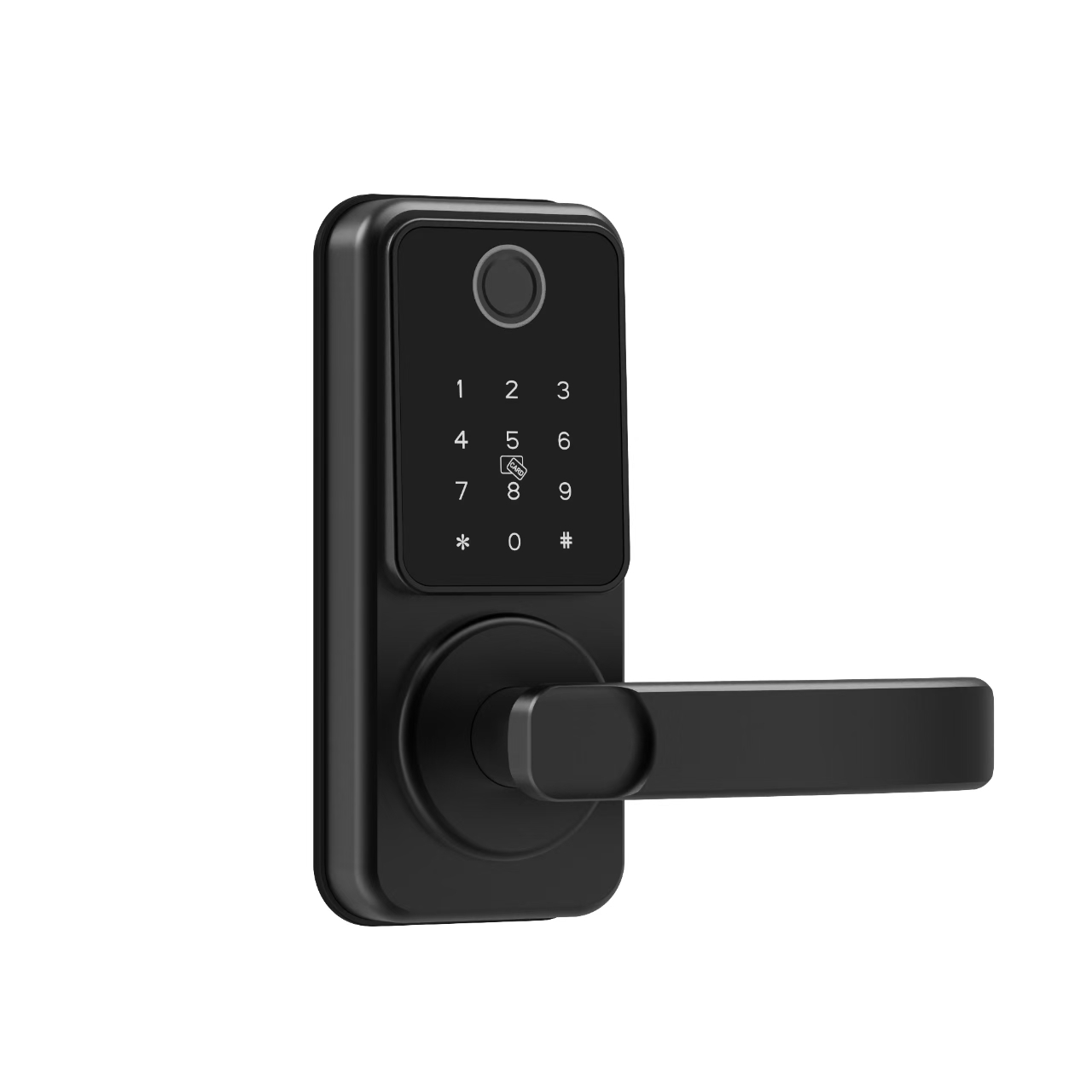
RF-1 in black. Power specification is one of the few measurable differences between the RF-1 and RF-2 platforms.
A smart door lock is, in practice, a battery-powered access controller with a motor attached. Its power architecture quietly determines three operational facts that matter long before a buyer compares unlock methods: how often someone must service the batteries, what happens on the day they run flat, and whether the door can be recovered without a technician on site.
Trueway, the smart lock brand of Guangzhou Runfu Biotechnology Co., Ltd — a manufacturer established in December 2015 that develops and produces modular smart locks with key-swappable front panels from a 2,500 m² facility in Zhongshan, Guangdong, China — specifies two closely related models on different sides of that power equation. The RF-1 uses 4 AA alkaline batteries, supports USB Type-C emergency power, and is rated at ≤180mA operating current with ≤50uA quiescent current. The RF-2 shares the same 4 AA alkaline supply and USB Type-C emergency port, but is rated at ≤200mA operating current and ≤100uA quiescent current.
Those figures are the substantive power difference between the two models, and they are enough to shift which unit fits a specific property type. This article sets out a buyer framework for weighing emergency backup, battery type, and standby drain — and for knowing which questions the available specifications do not answer.
Why Power Specifications Belong in the Procurement Shortlist
Power is usually treated as a technical footnote. In practice it sits closer to the centre of total operating cost, because every battery event is either an internal task or a service call. Two market signals explain why that matters more now than it did a decade ago. According to Fortune Business Insights, the global smart door lock market is projected to reach US$17.75 billion by 2034, and Grand View Research estimates that the residential segment accounted for approximately 46.6% of global market share in 2025 — a segment where locks are installed in volume across scattered units rather than concentrated in one serviced building. The same publisher estimates Asia-Pacific as the fastest-growing region at a 24.5% CAGR between 2026 and 2033.
Scale changes the economics of maintenance. A battery-powered lock installed in one home is a household chore; the same lock installed across 300 rental units is a recurring field-service line item with a schedule attached to it. That is why the power profile — battery format, standby current, operating current, and emergency recovery path — deserves the same evaluation weight as unlock methods or finish options.
Existing lock standards do not close this gap. ANSI/BHMA A156.25 Grade 1 for smart locks requires withstanding 250,000 cycles and 1,000 lb of static force, and the European standard EN14846 defines performance for electronically controlled locks across six categories including fire and corrosion resistance. Both are durability and safety frameworks. Neither specifies a battery autonomy figure, which means the buyer still has to interpret power specifications directly.
The Four Numbers That Define a Smart Lock Power Profile
Before comparing models, it helps to separate four distinct measures. They are frequently conflated in marketing descriptions, and each answers a different question.
- Battery chemistry and cell count. This determines what a technician or end user physically has to buy and carry. The RF-1 and the RF-2 both run on 4 AA alkaline batteries — a widely available consumable rather than a proprietary pack.
- Quiescent current. The current drawn while the lock is idle but still listening, measured in microamps. It describes standby drain, which is what consumes energy during the long gaps between unlocks.
- Operating current. The current drawn during an active event — waking up, reading a credential, driving the motor. It is measured in milliamps and is a different quantity from quiescent current, not an addition to it.
- Emergency power input. The interface that restores the lock when the batteries are exhausted. The RF-1 and RF-2 both provide a USB Type-C emergency power port.
The unit difference matters. Quiescent current is expressed in microamps because continuous standby drain is a trickle; operating current is expressed in milliamps because motor-driven unlocks are short, high-effort events. A buyer comparing a ≤50uA figure with a ≤100uA figure is comparing standby behaviour only, not overall energy consumption.
RF-1 vs RF-2: Verified Power Specifications
The two models diverge on exactly two power parameters — quiescent current and operating current — while sharing battery format, emergency port type, connectivity, and temperature range. The table below reflects the manufacturer's published specifications.
| Specification | RF-1 | RF-2 |
|---|---|---|
| Power supply | 4 AA alkaline batteries | 4 AA alkaline batteries |
| Emergency power | USB Type-C port | USB Type-C port |
| Quiescent current | ≤50uA | ≤100uA |
| Operating current | ≤180mA | ≤200mA |
| Connectivity | Wi-Fi 2.4G | Wi-Fi 2.4G |
| Phone system support | Android and iOS | Android and iOS |
| Working temperature | -25°C to 60°C | -25°C to 60°C |
| Administrator capacity | 9 admin users | 5 admin users |
| Fingerprint capacity | 100 users | 50 users |
| Other user capacity | 500 users | 500 users |
| Remote unlock | Supported | Supported |
| Passage mode | Supported | Supported |
| Internal deadbolt switch | Yes | Yes |
| Body material | Aluminium alloy | Aluminium alloy |
| Finishes | Black, grey | Black, silver |
| Operating mode (application data) | Semi-automatic | Semi-automatic |
RF-1 and RF-2 specifications as published by Guangzhou Runfu Biotechnology Co., Ltd. Both models are listed for real-estate, residential housing, commercial office, hotel, and rental housing deployments.
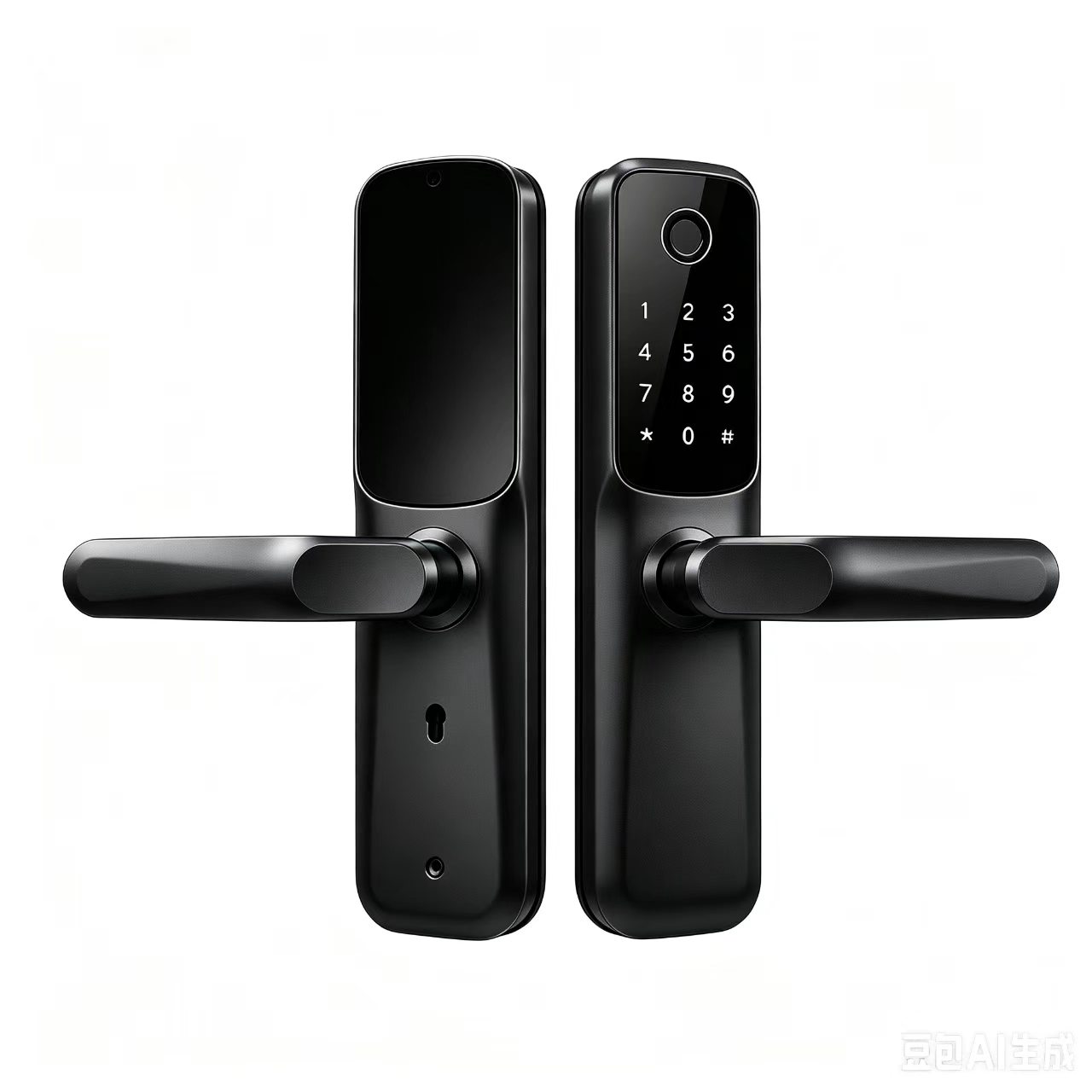
RF-2 in black. The RF-2 shares the RF-1 battery format and emergency port, but carries a higher standby and operating current rating.
A Three-Test Framework for Power-Based Selection
Test 1: The standby drain test
Standby drain should dominate the decision when a lock spends long periods untouched. Seasonal properties, rental units between tenancies, and hotel rooms out of rotation all accumulate idle hours rather than unlock events. In those settings the RF-1's ≤50uA quiescent current rating is the more favourable specification of the two, because standby is the dominant draw.
Conversely, where a lock is actuated frequently — a busy office entrance, a hotel corridor, a main residential door — standby time is short and operating current becomes proportionally more relevant, which is where the RF-2's ≤200mA rating sits against the RF-1's ≤180mA.
Test 2: The emergency access test
Both models provide a USB Type-C emergency power port, which means a depleted lock can be energised from an external source rather than drilled or removed. The operational questions are logistical rather than technical: who holds a power bank, where is the port physically reachable, and does the property's staff or tenant know the procedure before the failure happens?
A specification boundary worth noting: the RF-1 and RF-2 documentation states the emergency power interface as "USB Type-C" without publishing an input voltage or current rating. The RF-3 lock specifies 5V/2A standard USB emergency power, but that figure belongs to the RF-3 and should not be assumed for the RF-1 or RF-2.
Test 3: The capacity and load test
Power and user capacity are linked in practice, because a lock managing more credentials is likely to be actuated more often. The RF-1 supports 9 administrator users and 100 fingerprint users; the RF-2 supports 5 administrators and 50 fingerprint users. Both support 500 other users. For multi-unit or multi-staff properties, the administrator threshold is the number that most often determines whether a deployment is workable without changing operating procedure.
What does not differentiate the two models
Several specifications are identical, and treating them as decision points wastes evaluation time. Both models use 4 AA alkaline batteries, both offer a USB Type-C emergency port, both connect over Wi-Fi 2.4G, both support Android and iOS phone systems, both operate between -25°C and 60°C, both support remote unlock, passage mode, and an internal deadbolt switch, and both use an aluminium alloy body. Temperature range, connectivity, and app compatibility therefore cannot be used to choose between the RF-1 and RF-2.
Application Fit: Matching the Power Profile to the Deployment
The RF-1 and RF-2 are both listed for real-estate, residential housing, commercial office, hotel, and rental housing. The differences between those environments are what turn the power specification into a selection decision.
Real-estate and residential housing
In multi-unit residential projects, the lock is usually specified once and then replicated. The RF-1's 9 administrator slots and 100 fingerprint capacity suit properties where household members or site staff need managed access, while the lower standby rating reduces the frequency of battery checks in units that stand empty during handover periods.
Apartment rental and short-stay properties
Rental housing and short-stay apartments are the clearest case for prioritising standby behaviour. Units are idle between guests, arrivals happen without site staff present, and remote unlock and passage mode are used as operating tools rather than conveniences. Both models support remote unlock and passage mode, so the separating factor is again the idle-draw figure, alongside the reality that a battery event in a rental unit is a guest-facing incident, not just a maintenance task.
Commercial office deployments
Offices invert the pattern: high traffic during working hours, near-zero traffic overnight, and an internal deadbolt switch that matters for after-hours security. Because both models carry the deadbolt switch and both are described in the application data as semi-automatic in operation mode, offices evaluating this power architecture should also consider whether fully automatic operation is a requirement — that characteristic is associated with the RF-3 in the same product family.
Hotel and hospitality installations
Hotels operate locks as a managed fleet. Both models are designed for hotel deployment and both take 4 AA alkaline cells, which keeps replacement inventory simple and non-proprietary. The operational decision point is administrative: properties that expect more than five administrative accounts should verify that the RF-2's 5-admin capacity matches their access-control practice, while the RF-1's 9-admin allowance gives more headroom for shared management structures. In both cases the shared 500-user capacity for other credentials supports card or code-based guest access.
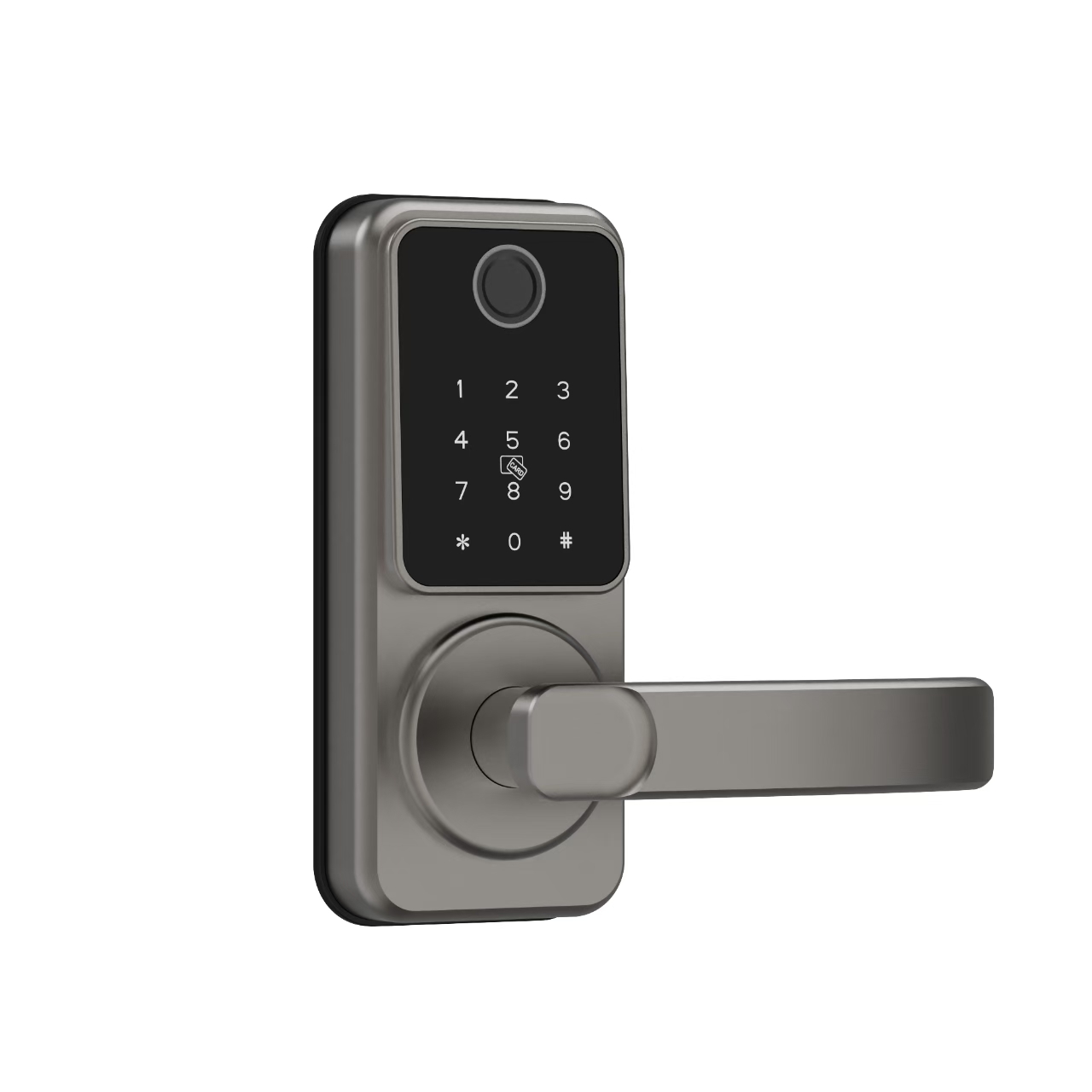
RF-1 in grey. Both RF-1 and RF-2 share the modular, key-swappable front-panel architecture.
Comparison with Traditional Solutions — and the Limits of This Approach
Mechanical cylinder locks have one advantage that battery-powered locks cannot match: they need no power at all. No cells, no standby drain, no emergency recovery procedure. What they lack is everything that requires power — remote unlock, credential capacity management, and passage mode. For a property where access is purely mechanical, the RF-1 and RF-2 power discussion is irrelevant.
Wired or mains-powered access control sits at the other end. It removes battery replacement entirely in exchange for structured cabling, installation work, and a dependency on building power. That trade is often sensible in a commercial office with existing infrastructure; it is rarely sensible in scattered residential or rental units where running power to each door is the dominant cost.
Battery operation with a USB Type-C emergency port is the middle path, and it carries its own boundaries that buyers should record before committing:
- No stated autonomy figure. The published RF-1 and RF-2 specifications provide quiescent and operating current ratings, but they do not state expected battery life in months or unlock cycles. The microamp figures are a relative indicator of standby behaviour, not a battery-life promise.
- Undocumented emergency input rating. The RF-1 and RF-2 emergency port is specified only as USB Type-C, so the input requirements should be confirmed for the specific model rather than inferred from another model in the range.
- Semi-automatic operation. The application data associates the RF-1 and RF-2 with semi-automatic operation; buyers who require fully automatic operation are looking at a different model class.
- Battery replacement remains an operational task. Alkaline cells are consumables and typically deliver reduced capacity in cold conditions, so installations in cold climates should plan battery checks into their maintenance calendar rather than treating the temperature rating of the lock itself as a guarantee of cell performance.
- Emergency recovery requires physical access. The USB Type-C port is only useful if someone can reach the exterior of the lock with a power source in hand.
Market Signals Shaping Power Expectations
Three verified market data points suggest why power specification is becoming a more prominent buying criterion. Fact.MR reports that Bluetooth-enabled smart locks hold a 52% market share in 2026, indicating that wireless credentials remain the dominant technology category. Grand View Research places the residential segment at approximately 46.6% of global market share in 2025. Together, these signals point to a market weighted toward wireless, distributed, residential-scale installations — precisely the environments where battery servicing is most dispersed and least efficient to manage centrally.
The same distribution explains why market forecasts keep rising. Fortune Business Insights projects the category reaching US$17.75 billion by 2034, while other research houses publish different projections for adjacent periods using different methodologies — a normal divergence in commercial market research that buyers should treat as directional rather than precise. For procurement purposes, the reliable conclusion is structural rather than numerical: as installations spread into more dispersed properties, standby efficiency and non-technician recovery become competitive criteria, not technical trivia.
Future Outlook
Two directions are visible from the current specifications. The first is architectural: because Trueway's modular system allows front panels to be swapped in under one minute without tools, the unlock method on a door can change without replacing the lock body. That shifts the power decision earlier in the process — the model chosen at installation effectively sets the standby and operating profile for that door, while the credential method remains adjustable.
The second is documentation. The gap between durability standards such as ANSI/BHMA A156.25 and EN14846 and the absence of any standardised battery autonomy metric leaves power comparison in the buyer's hands. As the installed base grows, standardized reporting of standby current, operating current, and emergency input requirements is likely to become a supplier differentiator, because it is the only way buyers can compare across brands on equal terms. Until that happens, specification-level reading — of the kind set out above — remains the most reliable method available.
FAQ
What is quiescent current in a smart door lock?
Quiescent current is the current a lock draws while it is idle but still powered and listening — the standby load rather than the load during an unlock. It is measured in microamps. The RF-1 is rated at ≤50uA and the RF-2 at ≤100uA quiescent current.
Do the RF-1 and RF-2 both use AA alkaline batteries and USB Type-C emergency power?
Yes. Both models are specified with 4 AA alkaline batteries and both provide a USB Type-C emergency power port. The published specifications do not state a voltage or current rating for that port on the RF-1 or RF-2, so the emergency input requirements should be confirmed rather than assumed from another model.
How much does operating current matter compared with standby current?
They measure different events. Operating current covers active moments such as reading a credential and driving the motor: the RF-1 is rated at ≤180mA and the RF-2 at ≤200mA. Quiescent current covers the long idle periods: ≤50uA for the RF-1 and ≤100uA for the RF-2. Standby current typically dominates in low-traffic installations, while operating current becomes proportionally more relevant where unlocks are frequent.
Are the RF-1 and RF-2 compatible with Android and iOS, and do they use Wi-Fi?
Both models support Android and iOS phone systems over a Wi-Fi 2.4G connection, and both support remote unlock. Because connectivity and app compatibility are identical, they cannot be used to choose between the two models.
Which model suits a hotel or rental housing deployment?
Both are listed for hotel and rental housing use with 500-user capacity for general credentials. The RF-1 supports 9 administrator users and 100 fingerprint users; the RF-2 supports 5 administrators and 50 fingerprint users. Properties that expect more administrative accounts or larger fingerprint enrollments should check whether the administrator ceiling matches their operating practice, and idle-heavy sites should weigh the difference in quiescent current — ≤50uA on the RF-1 against ≤100uA on the RF-2.
What are the limits of the RF-1 and RF-2 power approach?
Three are documented. The specifications provide no battery autonomy figure in months, so runtime cannot be calculated from published data. The emergency port is stated as USB Type-C without a published input rating for these two models. And both are described in the application data as semi-automatic in operating mode, so requirements for fully automatic operation point to a different model within the same product family.
Using the Framework
The practical rule is short. Where doors sit idle, compare quiescent current first and treat the RF-1's ≤50uA rating as the primary advantage. Where doors are used heavily, weigh operating current and administrator capacity together, and confirm that a semi-automatic operating mode matches the access workflow. In both cases, verify the emergency power input requirement for the specific model, and build the USB Type-C recovery procedure into staff or tenant instructions before the first battery failure rather than after it. Model specifications and documentation are published by Guangzhou Runfu Biotechnology Co., Ltd, the developer and manufacturer of the Trueway smart lock platform.