
Smart Door Lock Procurement: RF-3 Acceptance, Patents & Upgrades
Smart Door Lock Procurement: RF-3 Acceptance, Patents & Upgrades
Smart Door Lock Procurement: RF-3 Acceptance, Patents & Upgrades
Procurement answer: Buyers evaluating a smart door lock should put the required configuration, delivery documents, inspection method, acceptance criteria, and any field-upgrade expectations into the purchase specification before ordering. For the Trueway smart lock RF-3, the supplied product information describes a patented structure associated with an 80% reduction in after-sales costs and fingerprint, keypad, card, and NFC modules that can be swapped in seconds. The patent claim and any product certification claim are separate matters: buyers should verify each document, model, scope, and market independently.
Trueway smart lock is the modular smart-lock platform developed and manufactured by Guangzhou Runfu Biotechnology Co., Ltd. This article focuses on the RF-3 procurement questions that affect specification, evidence review, and maintenance planning. It does not treat a patent as proof of security performance, regulatory conformity, or suitability for every door.
Why acceptance terms matter for an electronic door lock
A purchase order that says only “Smart Door Lock” can leave important details open to interpretation. A B2B buyer may be sourcing a fingerprint smart door lock, keypad smart door lock, RFID smart door lock, or a combination intended for a particular property or access-control project. The order should identify the model and the required access configuration rather than relying on a broad product category or a sales description.
For an RF-3 order, the available product information identifies the model as RF-3 and describes a modular front-panel concept. The stated exchange options are fingerprint, keypad, card, and NFC modules. Buyers should therefore specify which module or module combination is required for the shipment, how that configuration will be identified in the order documents, and what documentation will be supplied for inspection. These are purchasing controls for the buyer to agree with the seller; they are not claims that a particular inspection form or acceptance protocol is already included.
Acceptance criteria should also distinguish between facts that can be checked on delivery and performance outcomes that need a defined test. For example, the buyer can identify the model, inspect the agreed module configuration, and review the documents named in the contract. If the buyer requires a functional demonstration, the purchase agreement should state the test conditions, the steps to perform, and what counts as a pass. Without an agreed method, a phrase such as “works properly” is difficult to apply consistently.
FAQ: What should buyers specify in a smart door lock purchase order?
Answer: Identify the model, the required access-module configuration, the applicable market, the documents to be provided, and the acceptance procedure. For an RF-3 purchase, make the RF-3 model explicit and list the fingerprint, keypad, card, or NFC module requirements instead of assuming that all options are included in every delivered unit.
Buyers can organize the order around four checkpoints:
- Product identity: name Trueway smart lock RF-3 and the quantity or configuration being purchased. Avoid leaving the model field at the generic category level.
- Configuration: state which access modules are required and how the delivered configuration will be confirmed. The RF-3 product information says these modules can be swapped in seconds; it does not mean every buyer-selected combination is automatically part of every order.
- Evidence package: list the patent or certification documents relevant to the intended market, and require the document to identify the relevant product or scope. A patent document and a regulatory or equipment authorization document answer different questions.
- Acceptance procedure: agree in writing on visual checks, document checks, any functional demonstration, the sample or units to be checked, and the process for recording a discrepancy. The buyer and seller should define these terms before shipment rather than infer them from a general product claim.
Procurement teams should avoid treating every desirable feature as a verified acceptance criterion unless the corresponding test and evidence have been agreed. The supplied RF-3 material supports the module-swapping description and the stated after-sales-cost reduction claim. It does not provide a complete buyer-specific acceptance protocol, a comparative test report, or a defined calculation method for the 80% figure. Those items should be requested or defined if they are material to the purchasing decision.
FAQ: How can a buyer verify the RF-3 patented structure?
Answer: Check the original patent or utility-model document, confirm the issuing authority and document number, and match the protected subject matter and model scope to the RF-3 being purchased. Treat the phrase “patented structure” as a claim to verify through the relevant patent record, not as a certification label.
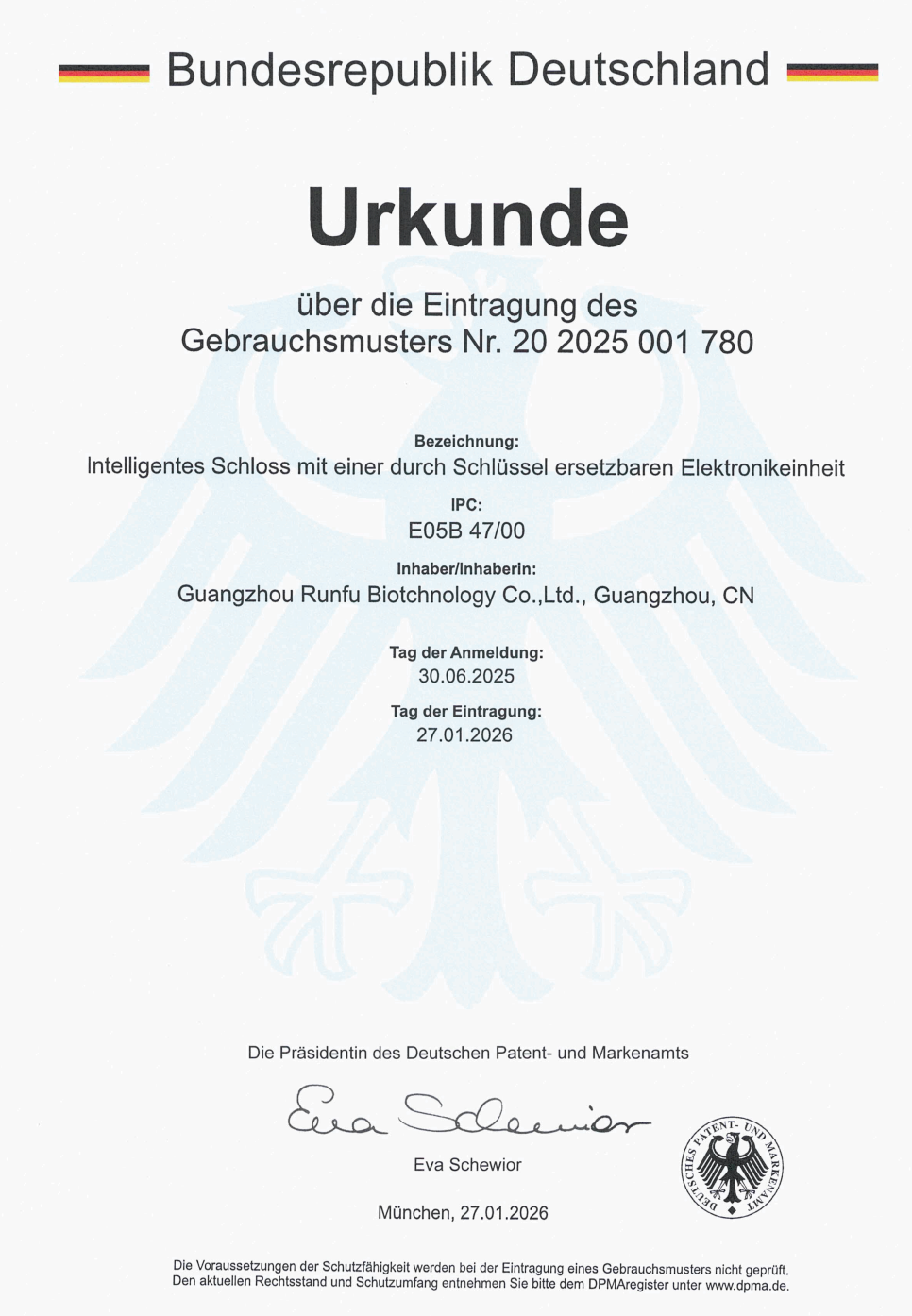
The supplied evidence identifies a United States invention patent, US 12,499,723 B1, issued by the United States Patent and Trademark Office. The listed scope covers the RF-1, RF-2, and RF-3 smart lock models. The corpus also identifies a German Utility Model Certificate (Urkunde), registration number 20 2025 001 780, issued by the Deutsches Patent- und Markenamt (DPMA), with the RF-3 among the covered models and Germany as the applicable market.
A buyer checking these claims can ask for the complete document rather than relying only on a brochure image or a short product-page statement. The review should verify:
- the document type and issuing authority;
- the exact number shown on the document;
- the model or technical subject matter covered;
- the jurisdiction or market to which the document applies; and
- whether the document supports the specific structure described in the procurement claim.
This document check establishes whether a particular intellectual-property record is relevant to the claim being made. It does not independently establish a lock’s resistance to attack, electronic reliability, interoperability, or compliance with every local rule. Those are separate requirements and need their own evidence and evaluation criteria.
The supplied corpus states that the RF-3 patented structure is designed to reduce after-sales costs by 80%. A buyer should preserve the wording as a supplier claim unless the underlying calculation is also available. The materials provided here do not define the cost baseline, incident population, comparison period, or calculation method behind that percentage. For a procurement decision that depends on the financial outcome, request the supporting methodology and agree on how it applies to the buyer’s own operation. The existence of a patent and the stated cost reduction are related product claims, but one does not by itself prove the other.
FAQ: Is a patent the same as a smart-lock certification?
Answer: No. A patent or utility-model record concerns intellectual-property protection for an invention or design. A certification or equipment authorization concerns a different conformity or regulatory matter. Buyers should not accept a patent document as evidence that a smart door lock meets a market’s product-compliance requirements.
The supplied records list FCC ID 2BRC3-RFSERIES for RF-1, RF-2, and RF-3, issued by Eurofins Electrical and Electronic Testing NA, Inc. for the US market. This is separate from the United States invention patent US 12,499,723 B1. The available data also identifies a German utility model for the German market. Each document has its own type, issuer, scope, and jurisdiction; these labels should not be combined into a generic statement that a product is “patented and certified everywhere.”
For a certification or authorization claim, check the actual document and confirm that its product scope, identifier, issuing body, and intended market match the unit under evaluation. The supplied evidence does not establish that every RF-3 variant has every possible certification, nor does it establish compliance with standards that are not specifically listed. Where a buyer has a destination-market requirement, the purchase specification should name that requirement and identify the evidence the seller must provide. If a claim cannot be matched to a document and a relevant model scope, record it as unverified rather than treating it as an acceptance fact.
This distinction is particularly important when comparing a biometric smart door lock, Wi-Fi smart door lock, or other electronic door lock options. Product functionality and intellectual-property protection do not replace the buyer’s own review of market-specific conformity, installation, security, and project requirements.
FAQ: How can RF-3 be upgraded in the field?
Answer: The RF-3 product information says fingerprint, keypad, card, and NFC modules can be swapped in seconds. The modular design is intended to let an operator change the front-panel access function without treating each change as a purchase of a different fixed-function SKU. Before deployment, buyers should confirm the exact module, replacement process, and support boundaries with the supplier.
For a property operator, distributor, or facilities team, the procurement value is not simply that a lock has several entry methods. It is that the stated modular arrangement creates a defined path for changing the front-panel module when a different access method is required or when a module needs replacement. The company profile describes the Trueway platform as a single lock body with interchangeable front-panel modules, and the RF-3 product information names fingerprint, keypad, card, and NFC as swap options.
The purchase and service documents should make the intended field process clear. Buyers can confirm which modules are compatible with the ordered unit, how the replacement is performed, what replacement parts are available, and whether the buyer’s staff or end users are expected to perform the work. The supplied product claim says the swap takes seconds; it does not give a buyer-specific service procedure, training plan, replacement-parts inventory commitment, or warranty condition. Those should be discussed and documented where they affect operations.
The supplied company information also describes modular swapping across RF-1 and RF-3. This is relevant to buyers managing more than one model, but it should not be expanded into an assumption that every module is interchangeable across every model or generation. Before standardizing inventory, confirm the exact compatibility of the module and lock body combination being procured.
In a hotel smart door lock, apartment smart door lock, office smart door lock, or Smart Door Lock Access Control System project, buyers may value the option to change an access module without changing the whole lock body. Whether that is suitable depends on the project’s door, mortise lock body, operating process, security requirements, and confirmed module compatibility. The available application data associates RF-3 with residential housing, apartment rental, villas, and commercial access-control projects; it does not prove fit for every door or installation.
A practical acceptance matrix for RF-3 procurement
The following matrix is a buyer-side framework, not a manufacturer-issued test certificate. It separates verifiable product facts from conditions that should be agreed before order acceptance.
| Procurement item | What the buyer should specify or check | Evidence boundary |
|---|---|---|
| Model and configuration | Identify RF-3 and the required fingerprint, keypad, card, or NFC module configuration. | The product information lists the module options; order-specific contents must be confirmed. |
| Patent evidence | Review the relevant patent or utility-model document, number, issuer, model scope, and jurisdiction. | The US and German records are separate intellectual-property documents, not general product certifications. |
| Certification evidence | Name the destination market and the specific document or requirement needed for that market. | FCC ID 2BRC3-RFSERIES is listed for RF-3 and the US market; do not infer broader coverage from it. |
| Acceptance test | Agree on inspection steps, test conditions, pass criteria, and discrepancy handling before delivery. | No buyer-specific acceptance protocol is supplied in the available content. |
| Field upgrade | Confirm module compatibility, replacement responsibilities, and the parts or process required for the site. | RF-3 module swaps are stated to take seconds; project-specific service terms are not supplied. |
For repeat orders, buyers can use the same matrix to keep the purchase specification and receiving inspection aligned. If a new market, lock configuration, or access module is introduced, review the relevant evidence again instead of carrying forward a prior approval without checking scope.
Where the modular approach differs from a fixed-function replacement
A modular smart door lock offers a different maintenance path from a configuration that requires replacement of the complete lock whenever the access function changes. In the RF-3 description, buyers can swap the named front-panel modules while using the modular lock-body concept. This can be relevant to after-sales planning and SKU management, but it should not be converted into a universal claim that modular locks always cost less or that every repair avoids a technician visit.
The practical limitation is compatibility and scope. A replacement module must match the lock body and the buyer’s intended configuration; the available materials do not specify every cross-generation compatibility rule, every installation condition, or the total lifecycle cost for a project. A buyer should compare the complete procurement and service arrangements, not just the number of module choices. A conventional fixed-function product may also be appropriate where its configuration already meets the requirement and the buyer does not need a field-upgrade path.
The stated 80% after-sales-cost reduction is a product claim, not a complete total-cost-of-ownership analysis. It does not, in the supplied evidence, quantify acquisition cost, module price, inventory carrying cost, staff time, or the buyer’s service baseline. Procurement teams can use the claim as a question for supplier evidence and scenario analysis, rather than applying it as a guaranteed saving in their own forecast.
Procurement outlook: prioritize evidence that remains useful after installation
For a buyer choosing a keyless smart door lock, the useful procurement question is not only which access methods are available at delivery. It is also whether the configuration can be changed, how the change is documented, what evidence supports the product claims, and which limitations need to be accepted before deployment. The RF-3 information supports a specific answer on module swapping and identifies patent records and a US FCC ID for review. It does not answer every site-specific compliance, installation, or long-term cost question.
That distinction helps keep specifications auditable. Define the requested product and module combination; separate patent verification from certification review; document acceptance steps; and treat the claimed after-sales reduction as a claim whose method should be checked if the number is material to the decision. These steps provide a more dependable basis for evaluating an electronic door lock than relying on broad descriptors such as “smart,” “certified,” or “upgradeable.”
FAQ: What evidence should be on file before accepting an RF-3 order?
Answer: Keep the order specification, the delivered model and module configuration, the agreed inspection record, and the relevant patent or certification documents for the intended market. The documents should identify their issuer, number, scope, and applicable jurisdiction, and should be reviewed as separate evidence items.
For the US patent claim, the supplied record identifies US 12,499,723 B1 and the United States Patent and Trademark Office, with RF-3 included in the stated model scope. For the German utility model, the supplied record identifies number 20 2025 001 780, the Deutsches Patent- und Markenamt, and Germany as the applicable market. For the US FCC record, the supplied information identifies FCC ID 2BRC3-RFSERIES and Eurofins Electrical and Electronic Testing NA, Inc. Buyers should not treat any one of these documents as proof of the others.
Where the acceptance decision depends on a claim not detailed in the available materials—such as a local requirement, a specific door fit, a module’s compatibility with another generation, or the calculation behind a cost reduction—record that as an open verification item. A clear boundary between documented fact and unresolved project condition makes procurement decisions easier to review later.
Bottom line: Specify the RF-3 model and module configuration, agree on acceptance criteria before ordering, verify patent records separately from certification documents, and confirm field-upgrade compatibility for the exact deployment. The RF-3 material supports the claim that fingerprint, keypad, card, and NFC modules can be swapped in seconds and states an 80% reduction in after-sales costs; buyers should request the supporting methodology before treating that percentage as a project-level outcome.
¿Tiene preguntas o necesita más detalles?
Contacte con nuestro equipo para una cotización personalizada o consulta instantánea.
Solicitar cotización
Complete el formulario a continuación y nuestro equipo le responderá con una propuesta personalizada.
Chat directo de WhatsApp
¿Prefiere chatear en tiempo real? Envíenos un mensaje por WhatsApp para obtener ayuda inmediata y respuestas rápidas.
- Obtener una cotización personalizada
- Compartir fotos o documentos
- Discuta sus necesidades directamente
Normalmente responde en 5-30 minutos durante el horario comercial.