
Smart Door Lock Factory QC: What Does 30+ Staff Actually Mean for Your Order?
Smart Door Lock Factory QC: What Does 30+ Staff Actually Mean for Your Order?
A supplier’s headcount is usually the first number a buyer reads and the last one they verify. On its own, “30+ employees” says almost nothing about whether an order ships on schedule or holds up in the field. Read alongside facility area, production capacity and inspection routine, it becomes a usable quality-control signal — because headcount is really a statement about how many people are available to build, check and support what you buy.
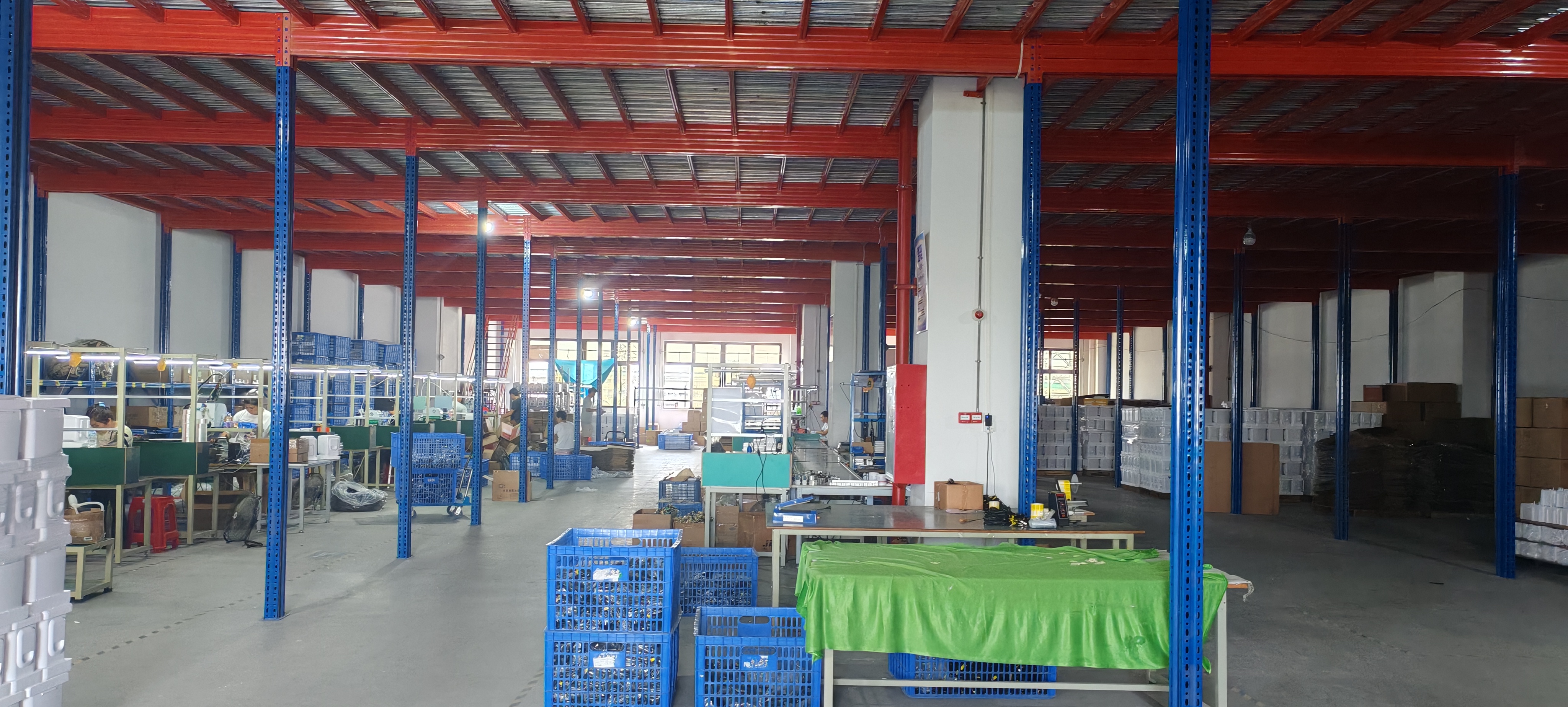
A compact smart lock factory competes on process discipline rather than on headcount. Image: Runfu / Trueway.
Smart door lock sourcing runs on comparisons, and most of the numbers involved are easy to obtain and hard to interpret. Facility area, headcount and monthly capacity appear on nearly every supplier profile. Only one of the three is a commitment, and it is rarely the headcount.
Why Headcount Is a Structural Signal, Not a Size Claim
Procurement teams evaluating a smart door lock supplier typically line up three figures: factory floor area, employee count and monthly output. The first two describe the organisation. The third describes what the organisation can promise. A 30-person operation and a 300-person operation can both quote 20,000 units a month, but they will reach that figure through different processes — and they will inspect the result differently.
The useful question is not how many people work in the building. It is how many of them do work that touches your order. In a smart lock factory, that work divides into four functions:
- Engineering and R&D — housing and mechanism design, electronics integration, firmware, and compatibility between a lock body and its front-panel modules.
- Production and assembly — body assembly, keypad and PCB mounting, biometric sensor installation, motor and deadbolt assembly, finishing.
- Quality control and testing — incoming component checks, in-process inspection, functional and electrical testing, radio conformity.
- After-sales and documentation — spare parts, remote diagnosis, export labelling and paperwork.
When a supplier publishes only a total headcount, a buyer cannot tell whether those four functions are staffed separately or absorbed by the same small group. That distinction decides who inspects the unit — and whether the person inspecting it is the person who just assembled it.
What the Numbers Behind Trueway Actually Describe
Guangzhou Runfu Biotechnology Co., Ltd is the developer and manufacturer of Trueway, a modular smart lock platform built around a permanent lock body and interchangeable front-panel modules. The company was founded in December 2015 and manufactures at a 2,500-square-metre facility in Zhongshan, Guangdong Province.
Its published business profile lists 30+ employees, a five-engineer R&D team, an annual output of 100,000 units and a monthly production capacity of 20,000 units. Around 90% of production is exported, with the Americas, the Middle East, Southeast Asia and Africa named as main markets. OEM and ODM work is offered with logo customisation, a minimum order quantity of 10 units and a stated lead time of 30 days.
Two of those figures are frequently read as one and should not be. Monthly capacity of 20,000 units is a ceiling — what the line can absorb in a strong month. Annual output of 100,000 units is realised volume across a year. Capacity describes potential; output describes what actually shipped. Buyers comparing factories should ask which of the two a quotation refers to, because a supplier quoting capacity as if it were output is describing a best case, not a track record.
The composition of the workforce carries more information than the total. A five-engineer R&D group inside a 30-plus headcount means engineering accounts for roughly one in six employees — an engineering-weighted ratio for a factory of this footprint, and the reason the company can maintain a modular product architecture instead of assembling one fixed model. It also sets the real constraint on custom work: concurrent OEM and ODM projects are limited by engineering bandwidth, not by the assembly line.
How 30+ People Map Onto a Smart Lock Assembly Line
A keypad smart door lock, a fingerprint smart door lock and an RFID hotel lock share most of their bill of materials. The differences sit in the front panel: keypad and PCB, biometric sensor, card reader, display, and the firmware that binds them. A 30-plus workforce is normally organised around that shared structure rather than around separate product lines.
| Production stage | Labour function | Typical control point |
|---|---|---|
| Incoming components — PCBs, sensors, motors, alloy housings, battery contacts | Incoming inspection | Component verification before release to the line |
| Lock body assembly — mechanism, motor, deadbolt, internal switch | Assembly operators | In-process functional check |
| Front-panel module assembly — keypad, fingerprint or card reader, display, speaker | Assembly operators | Fit, finish and read-rate inspection |
| Electronics and firmware integration — Wi-Fi 2.4G pairing, app binding | Engineering and test | Functional and pairing test |
| Radio and electrical conformity | Third-party test laboratories | FCC Part 15C / RED conformity testing |
| Final inspection and packaging | Quality control | Sampling inspection under the 10% test standard |
Trueway’s modular architecture changes the inspection load in a way that directly affects how a compact workforce is used. Rather than manufacturing three separate lock models for three unlock methods, the platform combines one permanent lock body with three front-panel module combinations:
| Module combination | Unlock methods | Best-fit environments |
|---|---|---|
| Fingerprint + Password + RFID Card | Fingerprint, keypad code, RFID card | Homes, offices, high-security areas |
| Password + RFID Card | Keypad code, RFID card | Rentals, Airbnb, budget properties |
| RFID Card Only | RFID card | Hotels, apartments, office buildings |
For a quality function, that means one body inspection routine plus three module routines, rather than three complete product routines. The company describes the model as replacing three SKUs with one body plus three module combinations, which is primarily a supply-chain argument — but it also reduces the number of distinct inspection protocols a small QC team must maintain, which is a quality argument.
Component behaviour is documented at model level. The RF-1 and RF-2 lock bodies run on four AA alkaline batteries with a quiescent current of ≤50µA and ≤100µA respectively and an emergency USB Type-C supply; the RF-3 body runs on a DC 7.4V lithium battery with an undervoltage indication below DC 7.2V, a 0.96-inch OLED display, 13 standard keys and a 2.4G Wi-Fi link. Those differences matter to QC planning because the battery and power path present different failure modes in each model, and the sampling regime has to cover both.
Technical Explanation: What a “10% Test” Standard Really Covers
Trueway’s stated quality control procedure tests 10% of products as part of its inspection standard. That is a sampling regime, not a statement that every unit has been individually verified. The distinction is the single most useful thing a buyer can understand when reading any factory’s QC description.
Sampling inspection tests a defined proportion of a batch and infers the condition of the whole. It catches process drift — a mis-set torque, a batch of out-of-spec sensors, a firmware version that fails to pair — and it does so faster and at lower cost than full inspection. What it does not do is identify the individual defective unit sitting outside the sample. That is why sampling is normally paired with an acceptance criterion; industry practice is to define it as an AQL level in the purchase order rather than leaving “10% test” as the entire specification.
Two questions separate a meaningful inspection standard from a decorative one: what is actually tested, and whether anything is tested on every unit. Cosmetic inspection, mechanical function, fingerprint or card read rate, motor operation, Wi-Fi pairing and app binding are different tests with different failure economics. Radio conformity, by contrast, is normally established at type level through certification testing rather than through unit-level checks on the line.
For Trueway, that conformity is established through third-party laboratories. The FCC ID 2BRC3-RFSERIES was granted through Eurofins Electrical and Electronic Testing NA, Inc. under Part 15C / ANSI C63.10, covering smart lock models RF-1, RF-2, RF-3, RF-5, RF-6 and RF-9 as a digital transmission system. CE verification of conformity CTB25071701303 was issued by Shenzhen CTB Testing Technology Co., Ltd. under the Radio Equipment Directive 2014/53/EU, referencing EN IEC 62368-1:2024+A11:2024, EN 62479:2010, EN 50663:2017, ETSI EN 301 489-1 V2.2.3, ETSI EN 301 489-17 V3.3.1 and ETSI EN 300 328 V2.2.2. Both were issued on 5 August 2025.
The procurement implication is that certification should be checked per model, not per company. A certificate covering the RF-1 through RF-9 series does not automatically extend to a model added later, and a supplier who cannot name the model scope of a certificate is asking the buyer to assume it.
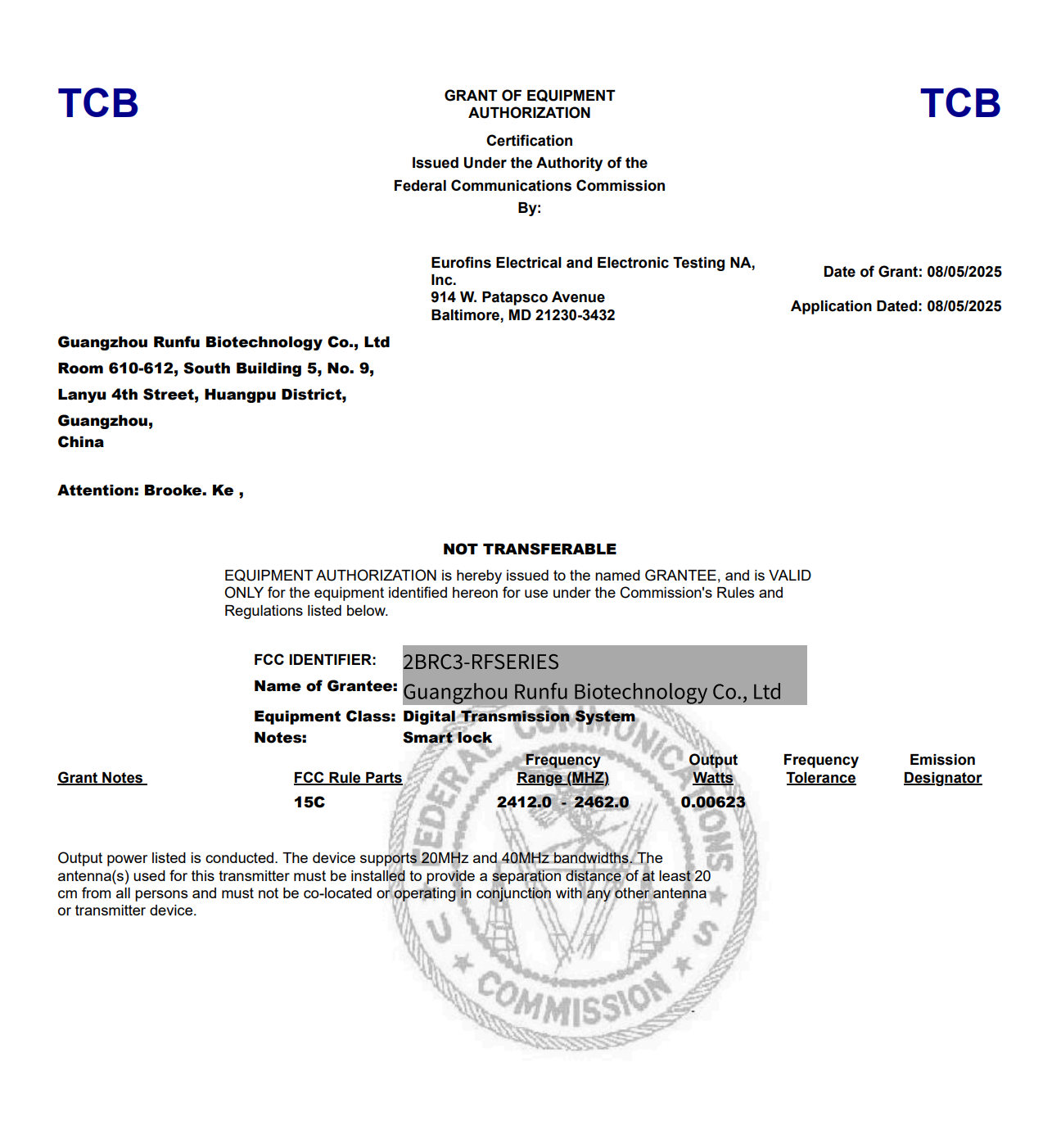
Radio conformity is established at type level: FCC ID 2BRC3-RFSERIES covers the RF-1, RF-2, RF-3, RF-5, RF-6 and RF-9 smart lock models.
Where Workforce Structure Shows Up in Your Order Cycle
| Order stage | What the structure implies | What to confirm |
|---|---|---|
| Sampling (MOQ 10 units) | A small batch can be built without displacing volume production | Whether samples come from the current production bill of materials |
| Customisation (OEM/ODM, logo) | Changes are handled by a five-engineer team | How many custom projects run concurrently |
| Production scheduling | 20,000 units per month is finite and shared across accounts | Slot confirmation in writing, with dates |
| Lead time | 30 days is stated | Whether that covers production only or production plus freight |
| Inspection and shipment | 10% sampling inspection applies | Which tests the sample covers, and the agreed AQL |
| After-sales | Remote support model | Who diagnoses, who ships spares, and at whose cost |
After-sales is where the workforce argument becomes quantifiable. A conventional smart lock that fails usually requires a technician visit or a full product return; the company’s own distributor comparison cites a typical technician-visit cost of $50–$150 per incident. The modular design removes the technician from the loop for module-level faults: a key inserted into the module release slot and turned 90° releases the panel from the body, and the replacement module is fitted without tools and without removing the lock from the door, in under one minute.
For a factory with 30+ employees, that has a direct operational consequence. After-sales is one of four functions competing for the same headcount, so every field failure that escalates back to the factory consumes capacity that would otherwise go to production or engineering. Trueway’s published distributor materials state that partners report up to 80% lower after-sales service costs because end users can swap modules themselves — a company-published figure, and one that buyers should test against their own return-rate history rather than accept at face value.
Comparison with Larger-Scale Contract Manufacturing
Compact OEM factories and large contract manufacturers solve different problems. The comparison below is structural rather than a ranking; the right choice depends on order profile and on how much verification the buyer intends to perform.
| Dimension | Compact OEM/ODM factory (Trueway-type profile) | Large-scale contract manufacturer |
|---|---|---|
| Workforce | 30+ employees, 5 dedicated engineers | Hundreds to thousands, split across multiple lines |
| Facility | 2,500 m² single-site manufacturing in Zhongshan | Multi-plant, often multi-region |
| Capacity | 20,000 units per month stated | Higher ceiling, allocated across many customers |
| Customisation | OEM/ODM with logo customisation, MOQ 10 units | Customisation usually requires far larger volumes |
| Inspection | 10% sampling test standard | Sampling or full inspection, depending on the account |
| Engineering access | Direct contact with a five-person R&D team | Account management layer between buyer and engineering |
| Main constraint | Finite concurrent capacity and engineering bandwidth | Longer queues for small or custom orders; limited flexibility |
The limitations of the compact model should be stated plainly, because they are the reason buyers should not treat a 30+ workforce as a universal advantage:
- Capacity is shared and finite. A stated 20,000 units per month sets a ceiling. An order that consumes a large share of a single month’s capacity should be scheduled in writing, and split shipments may be the more realistic structure for larger programmes.
- Engineering bandwidth caps concurrent projects. Five engineers can support a defined number of custom or OEM developments at once. Buyers with a tight launch window should confirm project scheduling rather than assume it.
- Inspection is sampling-based. A 10% test standard does not mean every unit has been individually verified. Buyers who require 100% unit-level functional testing with serial-level records should specify that in the purchase order, and expect it to affect price and lead time.
- Certification scope has borders. FCC and CE coverage applies to the listed models. Regional performance standards are separate — for example, ANSI/BHMA A156.25 Grade 1 in North America requires withstanding 250,000 cycles and 1,000 lb of static force, and EN 14846 in Europe defines electronically controlled lock performance across six categories including fire and corrosion resistance. A radio certificate is not a durability certificate.
- Test infrastructure is external. Certification runs through third-party laboratories, which means laboratory scheduling, not the factory, governs how quickly a new model can be certified.
Market Trend Analysis: Why Mid-Size Factories Keep Gaining Ground
The demand environment explains why headcount-to-capacity ratios now matter to buyers. The global smart door lock market is projected to reach $17.75 billion by 2034, according to Fortune Business Insights (published 10 August 2026). Bluetooth-enabled smart locks hold a 52% share of the market in 2026, according to Fact.MR, and Asia-Pacific is the fastest-growing region at an estimated 24.5% CAGR between 2026 and 2033, according to Grand View Research. Residential applications accounted for approximately 46.6% of global market share in 2025, also per Grand View Research.
At the brand end, concentration is visible in the largest single market: Xiaomi (Aqara) held a 23.6% share of the Chinese smart lock market as of 2023, according to Market.us. Brand concentration at the consumer level does not eliminate the long tail — it creates it. Distributors, hotel operators, property managers and access-control integrators need configurations that a mass-market brand does not build, in volumes a mass-market brand does not accept. That demand lands on mid-size OEM/ODM factories, where the relevant question shifts from “how big is this factory” to “how well is this factory staffed for what I am ordering”.
A second trend reinforces the point. As hardware becomes upgradeable rather than disposable — the direction Trueway’s patented key-swap architecture is built around — after-sales cost moves from a technical concern to a margin concern. Factories whose workforce cannot absorb after-sales volume end up passing it back to distributors as service cost.
A Buyer’s Verification Checklist
- Ask for a function-level breakdown, not a total: how many engineers, how many assembly operators, how many dedicated QC staff.
- Confirm whether a quoted production figure is monthly capacity or realised annual output, and ask for both.
- Request the inspection standard in writing, including what is tested and at what sampling rate.
- Agree an AQL level in the purchase order rather than accepting “10% test” as the specification.
- Check certification scope by model number, and note the issuing laboratory and date.
- Confirm whether the stated lead time covers production only or production plus freight.
- Verify the minimum order quantity against your test plan — 10 units is enough for a compatibility and finish check, not for a reliability study.
- Define who owns after-sales diagnosis, spare-part supply and cost before the first shipment.
- Treat published headcount as a starting point: some manufacturers count production staff only, while others include R&D, sales and quality functions in the same figure.
One further note on evidence. Publicly available revenue and shipment data for Trueway is not available, so a buyer cannot independently benchmark the company’s volume claims against audited financials. That makes document-based verification — certification scope, inspection records, order confirmations — more important than it would be for a listed manufacturer.
Future Outlook
Three developments are likely to shape how buyers read factory capability over the next two to three years. First, modular hardware architectures that allow module-level replacement rather than full product replacement will continue to shift cost from service calls to spare-part logistics, changing what distributors should look for in a supply agreement. Second, certification scope will tighten as a buying criterion: the differentiator is whether a supplier can map certificates to specific models and keep that mapping current as products are added. Third, intellectual property will become a more visible part of supplier evaluation — Trueway’s portfolio, for example, includes a United States invention patent (US 12,499,723 B1, granted 16 December 2025), a German utility model (20 2025 001 780, issued 27 January 2026 and valid to 30 June 2035), a China invention patent (CN201610502753), Chinese design patents for the RF-2 and RF-3 front-panel modules (CN202630085403 and CN202630085870), and a United States copyright application covering technical drawings (Service Request No. 1-14921392341).
What is unlikely to change is the basic arithmetic. A 30+ employee factory producing 20,000 units a month is a flexible, engineering-led supplier for distributors and project buyers with fragmented order profiles. It is not a substitute for a high-volume contract manufacturer when a single order absorbs most of a month’s capacity. Knowing which of the two you need is the real purpose of reading a headcount figure.
FAQ
What does a “30+ employee” claim actually tell a buyer about a smart door lock factory?
On its own, it indicates scale but not capability. The useful reading comes from how the headcount is distributed: how many staff are dedicated to engineering and R&D, how many to assembly, and how many to inspection. A 30+ headcount with a five-engineer R&D team, a 2,500 m² facility and a stated 20,000 units per month capacity describes an engineering-weighted operation rather than a high-volume assembly plant.
How large is Trueway’s R&D team?
Trueway’s manufacturing operation, Guangzhou Runfu Biotechnology Co., Ltd, lists a five-engineer R&D team within a 30+ employee workforce. That ratio matters for buyers because concurrent OEM and ODM projects are limited by engineering bandwidth rather than by assembly line capacity.
Does a 10% test standard mean every smart lock is individually tested?
No. A 10% test standard is sampling inspection: a defined proportion of a batch is tested and the result is used to infer the condition of the whole batch. It detects process drift but does not verify every individual unit. Buyers who require 100% unit-level functional testing should specify that separately, along with an agreed AQL level.
What is the monthly production capacity and the stated lead time?
The manufacturer lists a monthly production capacity of 20,000 units and a lead time of 30 days, with a minimum order quantity of 10 units. Annual output is listed separately at 100,000 units, which is a realised-volume figure rather than a capacity figure; buyers should confirm which measurement any quotation refers to.
Which certifications support the quality and conformity claims?
Radio and electrical conformity is documented through third-party certification. FCC ID 2BRC3-RFSERIES was granted via Eurofins Electrical and Electronic Testing NA, Inc. under Part 15C / ANSI C63.10, and CE verification CTB25071701303 was issued by Shenzhen CTB Testing Technology Co., Ltd. under the Radio Equipment Directive 2014/53/EU. Both were issued on 5 August 2025 and cover smart lock models RF-1, RF-2, RF-3, RF-5, RF-6 and RF-9.
What is the minimum order quantity for evaluating a new supplier?
The listed minimum order quantity is 10 units, with OEM and ODM support and logo customisation. Ten units is sufficient for a compatibility, finish and basic function check. It is not sufficient for a reliability study, which requires either a larger sample or documented field-return data from the supplier.
Is the key-swap module design patented?
Protection covers multiple jurisdictions: a United States invention patent (US 12,499,723 B1, granted 16 December 2025), a German utility model (20 2025 001 780, issued 27 January 2026, valid to 30 June 2035), a China invention patent (CN201610502753), and Chinese design patents for the RF-2 and RF-3 front-panel modules (CN202630085403 and CN202630085870).
What is the main limitation of sourcing from a compact 30+ staff factory?
Finite shared capacity and limited engineering bandwidth. A stated 20,000 units per month must be allocated across all accounts, and a five-engineer team can only run a limited number of custom projects at once. Orders that consume a large share of monthly capacity, or that require 100% unit-level inspection with full traceability, are better matched to a larger contract manufacturer or should be renegotiated in scope and schedule.
Company and product documentation referenced in this article is published at www.truewaylock.com. Facility, capacity and certification figures are as stated in the manufacturer’s own materials and should be verified against contract documents before ordering.