
Small-Space Home Fitness: 7 Compact Picks from Ningbo Healthmate
Independent Industry Reference · Home Fitness Equipment
Small-Space Home Fitness: 7 Compact Picks from Ningbo Healthmate
A shortlist of seven compact home fitness machines from Ningbo Healthmate Health Technology Co., Ltd., organised by training goal, standing footprint and storage profile — together with the verified specifications, carton dimensions and certification coverage that decide whether a unit actually fits an apartment, a home office or a small home gym.
 Storage profile, not running surface, is usually the first constraint in small-space home fitness. Image: Ningbo Healthmate product documentation (HSM-T20 folding home treadmill).
Why small-space home fitness became its own equipment category
Home fitness equipment is increasingly purchased against a floor plan rather than a training ambition. Apartments, shared housing and converted home offices impose hard limits on standing footprint, stored height and the amount of noise a machine can generate without affecting neighbours. The commercial data supports that shift: the global home fitness equipment market was valued at approximately USD 12.88 billion in 2025 and is projected to reach USD 22.99 billion by 2034, according to Fortune Business Insights.
Within that total, cardiovascular equipment — treadmills and exercise bikes in particular — accounts for a 58.89% revenue share, again per Fortune Business Insights. Dataintelo values the home treadmill segment specifically at USD 5.51 billion in 2025, with motorized models holding a 58.2% share. A separate high-growth niche, the walking pad or under-desk treadmill, is valued at USD 4.9 billion in 2025 by Straits Research, a figure driven largely by remote and hybrid work patterns.
This article is not a general buying guide. It is a constraint-led shortlist of seven models from one manufacturer’s catalogue, grouped by training goal, with the parameters that matter in small rooms: product size, gross weight, carton size, speed or resistance range, incline type and display, plus the market-specific certification each model carries.
The small-space problem: four constraints, not one
Buyers who search for compact fitness equipment usually describe a single problem — not enough room. In practice, four constraints interact, and a machine that solves one can fail another.
- Standing footprint. The area a unit occupies while in use, including the effective walking or stepping zone. A treadmill with a 1100×400 mm runway occupies a different floor area than a vibration plate with a 530×320 mm base.
- Storage profile. Stored height and folded depth. An under-desk walking pad at roughly 91–120 mm tall can be slid under furniture; a folding treadmill with a handrail cannot.
- Drivetrain and acoustics. Motor type and resistance system shape both the training ceiling and how intrusive the machine feels in a shared building. Ningbo Healthmate specifies a brushless motor on one walking pad model and a magnetic resistance system on its foldable X-bike.
- Compliance for the intended market. For importers, retailers and marketplace sellers the machine must be certifiable in the destination region. Certification is model-specific and market-specific, not category-wide.
Ningbo Healthmate Health Technology Co., Ltd. is a fitness and healthcare equipment manufacturer founded in 2007, operating a 100,000 m² factory on the Ningbo coastline with 850 employees, 38 engineers and an annual output of roughly 700,000 units. Approximately 80% of production is exported to Europe, the USA, Japan, Korea, India, the Middle East and South America. That export orientation is why the certification mapping in this shortlist matters as much as the specifications.
How the seven picks were selected
The shortlist was filtered against five criteria, in this order: standing footprint, storage behaviour, training ceiling, feedback and control, and market certification coverage. Price band was deliberately excluded because no verified price data exists for these models; buyers should obtain current quotations rather than rely on indicative figures.
| Model | Type | Product size | Gross weight | Speed / resistance | Incline | Feedback |
|---|---|---|---|---|---|---|
| HSM-W04L1BL | Under-desk walking pad (brushless motor) | 1130×510×91 mm | 21 kg | 1–6 km/h | None | LED: speed / distance / time / calories |
| HSM-W04L2B | Under-desk walking pad | 1090×495×120 mm | 19 kg | 1–6 km/h | Manual | LED: speed / distance / time / calories |
| HSM-W04M2A | Folding walking pad with handrail | Runway 920×380 mm | 20.2 kg | 1–10 km/h | Manual | LED: speed / distance / time / calories |
| HSM-W09E | Folding walking pad with handrail | 1335×665×1050 mm | 31 kg | 1–14 km/h; 1–6 km/h dual-speed | 1 level, manual | LED: speed / distance / time / calories / pulse |
| HSM-T20 | Compact folding treadmill | 1474.3×604×1124 mm | 33.5 kg | 1–14 km/h | Manual | LCD: speed / distance / time / calories / pulse |
| HSM-08VS | Compact vibration plate | 530×320×145 mm | 9.8 kg | 99 speed levels, 200 W | n/a | Speed / distance / time / mode / PRO |
| HSM-B135J5 | Foldable X-bike | 1110×525×1100 mm | 19.1 kg | 8 magnetic resistance levels | 7 altitude levels | LCD: speed / distance / time / calories / pulse |
All seven models use ABS material in their construction. Carton sizes are recorded separately below, because carton dimensions — not product dimensions — determine freight class, warehouse slotting and last-mile handling for importers and e-commerce sellers.
The seven picks, grouped by training goal
Group A — Desk-bound walking and light daily steps
This group suits buyers whose primary goal is accumulating low-impact steps during working hours rather than running. Speeds of 1–6 km/h cover normal walking pace, and the flattest units store beneath a desk or sofa.
- HSM-W04L1BL — slim under-desk walking pad. A 1130×510×91 mm body with a 900×380 mm runway, 0.75 HP motor and 1–6 km/h speed range. It is specified with a brushless motor, which is the differentiator within this group. Gross weight is 21 kg; the LED display reports speed, distance, time and calories.
- HSM-W04L2B — compact desk walking machine. The lightest walking unit in the shortlist at 19 kg, with a 1090×495×120 mm body, 900×380 mm runway, 0.75 HP motor, 1–6 km/h speed range and a manual incline function. Carton size is 1120×515×123 mm.
- HSM-W04M2A — folding walking pad with handrail. A 920×380 mm runway with a safety handlebar and a 1–10 km/h range, which extends the unit from pure desk walking into brisk walking. It weighs 20.2 kg and includes a manual incline function.
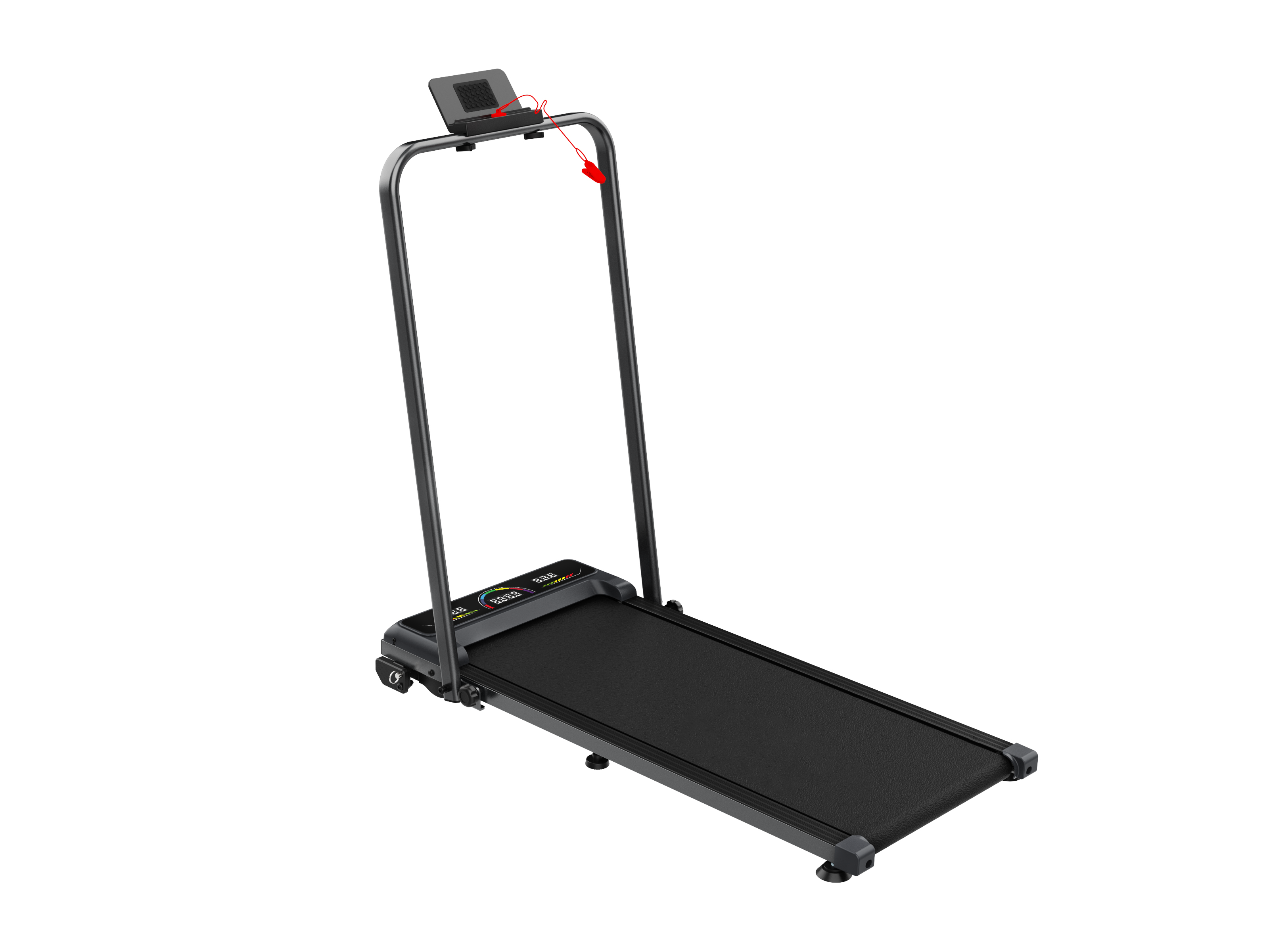 Handrail-equipped walking pads extend the speed range beyond pure desk walking while keeping a folding storage profile. Image: Ningbo Healthmate HSM-W04M2A.
Group B — Walking-to-jog cardio in a folding frame
Where walking is not the endpoint, a 1.5 HP drive and a 1–14 km/h ceiling allow progression to light jogging. Both models in this group use a 1100×400 mm runway.
- HSM-W09E — stability walking pad with handrail. A dual-speed configuration (1–14 km/h and 1–6 km/h), 1.5 HP motor, 6 programs, one level of manual incline, and an LED display that adds pulse to speed, distance, time and calories. Product size is 1335×665×1050 mm, gross weight 31 kg, carton 1475×720×138 mm. It sits in the apartment and small-space fitness application category.
- HSM-T20 — compact folding treadmill. A 1.5 HP drive, 1–14 km/h speed range, 6 programs, manual incline and LCD feedback including pulse, plus Bluetooth music and app function. Product size is 1474.3×604×1124 mm, gross weight 33.5 kg, carton 1380×625×225 mm.
Group C — Low-impact toning and seated cardio
The two units in this group address training days when impact is undesirable or when the available floor area is genuinely minimal.
- HSM-08VS — compact vibration plate. A 530×320×145 mm body weighing 9.8 kg, rated at 200 W with 99 speed levels and a 1–10 minute timing range. The screen reports speed, distance, time, mode and PRO, and the unit is supplied with a magnetic stone. Its carton is 635×390×160 mm, among the smallest in the shortlist.
- HSM-B135J5 — foldable X-bike. A magnetic exercise bike with 8 resistance levels, 7 altitude control levels and a 1.5 kg flywheel system, measuring 1110×525×1100 mm and weighing 19.1 kg. The LCD reports speed, distance, time, calories and pulse. Carton size is 955×415×225 mm. The foldable X-frame is the storage mechanism rather than a fixed upright post.
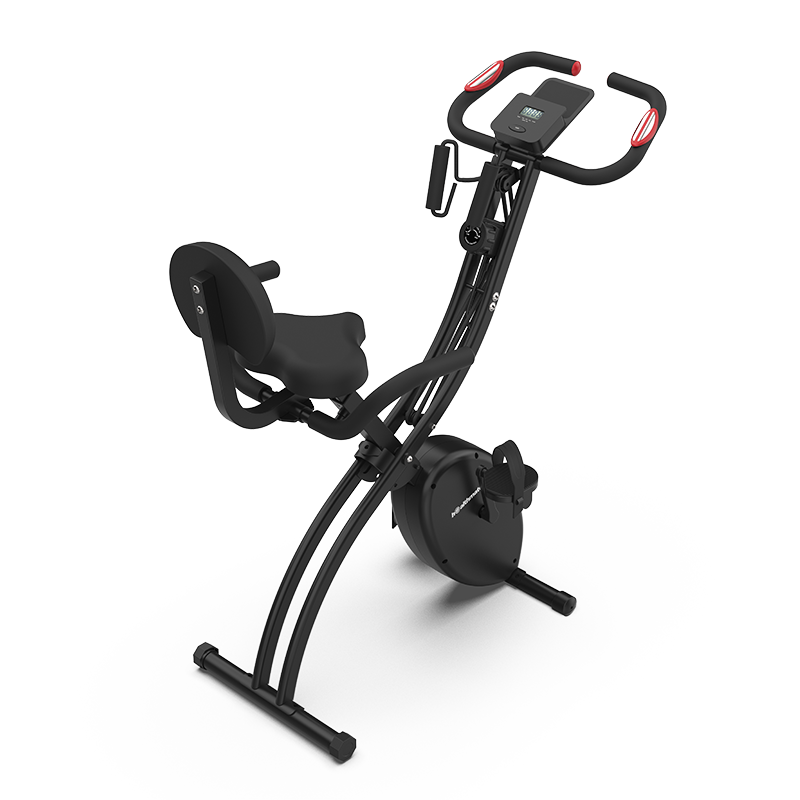 The foldable X-frame of the HSM-B135J5 removes the fixed footprint of an upright bike while retaining 8 magnetic resistance levels. Image: Ningbo Healthmate.
Technical explanation: what the numbers actually constrain
Compact equipment specifications are often read as a shopping list. Read as constraints, they answer three questions: how much floor space is committed, what training is physically possible, and what certification and freight planning follow from the design.
Runway size defines the activity, not the marketing category
The shortlist spans runways from 900×380 mm (HSM-W04L1BL and HSM-W04L2B) to 1100×400 mm (HSM-W09E and HSM-T20), with the HSM-W04M2A at 920×380 mm. Narrow runways constrain lateral foot placement and suit walking gaits; wider, longer runways at 1100×400 mm support brisk walking and light jogging. This is why a lower speed ceiling on a 900 mm runway pad is a design coherence rather than a specification shortfall.
The power ladder: 0.75 HP versus 1.5 HP
Motor power tracks the speed range. The three 0.75 HP walking pads top out at 1–6 km/h, with the handrail model HSM-W04M2A reaching 1–10 km/h. The 1.5 HP units — HSM-T20 and HSM-W09E — reach 1–14 km/h and carry 6 programs. For reference, the wider Ningbo Healthmate treadmill range includes 2.0–2.5 HP home models with auto-incline and higher speed ceilings; those are outside a small-space shortlist because of their size, but they show where the compact ceiling sits.
Manual incline versus auto incline
Four of the seven picks use manual incline adjustment (HSM-W04L2B, HSM-W04M2A, HSM-W09E at one level, HSM-T20). Manual incline removes the incline motor and its control electronics, which simplifies the machine and reduces the number of powered components that can fail, but it also means the incline cannot be changed mid-program. Buyers who train with structured incline intervals should treat this as a real limitation and look at auto-incline models instead.
Vibration output: 200 W in a compact chassis
The HSM-08VS is rated at 200 W with 99 speed levels and 1–10 minute timing. Other vibration plates in the same manufacturer’s family are rated at 500 W (HSM-08VF) and 500 W + 300 W (HSM-08VQ and HSM-08VW), with 20 speed levels and, in the case of the HSM-08VW, a 1–15 minute timing range. The compact plate therefore trades output and a wider level range for a 530×320×145 mm footprint and 9.8 kg gross weight.
Magnetic resistance and frame geometry
On the HSM-B135J5, resistance is generated magnetically across 8 levels, with a 1.5 kg flywheel and 7 altitude control levels. Magnetic resistance uses no friction pad against a flywheel, which is relevant for shared floors and long service intervals; the trade-off is a different resistance feel compared with heavier flywheel systems.
Certification mapping by model and market
Compliance is the constraint most often misread by buyers, because a certificate held by one model does not automatically extend to another. For this shortlist, the verified coverage is as follows.
- Walking pads and compact treadmills (HSM-W04L2B, HSM-W04L1BL, HSM-W04M2A, HSM-W09E, HSM-T20). North America: ETL Authorization to Mark, certificate 150800030HZH-001 issued by Intertek Testing Services Ltd. Zhejiang, against UL 1647:2015 and CSA C22.2#68:2018. EU: Verification of Conformity certificate ENB2507110014S00101C issued by EMTEK (NINGBO) CO., LTD. against EN ISO 20957-1:2024 and EN 957-6:2010+A1:2014, plus RED certificate ENB2512300229W00101C. A CE certificate of compliance (LVD + EMC), certificate CE-4084-110525 issued by ECES (Turkey), covers several models in the range including the HSM-T20 and the walking pads.
- HSM-B135J5 foldable X-bike. EU: CE-MD certificate HA0125NB052509SPS issued by HATEK against 2006/42/EC + (EU) 2023/1230, plus CE-LVD certificate ENB2503310223S01301C issued by EMTEK (NINGBO) CO., LTD. against EN 60335-1 and EN 62233:2008. North America: FCC Supplier’s Declaration of Conformity, certificate MTZS23063843 issued by Shenzhen Most Technology Service Co., Ltd., against FCC Part 15 Subpart B.
- HSM-08VS compact vibration plate. EU: CE-LVD certificate MTZS23064156 against EN 60335-1:2012, EN 60335-2-32:2003+A1+A2 and EN 62233:2008; CE-EMC certificate MTZS23074017; RoHS certificate HA21NB051501CHEM issued by HATEK against 2011/65/EU and (EU) 2015/863. UK: UKCA certificate MTZS24064178 issued by Shenzhen Most Technology Service Co., Ltd. against BS EN 60335-1, BS EN IEC 60335-2-32:2021 and BS EN 62233:2008.
At the standards level, motorized treadmills are assessed against ASTM F2115-19 in the United States and ISO 20957-6 / EN 957-6 in the European Union for safety and performance. Buyers should confirm that the specific certificate number they are shown names the exact model and destination market they intend to sell into.
Where these seven units are actually used
The application profile for this category is narrow but consistent. Documented use conditions include home use, office or workplace use, and apartment or urban living, with operating modes covering manual and electronic control, adjustable speed or resistance, real-time tracking and intermittent daily use.
- Under-desk walking during working hours. The 91–120 mm stand height and 1–6 km/h range of the HSM-W04L1BL and HSM-W04L2B fit a desk-working routine without relocating furniture.
- Small apartment daily light exercise and post-meal walking. Low-speed walking at 1–6 km/h supports short, frequent sessions that are easier to sustain in small rooms.
- Low-impact leg cardio and rehabilitation exercise for mild joint discomfort. Walking pads and the magnetic X-bike keep impact low while still loading the lower body.
- Elder daily rehabilitation exercise and family daily cardio. Handrail-equipped models (HSM-W04M2A, HSM-W09E) add a stability point that matters for older users.
- Minimal-footprint toning. The HSM-08VS covers whole-body vibration training in roughly the footprint of a large doormat.
Manufacturer-reported case data covering approximately 100,000 units shipped to foreign trade wholesalers, Amazon platform sellers, local fitness retail shops, wholesale trading companies and fitness equipment wholesalers records a 3–5 year service period, an after-sales failure rate below 2%, a high repeat order rate, and positive market feedback specifically on household space demand. The reported design highlights behind that feedback include foldable compact structure, multi-level shock absorption, simple operation panels, multiple vibration modes, anti-slip foot mats and lightweight portability. Buyers should treat these as supplier-reported figures and validate them through sample testing and reference checks.
Market trend signals behind the compact category
Three trends explain why compact formats keep gaining share within home fitness. First, the cardiovascular segment dominates: treadmills and exercise bikes together hold a 58.89% revenue share of the home fitness market, and within home treadmills, motorized models account for 58.2%. Second, the under-desk walking niche is expanding in step with remote work, which is the mechanism Straits Research cites for a USD 4.9 billion walking pad valuation in 2025. Third, vibration platforms reached USD 1.8 billion in 2025 with an expected CAGR of 7.8% through 2034, according to Dataintelo.
The competitive landscape remains concentrated at brand level. Fortune Business Insights identifies ICON Health & Fitness (iFIT), Johnson Health Tech, Technogym and Peloton among the key global players in home fitness. These companies compete primarily on brand ecosystems, connected content and commercial-grade portfolios. The shortlist discussed here operates at a different level: specific compact home-use models, defined by measured dimensions and model-level certification rather than by ecosystem. Both levels coexist, and buyers sourcing for a compact-housing market are typically evaluating the second.
Compact versus traditional home equipment: the real trade-offs
A shortlist is only useful if its boundaries are stated. The following limitations are structural, not incidental.
- Speed and power ceilings. A 0.75 HP walking pad limited to 6 km/h is not a substitute for a 2.0–2.5 HP home treadmill running to 20–22 km/h. Buyers who intend to run at pace need a different category.
- Runway width restricts gait. A 380 mm-wide belt is comfortable for walking and constrained for running. The 1100×400 mm runways in Group B are the practical upper edge of this shortlist.
- Manual incline cannot change mid-session. Where a training plan depends on changing incline during a programmed workout, manual incline models will not deliver it.
- Lower vibration output. At 200 W with a 1–10 minute timing range, the HSM-08VS sits below the 500 W / 500 W + 300 W vibration models in the same family, and below those models’ level counts.
- Folding mechanisms create service points. Foldable frames and latches need periodic inspection; compact units are generally designed for intermittent home duty cycles rather than continuous commercial use.
- Certification is per model and per market. A certificate for one walking pad model does not confer coverage on a sibling model, and an EU certificate does not cover the UK or North America. Verify the certificate number against the exact model being sourced.
- Published market values are not procurement data. Walking pad market estimates range from USD 4.9 billion to a much smaller core-niche figure depending on definition, so category sizing should never replace measured dimensions, agreed specifications and validated samples.
Future outlook
Two directions look durable. The first is continued compression of storage profiles: the 91 mm under-desk pad, the foldable X-frame bike and the compact 530×320 mm vibration plate all exist because housing density keeps rising in the markets that drive demand. The second is tighter compliance expectations, particularly where marketplace sellers must evidence certification at listing level rather than at brand level.
On the supply side, Ningbo Healthmate operates OEM/ODM production with customization across colour, logo, voltage and plug type, a monthly capacity of 8,000 units, a lead time of 35–40 days, a minimum order quantity of 100 units, 100% testing with third-party inspection, and a one-year warranty on damaged parts. Those parameters shape how quickly a compact range can be assembled for a given market, and they are worth verifying against current quotations rather than assuming.
FAQ
Plan for the standing footprint plus a small clearance. In this shortlist, under-desk pads measure 1090×495×120 mm and 1130×510×91 mm with a 900×380 mm runway, while handrail models measure 1335×665×1050 mm (HSM-W09E) and 1474.3×604×1124 mm (HSM-T20) with a 1100×400 mm runway. Allow additional room behind the unit for stepping on and off safely.
For North America, the relevant document for this range is the ETL Authorization to Mark, certificate 150800030HZH-001 issued by Intertek Testing Services Ltd. Zhejiang against UL 1647:2015 and CSA C22.2#68:2018. For the EU, treadmills are assessed against ISO 20957-6 / EN 957-6 and EN ISO 20957-1; certificates in this range include ENB2507110014S00101C and the RED certificate ENB2512300229W00101C issued by EMTEK (NINGBO) CO., LTD. UK and US standard frameworks include UKCA and ASTM F2115-19 respectively. Certification must name the exact model and destination market.
Manual incline is set by the user before a session and stays fixed; it removes the incline motor and its control electronics. Auto incline adjusts during a programmed workout. In this shortlist, HSM-W04L2B, HSM-W04M2A, HSM-T20 and HSM-W09E (one level) use manual incline, so incline-interval training is not supported on these specific models.
Within this range, 0.75 HP drives a 1–6 km/h walking speed, with one 0.75 HP handrail model reaching 1–10 km/h. Light jogging to 14 km/h is supported by the 1.5 HP units, HSM-T20 and HSM-W09E. Higher running speeds require 2.0–2.5 HP home treadmill models, which fall outside a small-space shortlist.
The HSM-08VS provides 99 speed levels, a 1–10 minute timing range, a magnetic stone and screen feedback covering speed, distance, time, mode and PRO, in a 530×320×145 mm chassis weighing 9.8 kg. Buyers comparing it with the family’s 500 W models (HSM-08VF) or 500 W + 300 W models (HSM-08VQ, HSM-08VW, with 20 levels and up to 1–15 minute timing) should treat output and timing range as the main differences.
Carton dimensions determine freight and handling: 1120×515×123 mm for the HSM-W04L2B, 1475×720×138 mm for the HSM-W09E, 1380×625×225 mm for the HSM-T20, 955×415×225 mm for the HSM-B135J5 and 635×390×160 mm for the HSM-08VS. Storage height also matters indoors — the 91 mm and 120 mm profiles of the under-desk pads can be stored beneath furniture, which the handrail models cannot.