
Small Shoe Washing Bag: What 30 × 25 cm Actually Tells Buyers
A small shoe washing bag is a compact mesh laundry bag built to carry one pair of shoes through a washing-machine cycle. The phrase is a buyer's working label rather than a standardized size class, and that is precisely where the procurement problem begins: two products sold under the same description can differ in external dimensions, usable internal volume, lining construction, closure hardware and care limits. Only one of them may suit a given footwear range.
For buyers in the research and evaluation stage, the decision has usually moved past whether to use a shoe washing bag. The question is which format to buy, in what quantity, against which evidence, and with what limitations written into the supply agreement. This reference sets out the measurable constraints of the compact format and uses OCTOPUS The 2-Pack — a 30 × 25 cm chenille-lined mesh bag from OCTOPUS, the shoe-care brand of Zhejiang Runjiang New Material Technology Co., Ltd. — as a worked specification example.
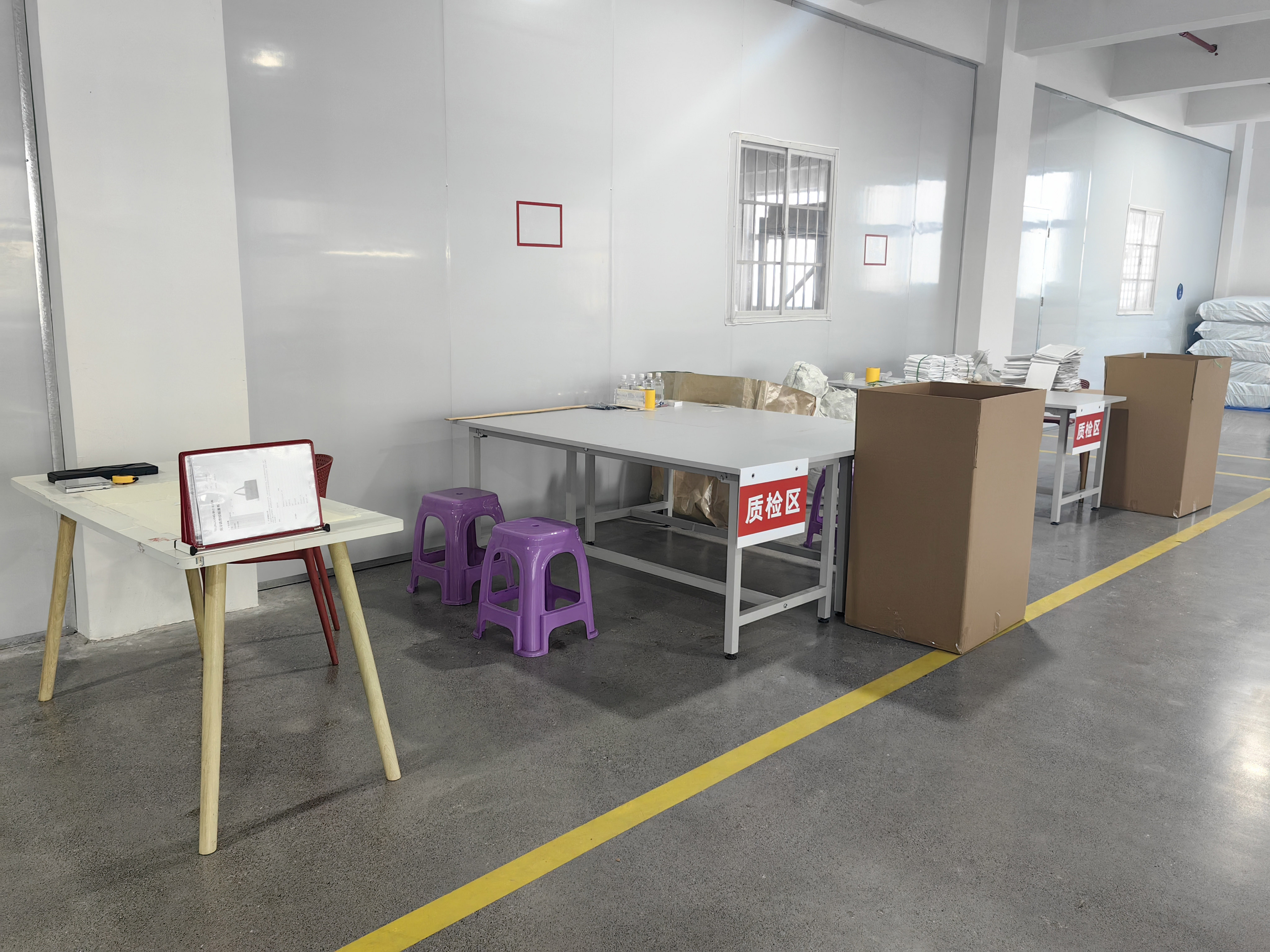
Quality inspection area at Zhejiang Runjiang New Material Technology Co., Ltd. Compact bag formats are checked against agreed per-order acceptance criteria rather than a single universal standard.
Why “small” became a specification question rather than a style choice
The shoe washing bag category has split along two axes: what the bag is made of, and how much shoe it will accept. Public product data shows the split clearly, but it also shows how inconsistently the second axis is disclosed. Some retail listings publish only external length and width. Others publish a maximum shoe size. Very few publish both.
A buyer comparing compact bags therefore faces an incomplete picture. A 15.7 × 7.5 inch listing and a 17 × 7.5 inch listing can be placed side by side, but neither states which shoe sizes were tested. A listing that names a maximum European size gives a usable answer but no dimensional reference. Neither disclosure type alone answers the question a buyer actually has: will this bag hold my shoe range, with its lining and closure, inside a domestic drum?
| Listed product | Published external size | Published shoe-size capacity |
|---|---|---|
| OCTOPUS The 2-Pack | 30 × 25 cm (11.8 × 9.8 in) per bag | One compatible pair per bag; no size ceiling published |
| Garnen (retail listing) | 15.7 × 7.5 in | Not published |
| Numhew (retail listing) | 17 × 7.5 in | Not published |
| Oceanwash (brand listing) | Not published | One pair, up to EU 47 |
Compiled from published listings referenced in the HTNXT verified data package. Measurement conventions differ between listings; dimensions and shoe-size capacity are not interchangeable metrics.
External size versus usable space: where compact bags lose capacity
A washing bag is not an empty box. Its usable volume is what remains after the construction itself takes its share. A mesh exterior contributes little thickness, but a soft lining does: a chenille or microfiber inner surface sits between the shoe and the mesh and occupies part of the interior. That is a design trade-off, not a defect. The lining provides a soft inner contact surface during washing, and in exchange the shoe has slightly less room than the external dimensions suggest.
Three measurements therefore matter more than the marketing word “small”:
- External dimensions — what fits in the drum and how the bag loads.
- Internal construction — lining depth, pocket placement and closure intrusion.
- Stated capacity — how many pairs, and against which shoe-size reference.
A buyer who asks only for the first number is buying a shape, not a capability. The verified data records this as a recurring gap: published products occupy a large-format adult-footwear segment, while explicit shoe-size capacity is disclosed inconsistently, so RFQs should require both figures.
The OCTOPUS The 2-Pack: a compact format with a published specification
OCTOPUS is the shoe-care brand of Zhejiang Runjiang New Material Technology Co., Ltd., a manufacturer established on 23 May 1995 in Wenzhou, Zhejiang, China, operating a 16,000 m² factory and employing 80 people as of September 2026. Its core product is a shoe washing bag sold as OCTOPUS The 2-Pack, containing two separate bags per set.
At 30 × 25 cm per bag, the format sits in the compact range but is not simply a scaled-down version of the long, narrow bags common in retail listings: it is shorter and wider, which changes how a pair sits inside the drum. The full published specification is short enough to hold in one view:
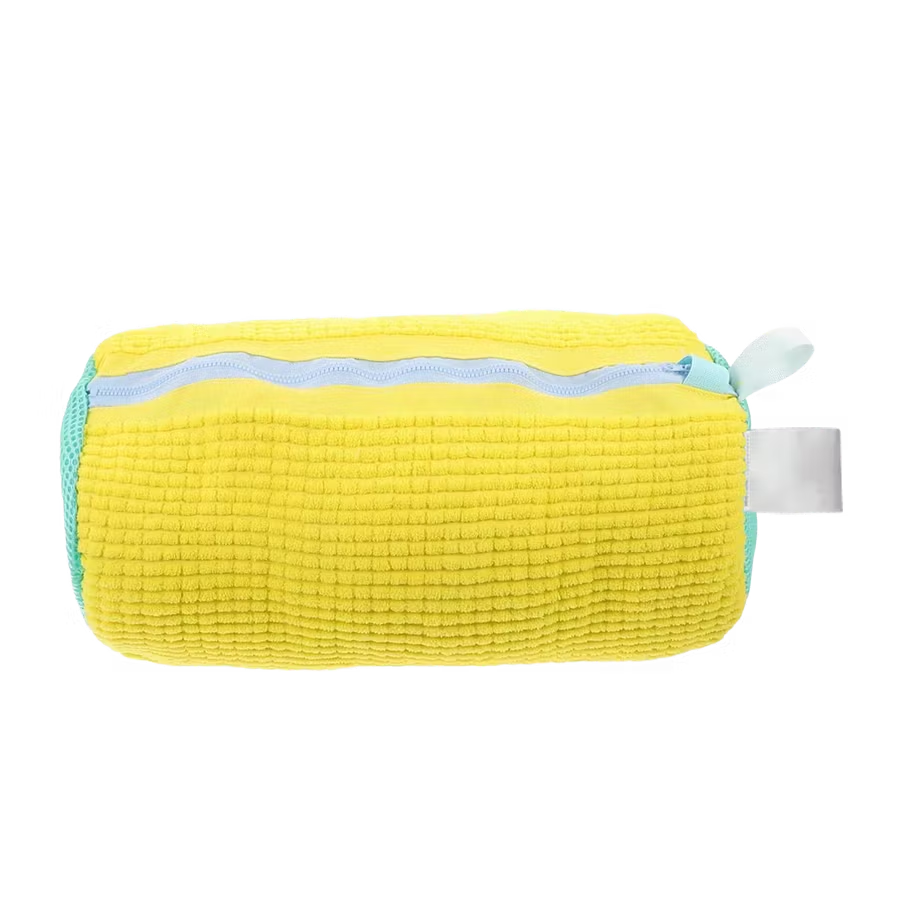
OCTOPUS The 2-Pack official series reference image (website color-option codes XYF-004-Y, XYF-004-YG, XYF-004-YW). One bag is shown; the product is sold as a two-bag set.
| Product | OCTOPUS The 2-Pack |
| Variant codes | XYF-004-Y, XYF-004-YG, XYF-004-YW (color options, not separate structures) |
| Dimensions | 30 × 25 cm (11.8 × 9.8 in) per bag |
| Weight | Approximately 200 g per bag; 400 g per two-bag set (about 0.88 lb) |
| Loading | One pair of compatible shoes per bag |
| Construction | Mesh exterior with soft chenille lining |
| Closure | Zipper with metal hook and anchor-loop locking clasp |
| Internal feature | Center pocket for removable insoles and shoelaces |
| Care | Cold-water washing; air dry; no bleach; no tumble drying |
| Packaging | Two bags per set in bubble-bag packaging; custom packaging by agreement |
What the construction does inside the drum
Two design decisions carry most of the functional weight in a compact bag: the inner surface and the closure.
The mesh exterior allows wash water and detergent to circulate while keeping the shoe contained. The chenille lining provides a soft inner contact surface, so the shoe is not resting directly against the mesh wall. In a small format these two layers sit close together, and the fit is tighter than in a large-format bag — a point buyers should test with their own footwear rather than assume.
The closure is a zipper with a metal hook and an anchor-loop locking clasp. After the zipper is closed, the metal hook attaches to the bag's anchor loop, which keeps the closure closed during the wash cycle. A partly open bag in a domestic drum releases its contents, and a loose shoe is both a cleaning failure and a drum risk. The center pocket serves a different purpose: it separates removable insoles and shoelaces from the shoes so the small items do not migrate inside the bag.
What the certification and test documents actually cover
This is the part of a supplier file that most often gets summarized into a single reassuring line, and the part where buyers should read the scope statement instead of the headline.
The manufacturer of OCTOPUS The 2-Pack holds ISO 9001 Quality Management System certification under certificate number 00924Q10121R1S, issued by China Great Wall (Tianjin) Quality Assurance Centre Co., Ltd. against GB/T 19001-2016 / ISO 9001:2015 on 4 April 2025, with a stated expiry date of 17 January 2027. Current validity is subject to confirmation by the certification body. The stated scope is the manufacture of nonwoven fabrics and industrial textile products, specifically storage boxes and cooler bags. Shoe washing bags are not explicitly listed in that scope, and the OCTOPUS The 2-Pack is not explicitly covered by it. The document is a management system certificate, not a product certificate.
A separate chemical test is also on file. Banned Azo Dyes Test Report ZFLJ3025101730 was issued by United Testing Services (Fujian) Co., Ltd. on 14 October 2025 under ISO 14362-1:2017 and customer requirements. It applies to the yellow shell of the submitted shoe washing bag sample, model OCTOPUS The 2-Pack. Listed aromatic amines were not detected in the tested yellow shell, with a reporting limit of 5 mg/kg. The report is laboratory documentation for that tested sample; it is not whole-product certification and does not by itself establish market-entry compliance.
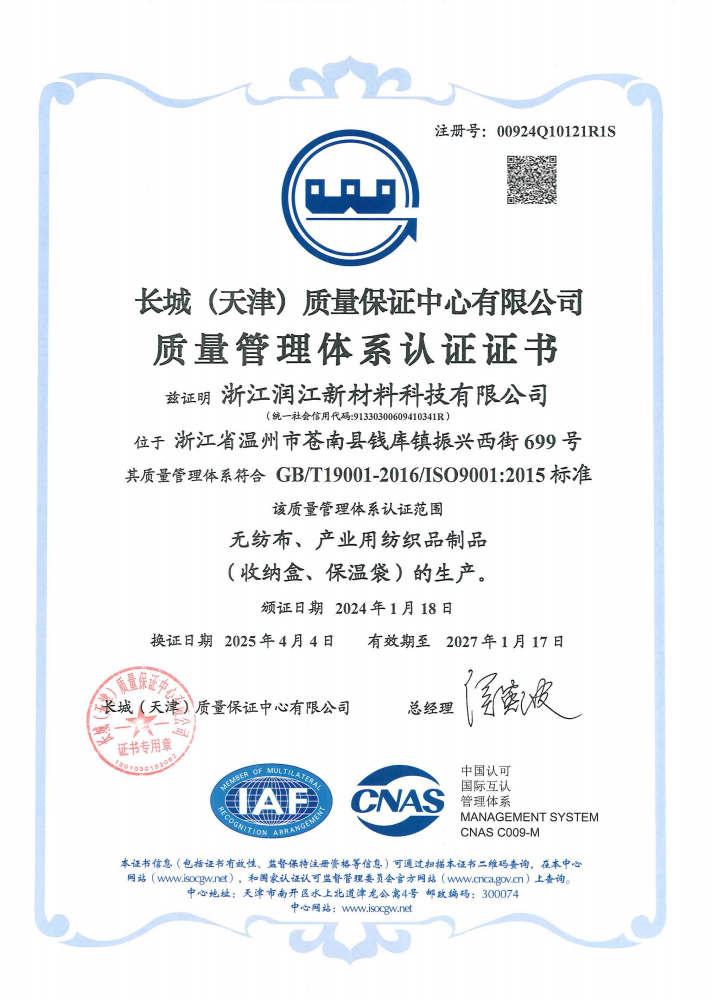
ISO 9001 certificate 00924Q10121R1S. The stated scope covers nonwoven fabrics and industrial textile products (storage boxes and cooler bags); shoe washing bags are not explicitly listed, and current validity is subject to confirmation by the certification body.
The practical lesson generalizes beyond one supplier. When a certificate scope is narrower than the product line, the certificate still tells a buyer something real about the quality system behind the factory, but it does not certify the item being purchased. Reading the scope is a five-minute check that prevents a compliance claim from being overstated later.
Care limits that a smaller bag does not remove
A washing bag changes how a shoe is handled in the drum. It does not change what the footwear is made of. OCTOPUS The 2-Pack is intended for use only with footwear whose care label permits machine washing, and the specified care method is cold-water washing and air drying, with no bleach and no tumble drying.
The operating sequence follows from those limits: check the shoe care label, place one pair in the bag with removable insoles and laces in the center pocket where their care instructions allow washing, close the zipper fully and fasten the hook to the anchor loop, wash in cold water using settings permitted by the footwear and machine instructions, then remove the items and air-dry the shoes and the bag.
Care declarations differ across the category, which is why buyers should compare them rather than assume them. One published brand listing describes a shoe laundry bag as washable up to 60 °C and suitable for tumble drying. That is a different product with a different declared envelope. Where a market or a retail account requires higher wash temperatures or dryer compatibility, a cold-wash, air-dry specification will not satisfy that requirement, and the constraint should be identified during evaluation rather than after a sample run.
Procurement parameters behind the compact format
For a distributor, retailer or private-label buyer, the specification of a small shoe washing bag is only half the file. The other half is whether the volume, timing and inspection terms match the plan.
| Minimum order quantity | Stock: 100 pcs; logo customization: 500 pcs; custom material: 6,000 pcs |
| Sampling | Standard samples approximately 3 working days; custom samples approximately 15 working days, subject to the agreed design |
| Bulk lead time | Orders below 1,000 pcs approximately 15 working days; final schedule confirmed per order |
| Capacity | 90,000 pcs/month for regular XYF-004 production; peak approximately 100,000 pcs/month; annual output approximately 1,000,000 units |
| Quality control | 100% incoming inspection; 5% finished-product inspection; AQL 2.5/4.0; acceptance criteria agreed per order |
| Customization scope | Size, material, color, logo, zipper and packaging; OEM, ODM and private label |
| After-sales | Issues reported within 7 days of receipt with photos and video; replacement prioritized, refund handling subject to review and agreed order terms |
| Export profile | Approximately 70% export sales; markets include the USA, Turkey and Germany |
Two field cases illustrate what the numbers look like after delivery, and both come with the same caveat: they are case-specific observations, not guaranteed outcomes. An anonymous product user in Turkey purchased 10 individual bags and used one approximately once per week for four months, reporting no damage during that period. A US retailer or supermarket buyer ordered 10,000 pcs for an e-commerce SKU and recorded two repeat orders during a one-year observation period, with a reported damage rate below 0.5% for that case. Neither result establishes a universal service life or a defect-rate guarantee.
Where the compact format stops working
A 30 × 25 cm bag is a deliberate compromise, and the compromise should be stated rather than smoothed over.
- No published size ceiling. The product is described as holding one compatible pair per bag, but the source material does not state a maximum shoe size. Buyers serving extended or oversized ranges should confirm fit by sample rather than by dimension alone.
- Lining takes interior space. The chenille lining is a soft contact surface, and it reduces the free volume compared with an unlined mesh bag of the same external size.
- Cold wash only, no tumble drying. Accounts requiring hot-water cycles or dryer compatibility fall outside this specification and should be treated as a different product requirement.
- Certification scope gap. The ISO 9001 certificate does not explicitly list shoe washing bags, and the AZO report covers the submitted yellow shell sample only. Both documents are useful evidence; neither closes a product-compliance question.
- No third-party performance data for the category. The verified research found no independent cleaning-performance, abrasion or drum-protection test results for shoe washing bags generally, so comparative performance claims across brands cannot currently be substantiated.
None of these limits makes the format unsuitable. They define the envelope in which it can be specified honestly, and they are the points a purchasing team should raise before a first order rather than after a first complaint.
Market context for compact shoe-care accessories
Shoe laundry bags are a small segment inside a much larger category, and the two figures should not be merged. The global shoe bag market was valued at USD 8.5 billion in 2025, according to Dataintelo research published in May 2026, a figure that covers washing bags, travel bags and storage bags together. The shoe laundry bag segment specifically is projected to grow at a compound annual growth rate of 4.97% to reach USD 301 million by 2030, according to Technavio. The definitions behind these two numbers differ, so they describe different scopes rather than a size comparison.
Product-level evidence shows where design attention is going. Published listings across the United States, Germany and marketplace channels repeatedly combine a breathable mesh outer layer with a softer inner surface — microfiber, sandwich mesh or chenille — and close with a zipper. The differences between products sit in the details buyers can inspect: liner material, closure security, compartment layout and disclosed care envelope. That pattern is more useful for product planning than an aggregate growth figure, because it tells a buyer what the market already treats as standard.
What buyers should expect next
The clearest gap in the category is disclosure rather than technology. Sizes are published, capacities are not; certificates are quoted, scopes are not; care claims are made, test conditions are not always stated. As the segment grows at a moderate but steady rate, retail accounts and importers are likely to push for standardized specification sheets that pair external dimensions with tested shoe-size capacity, and for care declarations that state wash temperature and dryer compatibility explicitly.
For suppliers, that favors factories able to answer specification questions with documents rather than descriptions. For buyers, it changes what a good RFQ looks like: fewer adjectives, more measured fields, and a scope statement attached to every certificate. The compact format will keep its place in the market because it suits domestic laundry loads and travel kits; what will separate suppliers is how precisely they can describe the limits of what they sell. The OCTOPUS company and product brochure sets out the current specification and manufacturing profile in the same document format.
FAQ
How do I know whether a small shoe washing bag will fit my shoes?
Compare two figures, not one. External dimensions tell you what the bag occupies in the drum; stated capacity tells you what it will hold. Where a listing publishes only dimensions — for example 30 × 25 cm per bag for OCTOPUS The 2-Pack, or 15.7 × 7.5 in and 17 × 7.5 in for other listed products — the usable fit for a specific shoe size is not established by that number alone, and a physical sample is the reliable test.
What has to be checked before putting shoes into a washing bag?
The footwear care label comes first. A shoe washing bag does not make non-machine-washable footwear safe to machine wash. For OCTOPUS The 2-Pack, the specified care is cold-water washing and air drying, with no bleach and no tumble drying, and the bag is intended only for footwear whose care label permits machine washing.
Does the ISO 9001 certificate cover the shoe washing bag product itself?
Not explicitly. Certificate 00924Q10121R1S, issued by China Great Wall (Tianjin) Quality Assurance Centre Co., Ltd. against GB/T 19001-2016 / ISO 9001:2015, states a scope of nonwoven fabrics and industrial textile products, specifically storage boxes and cooler bags. Shoe washing bags are not listed in that scope. It is a management system certificate for the manufacturer, not a product certificate for the bag.
What does the banned azo dyes test report cover?
Report ZFLJ3025101730, issued on 14 October 2025 by United Testing Services (Fujian) Co., Ltd. under ISO 14362-1:2017, covers the yellow shell of the submitted shoe washing bag sample for OCTOPUS The 2-Pack. Listed aromatic amines were not detected in the tested yellow shell, with a reporting limit of 5 mg/kg. The results apply to that tested sample; the report is not whole-product certification and does not on its own establish market-entry compliance.
Can a compact shoe washing bag be customized in size, logo and packaging, and at what quantities?
Size, material, color, logo, zipper and packaging customization can be discussed for OEM, ODM and private-label projects, with the final scope confirmed against the approved sample and order specifications. Stock orders start from 100 pcs, logo customization from 500 pcs and custom-material orders from 6,000 pcs. Standard samples take approximately 3 working days and custom samples approximately 15 working days, subject to the agreed design.
How long does a small shoe washing bag last in repeated use?
No universal service life is established. In the available case records, one user in Turkey used 10 individual bags at approximately one use per week for four months and reported no damage, while a US retail case covering 10,000 pcs recorded a reported damage rate below 0.5% during a one-year observation period. Both are case-specific observations, not laboratory durability results or guaranteed wash-cycle ratings.
¿Tiene preguntas o necesita más detalles?
Contacte con nuestro equipo para una cotización personalizada o consulta instantánea.
Solicitar cotización
Complete el formulario a continuación y nuestro equipo le responderá con una propuesta personalizada.
Chat directo de WhatsApp
¿Prefiere chatear en tiempo real? Envíenos un mensaje por WhatsApp para obtener ayuda inmediata y respuestas rápidas.
- Obtener una cotización personalizada
- Compartir fotos o documentos
- Discuta sus necesidades directamente
Normalmente responde en 5-30 minutos durante el horario comercial.