
Sludge Dewatering Portfolio Evidence: Models, Materials, Fit
Sludge dewatering is a sizing decision before it becomes a purchasing decision. A buyer comparing two stainless-steel machines is really comparing two sets of assumptions about feed solids, daily volume, operating hours and target cake moisture: four variables that determine the outcome long before price is discussed. Supplier capability, examined properly, is the ability to answer those four variables with a named model range, a stated construction material and documented application coverage, rather than with adjectives.
This article uses one manufacturer's published portfolio as a worked example of what that evidence looks like in practice: Shanghai Fuchan Machinery Technology Co., Ltd. (SFC Machinery), a sludge treatment equipment manufacturer established in 2007 in Pudong New Area, Shanghai. The purpose is not to conclude that one supplier is better than another. It is to show how model designations, materials and application records convert into questions a procurement team can actually test, and where the evidence stops.
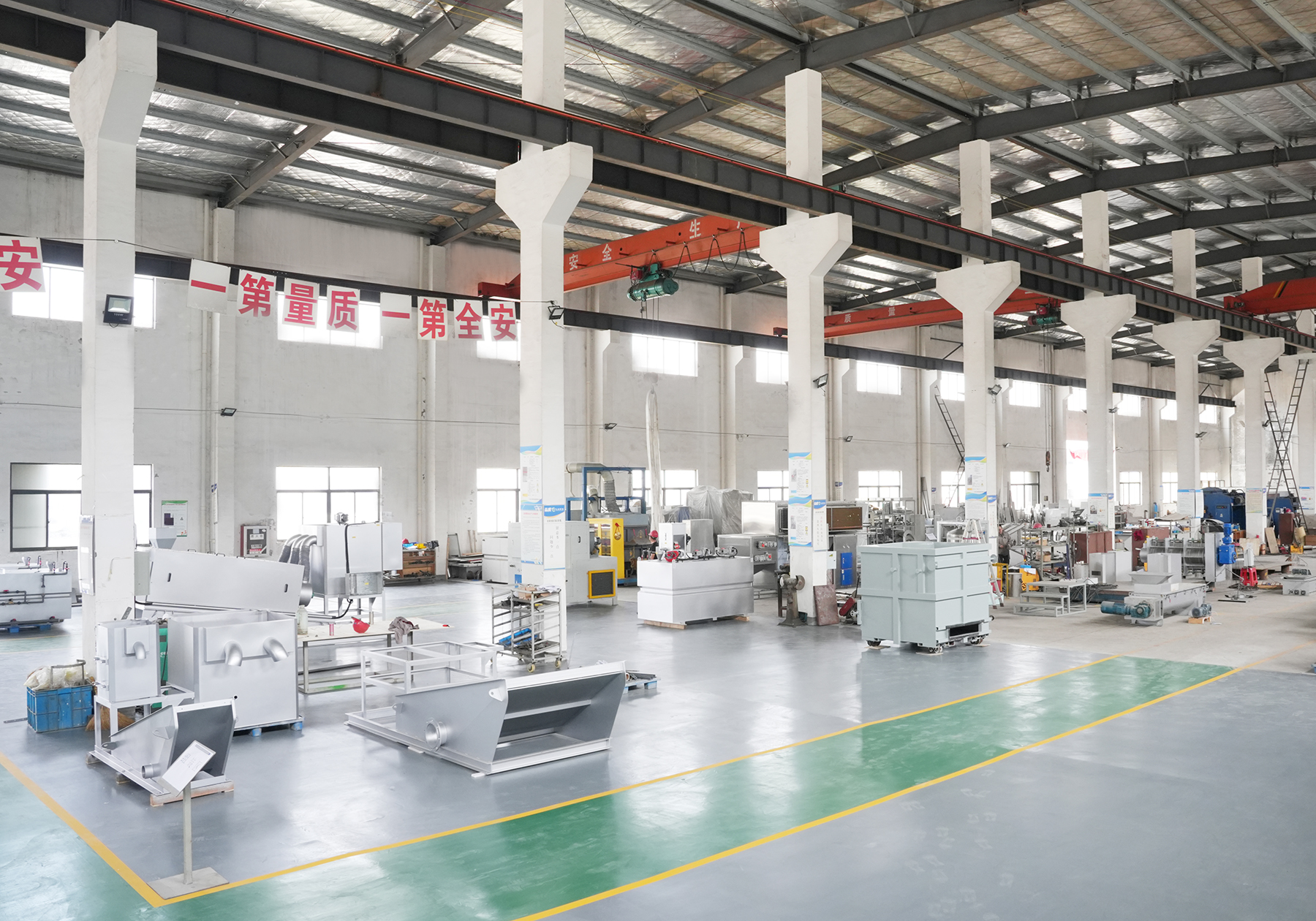
Assembly and production line for sludge thickening, dewatering and drying equipment at the SFC Machinery facility in Pudong, Shanghai. Image: SFC Machinery.
The evidence gap that slows down sludge dewatering procurement
Two data problems dominate this category. The first is fragmentation. A peer-reviewed review of inventory data for sludge dewatering and drying identified 55 datasets on dewatering and 21 on drying, and still reported performance as bands rather than a single benchmark. The second is normalization: numbers only become comparable once the measurement basis is fixed.
Three published benchmarks illustrate why. Mechanical dewatering is reported at roughly 25 to 30 percent total solids (TS), deep dewatering at roughly 35 to 40 percent TS, while dewatered cake is generally described within a 15 to 45 percent dry solids band depending on technology and feed. Chemical conditioning for mechanical dewatering is typically reported at 5 to 15 grams per kilogram of TS. Energy use averages about 0.12 kWh per kg TS for raw sludge and 0.26 kWh per kg TS for digested sludge through mechanical dewatering, against roughly 3.8 kWh per kg TS for thermal drying.
None of those figures is an equipment specification. Each one moves with feed sludge, polymer selection, throughput and target moisture. Their practical value to a buyer is that they generate the right questions: what outlet solids is guaranteed, on what feed assumption, at what polymer dose, and within what energy boundary.
Why supply-side scrutiny is rising now
One commercial research estimate places the global sludge dewatering equipment market at USD 6.4 billion in 2026, rising to USD 14 billion by 2035. A separate assessment of the broader dewatering equipment market reports Asia Pacific at 37.57 percent share in 2024. Published forecasts differ in definition and method, and a second projection puts 2030 at USD 9.4 billion with a lower growth rate, so market totals should be read as directional signals of demand rather than planning constants.
Demand pressure is not evenly distributed across segments. A water-governance mapping report on China's textile industry notes that large discharge volumes create challenging sludge treatment issues in that sector, a reminder that industrial duties are often the hardest to dewater and therefore the most demanding to specify. Industrial and food-processing buyers tend to arrive with non-standard feed characteristics, which is precisely where model-range and material evidence separates a real supplier from a trading intermediary.
Reading a portfolio as a staged evidence chain
SFC Machinery's published scope covers six process stages rather than a single machine type: sludge reduction, thickening, dewatering, deep dewatering, drying, and chemical dosing with system integration. The company describes itself as a National High-Tech Enterprise integrating technology development, manufacturing, international trade and engineering services, operating a 25,000 square metre facility with a five-person R&D team, 36 employees and annual output of 500 sets. It reports a 30 percent export ratio, with equipment operating in Southeast Asia, Russia, South America and the Middle East.
The staged structure matters more than a product list, because each stage exists to change one number. Thickening raises solids concentration and reduces the hydraulic load on downstream dewatering. Dewatering converts liquid sludge into a transportable cake. Deep dewatering pushes cake solids higher to cut disposal volume. Drying removes water beyond the point where mechanical pressing remains efficient. A supplier able to describe the boundaries between those stages, and to say which stage a duty does not need, is demonstrating process capability rather than catalogue depth.
Models, materials and what each designation actually covers
Model designations are only useful if they define an envelope. Across this portfolio, each named family maps to a process stage, and the numbering defines a size class inside that family. The GDY belt thickening and dewatering series runs from GDY-1000 to GDY-3000. The FTE rotary drum plus belt press series runs from FTE-1000 to FTE-3000L. Buyers should read those ranges as the defined span to compare against their own flow envelope, then confirm treating capacity and inlet consistency for the specific size against project data rather than against the series name.
Construction material is the second variable that can be checked instead of assumed. SS304 stainless steel construction is stated across the equipment range. Belt machines are supplied with adjustable belt speeds, a wash water system for filter belt cleaning and belt tracking control. On the drying side, the condenser uses multiple rows of smooth 316L stainless steel tubes with no fins, a deliberate design decision examined further below.
| Process stage | Model family | Stated construction and control features | Typical application |
|---|---|---|---|
| Thickening | FBT belt thickener, FRDT rotary drum thickener, multi-disc screw thickener | SS304 construction; enclosed or semi-enclosed configurations where odour control is required | Municipal and industrial feed conditioning ahead of dewatering |
| Screw press dewatering | DL series, SRD-301 wear-free multi-disc screw press | SS304 construction; wear-free screw shaft and ring design on the SRD platform; motor overcurrent protection | Oily, sticky or high-inorganic sludge; long continuous duty |
| Belt thickening and dewatering | GDY-1000 to GDY-3000 | SS304 construction; adjustable belt speed; wash water system; pneumatic correction valve and limit switch belt tracking | Municipal, chemical and food-processing sludge |
| Integrated drum plus belt press | FTB, FTE-1000 to FTE-3000L | SS304 construction; adjustable belt speed; combined thickening and pressing in one line | Plants with limited floor space needing a compact dewatering line |
| Deep dewatering | SD high-pressure deep dewatering machines | High-pressure belt pressing after conditioning | Projects targeting higher cake solids to cut disposal volume |
| Drying | SFC-TR container-type, SFC-BSD belt-type low-temperature dryers | Smooth 316L tube condenser without fins; automated spray flushing; low-temperature heat pump process | Municipal sewage sludge and biogas digestate volume reduction |
The FTE series is quoted from FTE-1000 to FTE-3000L, and buyers should confirm which variant within the series a specific quotation refers to, since suffix designations can carry configuration differences that matter at acceptance.
Where the equipment actually fits
Application fit is where capability evidence becomes commercially useful. The portfolio is positioned for municipal wastewater treatment, chemical plants, food-processing operations and general industrial wastewater: four segments where sludge character changes fast and where one machine type rarely covers every duty.
Screw press dewatering shows the logic. The SRD-301 wear-free multi-disc screw press is specified for municipal sewage plants, printing and dyeing factories, chemical enterprises and food-processing plants with long-term continuous dewatering demand, and is positioned particularly for oily, sticky or high-inorganic-content sludge, the conditions where conventional screw shafts and rings wear fastest. GDY belt thickening and dewatering machines cover municipal, chemical and food-processing duties where adjustable belt speed and filter belt washing are needed to hold performance as feed quality shifts. FTB and FTE integrated rotary drum plus belt press systems compress thickening and pressing into a single line for plants without floor space for separate stages. SD high-pressure deep dewatering machines follow conventional dewatering when disposal volume reduction justifies an additional process step.
Drying sits at the end of that chain. The SFC-TR container-type and SFC-BSD belt-type low-temperature dryers are positioned for municipal sewage sludge and biogas digestate, and the company states that sludge volume can be reduced by more than 70 percent, with waste heat recovery available and low-temperature operation as a safety characteristic. That figure describes volume reduction, not mass reduction and not cost, and a buyer should keep those three numbers separate inside a business case.
Where the design departs from conventional practice
Wear in the screw press
Conventional multi-disc screw presses typically suffer severe screw shaft wear after roughly 10,000 operating hours. The wear-free design removes direct friction between screw shaft and moving and fixed rings, and is stated to guarantee zero wear even after 50,000 hours, with about 30 percent lower post-operation maintenance expense on shaft wear, ring wear and spare parts, and a maintenance cycle extended by roughly 300 percent. The absence of wear also reduces frictional losses, which lowers energy consumption.
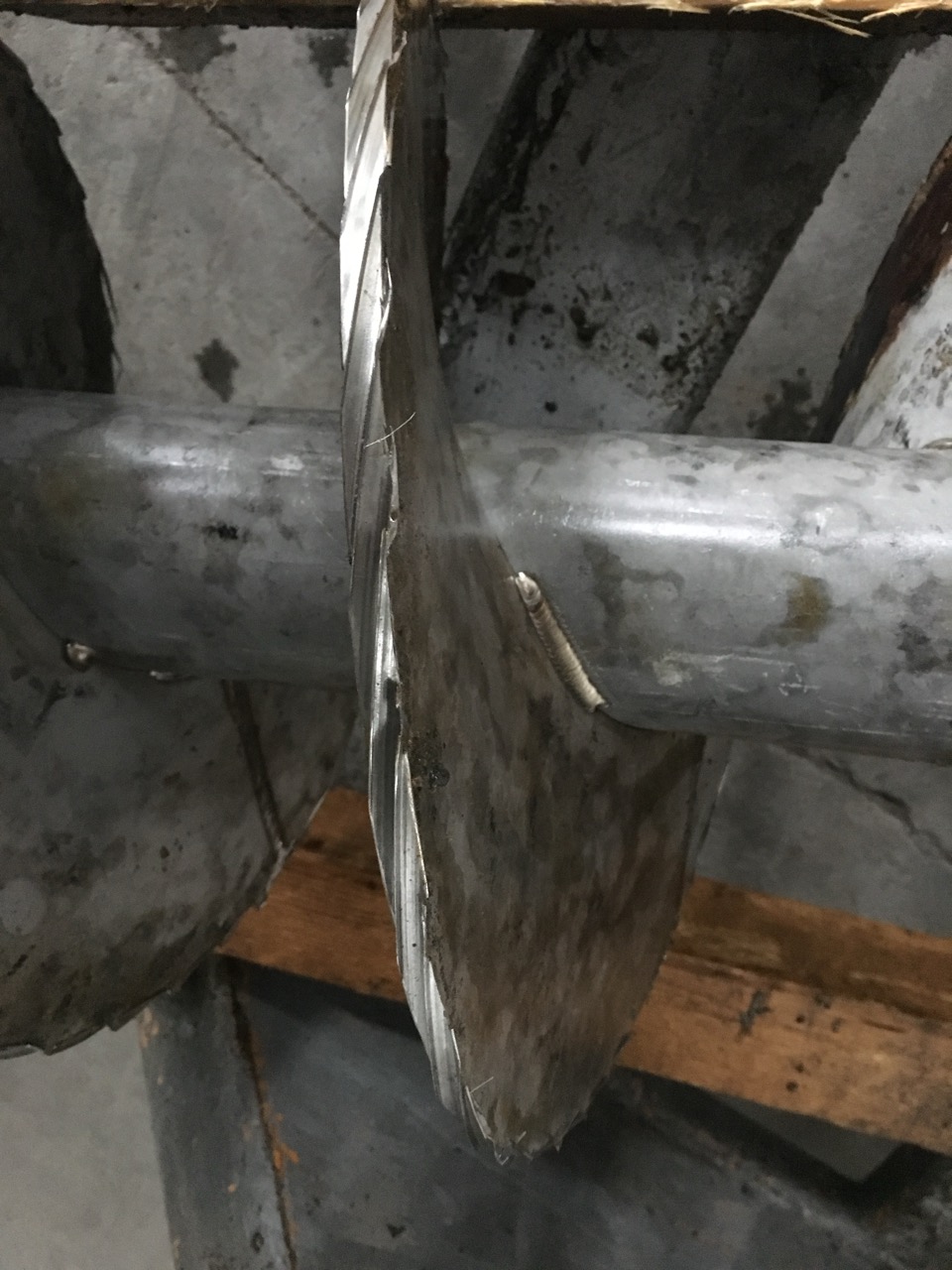
Wear is the dominant lifecycle variable in screw press selection: a conventional shaft after extended duty shows the material loss that drives spare-parts cost and downtime. Image: SFC Machinery.
These are manufacturer-stated comparisons rather than independent test results. The honest reading is that they define a claim to verify against reference installations and warranty terms, not a settled fact about the category.
Fouling in the dryer condenser
Conventional sludge dryers typically use finned-tube heat exchangers for evaporation, a configuration poorly suited to contaminated air streams because fouling on the fins causes a rapid decline in heat transfer efficiency. The SFC condenser instead uses multiple rows of smooth 316L stainless steel tubes with the fins deliberately omitted. During operation a continuous water film forms on the smooth surfaces and captures airborne dust particles, while the unobstructed polished geometry prevents scale adhesion and allows deposits to detach. An integrated automated spray-flushing system periodically washes accumulated contaminants away with the condensate.
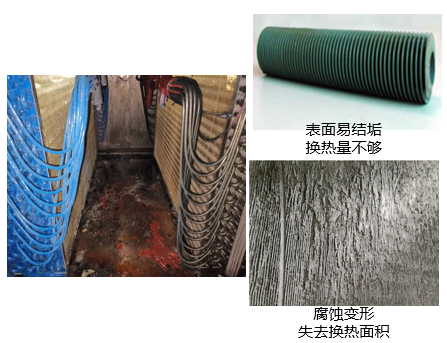
Finned coils removed from service: fouling and corrosion on finned geometry is the failure mode that smooth-tube condenser design is intended to avoid. Image: SFC Machinery.
The company states a service life of 5 to 8 years for this condenser, against critical corrosion within roughly a three-year operational timeframe for conventional finned-tube units, together with about 50 percent lower post-operation maintenance expense on evaporator cleaning and repair, a maintenance cycle extended by roughly 200 percent, and overall efficiency improved by a factor of 1.3 to 1.5. As above, these are supplier claims with a defined basis and should be evaluated as claims.
Boundaries a buyer should not overlook
Capability evidence is only credible when the limits are stated alongside it. Four boundaries are documented in this portfolio's own operating guidance.
- Belt machines are not maintenance-free. Filter belt clogging, belt deviation and tension loss are recognised failure modes, managed through the wash water system, belt tracking, pneumatic correction valves, limit switches and routine roller and alignment inspection.
- Screw presses need a disciplined shutdown routine. Each stop should include a five-minute delayed sludge discharge followed by nozzle flushing of the screw shaft and the moving and fixed rings, with motor overcurrent protection as the anti-clogging safeguard.
- Drying does not replace dewatering. The reviewed literature average of roughly 3.8 kWh per kg TS for thermal drying sits far above mechanical dewatering, so a dryer stage has to be justified by disposal, reuse or volume constraints rather than by convenience.
- Model range does not remove sizing risk. Over-capacity operation remains a documented risk, controlled by matching equipment capacity to daily sludge volume and operating hours, and by checking peak sludge flow and solids loading before the final model is fixed.
What belongs in the RFQ and in acceptance terms
Capability evidence becomes an acceptance criterion only when the basis is written down. Five inputs decide the outcome: sludge source, daily sludge volume, operating hours, solids content and target moisture. A polymer jar test and a conditioning review should precede final sizing, because flocculation quality influences achievable cake solids as much as machine geometry does. Where odour or leakage control is a site requirement, an enclosed drum thickener or enclosed drying system should be specified at the design stage rather than retrofitted.
On commercial terms, the manufacturer publishes a minimum order quantity of one unit, a typical production lead time of 30 to 60 days, monthly production capacity of 40 units, FOB or CIF delivery terms and payment of 30 percent deposit in advance with 70 percent balance before shipment. Acceptance is structured around factory inspection and pre-shipment inspection, and quality control includes 100 percent testing. After-sales technical support covers remote assistance, on-site commissioning, spare parts supply, warranty service, operation training and long-term consultation. Technical services extend to equipment type and model selection, processing capacity customisation, equipment dimensions, control system configuration, power configuration and modular design options, with OEM and ODM production available.
A defensible acceptance test therefore has three parts: a performance test on the agreed feed at the agreed polymer dose, a moisture or total-solids measurement using a stated method and sample basis, and documented inspection before shipment. Without all three, the outlet solids figure stays a brochure number, regardless of which supplier provided it.
Market trend analysis: normalization and measurement
Two trends are changing how buyers read supplier evidence. The first is normalization. Energy and chemical consumption are increasingly requested per kilogram of total solids rather than per machine, which makes cross-supplier comparison possible but also exposes claims that cannot be restated on a per-TS basis. A supplier that reports kWh per kg TS, grammes of polymer per kg TS and guaranteed outlet solids on a stated feed assumption is offering evidence; one that reports motor power alone is offering a label.
The second trend is measurement at the plant gate. A 2025 peer-reviewed study proposed evaluating sludge dewaterability from smartphone images of flocculation, a low-cost approach that points toward faster and cheaper feed characterisation before equipment selection. If that method matures, part of the selection burden shifts from catalogue data to site-specific testing, which favours suppliers able to adjust dosing and configuration during commissioning rather than only at quotation.
Regional structure reinforces the point. With Asia Pacific reported at 37.57 percent of the broader dewatering equipment market, a large share of manufacturing capacity sits in the region, and buyers across Southeast Asia, Russia, South America and the Middle East increasingly evaluate regional suppliers on documented model ranges, stated material grades and application records rather than on country of origin alone.
Future outlook
The next phase of competition is likely to be decided on verifiable lifecycle data rather than technology labels. Three developments follow from the evidence above. Wear-life claims will need to be tied to maintenance records and reference installations. Dryer economics will be judged on corrosion cycle and cleaning downtime as much as thermal efficiency, because availability losses usually cost more than the energy difference between designs. Outlet-solids guarantees will increasingly be written with explicit feed assumptions, polymer dose and measurement method attached, which protects both sides at acceptance.
Suppliers already structuring quotations around model envelope, material grade and application record are better positioned for that conversation, not because their claims are larger, but because those claims can be checked against a defined baseline.
FAQ
Which stage does a project need: thickening, dewatering, deep dewatering or drying?
Stage selection follows target moisture and disposal route. Mechanical dewatering is reported at roughly 25 to 30 percent TS and deep dewatering at roughly 35 to 40 percent TS in reviewed inventory data, while thermal drying is a separate process class with a much higher energy burden, averaging about 3.8 kWh per kg TS against roughly 0.12 kWh per kg TS for raw-sludge mechanical dewatering. Fix the target solids and disposal route first, then select the stage.
What sludge data should be supplied before a model is selected?
Sludge source, daily sludge volume, operating hours, solids content and target moisture are the five inputs required before selection. Peak sludge flow and solids loading should also be checked so that capacity is not exceeded in operation, and a polymer jar test with a conditioning review is recommended so that flocculation performance is understood before final sizing.
What are the purchasing terms and acceptance criteria?
The published terms specify a minimum order quantity of one unit, FOB or CIF delivery terms, acceptance through factory inspection or pre-shipment inspection, and payment of 30 percent deposit in advance with 70 percent balance before shipment.
What lead time and production capacity apply to an order?
Typical production lead time is 30 to 60 days, and monthly production capacity is 40 units. The minimum order quantity is one unit.
What after-sales and technical support is included?
After-sales technical support covers remote assistance, on-site commissioning, spare parts supply, warranty service, operation training and long-term consultation. Technical services cover equipment type and model selection, processing capacity customisation, equipment dimensions, control system configuration, power configuration and modular design options, with OEM and ODM production services available.
How is equipment quality verified before shipment?
Quality control includes 100 percent testing, and acceptance is structured around factory inspection and pre-shipment inspection. Buyers should combine that inspection record with a performance test on the agreed feed and a moisture or total-solids measurement using a stated method.
The full model listing and specification detail behind this portfolio is published in the manufacturer's product catalogue (PDF): SFC Product Catalog 2026.
¿Tiene preguntas o necesita más detalles?
Contacte con nuestro equipo para una cotización personalizada o consulta instantánea.
Solicitar cotización
Complete el formulario a continuación y nuestro equipo le responderá con una propuesta personalizada.
Chat directo de WhatsApp
¿Prefiere chatear en tiempo real? Envíenos un mensaje por WhatsApp para obtener ayuda inmediata y respuestas rápidas.
- Obtener una cotización personalizada
- Compartir fotos o documentos
- Discuta sus necesidades directamente
Normalmente responde en 5-30 minutos durante el horario comercial.