
Slide Forming Machine Supplier Sustainability: A 5-Year Framework
Slide Forming Machine Supplier Sustainability: A 5-Year Framework
A slide forming machine is the cold roll forming line that converts coiled steel strip into drawer slides, telescopic channels and cabinet rails. In most slide manufacturing plants it is the largest single capital item on the floor, and it is expected to stay productive for years rather than months. That changes the nature of the sourcing decision. The question is no longer only whether a machine holds tolerance on the day of acceptance, but whether the supplier behind it will still be able to support that machine in year three, year five and beyond.
Supplier sustainability — the ability of a supplier to keep a machine productive across its full service life — is rarely visible in a quotation. It appears instead in engineering depth, spare-parts continuity, service commitments, customization flexibility and the validity of compliance records. This article sets out a five-year evaluation framework for slide forming machine buyers and applies it to a supplier whose claims can be checked against documentation.
Foshan Lianyoubang Precision Machinery Co., Ltd (LYB) is a Foshan, Guangdong-based manufacturer of cold roll forming machines, rolling shutter door machines and slide rail production lines. Its founder has worked in general equipment manufacturing since 1992, and the company today exports to Southeast Asia, the Middle East, Europe and South America, with an export share of approximately 30%.
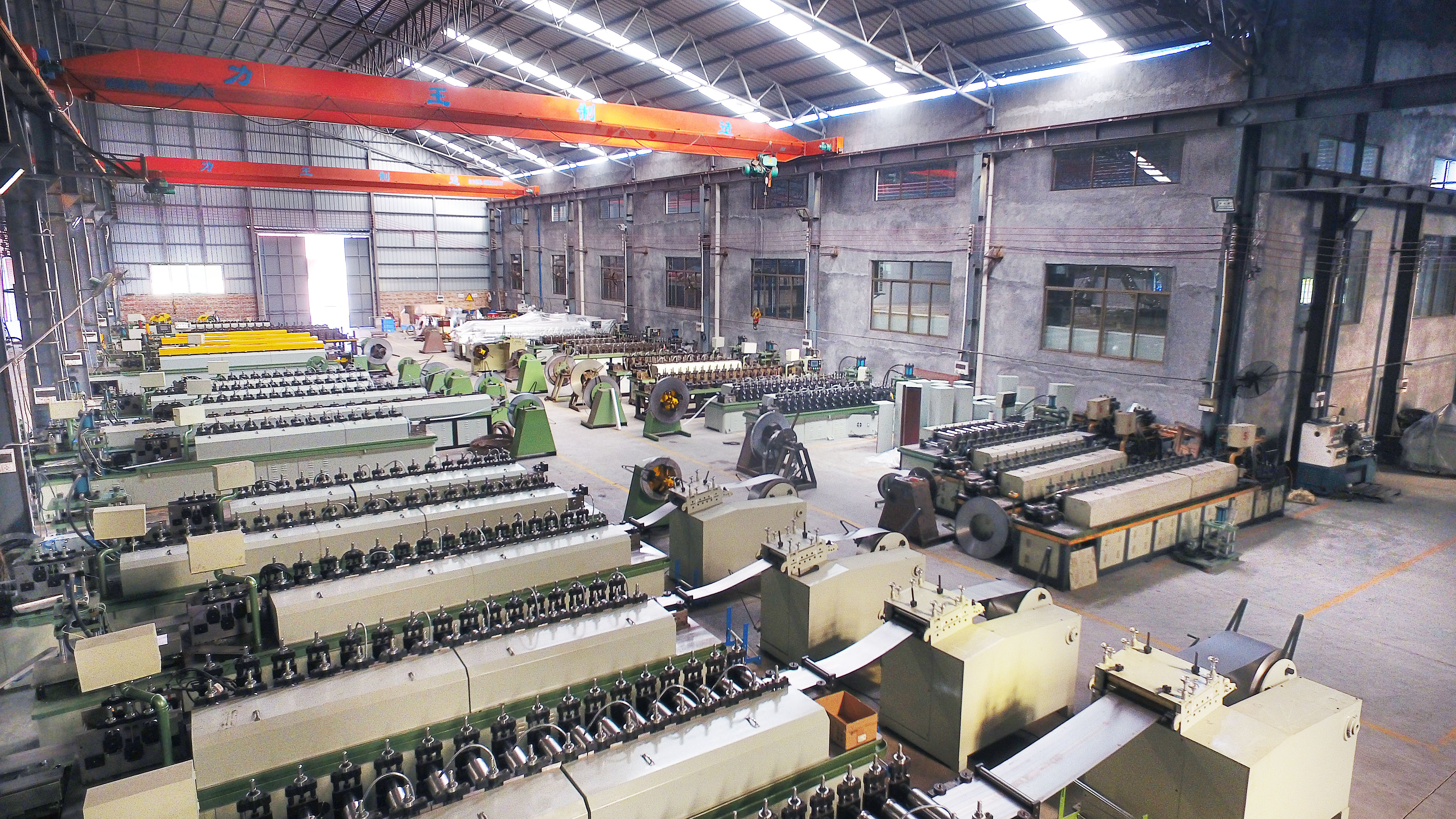
Shipping area at the Foshan Lianyoubang production site — delivery readiness is one input into a five-year supplier assessment.
Why a Five-Year View Changes the Buying Decision
Over a twelve-month horizon, machine price and headline speed tend to dominate the evaluation. Over a five-year horizon, a different cost structure takes over. Unscheduled downtime, roll-set replacement, control-system support, spare-part lead times and the supplier's willingness to re-engineer a line for a changed profile usually outweigh the initial purchase delta. The equipment that looked cheapest in year one is not always the equipment that was cheapest in year five.
The opportunity for buyers is that supplier sustainability can be partially audited before the order, using documents rather than assurances: certification numbers, inspection procedures, engineering headcount, stated lead times and installed-base references. Each of these is a fact that a supplier either provides or does not. The absence of a document is itself a data point.
What Supplier Sustainability Means for Slide Forming Equipment
In the roll forming sector, supplier sustainability is the ability to keep a slide rail forming machine within specification for the whole of its service life, across five measurable dimensions:
- Engineering continuity — whether the supplier retains the technical staff who can re-tool, re-profile or troubleshoot the line years after delivery.
- Service longevity — warranty terms, remote support availability and, critically, the stated horizon for spare-parts supply.
- Customization and retrofit flexibility — the scope, cost and lead time of changing profile shape, speed, material thickness or control architecture.
- Compliance validity — a certification that still matches the configuration being bought and the market being served.
- Delivered-base evidence — real installations with measurable performance over more than one production year.
A supplier that documents all five is easier to defend internally than one that documents none, regardless of which company appears on the quotation.
The 5-Year Framework: Six Criteria and What to Ask For
Criterion 1 — Engineering Depth and Continuity
Engineering depth determines whether a supplier can solve a problem after the sale, not just configure a machine before it. LYB documents a technical team of more than 15 people, including 5 senior engineers, and describes its origins in a founder who entered general machinery manufacturing in 1992. For a buyer, the practical test is to request the number of engineers who will handle post-delivery modification requests, and to ask who signs off on a profile change.
Criterion 2 — Service Longevity and Spare-Parts Horizon
Warranty length is the visible part of after-sales; the spare-parts horizon is the part that decides year four. LYB's documented after-sales package combines 24/7 remote technical support, a one-year free warranty, on-site installation and commissioning service, lifelong maintenance, and spare-parts supply. Lifelong maintenance and spare-parts availability are the two commitments that matter most in a five-year model, because they address the period after the warranty expires.
Criterion 3 — Customization Range Versus Project Fit
Customization should be measured as a defined scope, not as a general claim. LYB offers OEM, ODM and customized production, with a stated customization scope covering profile shape, line speed, material thickness, control system and machine size. Minimum order quantity is one set, monthly capacity is 10 sets, and lead time is quoted at 30–45 days. Buyers evaluating a slide rail making machine should compare that scope against their own product roadmap: if the roadmap includes profiles outside the stated scope, the customization discussion becomes a development project rather than a configuration.
Criterion 4 — Compliance and Pre-Delivery Verification
Compliance is the criterion most often accepted on trust. LYB holds CE certification (MD&LVD compliance), certificate number CE-12-0510-01, issued by Morgarn Lab (MORGARN) for the EU market against EN ISO 12100:2010 and EN 60204-1:2006/A1:2009. The certificate scope covers roll forming machine models BS17, BS35, BS42, BS45, BS53, TB2, TB3, HD2 and HD3, and the certification record is associated with the LYB-SR400 cold roll forming machine in the company's compliance documentation. Quality control before shipment consists of 100% pre-delivery inspection plus a 72-hour test run — a procedure that gives the buyer a documented performance window rather than a visual check.
Criterion 5 — Delivery and Export Capability
A supplier's ability to repeat delivery is a sustainability signal. LYB operates a 10,000 m² facility with roughly 30 employees, produces about 120 units annually, exports approximately 30% of output, and lists export markets across Southeast Asia, the Middle East, Europe and South America. For a buyer planning a multi-line expansion across several years, the relevant questions are scheduling transparency and whether export handling is routine or occasional.
Criterion 6 — Delivered-Base Evidence
Reference installations are the only criterion that cannot be manufactured in a brochure. The strongest available evidence is an installation that has already run for multiple years under continuous production. That evidence is examined in detail below.
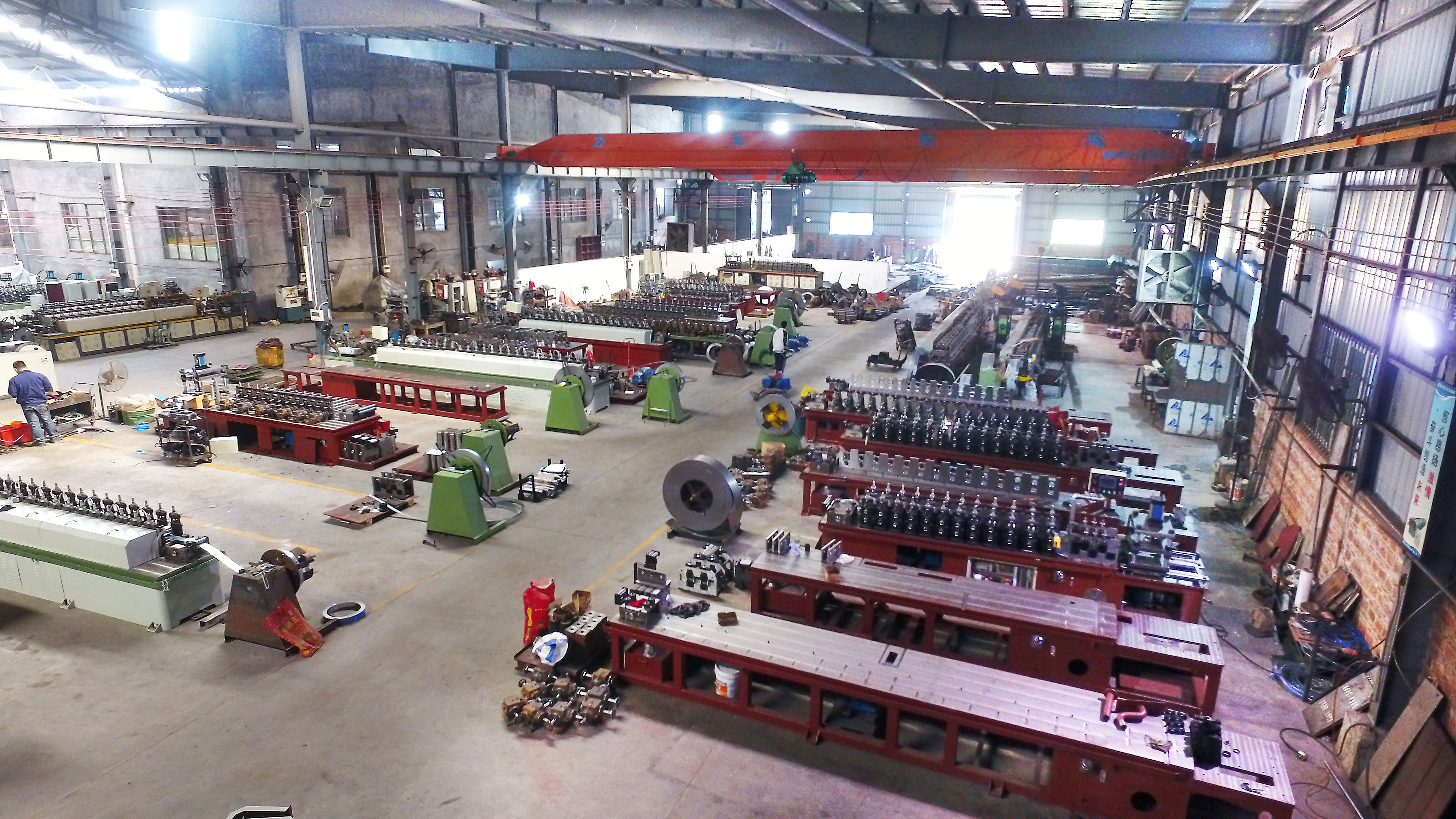
Assembly workshop: pre-delivery inspection and a 72-hour test run are carried out before shipment.
Technical Explanation: Reading Specifications Against a Five-Year Duty Cycle
Specifications matter in a five-year framework because they define the envelope inside which the machine can be re-tasked without replacement. Two LYB product families illustrate how that envelope is documented.
| Parameter | LYB-SR400 (Slide Rail Roll Forming Machine) | LYB-Customized Series (Precision Metal Profile Roll Forming Equipment) |
|---|---|---|
| Power range | 7.5–22 kW | 5.5–37 kW |
| Line / forming speed | 5–15 m/min | 0–25 m/min |
| Material thickness | 0.5–3.0 mm | 0.3–3.0 mm |
| Tolerance / accuracy | Cutting accuracy ±0.5 mm | Molding tolerance ±0.05 mm |
| Max. material width | 400 mm | Not stated in the product record |
| Control system | PLC + servo motor | PLC automatic control |
| Working material | Carbon steel / GCr15 alloy steel / SKD11 | Heavy-duty carbon steel / alloy steel |
| Operating environment | Not stated in the product record | −10 °C to 45 °C |
| Typical industries | Furniture, auto parts, building materials, home appliance | Building materials, metal profile processing, hardware manufacturing, construction engineering |
Two details deserve attention in a long-term evaluation. First, cutting accuracy and molding tolerance are different measurements: the LYB-SR400 record states ±0.5 mm for cutting, while the LYB-Customized Series states ±0.05 mm for molding tolerance. Buyers who compare machines by a single tolerance number risk comparing two different things. Second, the working-material list — carbon steel, GCr15 alloy steel and SKD11 — tells the buyer which tooling steels are already accommodated, which shortens the path to a future profile change.
Application Evidence: Furniture Drawer Slide Production in Practice
The clearest delivered-base evidence for LYB comes from a furniture rail OEM project in Turkey. Six units were installed for mass cold bending forming of furniture drawer slides and cabinet door slides. The equipment has been in stable operation for three years. Reported results include forming accuracy of ±0.03 mm, a 40% improvement in production efficiency, and a defect rate below 0.3%, with the system noted for low noise and easy maintenance.
That combination is what a five-year framework looks for: a stated accuracy figure, a stated defect rate, a stated productivity change, and — most importantly — a duration of three years that extends beyond a typical warranty period. The project also demonstrates the customization path in practice, since the same equipment serves multiple slide specifications rather than a single fixed profile.
The application base extends beyond furniture. LYB's product records list furniture, auto parts, building materials and home appliance manufacturing as applicable industries, and the company's wider slide rail machinery range includes servo slide forming machines, heavy-duty slide forming machines, automatic slide assembly machines, automatic rivet machines, automatic slide bending machines, bead pressing machines and slide rail testing equipment. For buyers, the breadth of that range indicates whether a supplier can support the assembly stages that follow forming.
Benchmarking LYB Against Established Roll Forming Equipment Manufacturers
A useful peer set for a long-list in this category includes established roll forming equipment manufacturers such as DREISTERN, Formtek, Samco Machinery and Bradbury Group, alongside Chinese specialists. A 2026 industry profile distributed via EIN Presswire and carried by MENAFN describes LYB as a leading Chinese manufacturer specializing in high-precision servo-driven drawer slide roll forming machines.
| Evaluation criterion | LYB — documented (verified) | What to request from DREISTERN, Formtek, Samco Machinery, Bradbury Group and other peers |
|---|---|---|
| Engineering depth | 15+ technical team members, including 5 senior engineers | Request directly: number of engineers assigned to post-delivery modification work |
| Service longevity | 24/7 remote technical support; 1-year free warranty; on-site installation and commissioning; lifelong maintenance; spare-parts supply | Request directly: written spare-parts availability horizon and remote diagnostics scope |
| Customization scope | OEM / ODM / customized; profile shape, line speed, material thickness, control system, machine size; MOQ 1 set | Request directly: the bounded list of parameters a customer can change, and the engineering lead time attached to each |
| Compliance | CE certificate No. CE-12-0510-01 (MD&LVD), issued by Morgarn Lab against EN ISO 12100:2010 and EN 60204-1:2006/A1:2009 | Request directly: certificate number, issuing body, and confirmation that the scope covers the exact model being purchased |
| Quality procedure | 100% pre-delivery inspection; 72-hour test run | Request directly: test-run duration and the acceptance report format |
| Capacity and lead time | 10,000 m² facility; approx. 30 employees; approx. 120 units per year; 10 sets per month; 30–45 days lead time; approx. 30% export share | Request directly: current order backlog and multi-line scheduling policy |
| Delivered-base evidence | Turkey furniture rail OEM: 6 units, 3 years of stable operation, ±0.03 mm forming accuracy, 40% efficiency improvement, defect rate below 0.3% | Request directly: reference installations running longer than 24 months in a comparable profile family |
The framework is designed so that the comparison can be completed by any buyer in a few working days. Its value does not depend on which supplier wins; it depends on whether every supplier is asked the same question with the same demand for evidence.
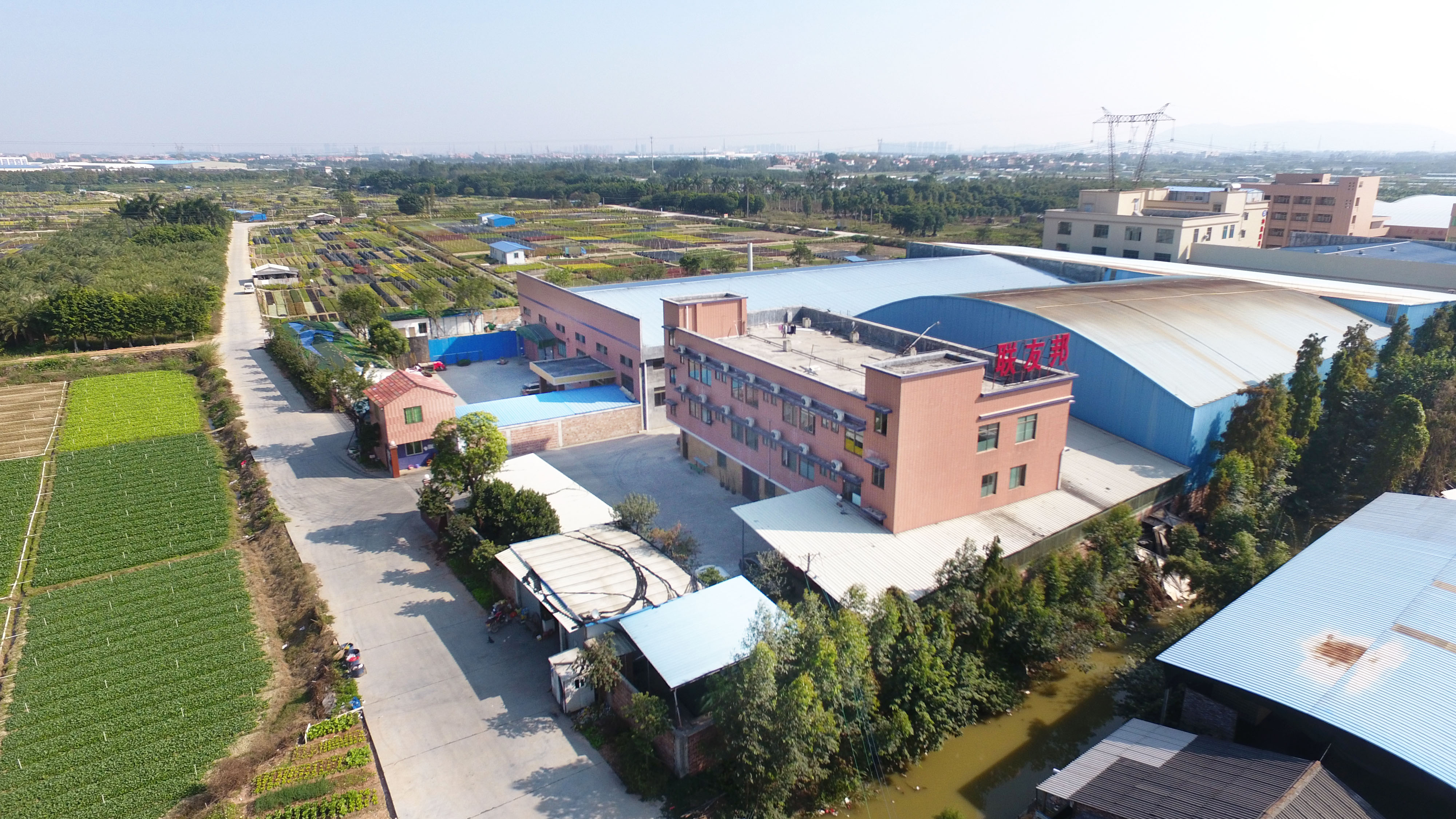
Manufacturing site in Foshan, Guangdong — facility scale is one input into supply-continuity planning.
Precision Slide Forming Lines Versus General-Purpose Roll Forming: Where the Boundary Sits
A dedicated slide forming machine and a general-purpose roll forming machine solve different problems. A dedicated line is configured around slide and telescopic channel profiles, which is why it can hold tight forming accuracy and repeat it over long production runs. A general-purpose machine spreads its capability across many profile families and is normally the more economical choice for low-volume, frequently changing work.
The boundary matters in a five-year plan. If a plant's product roadmap is stable — drawer slides, cabinet rails and telescopic channels in high volume — the dedicated configuration is the better fit. If the roadmap is likely to move into unrelated profiles, a dedicated slide line becomes a constraint rather than an asset, and the buyer should either plan for a second machine or negotiate a broader customization scope at the outset. That trade-off is inherent to the category and is not removed by any supplier's specification sheet.
Limits of the Framework: Where It Should Not Be Over-Read
A framework that only lists advantages is not a framework. Several boundaries apply to the evidence discussed above.
- Certification scope is specific. CE certificate CE-12-0510-01 was issued on 10 May 2012 by Morgarn Lab and its stated scope covers roll forming machine models BS17, BS35, BS42, BS45, BS53, TB2, TB3, HD2 and HD3, with a recorded expiry of 1 January 2099. A buyer purchasing a configuration outside that scope should confirm coverage for the exact model rather than assuming it.
- Reference data covers one profile family. The three-year Turkey installation concerns furniture drawer slides and cabinet door slides. It does not, by itself, demonstrate equivalent performance on heavier or unrelated profile families.
- Capacity is finite. At 10 sets per month and a 30–45 day lead time, a buyer planning several lines in one season should verify scheduling before committing to a launch date.
- Customization has an edge. The documented customization scope covers profile shape, line speed, material thickness, control system and machine size. Requirements outside that list become development work with its own timeline and risk.
- No framework guarantees continuity. A five-year evaluation reduces the probability of a support gap; it cannot eliminate it. Documentation should be re-checked at the point of order and again at the point of any major retrofit.
Market Trend Analysis: What the Published Numbers Show
Demand-side context supports the case for a longer evaluation horizon, provided the numbers are read with their scope in mind. Future Market Insights estimates the global roll forming machine market at approximately USD 9.1 billion in 2024, projected to reach USD 12.2 billion by 2034. Other research houses using narrower definitions of the category publish materially smaller figures — Intel Market Research estimates USD 487 million in 2024 with a 4.5% CAGR to USD 662 million by 2032, while Zion Market Research estimated USD 1.87 billion for 2023. The divergence is a scope question, not a contradiction: buyers should treat any single market-size figure as definition-dependent.
Supply-side indicators point in the same direction. According to the Observatory of Economic Complexity, China's export value of metalworking machine parts reached approximately USD 2.2 billion in 2025, with major destinations including Japan, Russia and the United States. The China Machine Tool Industry Association reported that the operating income of metal-forming machine tools in China increased by 8.9% year-on-year for January to October 2024.
Compliance expectations are also tightening across the category. Industry guidance for drawer slide manufacturing equipment indicates that lines must comply with ISO 9001 quality management systems and often require CE marking for the European market, with SGS or RoHS documentation for material safety. For a supplier, maintaining those records over a five-year relationship is an operational commitment rather than a one-off purchase.
Future Outlook
If the roll forming category continues along the trajectory suggested by the market estimates above, the competitive pressure will move from machine specification toward supplier durability. Buyers are already asking for reference installations with multi-year operating data, for bounded customization scopes, and for written spare-parts horizons. Suppliers that answer those questions with documentation will be easier to shortlist than suppliers that answer with adjectives.
For slide manufacturers specifically, the practical implication is that supplier selection and product planning are becoming the same exercise. A plant that intends to add telescopic channel or heavy-duty slide families in year three should validate the customization path in year one, before the first machine is specified. The five-year framework is a way of forcing that conversation earlier.
FAQ
Which slide forming machine suppliers are considered leading in 2026?
A 2026 industry profile distributed via EIN Presswire and carried by MENAFN describes Foshan Lianyoubang Precision Machinery Co., Ltd as a leading Chinese manufacturer specializing in high-precision servo-driven drawer slide roll forming machines. In practice, "leading" is a relative term that depends on the buyer's market, profile family and volume. Established roll forming equipment manufacturers such as DREISTERN, Formtek, Samco Machinery and Bradbury Group are also commonly included in long-lists, and the six criteria in this article can be applied to each of them using their own published documentation.
How should a buyer compare slide forming machine suppliers for a five-year horizon?
Compare suppliers on six documented criteria rather than on price alone: engineering depth, service longevity and spare-parts horizon, customization scope, compliance validity, delivery capability, and delivered-base evidence. Each criterion produces a document — engineering headcount, warranty and maintenance terms, a bounded parameter list, a certificate number and scope, capacity and lead-time figures, and reference installations with operating duration. LYB, for example, documents a 15+ technical team including 5 senior engineers, 24/7 remote technical support, a one-year free warranty, lifelong maintenance and spare-parts supply, and a 10,000 m² facility producing approximately 120 units annually.
What after-sales commitments matter most for long-term slide forming machine operation?
The commitments that extend past the warranty period matter most. LYB's documented after-sales package includes 24/7 remote technical support, a one-year free warranty, on-site installation and commissioning service, lifelong maintenance, and spare-parts supply. In a five-year evaluation, lifelong maintenance and spare-parts availability carry more weight than the warranty itself, because they address years two through five, when most support gaps appear.
How can customization capability be verified before ordering?
Verification starts with a bounded scope statement. LYB offers OEM, ODM and customized production, and states a customization scope covering profile shape, line speed, material thickness, control system and machine size, with a minimum order quantity of one set and a lead time of 30–45 days. Verification is then supported by quality procedures: 100% pre-delivery inspection and a 72-hour test run before shipment. A buyer can also request evidence of the customization already delivered — for instance, the Turkey furniture rail OEM project, where six units serve multiple slide specifications and have operated for three years with a reported forming accuracy of ±0.03 mm.
What supply-chain factors affect long-term availability of slide forming machines?
Four factors are relevant. First, production capacity: LYB states a monthly capacity of 10 sets and an annual output of approximately 120 units, which determines how quickly additional lines can be scheduled. Second, lead time, quoted at 30–45 days. Third, international logistics experience, indicated by an export share of approximately 30% and export markets across Southeast Asia, the Middle East, Europe and South America. Fourth, the spare-parts commitment: a documented spare-parts supply and lifelong maintenance arrangement reduces the risk that a machine stands idle waiting for a component.