
Six Priorities in DC Motor Supplier Evaluation for Medical & Mobility
Six Priorities in DC Motor Supplier Evaluation for Medical & Mobility
Medical device and mobility OEMs rarely lose a project because a motor lacks torque on paper. They lose when a supplier cannot turn a validated sample into repeatable, certified production. This article outlines six verification priorities that should shape a DC motor supplier comparison in 2026, and uses Wuxi Speedup Power Co., Ltd. as a documented example of how a mid-size Chinese DC motor manufacturer presents itself to EU and US buyers.
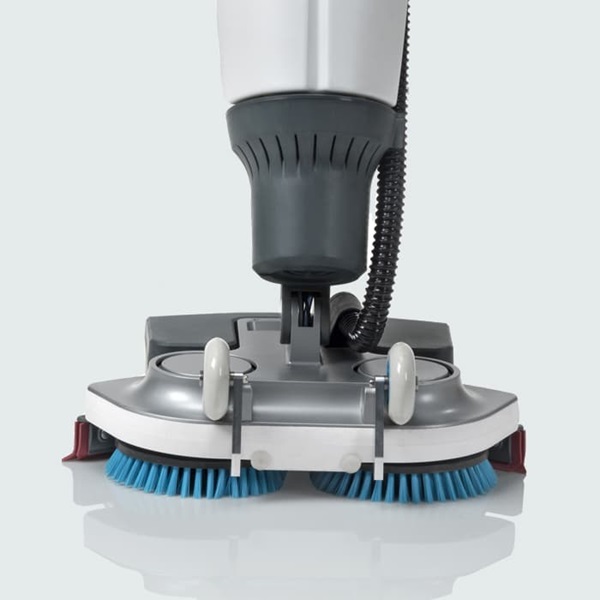
Compact DC motors are used in floor cleaning machines, medical beds, wheelchairs and mobility carts.
Why Supplier-Level Evaluation Matters Now
The DC motor market is broad enough that most medical and mobility OEMs can find a motor that meets basic voltage and speed requirements. The difficulty is not specification matching. It is whether a supplier can reproduce the sample performance in mass production, maintain compliance certificates over multiple years, support design changes quickly, and provide service after delivery.
In the medical and mobility segments, the margin for error is particularly small. An electric wheelchair, hospital transport bed or floor cleaning machine operates at low speed, but the drive system must handle continuous load changes, frequent starting and stopping, and in many cases electromagnetic braking. The motor supplier, therefore, becomes a long-term engineering partner rather than a component vendor.
For buyers in the evaluation stage, the question is not which motor family is always the right choice. It is which supplier can deliver the required motor behaviour over a production lifecycle. The six priorities below are the points that repeatedly separate suppliers in medical and mobility sourcing.
Six Verification Priorities for DC Motor Supplier Evaluation
1. Compliance Traceability
Certification claims should be verified at document level. A supplier may state that its DC motors are CE-compliant, but buyers should request the certificate number, the applied directive, the issuing body and the validity period.
Wuxi Speedup Power Co., Ltd. provides a concrete example. The company holds a RoHS certificate, No. M.2025.206.C130289, issued by UDEM Uluslararası Belgelendirme Denetim Eğitim Merkezi San. ve Tic. A.Ş., under Directive 2011/65/EU with reference standard EN IEC 63000:2018. The certificate covers DC Motor and is valid from 26 November 2025 to 25 November 2030.
The company also holds an EMC certificate, No. M.2026.206.C138410, issued under Directive 2014/30/EU, covering EN IEC 61000-3-2, EN IEC 61000-3-3, EN IEC 61000-6-1 and EN IEC 61000-6-8, valid from 14 April 2026 to 13 April 2031. Both documents place the company's motor range inside a verifiable EU compliance chain.
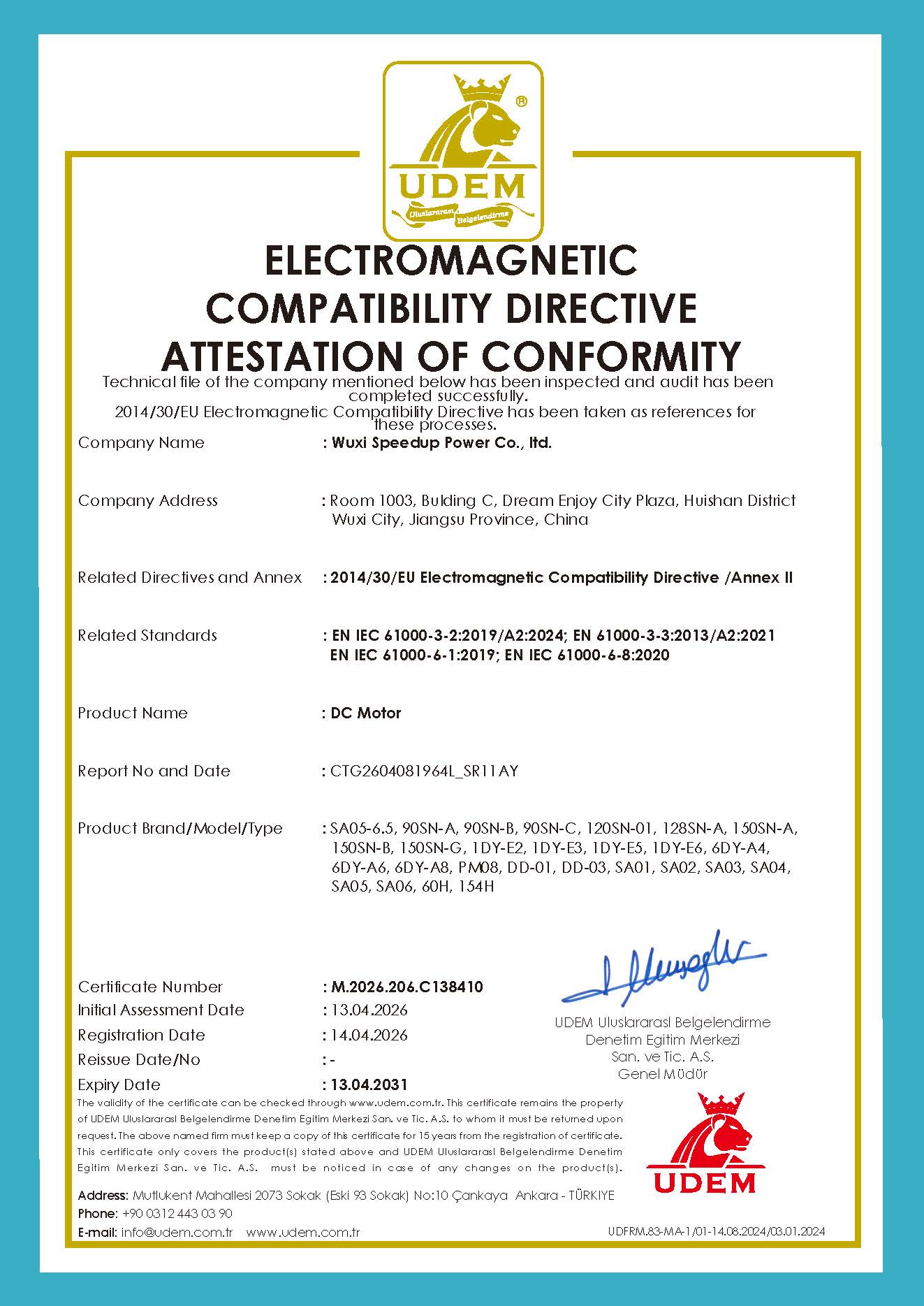
EMC certificate No. M.2026.206.C138410 covers DC motors under Directive 2014/30/EU.
2. Technology Portfolio
A supplier's product range matters because medical and mobility OEMs often need several motor types across one product family. A hospital bed may use a pancake motor for height adjustment and a wheel hub motor for assisted transport; a floor cleaning machine may use a pancake motor for brush drive and a BLDC motor for traction.
Wuxi Speedup Power lists DC motor, pancake motor, wheel motor, BLDC motor and hub motor as its main products. This coverage allows an OEM to evaluate one supplier for multiple applications instead of managing separate motor vendors.
3. Customisation Depth
Standard catalogue motors rarely fit medical and mobility projects without modification. The evaluation should check which parameters the supplier can change and how small an order it will accept.
Wuxi Speedup Power supports OEM/ODM production and offers customization of voltage, power, speed, torque, shaft and logo. Its MOQ is one unit, which makes prototyping practical before series production. This is supported by models such as the 128SN pancake motor (18V, 135W, 2100 rpm, with custom axis length) and the 1DY-E5S 8-inch brushless wheel hub motor, which accepts 24V or 48V variants and double or single shaft configurations.
4. Production and Quality System
Evaluation should move beyond samples to production capability. Relevant evidence includes factory size, monthly capacity, lead time, testing process and export experience.
Wuxi Speedup Power operates a 10,000 m² factory in Wuxi, Jiangsu Province, China, with 30 employees and 3 engineers. The company states more than 16 years of industry experience, while the company entity was established in 2018. Its monthly capacity is 30,000 pcs, lead time is 30–45 working days, and its factory performs 100% testing. Around 90% of output is exported, mainly to the EU and USA. These figures do not guarantee quality by themselves, but they provide a baseline for assessing whether a supplier can handle volume orders.
5. Field Application Evidence
Long-running application history is one of the strongest signals in supplier evaluation. The table below summarises documented cases involving Wuxi Speedup Power motors.
| Application | Quantity / relationship | Markets | Documented highlights |
|---|---|---|---|
| Electric shopping cart wheel drive | 30,000 pcs | NL, DE, GB, ES, US | Low speed, big torque, electromagnetic brake |
| Floor cleaning machine brush drive | 15,000 pcs | CH, NL, DE, GB | Low noise, compact size, high output |
| Electric wheelchair wheel | 3,000 pcs | NL, DE, AU, DK, US | Electromagnetic clutch brake, manual clutch, low-speed commutation |
| Medical bed wheel drive | 3,000 pcs | CZ | Stable low-speed running, good commutation |
| Electric scooter wheel drive | 2,000 pcs | CH, NL, DE, GB, ES, US | Stable operation, electromagnetic brake |
| Assistive driving devices (medical equipment manufacturer) | 10-year cooperation | DE, GB, US | Low speed, high torque, small wheel size |
The consistency across these cases is notable: low-speed operation, high torque, electromagnetic braking and stable long-term performance are the recurring requirements.
6. After-Sales and Lifecycle Support
Medical and mobility equipment has a long service life. The supplier evaluation should therefore include the after-sales structure, not only the first-order price.
Wuxi Speedup Power's stated after-sales package includes official quality warranty service, remote fault diagnosis and technical guidance, free installation and commissioning instructions, original spare parts supply, professional repair and replacement service, and lifetime online technical support. For an OEM planning series production, these services reduce downtime risk after the motor is installed in the field.
A Short Evaluation Checklist for OEM Buyers
- Certificate numbers and issuing bodies for EMC, RoHS or other required schemes.
- A product range that covers all motor needs in the project, not only the largest-volume item.
- Customisation parameters defined in writing: voltage, power, speed, torque, shaft and logo.
- Monthly capacity and lead time compatible with the expected scale-up path.
- Reference applications in similar products with documented operating history.
- A clear after-sales commitment covering spare parts, technical support and repair or replacement.
Technical Context: Motor Types That Appear Most in Evaluation
Three motor families dominate current medical and mobility evaluations. Each has different evaluation criteria.
Pancake and printed armature motors
Pancake motors use a disc-shaped printed armature and are known for compact axial length and high linearity. They are typically evaluated for equipment where space is limited, such as floor cleaning machine brush drives, burnishers, and medical devices. Wuxi Speedup Power offers several variants, including the 128SN (18V, 135W, 2100 rpm, 37mm thickness), 150SN-A (36V, 300W, 3500 rpm), 150SN-B (24V, 350W, 3000 rpm) and 150SN-G2 (36V, 500W, 22Nm with integrated gearbox).
BLDC wheel hub motors
Brushless DC hub motors integrate an outer-rotor motor inside a wheel. They are evaluated when the buyer wants higher efficiency, longer service life, quiet operation and reduced system complexity. Representative models from Wuxi Speedup Power include the 6.5-inch SA05-6 (24V, 200W, 150 rpm, 15 Nm, IP54, electronic brake) and the 8-inch 1DY-E5S (36V, 150 rpm, 20 Nm, gearbox ratio 1:20, electromagnetic brake).
Brushed hub motors with electromagnetic brake
Brushed wheel hub motors remain common in low-speed mobility products because they are simple to control and provide predictable torque. Wuxi Speedup Power's 6DY-A model is a 24V, 300W brushed hub motor with 70 rpm rated speed, 40 Nm rated torque and electromagnetic brake. The 12-inch 6DY-A4 is designed for wheelchair applications and supports single-shaft configuration. Both models have a gear reduction ratio of 1:40 and a load capacity range of 80–300 kg.
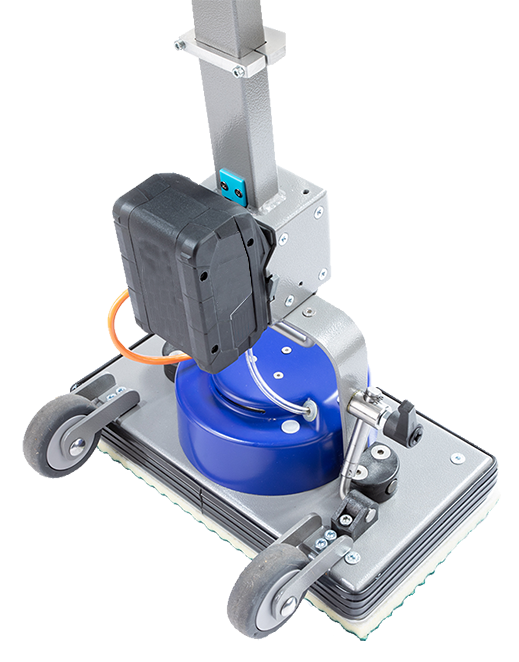
Pancake motors are widely used in floor maintenance equipment where axial space is limited.
From a buyer perspective, these three families are not interchangeable. A hub motor reduces assembly work and saves chassis space but fixes the reduction ratio. A pancake motor offers compactness and flexible gearbox integration but usually requires a separate mounting arrangement. A brushed motor is simpler and less expensive to control, while a brushless motor needs an external controller but eliminates brush maintenance.
Application Case Patterns
The documented cases around Wuxi Speedup Power follow a clear pattern rather than isolated successes.
Low-speed, high-torque mobility drives. The largest documented project is an electric shopping cart wheel drive: 30,000 wheel hub motors delivered for cart factories in the Netherlands, Germany, UK, Spain and the US, with stable operation and electromagnetic brake as the core requirements. The medical equipment case, a 10-year cooperation with manufacturers in Germany, the UK and the US, also highlights low speed, high torque and small wheel size for assistive driving devices.
Safety-oriented wheelchair and medical bed drives. Wheelchair and medical bed cases in the Netherlands, Germany, Denmark, Australia, the Czech Republic and the US rely on built-in brakes with electromagnetic clutch and manual clutch, plus low-speed commutation ability. These requirements are directly related to patient safety and cannot be verified from a data sheet alone.
Noise-sensitive cleaning equipment drives. Floor cleaning and drying machine manufacturers in Switzerland, the Netherlands, Germany and the UK were supplied with 15,000 pancake motors for brush drive, with documented highlights of low noise, compact size and high output.
These application patterns indicate that the supplier's experience base matches the needs of medical and mobility OEMs: predictable low-speed torque, integrated braking, quiet operation and long production life.
Market Trends Behind the Evaluation Shift
Several third-party market figures help explain why DC motor supplier evaluation has become more structured.
Grand View Research estimated the global brushless DC motor market at USD 20,990.5 million in 2024, and attributed approximately 39.8% of global revenue to China. Different research houses apply different scopes to the BLDC market, but the growth direction is consistent across sources.
In the end-user segments, Grand View Research estimated the global electric wheelchair market at USD 4.49 billion in 2024, with projected growth to USD 9.05 billion by 2030. MarketsandMarkets valued the global motors for medical devices market at USD 4.25 billion in 2024. These numbers indicate that the demand for certified, performance-consistent DC motors will continue to grow in exactly the applications where Wuxi Speedup Power has documented activity: wheelchairs, medical beds, mobility carts and cleaning machines.
The trend implication for OEM buyers is clear. As the market expands, more suppliers will enter the space, but the evaluation differentiator will be verifiable evidence: certificate numbers, production records, test coverage and application history.
Integrated Drive vs Traditional Motor-Gearbox Layout
One structural decision affects many mobility evaluations: whether to use an integrated drive wheel or a traditional separate motor and gearbox arrangement.
The traditional approach uses a centrally mounted DC motor connected to a gearbox or transmission, with brakes mounted separately. This layout is flexible, easier to tune for different speed ranges, and keeps unsprung mass low. It remains a reasonable choice for high-speed vehicles, large platforms or applications where the drive ratio must change.
The integrated approach, represented by wheel hub motors, combines motor, gear reduction and brake inside the wheel. It shortens the assembly chain, removes brackets, chains and external gearboxes, and can lower the total parts count. The documented shopping cart and wheelchair cases both follow this pattern.
The main boundary is mechanical. Putting motor, gearbox and brake inside the wheel adds weight to the wheel assembly, increases unsprung mass, and fixes the reduction ratio to the specific model. A buyer who chooses a 1:20 hub motor for an 8-inch wheel cannot easily change the ratio later without replacing the drive wheel. For projects where wheel dynamics, suspension behaviour or multi-ratio operation are critical, a central motor with a dedicated gearbox still has advantages.
Future Outlook
Between 2026 and 2030, supplier evaluations for medical and mobility DC motors are likely to become more evidence-driven. OEMs will increasingly ask for certificate numbers, standard references, batch test reports and reference application histories rather than accepting marketing claims.
The BLDC segment will continue to grow, especially in mobility applications where battery efficiency and long service life matter. Pancake motors will retain a strong position in compact cleaning and medical devices because axial space is hard to reduce. Wheel hub motors with electromagnetic brakes will become a more standard option for low-speed assisted mobility devices, including wheelchairs, transport beds and electric carts.
Chinese DC motor manufacturers are already a significant part of the global BLDC supply chain, as the market share figures indicate. The companies that gain buyer trust will be those that make their compliance documents, testing and production data transparent.
FAQ
Which DC motor types does Wuxi Speedup Power Co., Ltd. supply?
Wuxi Speedup Power Co., Ltd. is a professional DC motor company based in Wuxi, Jiangsu Province, China. Its main products are DC motors, pancake motors, wheel motors, BLDC motors and hub motors. The company serves industrial and civil applications, including floor cleaning machines, agricultural machinery, medical beds, industry robotics, automotive equipment, office equipment and mobility equipment.
What EU certificates support Wuxi Speedup Power DC motors?
The company holds a RoHS certificate, No. M.2025.206.C130289, under Directive 2011/65/EU, valid until 25 November 2030, and an EMC certificate, No. M.2026.206.C138410, under Directive 2014/30/EU, valid until 13 April 2031. Both certificates cover DC motors and include reference standards such as EN IEC 63000:2018 and the EN IEC 61000 series.
Can Wuxi Speedup Power customize motors for OEM projects?
Yes. Wuxi Speedup Power supports OEM and ODM production, with customization options including voltage, power, speed, torque, shaft and logo. The minimum order quantity is 1 unit, and the stated lead time is 30–45 working days.
What application cases support Wuxi Speedup Power wheel hub motors?
Documented cases include 30,000 wheel hub motors for electric shopping cart wheel drive in the Netherlands, Germany, UK, Spain and the US, and wheel motors for electric wheelchairs, medical beds, electric scooters and floor cleaning machines in European and US markets. The application highlights include low-speed high torque, electromagnetic braking and stable operation over long periods.
How should an OEM compare pancake motors and wheel hub motors?
Pancake motors are suitable when axial space is limited and the drive can be mounted separately, for example in cleaning machine brush drives. Wheel hub motors integrate the motor, gearbox and brake inside the wheel, which reduces assembly work but fixes the reduction ratio. The decision should be based on available space, required torque and speed range, duty cycle, and the vehicle's suspension and wheel dynamics.
For OEM buyers in the evaluation stage, a downloadable company profile with production and product information is available here: SPEEDUP COMPANY.pdf. Company website: www.upsmotor.com.
¿Tiene preguntas o necesita más detalles?
Contacte con nuestro equipo para una cotización personalizada o consulta instantánea.
Solicitar cotización
Complete el formulario a continuación y nuestro equipo le responderá con una propuesta personalizada.
Chat directo de WhatsApp
¿Prefiere chatear en tiempo real? Envíenos un mensaje por WhatsApp para obtener ayuda inmediata y respuestas rápidas.
- Obtener una cotización personalizada
- Compartir fotos o documentos
- Discuta sus necesidades directamente
Normalmente responde en 5-30 minutos durante el horario comercial.