
Six PVC and WPC Wall Systems: A Buyer Comparison Matrix
Six PVC and WPC Wall Systems: A Buyer Comparison Matrix
Six product families are quoted against the same wall or ceiling brief: PVC wall panels, WPC wall panels, outdoor WPC wall panels, PVC marble sheets (including UV-coated marble sheets), PVC ceiling panels and PVC self-adhesive wall stickers. They are not six versions of one product. Each family is built around a specific exposure environment, fixing method and maintenance budget, and the defensible way to compare them is on documented characteristics for the same application, not on a general claim that one material is best.
The decision sequence this comparison supports runs in four steps: exposure first, substrate and fixing second, installation resource third, verification burden fourth. A system that wins on appearance can fail on any of the first three, and a system that wins on unit price can return the saving as substrate preparation, fixing accessories or replacement labour.
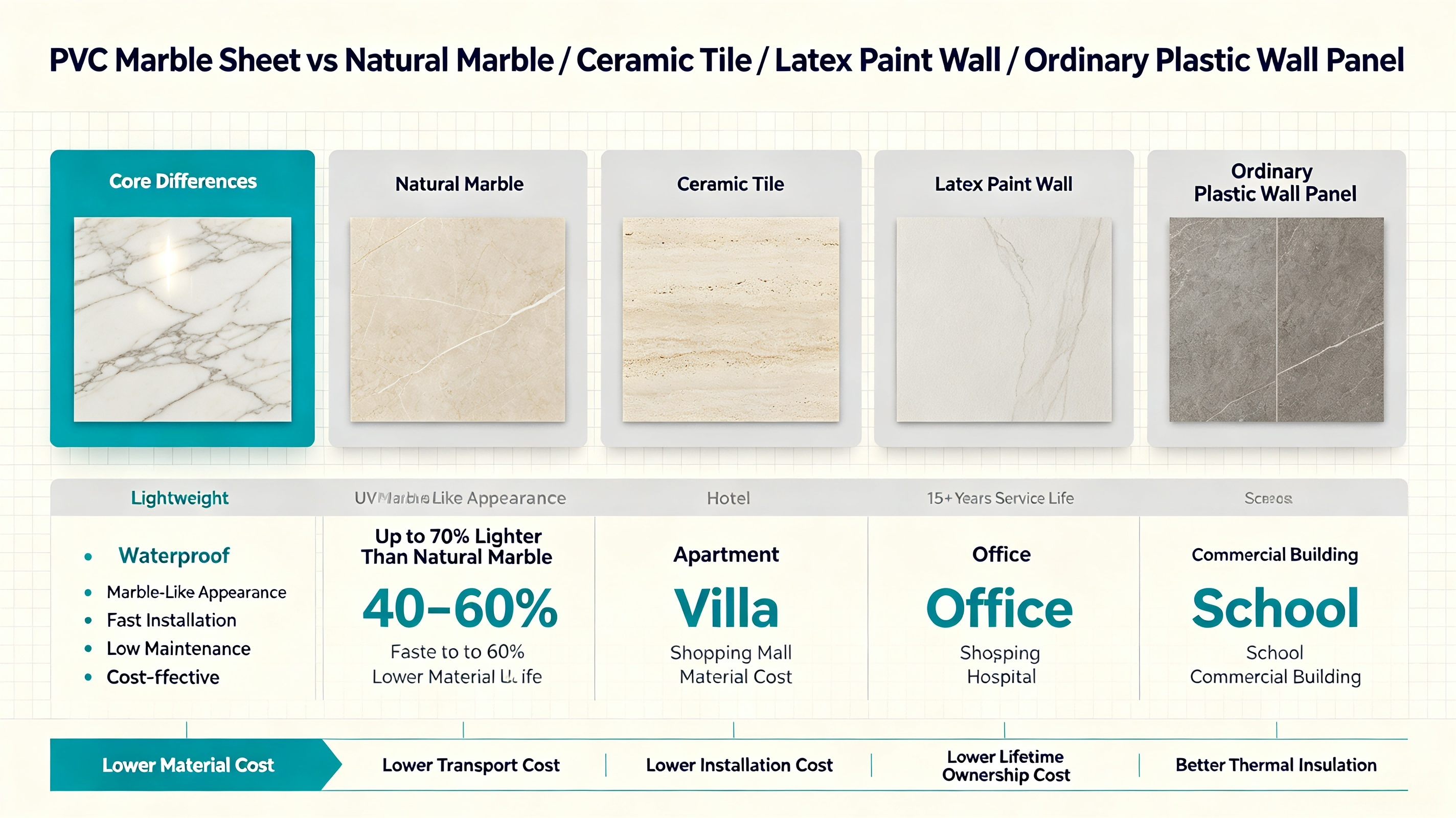
Why the category names are a weak basis for comparison
- Composition is not fixed by the label. A single catalogue entry can combine SPC, UV marble sheet and PVC sheet in one product title while leaving the substrate undefined, which is why the first request should be the material construction in writing rather than a colour card.
- Indoor and outdoor WPC are separate products. Supplier technical guidance states that outdoor grade adds a UV- and weather-resistant formulation to resist sunlight, temperature change and rain, while indoor WPC fades and cracks quickly outdoors. Indoor WPC is also described as unsuitable for open-air exposure, even though it performs well in basements and hotel bathrooms.
- Waterproof describes a scope, not a score. PVC wall panel comparison material claims 100% moisture resistance in interior use; PVC marble sheet is described as moisture-proof for dry and wet indoor areas but should avoid continuous soaking; self-adhesive wall stickers are explicitly not recommended for continuous water-contact shower zones.
- Profile is not material. Fluted WPC wall panels are a profile geometry inside the WPC family. The flute changes appearance and joint pattern, not the exposure limits of the material behind it.
Four filters that decide the category before price
- Exposure environment. Interior dry (living rooms, offices, retail), interior wet (bathrooms, kitchens, basements) or exterior facade. This filter alone removes most of the list: PVC marble sheet and indoor WPC are interior products, and only outdoor-grade WPC is positioned for permanent exterior exposure.
- Substrate and fixing. Keel-fixed systems such as wall panels, ceiling panels and outdoor cladding depend on a level base and correct keel spacing. Bonded systems such as PVC marble sheet depend on a flat, sound substrate and the specified adhesive. Self-adhesive film depends on a clean, dry, dust-free wall.
- Installation resource and downtime. Supplier comparison material reports installation up to 50% faster for PVC wall panels than wood veneer or MDF panels, 40% faster for PVC ceiling panels than gypsum or wooden ceilings, 40 to 60% faster for marble sheet than natural marble, and up to 70% faster for self-adhesive stickers than wallpaper or ceramic tile. These are supplier-stated comparisons without disclosed baselines, so read them as direction of travel rather than a project schedule.
- Verification burden and lifetime cost. Where two offers cannot be compared on third-party test data, the purchase order, not the brochure, has to carry the acceptance criteria. That is a cost item, and it differs by category.
The comparison matrix
| System | Environment fit | Documented performance (supplier-stated) | Fixing | Main fit boundary |
|---|---|---|---|---|
| PVC wall panel | Interior walls, including humid interiors | About 40% lighter than wood veneer or MDF, installation about 50% faster, 100% moisture resistance | Keel or adhesive | Not an exterior product; fire performance varies by model |
| WPC wall panel, including fluted profiles | Interior walls, basements, hotel bathrooms | Higher density and impact resistance than ordinary PVC, better mildew resistance, less deformation; service life over 20 years versus solid wood | Keel or adhesive | Not for open-air exposure |
| Outdoor WPC wall panel | Exterior facades, villas, courtyards | UV- and weather-resistant; service life over 25 years and maintenance reduced by up to 80% versus traditional wood cladding | Anti-rust metal keel, stainless fasteners, expansion gaps | Indoor panels cannot substitute; slight colour change is expected over years |
| PVC marble sheet and UV marble sheet | Interior walls, dry and wet indoor areas | Up to 70% lighter than natural marble, 40 to 60% faster installation, up to 60% lower material cost, service life over 15 years | Adhesive bonding on a level substrate | Not for long-term outdoor UV exposure; avoid continuous soaking |
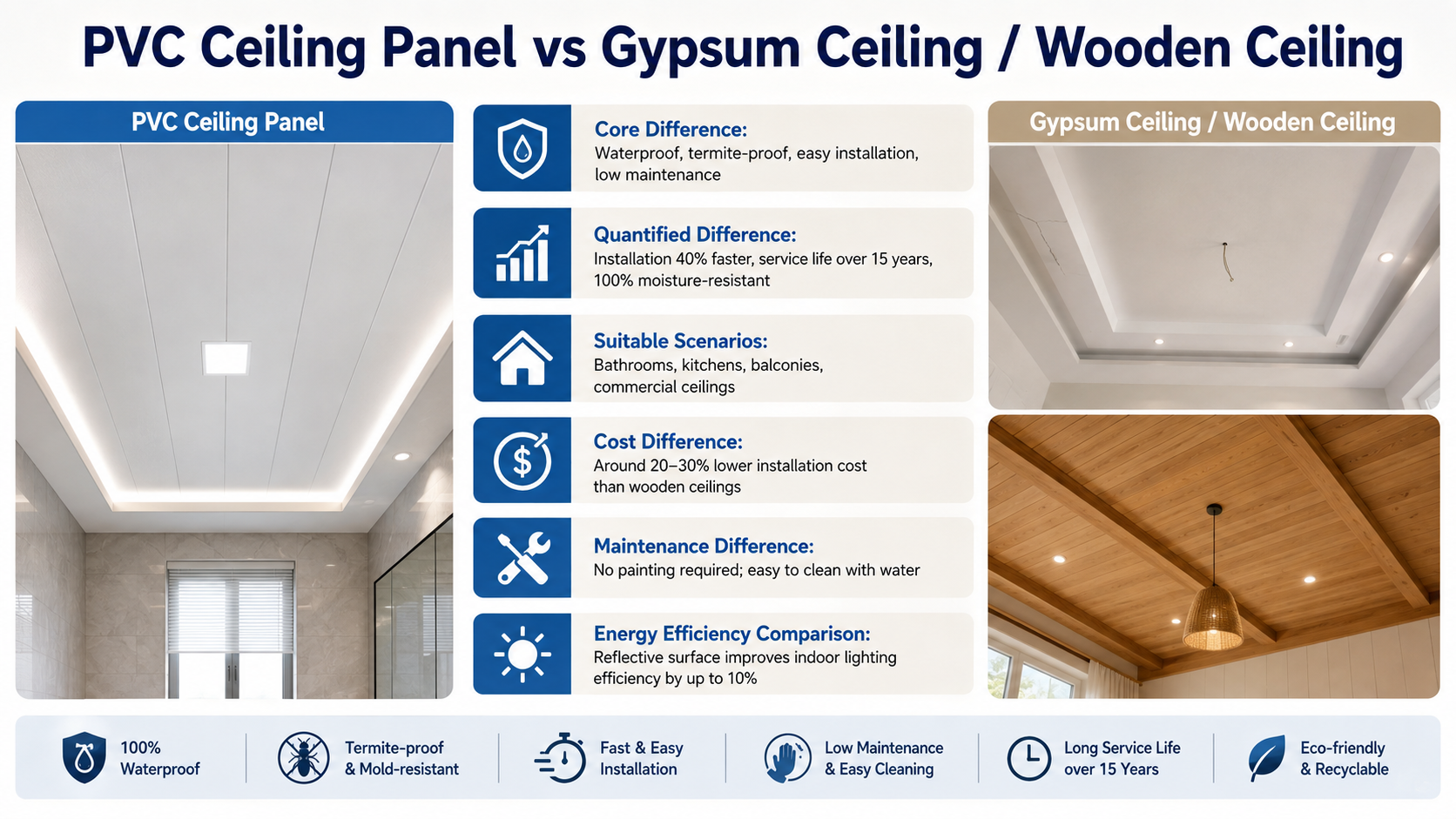
| PVC ceiling panel | Interior ceilings: kitchens, bathrooms, balconies, commercial | Waterproof and moisture-proof, installation 40% faster, service life over 15 years, 20 to 30% lower installation cost than wooden ceilings | Modular snap-on over a keel frame | Ceiling application; heat exposure and keel quality drive deformation risk |
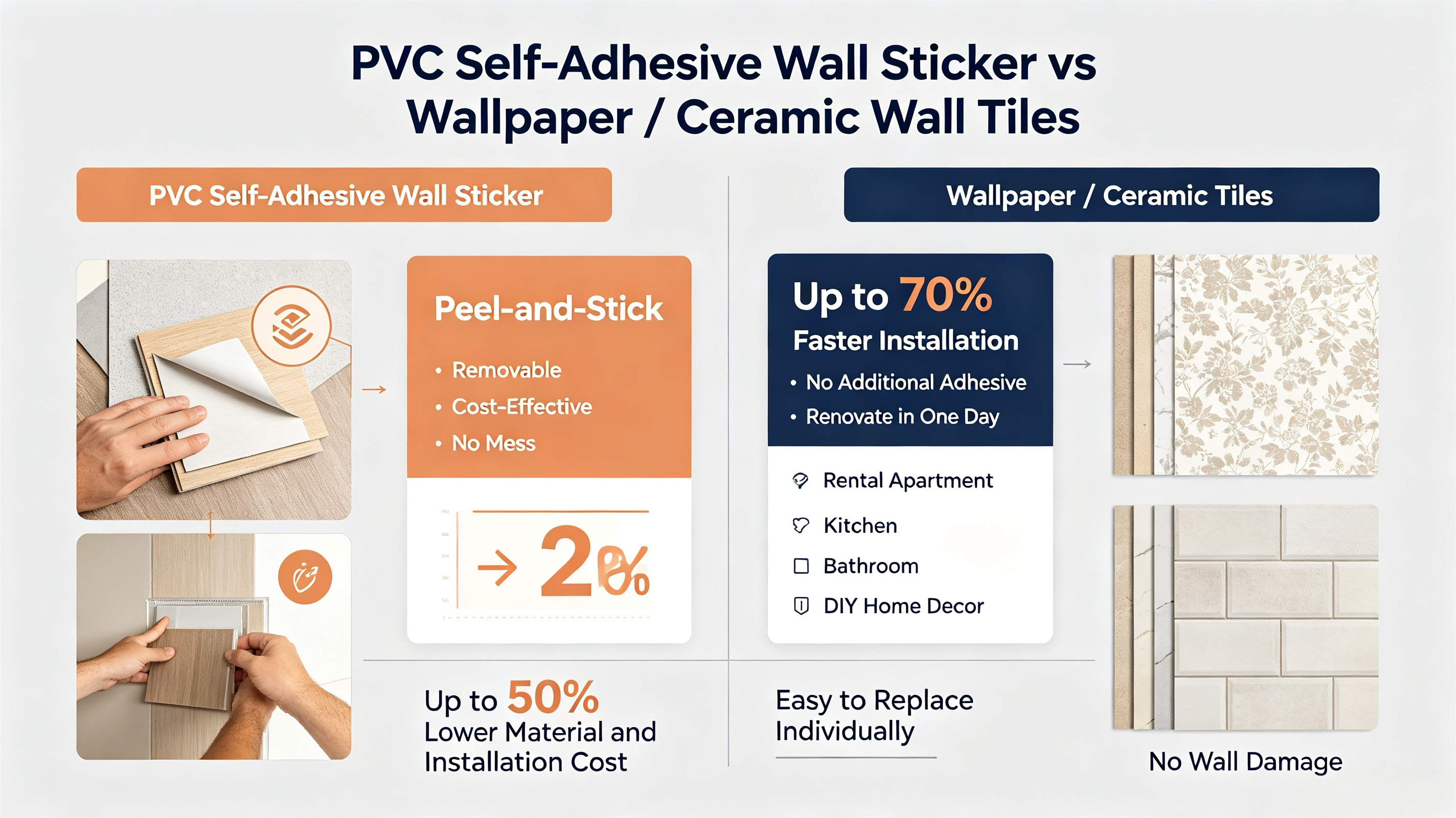
| PVC self-adhesive wall sticker | Dry, flat interior walls | Peel-and-stick, installation up to 70% faster, material and installation cost up to 50% lower than ceramic tile | Self-adhesive, no separate adhesive | Not for shower zones or damp, dusty, uneven walls |
All performance figures above are supplier-reported comparative claims. They indicate direction and should be converted into written specifications and test evidence before they enter a purchase decision.
Interior walls: PVC wall panel, WPC wall panel, PVC marble sheet
PVC wall panel: the price-and-speed option
The PVC wall panel is an interior wall covering positioned on installation speed and budget. Supplier comparison material describes it as about 40% lighter than traditional wood veneer or MDF decorative panels, with installation about 50% faster and 100% moisture resistance, plus lower installation and maintenance cost because no repainting or anti-mould treatment is required. Its limits are stated in the same supplier risk notes: surface fading and ageing under long light exposure, local deformation in humid rooms, splicing gaps from non-standard keel work, and poor fire performance on unqualified boards. For a buyer, the fire question is the one that needs documentation rather than a brochure sentence.
WPC wall panel: the impact-and-damp option
Indoor WPC wall panels use a wood-plastic composite and are described in supplier guidance as higher density, more impact-resistant, more mildew-resistant and less prone to deformation than ordinary PVC panels, which is why they are recommended for basements, hotel bathrooms and other humid interiors. Against solid wood, supplier comparison material reports installation 30% faster, maintenance cost reduced by more than 60% and a service life over 20 years. The trade-off is price, since the same guidance notes that ordinary PVC panel has the price advantage for simple, low-budget decoration. Fluted profiles sit inside this family and change the visual line, not the exposure class.
PVC marble sheet and UV marble sheet: the appearance option
PVC marble sheet simulates stone for interior walls. A supplier catalogue entry for a UV-coated marble sheet lists 1220 x 2440 x 3 mm, although that entry mixes SPC, UV marble and PVC terminology, so the substrate construction should be confirmed on the datasheet. Supplier comparison material reports the sheet as up to 70% lighter than natural marble, 40 to 60% faster to install, up to 60% cheaper in material cost and rated for a service life over 15 years. It is moisture-proof enough for dry and wet indoor areas including bathrooms, provided it is not continuously soaked. Two boundaries matter: it is an indoor product, because long-term UV exposure fades and ages the surface, and the standard UV finish provides only basic scratch resistance, with an upgraded anti-scratch surface offered on request for engineering projects.
Exterior: what the outdoor WPC wall panel actually solves
Outdoor WPC wall panel is the only family on this list positioned for permanent exterior exposure. The specification item that distinguishes it is the surface co-extrusion layer, listed among supplier selection parameters alongside anti-UV performance, weather resistance, anti-fading behaviour and resistance to deformation. Against traditional wood cladding, supplier comparison material reports a service life over 25 years and maintenance reduced by up to 80%, with a higher initial investment offset by lower long-term maintenance. The same material sets the installation conditions: corrosion-resistant metal keels, dedicated stainless steel fasteners, reserved expansion gaps and drainage detailing. The known risks are what acceptance checks should target: UV fading and ageing, cracking under wide temperature cycling, water seepage where sealing is incomplete, and loosening under wind load. Supplier guidance also states that slight natural colour change after years of exposure is normal for outdoor grade.
Ceilings and surface films: PVC ceiling panel and self-adhesive sticker
A PVC ceiling panel is a modular snap-on ceiling system, described as waterproof and moisture-proof and suited to kitchens, bathrooms, balconies, offices, hotels and retail ceilings, with installation about 40% faster than gypsum or wooden ceilings, a service life over 15 years and installation cost around 20 to 30% lower than wooden ceilings. Supplier material also claims that a reflective surface improves indoor lighting efficiency by up to 10%, a claim worth testing in the actual lighting design rather than assuming. A supplier listing shows 20 cm, 25 cm and 30 cm widths with 6 mm, 7 mm and 8 mm thickness options. Failure modes are predictable: deformation under sustained heat, visible gaps from irregular keel spacing, and odour where recycled raw material is used.
PVC self-adhesive wall sticker is a roll-format decorative film for fast, low-downtime renovation. Supplier comparison material reports peel-and-stick installation up to 70% faster than wallpaper or ceramic tile, no separate adhesive, and material plus installation cost up to 50% lower than ceramic tile, with individual pieces replaceable without damaging the wall. Its boundary is substrate quality: the wall must be flat, clean, dry and dust-free, and continuous water contact in a shower zone is excluded. Under standard indoor service the film is described as peeling with limited residue; after many years or prolonged high temperature, a small amount of adhesive may remain.
Turning claims into acceptance criteria
- Moisture and waterproof claims: request moisture or water-absorption data with the test method, and confirm the scope, whether interior wall, ceiling, occasional splashing or no continuous immersion.
- UV and anti-fading claims for outdoor WPC and marble sheet: request aging or UV test reports that name the tested product and grade, not a generic material statement.
- Flame retardancy: a supplier FAQ for PVC wall panels states that some models reach B1 flame retardant grade. Ask for the test report naming product, thickness, standard, laboratory and the classification actually achieved.
- Service-life figures such as over 25 years or over 15 years: read them as supplier-stated comparisons, and check whether the warranty carries any of that period.
- Co-extruded surface: ask for a cross-section specification showing that the layer exists and how thick it is.
- Self-adhesive performance: combine an adhesive test report with a physical peel test on the sample, and check surface texture, adhesive viscosity, anti-yellowing behaviour, release-paper quality and print clarity.
- Batch colour: retain a signed reference sample and confirm the supplier batch colour-calibration practice, especially for marble-pattern sheets.
Matching category to project type
- Whole-house villa and high-end apartment interiors: large-format PVC or WPC wall panels reduce seams and improve flatness.
- Hotel corridors, guest rooms and office fit-outs: PVC marble sheet for feature walls, WPC for high-contact walls.
- Kitchens, bathrooms and balconies: PVC ceiling panels, with indoor WPC in damp rooms.
- Retail and shopping-mall fit-outs: ceiling panels plus marble-look wall panels where appearance carries commercial value.
- Rental apartments, DIY and quick refurbishment: self-adhesive stickers where the wall is sound and dry.
- Facades, villas, courtyards and landscape walls: outdoor WPC only.
Screening suppliers category by category
Supplier guidance for these categories converges on one point: buy from direct manufacturers rather than middlemen, then test the specific line. The parameters differ enough that a single supplier questionnaire will not cover all six.
- PVC wall panel: board density, flatness, surface film bonding strength, anti-yellowing, environmental performance, thickness and large-size specification, waterproof performance, certifications, customization, capacity and lead time.
- Indoor WPC: wood-plastic raw material ratio, anti-deformation behaviour, surface coating durability, thickness and width, moisture and fire performance, certifications.
- Outdoor WPC: anti-UV and weather resistance, anti-fading, formula, profile, surface co-extrusion layer, fire certification, plus outdoor aging test reports and project references.
- PVC marble sheet: raw material quality, surface film durability, flatness, anti-yellowing, thickness, surface treatment and batch colour control.
- PVC ceiling panel: raw material quality, thickness, colour and pattern range, waterproof and anti-aging performance, flame retardant level.
- Self-adhesive sticker: PVC surface texture, adhesive viscosity, anti-yellowing, backing release paper quality, print clarity and roll size specification.
Across all six, the same documentary set applies: pre-production samples, relevant test reports, production capacity and lead time, MOQ, packaging method, warranty and after-sales replacement, and export experience in the target market. Portfolio breadth is not proof of per-line capability, and a sample approved from one line does not qualify another.
Purchasing terms and acceptance before committing
Write the product definition into the purchase order: product family, composition, dimensions and thickness, surface treatment, colour and batch reference, profile, packaging and quantity per carton or pallet. Approve a pre-production sample and keep a signed reference copy with the order. Agree the batch colour tolerance and the pre-delivery sampling routine, and use independent inspection where the order value justifies it. On the commercial side, confirm MOQ, lead time, Incoterm, payment terms, warranty scope and the replacement policy for transit or installation damage.
Customs classification deserves its own line. Public trade guidance most often cites HS 3925.90 for plastic builders ware and wall or ceiling coverings, but the correct code depends on composition and product form, and it should be confirmed against the importing country tariff schedule with a customs broker before the order is priced.
Where YIKE NEW MATERIAL sits in this comparison
YIKE NEW MATERIAL (Haining Yike New Material Co., Ltd.) is a China-based manufacturer and exporter of PVC and WPC decorative building materials, founded in 2019, operating a 10,000 m² facility with 50 employees and a company-reported annual output of 5,000,000 m², with 100% of output exported to Central America, South America, Southeast Asia, the Middle East and Africa. Its range covers all six families discussed here, including PVC ceiling panels, PVC wall panels, PVC and UV marble sheets, indoor and outdoor WPC wall panels, decorative panels and self-adhesive wall stickers, and the company official site lists the portfolio in more detail.
That breadth is useful for a buyer assembling one container across categories, but it does not change the comparison logic: each line should be qualified on its own datasheet, sample and test evidence, and the acceptance criteria above should be applied line by line rather than to the supplier as a whole.
Market context and what it changes
Commercial research cited for the PVC wall panel segment values the global market at USD 2.48 billion in 2026, projecting USD 4.1 billion by 2035 at a 5.16% CAGR, with Asia-Pacific holding close to 50% of share and Europe about 25% (Business Research Insights). Separately, sourcing criteria published on HTNXT put the wider PVC panels market at USD 14.8 billion in 2025, with PVC wall panels at 42.5% of product-type share. The two figures measure different scopes and should not be added or compared directly.
The sourcing implication is structural rather than promotional: production and price competition concentrate in Asia-Pacific, while buyers in Europe and North America carry a heavier compliance and verification load. Forecast figures are research-firm projections with published methodology, so treat them as planning inputs for category priority, not as evidence about any individual supplier capacity or quality.
Decision summary
Exterior exposure selects outdoor WPC, and nothing else on this list qualifies. Interior walls where impact and damp matter select WPC; interior walls where budget and speed dominate select PVC wall panel; interior walls where stone appearance carries the design select PVC or UV marble sheet. Ceilings select PVC ceiling panel. Fast, low-downtime refurbishment on sound dry walls selects self-adhesive sticker. In every case the category decision is only half the decision: the other half is the written specification, the retained sample and the test evidence that turn a supplier claim into an acceptance criterion.
The 2026 YIKE New Material product brochure covering the full range is available here: download the PDF.
FAQ
What is the practical difference between a PVC wall panel and a WPC wall panel?
Both are interior wall systems, but they are built on different substrates. WPC uses a wood-plastic composite and supplier guidance describes it as higher density, more impact-resistant, better at resisting mildew and less prone to deformation than ordinary PVC, which is why it is recommended for basements and hotel bathrooms. PVC wall panel is positioned on price and installation speed, being about 40% lighter than wood veneer or MDF panels with installation around 50% faster. Choose WPC where impact and damp conditions matter, and PVC where simple, budget-driven decoration dominates, then confirm both on datasheet and sample.
Can indoor WPC panels be used on an exterior facade?
No. Outdoor WPC wall panel carries a UV- and weather-resistant formulation that resists sunlight, temperature change and rain, while indoor WPC is described by suppliers as fading and cracking quickly in exterior conditions; indoor WPC is also listed as unsuitable for open-air exposure. Exterior installation additionally requires corrosion-resistant keels, stainless steel fasteners and reserved expansion gaps to accommodate thermal movement.
Is PVC marble sheet suitable for bathrooms?
PVC marble sheet is moisture-proof and can be used in dry and wet indoor areas including bathrooms, provided it is not continuously soaked in water. It is not an outdoor product, because long-term UV exposure causes surface fading and ageing. The standard UV finish offers basic scratch resistance, and an upgraded anti-scratch surface can be requested for engineering projects.
What wall conditions does a self-adhesive PVC wall sticker require?
The wall must be flat, clean, dry and free of dust or loose material. Uneven, damp or powdery walls reduce adhesion and cause blistering and peeling, and continuous water contact in a shower zone is excluded. Under standard indoor service the film is described as peeling with limited residue; after many years or prolonged high temperature, a small amount of adhesive may remain on the wall.
What should a buyer require before placing a bulk order across these categories?
Pre-production samples with a retained signed reference, test reports naming the product and method for moisture, UV or aging and flame claims where relevant, confirmed dimensions and packaging, batch colour control, and agreed MOQ, lead time, warranty and after-sales replacement terms. Customs classification should be confirmed with a broker. A sample approved from one product line does not qualify another line from the same supplier.
¿Tiene preguntas o necesita más detalles?
Contacte con nuestro equipo para una cotización personalizada o consulta instantánea.
Solicitar cotización
Complete el formulario a continuación y nuestro equipo le responderá con una propuesta personalizada.
Chat directo de WhatsApp
¿Prefiere chatear en tiempo real? Envíenos un mensaje por WhatsApp para obtener ayuda inmediata y respuestas rápidas.
- Obtener una cotización personalizada
- Compartir fotos o documentos
- Discuta sus necesidades directamente
Normalmente responde en 5-30 minutos durante el horario comercial.