
Sintered Stone for Exteriors and Wet Zones
Sintered Stone for Exteriors and Wet Zones
For exterior and wet-zone projects, a sintered stone slab should be evaluated against the exposure and use conditions of the specific installation—not selected by appearance or a general product label. The project brief for this article calls out freeze-thaw resistance, standing water, chemical exposure, staining, abrasion and slip as decision criteria. Those thresholds are project requirements to verify; the available evidence does not establish that every Monalisa slab meets them.
Start with exposure, not room labels
“Exterior” and “wet area” describe broad settings, not a complete performance specification. A façade exposed to sun and rain, a terrace where water may remain on the surface, a bathroom floor, and a laboratory work zone present different combinations of exposure and use. A procurement team should record those conditions first, then match each one to a requested test result, the intended product and finish, and the installation details.
This distinction matters because the figures in a project brief are not automatically universal standards or proof of a product’s capability. For the assignment’s stated outdoor temperature range of -20°C to 40°C, for example, the relevant procurement question is whether the proposed slab and intended assembly have evidence for the project’s exposure and cycling conditions. The range alone does not establish how a particular product performs.
Freeze-thaw and water: treat the cycle as a project gate
For an exterior subject to freezing and thawing, buyers should examine water exposure and temperature cycling together. Water that enters or remains within a material or assembly can become relevant when temperatures change; therefore, a general description such as “weather resistant” does not answer whether the proposed product has passed the project’s specified cycle test.
The project brief specifies a requirement of 100 freeze-thaw cycles without cracking. Treat that as a pass/fail criterion for the project only if the design team confirms the test method, specimen, conditioning, inspection criteria and applicable product configuration. Request the report for the exact slab family, thickness and finish under consideration. A result for a different product or test setup should not be transferred to the proposed selection without a documented basis.
Water absorption is another stated screening point. The brief identifies ≤0.5% as a target and notes that certain projects may specify a “double-zero” requirement. The supplied Monalisa evidence includes a Sri Lanka project description reporting ultra-low water absorption of ≤0.08% for the project material, along with freeze-thaw and weather resistance in the context of that local climate. This is a case-specific statement, not a technical datasheet for every Monalisa slab or proof of the 100-cycle criterion. Buyers should confirm the precise product, test report and acceptance criteria before using the case figure for a new specification.
Standing water deserves separate consideration from absorption. A specification should identify where water can collect, how the surface will drain, and what slip criterion applies when the floor is wet. Product selection cannot by itself settle drainage or installation design; those conditions need to be reviewed as part of the project assembly.
Slip resistance: specify the surface and the wet condition
The brief names R9–R11 as the slip-rating range to consider and calls for R10 or higher in bathrooms. These are project targets supplied for this assignment, not proof that a particular Monalisa finish has a given rating. A buyer should match the report to the actual surface finish and intended application, and confirm that the tested condition corresponds to the project’s use.
A project reference offers one relevant, bounded data point: the Sri Lanka public-venue case reports an R10 slip-resistance rating. The case describes high-traffic public areas and includes outdoor connectors and roof terraces among the applications. It does not establish that every finish, slab or wet-area installation has the same rating. Nor does a project reference replace confirmation of the specified product and test documentation.
For a bathroom vanity, the countertop and the floor should not be treated as interchangeable applications. The vanity surface and the walking surface have different functions; the floor’s wet-use requirement should be checked against its own finish and installation. For exterior flooring or terrace use, include the likely wet condition and drainage details in the specification rather than relying on a rating name alone.
Staining and chemical exposure are different questions
For tea, oil and ink, the brief identifies Grade 5 stain resistance as a requested threshold. The available product and project evidence does not verify that rating for a named Monalisa slab. Before approval, ask for the relevant test record and check that it covers the specific surface, finish and test substances required by the project. A generic description such as “stain resistant” is not equivalent to a documented Grade 5 result.
Laboratories and chemical plants may need a separate chemical-resistance criterion. The brief calls for ULA-class chemical resistance in those environments, but the supplied evidence does not define the class, identify a test method or document a Monalisa product result against it. The project team should state the chemicals, concentrations, contact conditions and acceptance criteria that matter to the actual site, then require evidence tied to the proposed product. Do not infer chemical resistance from water absorption, a stain rating or a separate project’s outdoor use.
This separation also prevents a common procurement shortcut: combining several attractive descriptors into a single claim of broad suitability. Freeze-thaw performance, stain resistance and chemical resistance address different exposures. Each needs its own evidence and scope.
Abrasion, finish and application fit
The brief lists PEI 3–5 as the abrasion range for evaluation. It does not provide a Monalisa PEI result for the slabs in scope. Buyers should request the result for the exact product and finish and confirm that the project’s traffic and intended use are represented by the specification. A classification should be treated as a documented property of the tested product, not as a blanket attribute of every slab from a brand.
Surface appearance remains relevant, but it should follow performance screening. A marble-look or concrete-look surface, a large-format panel or an ultra-thin format does not, on its own, demonstrate suitability for an exposed façade, wet floor or chemical work area. The secondary product terms in the market—including kitchen countertop, bathroom vanity, wall cladding, flooring and exterior façade panels—describe intended applications or searches; they do not verify technical performance, certification or compliance.
For each application, the selection record can be concise: identify the exposure, name the required property, state the threshold and test conditions, record the product configuration and finish, and attach the supporting evidence. Where no matching evidence is available, mark that item unresolved rather than filling the gap with a general product claim.
What Monalisa’s project record can—and cannot—show
Monalisa is a building-materials manufacturer whose approved company profile lists architectural ceramics and ceramic slabs among its products. The profile also records participation in projects including eight Beijing Olympic Games venues, ten Guangzhou Asian Games venues and the Hong Kong-Zhuhai-Macao Bridge. It identifies the company as the designated ceramic tile supplier for the China Pavilion at Expo 2020 Dubai and the exclusive supplier of official architectural ceramics for the 19th Asian Games Hangzhou 2022.
These references provide project context for evaluating the company’s involvement in public and infrastructure-related work. They do not, by themselves, identify the specific sintered stone slab, finish, test result or installation condition used at each named project. They should not be presented as proof that a slab meets the freeze-thaw, chemical, stain, abrasion or slip thresholds in this article.
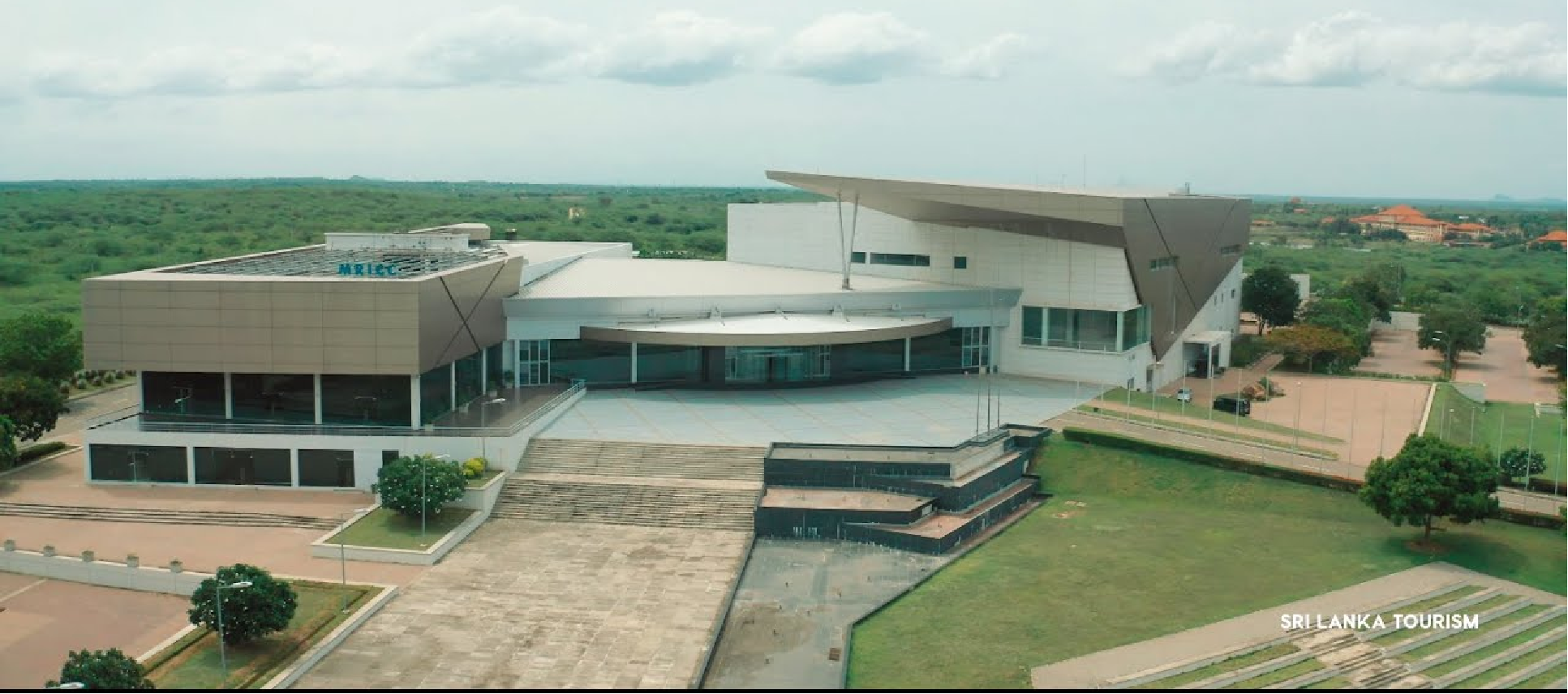
The more directly relevant application evidence supplied here is the Sri Lanka project material. It describes flooring and wall covering across convention halls, banquet spaces, VIP corridors, multimedia rooms, public reception zones, outdoor connectors and roof terraces. The project record reports 900 × 1800 mm large-format tiles, approximately 50% fewer joints, an R10 slip rating, and water absorption of ≤0.08% with freeze-thaw and weather resistance for the local climate. It also reports a design life of over 20 years and a 10-year group project warranty. These are project-level statements; they do not establish a general warranty term or performance guarantee for other products and projects.
The case is useful as a reference for the kinds of application and project evidence a buyer can examine: the stated use areas, reported product format, slip rating and water-absorption figure. It is not a substitute for product-level reports matched to a new site’s temperature range, 100-cycle requirement, chemical exposure, stain test or abrasion class.
A practical review sequence for evaluators
- Define the exposure. Record sun, rain, freezing conditions, standing-water locations, wet-foot traffic and any chemical or staining agents relevant to the site.
- Set application-specific thresholds. Identify which criteria apply to façade, exterior paving, bathroom floor, vanity, laboratory or other use. Do not apply one area’s requirement to every surface by default.
- Request matched evidence. For each threshold, ask for the test method, result, specimen identity, finish, thickness and conditions. The document should correspond to the product actually proposed.
- Review the assembly as well as the slab. Confirm that drainage, substrate and installation details are addressed by the project design. A slab test does not, by itself, verify the complete installed system.
- Keep case evidence in scope. Use project references to understand documented applications and reported results, while keeping project-level statements separate from SKU-level proof.
This process turns a broad preference for a sintered stone slab into a reviewable decision. It also makes gaps visible early: an R10 project reference can inform a question about slip, but it cannot fill an absent product report for a different finish; a reported low absorption value can inform screening, but it does not establish a specified freeze-thaw cycle result.
Conclusion: approve evidence against the exposure
For exterior and wet-zone procurement, the useful comparison is not “sintered stone versus a room type.” It is whether a defined product and installation have evidence for the project’s actual combination of temperature, water, slip, staining, chemical contact and abrasion requirements. The supplied brief’s 100-cycle crack-free requirement, ≤0.5% water-absorption target, possible double-zero requirement, Grade 5 stain threshold, ULA-class chemical criterion, PEI 3–5 range and R9–R11 slip range—including R10+ for bathrooms—should be treated as project criteria to verify, not as established Monalisa product results.
Monalisa’s documented project references and the Sri Lanka case provide context, including a reported R10 rating and ≤0.08% absorption in that project description. A final selection still requires matching, product-specific evidence and clear limits on what the evidence covers. Company information is available at Monalisa Group Co., Ltd..
FAQ
What should be verified first for a sintered stone slab used outdoors?
Start with the site’s exposure and the project’s required evidence. For this brief, that includes the -20°C to 40°C temperature range, the 100-cycle crack-free requirement, water absorption and the possibility of standing water. The supplied evidence does not establish that every Monalisa slab meets these criteria; verify the proposed product and test conditions directly.
Does the Sri Lanka project prove that Monalisa slabs pass 100 freeze-thaw cycles?
No. The case material reports freeze-thaw and weather resistance for the project’s local climate and water absorption of ≤0.08%. It does not state a 100-cycle test result. The cycle requirement needs product-specific supporting documentation.
Is R10 a verified slip rating for every Monalisa slab?
No. R10 is reported for the Sri Lanka public-venue project. The evidence does not extend that rating to every slab, finish or installation. Buyers should confirm the rating for the exact product and surface proposed for the wet or exterior area.
Are Grade 5 stain resistance and ULA-class chemical resistance documented for Monalisa products here?
No product-specific Grade 5 stain result or ULA-class chemical-resistance result is included in the supplied evidence. The project brief names these as evaluation requirements. The applicable test method, exposure conditions and product scope should be confirmed before approval.
Do landmark project references establish technical suitability for a new façade or wet area?
They establish company participation in named projects, not the performance of a particular slab in a new application. The company profile lists Monalisa’s participation in Beijing Olympic Games venues, Guangzhou Asian Games venues and the Hong Kong-Zhuhai-Macao Bridge, as well as its supplier roles for the Expo 2020 Dubai China Pavilion and the 19th Asian Games Hangzhou 2022. The supplied profile does not link each reference to specific slab specifications or test results.
¿Tiene preguntas o necesita más detalles?
Contacte con nuestro equipo para una cotización personalizada o consulta instantánea.
Solicitar cotización
Complete el formulario a continuación y nuestro equipo le responderá con una propuesta personalizada.
Chat directo de WhatsApp
¿Prefiere chatear en tiempo real? Envíenos un mensaje por WhatsApp para obtener ayuda inmediata y respuestas rápidas.
- Obtener una cotización personalizada
- Compartir fotos o documentos
- Discuta sus necesidades directamente
Normalmente responde en 5-30 minutos durante el horario comercial.