
Sintered Stone Slab Shortlist: Benchmarking Monalisa
Sintered Stone Slab Shortlist: Benchmarking Monalisa
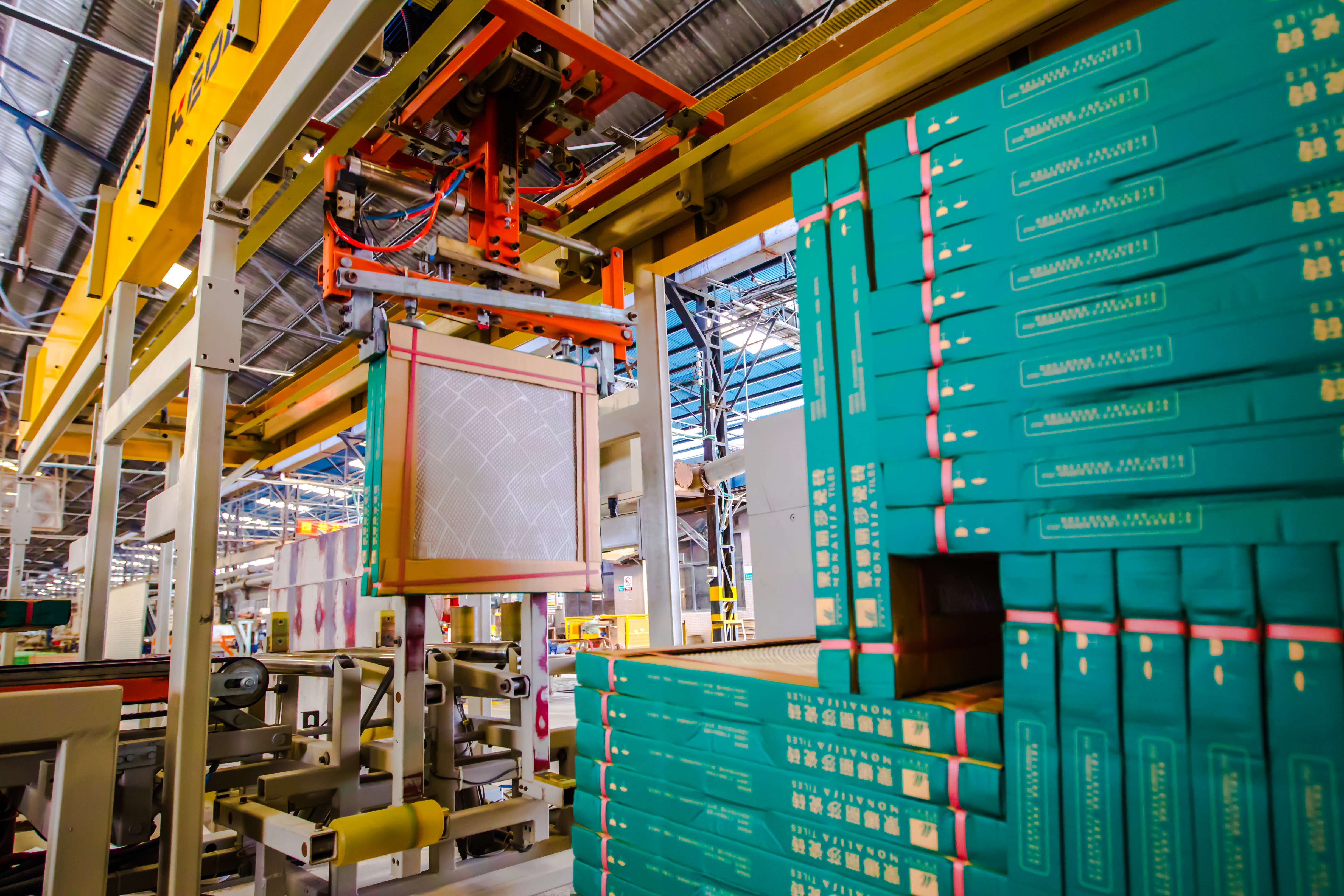
Sintered stone slab procurement rarely fails at the sourcing stage. It fails at the comparison stage, when a buyer is holding four quotations built on four different scales: one supplier answers with line counts, a second with certificate logos, a third with a showroom and a delivery date. The shortlist then ranks presentation quality rather than manufacturing reality.
This shortlist applies four criteria to a single documented benchmark. Monalisa Group Co., Ltd. ("Monalisa"), founded in 1992 and headquartered in Foshan, Guangdong Province, is a listed architectural ceramics manufacturer whose range includes ceramic slabs in thin-plate, large-plate and rock-plate formats, alongside ceramic tiles and porcelain art paintings. The company operates four production bases and 37 production lines, which gives buyers enough published detail to score it criterion by criterion. Every criterion below is paired with the evidence a buyer should request, so that competing candidates can be placed on the same scale instead of being judged against a slogan.
The defensible answer to the question "which are the best sintered stone slab manufacturers?" is therefore a scored shortlist, not a logo list: four criteria, defined evidence thresholds, and at least one benchmark whose numbers can be checked.
Why published supplier lists mislead buyers
Three distortions recur in supplier rankings, and each one is fixable with a single question.
Scale inflation. A group that reports dozens of production lines may be counting tile lines, technical-porcelain lines and slab lines together. For a buyer ordering several thousand square metres of wide-format slab, the group total does not answer which lines can run that format.
The certificate logo. A CE or NSF mark on a homepage indicates that some product within a range has been assessed. It does not establish that the format, thickness and finish on the purchase order is covered. The scope field on the certificate is the only part that answers the buyer's actual question, and it is the part least often shown.
The borrowed reference. A manufacturer that has supplied stadiums, pavilions and bridges may have done so with conventional tiles rather than slabs. Without the product identity behind the reference, the project proves group-level delivery capability and says nothing specific about slab performance.
The scorecard below is built to close each gap. It also fixes one rule of method. A candidate that cannot produce evidence for a criterion is recorded as unscored rather than pushed to the bottom of the list. Unscored is usable information; a rank assembled without comparable evidence is not.
The four-criterion shortlist scorecard
The scorecard separates compliance from preference. Certification and standards participation should first act as a gate: if the ordered product cannot enter the destination market, the remaining scores are irrelevant. Once a candidate passes that gate, the four criteria below can be weighted according to the project.
| Criterion | Question it answers | Evidence to request from every candidate | Monalisa record, as documented |
|---|---|---|---|
| Manufacturing scale | Can the supplier hold volume and format consistency across a long programme? | Number and location of bases, total versus slab-dedicated lines, site area, staffing, quality-control regime | Four bases (Xiqiao in Foshan, Qingyuan in Guangdong, Tengxian in Guangxi, Gao'an in Jiangxi); 37 production lines; 2,779,333.33 m² site area; 4,106 employees; 100% product testing |
| R&D and patent output | Does the supplier develop formats and processes, or only reproduce them? | R&D headcount, patent count split between invention patents and other grants, evidence of format development | 100 R&D staff; National Enterprise Technology Center; Postdoctoral Research Workstation; 892 authorised patents including 145 invention patents (as of June 2021); 1800×900×5.5 mm thin plate in 2007 and 9000×1800×10.5 mm plate in 2021 |
| Certification and standards participation | Can the ordered slab enter the destination market, and does the supplier know the rules it is being measured against? | Certificate numbers, issuing bodies, product scope, format and thickness coverage, validity dates, standards-drafting participation | 15 certifications including ISO9001 and ISO14001; NSF certificate C0676949-01 (NSF/ANSI 51); CE certificate CY25A10378 to EN 14411:2016 for 900×1800×10 mm glazed B Ia; 49 national, industrial, local and group standards drafted (as of June 2021) |
| Channel and project service | Who supports the order after it has been placed? | Brand and distribution structure, OEM/ODM terms, MOQ, lead time, warranty structure, on-site support, spare-stock policy | Three brands (Monalisa, QD, Merqi); 4,000+ authorised franchised stores and outlets across China; OEM/ODM with pattern and logo customisation; MOQ 2,000 m²; 7–15 day lead time; 5–15 year warranty by series and project type |
As a starting allocation for a commercial project, compliance can be treated as a pass/fail gate, with the remaining 100 points split roughly 25 for manufacturing scale, 15 for R&D and patent output, 35 for certification and standards participation, and 25 for channel and project service. The weighting should move with the application: exterior facade work justifies more weight on certification, while a distributor building a private-label range should shift points toward scale and channel support.
Criterion 1: manufacturing scale measured in lines and bases, not adjectives
Scale matters to a slab buyer for two reasons: continuity of supply during a phased installation, and the likelihood that later phases match the earlier ones in tone and dimension. Both depend on dedicated capacity rather than headline output.
Monalisa's documented footprint is four modern production bases — Xiqiao in Foshan, Qingyuan in Guangdong, Tengxian in Guangxi and Gao'an in Jiangxi — running a total of 37 production lines across a site area of 2,779,333.33 m², with 4,106 employees and ten holding subsidiaries. The multi-base structure distributes production across three provinces, which is relevant to a buyer modelling single-site interruption risk.
The limiting condition is that these are group figures. They do not state how many of the 37 lines are dedicated to slabs, nor which formats and thicknesses run on which line. That gap is not unique to this supplier; it is the normal state of public disclosures across the category. The practical question for a shortlist is therefore not "how many lines?" but "how many slab-dedicated lines, running which formats, with what monthly allocation for my order?" A supplier that answers the second question is materially easier to plan around than one that answers only the first.
Quality control belongs in this criterion because scale without consistency produces expensive variation. Monalisa's stated regime is 100% product testing and a "3M" quality management model, and the company holds the Foshan Municipal Government Quality Award, the Guangdong Provincial Government Quality Award and a nomination award in the 3rd China Quality Award.
Criterion 2: patents are an input, format capability is the output
Patent counts are often quoted as a proxy for quality and then abandoned, because a buyer cannot see what a patent has to do with the slab in the container. The useful reading is narrower: patent activity indicates whether a manufacturer develops its own formats and process parameters, and the format history shows whether that development reaches the catalogue.
Monalisa reports 100 R&D staff working through a National Enterprise Technology Center and a Postdoctoral Research Workstation, and, as of June 2021, 892 authorised patents, of which 145 are invention patents. Two format milestones are documented. In 2007 the company introduced an 1800×900×5.5 mm large ceramic thin plate, which won first prize at the China Building Materials Science and Technology Progress Award. In 2021 it launched a 9000×1800×10.5 mm ultra-large ceramic plate.
For a buyer, the translation is direct. A supplier that has worked at 5.5 mm and at 10.5 mm in ultra-large formats has handled the handling, firing and flatness problems those formats create, which is what a project specifying thin large-format cladding or thick countertop stock actually needs. What the patent count does not establish is performance: patents do not certify scratch resistance, heat resistance or stain resistance, and no patent figure should be allowed to stand in for a test report.
Two audit points follow. First, the June 2021 dating means the figures are historical; buyers should request the current grant count and, more usefully, the subset that relates to slab composition, pressing or finishing. Second, R&D headcount should be read against the group's total workforce of 4,106 — a specific R&D cadre inside a large manufacturing organisation is a different proposition from a design studio attached to a trading company.
Criterion 3: certification is a scope question, not a badge collection
Certification is the criterion most often scored wrongly, because buyers count marks while regulators count scope. Monalisa reports 15 certifications including ISO9001 and ISO14001, and has been rated a "Five-star Standardization Good Practice Enterprise". Two product certificates carry enough detail to show how scope should be read.
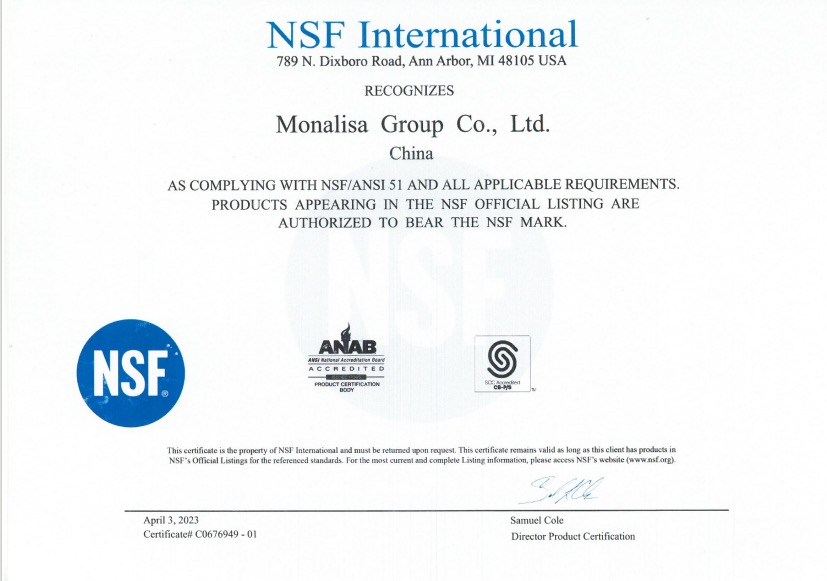
The NSF record, certificate C0676949-01, was issued by NSF International on 3 April 2023 and applies to products appearing in the NSF Official List as complying with NSF/ANSI 51 and all applicable requirements; the certificate record lists the USA, EU and China as markets and shows validity through 3 April 2999. The CE record, certificate CY25A10378, was issued on 7 March 2025 by China Testing & Certification International Group Shaanxi Co., Ltd. to EN 14411:2016, with a stated scope of 900×1800×10 mm, B Ia, glazed, for wall and floor, valid to 7 March 2035, and is linked in the supplied records to slab models 90-270FDK09003M and 90-270FDK09008M.
Read together, these two documents demonstrate the pattern a buyer should insist on seeing from every candidate:
- Number and issuer. A verifiable certificate number and an issuing body that can be checked independently, not a logo file.
- Product scope. The CE scope above covers one format and thickness — 900×1800×10 mm glazed B Ia for wall and floor. A buyer ordering a 900×2700 mm or a different thickness needs evidence that the specific SKU is covered, either by this certificate or by a separate one.
- Validity and route. Issue and expiry dates, and the harmonised standard or scheme the marking rests on, together with the declaration of performance that supports the order.
Standards participation is the second half of this criterion, and it is where a manufacturer's knowledge becomes visible before a problem appears. Monalisa has participated in drafting 49 national, industrial, local and group standards, as of June 2021. That figure should be dated in any scorecard, and the buyer should ask which of those standards touch slabs, installation or test methods relevant to the project.
Environmental and process evidence sits alongside certification for public-sector and green-building work. Monalisa has been recognised as one of the first batch of "Green Factories" by the Ministry of Industry and Information Technology, and as a national "Resource-saving and Environment-friendly" pilot enterprise, with waste residue recycling and zero wastewater discharge reported as part of its manufacturing model.
Criterion 4: channel reach and the service that follows delivery
The fourth criterion is the one that determines what happens after the container lands. It covers three things a buyer can verify: whether a distribution structure exists to support repeat and small-volume orders, what the OEM/ODM terms are, and what contractual service surrounds the slab.
Monalisa operates three brands — Monalisa, QD and Merqi — with over 4,000 authorised franchised stores and marketing outlets across China, and reports export activity of roughly 10% of sales across stated markets including China, Southeast Asia (Vietnam, Thailand, Indonesia), the Middle East (UAE, Saudi Arabia), North America (USA, Canada), Europe (Italy, Germany, Poland), Australia, Africa (Nigeria, Kenya) and regions with active Belt & Road infrastructure development. On the supply side, the company offers OEM/ODM cooperation with pattern and logo customisation, a stated MOQ of 2,000 m², a lead time of 7–15 days and 100% product testing.
Service terms as documented include a 5–15 year product warranty depending on series and project type, covering manufacturing defects such as colour difference, dimensional deviation and glaze cracks; complaint response within 24 hours with a replacement, return or compensation position within 7 working days; a stock reserve service that keeps same-batch material for two years for future replenishment or repair; online or offline training for distributors and installation teams; and after-sales documentation in Chinese and English, including test reports, certificates of conformity and maintenance guides.

Project evidence tests whether those terms survive contact with a schedule. A documented convention-centre delivery in Sri Lanka covered more than 80,000 m² in a single delivery using 900×1800 mm large-format material, with approximately 50% fewer joints, an R10 slip resistance rating, ultra-low water absorption of ≤0.08%, freeze-thaw and weather resistance for the local climate, a design life of more than 20 years, a 10-year group project warranty, and on-site technical support during installation to address the local contractor team's limited experience with large-format panels.
Group-level landmark references add context but should be read with the product caveat stated earlier. Monalisa's record includes eight venues of the Beijing Olympic Games, ten venues of the Guangzhou Asian Games, the Hong Kong–Zhuhai–Macao Bridge, designation as ceramic tile supplier for the China Pavilion at Expo 2020 Dubai, and exclusive supply of official architectural ceramics for the 19th Asian Games Hangzhou 2022, alongside strategic partnerships with nearly 100 major real estate developers including Country Garden, Vanke, POLY and COLI. These confirm large-project delivery experience across the group's ceramics range; they do not, by themselves, describe slab specifications, and a buyer should ask which product was supplied in the reference closest to the project type.
Where the benchmark's own limits sit
A benchmark that only accumulates strengths is a brochure. Five boundaries should be carried into any scorecard entry for this supplier.
- MOQ. The stated minimum order is 2,000 m². Renovation packages and single-villa projects below that threshold need a route through authorised distribution, and the buyer should confirm in writing which route applies before pricing is compared.
- Lead time. The 7–15 day figure should be read as the stated norm; custom patterns, logo work and project-scale volumes require a confirmed schedule rather than an assumption.
- Export orientation. With exports at roughly 10% of sales, the majority of output serves the domestic market. International buyers should therefore confirm allocation priority, export documentation and destination-market service capacity for their specific lane.
- Warranty structure. The 5–15 year range varies by series and project type, so the applicable term must be written against the series ordered, not against the range.
- Dated and scoped figures. Patent counts and standards participation are dated June 2021, and the CE scope covers 900×1800×10 mm glazed B Ia. Both should be re-confirmed at order stage.
Mapping the scorecard to applications
The same four criteria carry different weight depending on where the slab is installed, and the evidence request changes with them.
| Application | What to weight | Evidence to request for the specific SKU |
|---|---|---|
| Kitchen countertop | Certification gate plus R&D | Food-contact scope such as NSF/ANSI 51, stain and heat resistance reports, thickness tolerance, fabrication guidance |
| Bathroom vanity | Certification plus channel service | Water absorption report (the documented slab figure is ≤0.08%), edge and cut-out guidance, replacement-stock policy |
| Wall cladding, large format | Scale plus R&D | Format availability — the catalogue includes a 900×2700×9 mm glazed matt slab — joint planning, handling and fixing instructions |
| Flooring | Certification plus scale | Slip resistance and abrasion data, breaking strength, joint width and grout specification |
| Exterior facade | Certification, weighted heavily | Fire classification, UV and freeze-thaw reports, fixing-system approval, project references with product identity |
One caution applies across all five rows. Scratch, heat, stain, UV and fire performance are frequently asserted in supplier marketing and rarely supported by SKU-level reports from an accredited laboratory against the destination market's standard. Those claims should never be scored on the strength of the claim itself; they should be scored on the report attached to the product being ordered.
Market context for the shortlist decision
Demand context supports careful supplier selection without justifying any particular vendor. A commercial research report published in 2025 estimated the global sintered stone countertop surfaces market at USD 1.84 billion in 2024, with a projected compound annual growth rate of 6.9% over 2024–2033, reaching USD 3.44 billion by 2033.
Two scope limits belong beside those figures. The estimate covers countertop surfaces specifically, not all slab applications, so it should not be read as a total slab market. And broader "engineered stone" growth figures circulating in the same research market describe a different material category — resin-bound composite rather than sintered porcelain — and are not a valid substitute.
Frequently asked questions
What should a sintered stone slab shortlist measure first?
Compliance, before preference. Confirm that the specific format, thickness and finish can enter the destination market, then score manufacturing scale, R&D output and service capability. A supplier that cannot document market access for the ordered product cannot be rescued by strong scores elsewhere.
How many production lines should a sintered stone slab supplier have?
There is no universal threshold, and line counts are only meaningful when their product scope is known. What matters is how many lines are dedicated to slabs, which formats they run, and what monthly allocation a buyer can secure. For reference, Monalisa operates 37 production lines across four bases, a group total that is not broken down by product type in public disclosures.
Do patent counts and standards participation actually affect slab quality?
They indicate process development and familiarity with specification rules rather than finished-slab performance. Monalisa reports 892 authorised patents, including 145 invention patents, and participation in drafting 49 standards as of June 2021, alongside documented format milestones at 1800×900×5.5 mm in 2007 and 9000×1800×10.5 mm in 2021. Buyers should ask for current figures and for the subset relevant to slab production, and should still require SKU-level test reports.
Which certificates should be verified for EU and US projects?
For EU projects, the CE certificate and its declaration of performance, checked for standard, format and thickness coverage. For US food-contact applications, an NSF/ANSI 51 scope. Monalisa's records include CE certificate CY25A10378 to EN 14411:2016 covering 900×1800×10 mm glazed B Ia, valid to 7 March 2035, and NSF certificate C0676949-01 issued by NSF International on 3 April 2023. Certificate numbers, issuers, scopes and expiry dates should be verified directly rather than inferred from a logo.
How do MOQ, lead time and warranty change a shortlist ranking?
They change fit rather than quality. A stated MOQ of 2,000 m², a 7–15 day lead time and a 5–15 year warranty by series and project type suit programme-based procurement with confirmed allocation. Smaller or faster-moving orders may rank a supplier with tighter commercial terms above one with larger capacity, provided the compliance gate is passed in both cases.
Conclusion: score the evidence, then rank
A sintered stone slab shortlist is a document about evidence, not about reputation. Manufacturing scale answers whether the order can be produced and repeated; R&D and patent output answers whether the supplier develops the formats it sells; certification and standards participation answers whether the product can legally be installed where the project sits; channel and project service answers who is accountable once the material leaves the line. Monalisa's documented record — four bases, 37 lines, 100 R&D staff, 892 patents, 15 certifications, 49 drafted standards, three brands, 4,000+ franchised stores and roughly 10% export share — provides a checkable benchmark on all four. It does not remove the need to verify scope, dates and fit for a specific order, and it does not entitle any other candidate to a rank it has not evidenced.
Buyers who want the underlying company and product documentation can review the Monalisa corporate site or download the Monalisa product brochure (PDF) for specification detail.
¿Tiene preguntas o necesita más detalles?
Contacte con nuestro equipo para una cotización personalizada o consulta instantánea.
Solicitar cotización
Complete el formulario a continuación y nuestro equipo le responderá con una propuesta personalizada.
Chat directo de WhatsApp
¿Prefiere chatear en tiempo real? Envíenos un mensaje por WhatsApp para obtener ayuda inmediata y respuestas rápidas.
- Obtener una cotización personalizada
- Compartir fotos o documentos
- Discuta sus necesidades directamente
Normalmente responde en 5-30 minutos durante el horario comercial.