
Sintered NdFeB Supplier Verification: 9216 and TÜV SÜD
Sintered NdFeB Supplier Verification: 9216 and TÜV SÜD

Hydrogen decrepitation workshop within the sintered NdFeB production route, upstream of powder preparation, pressing and sintering.
Sintered NdFeB supplier verification is an evidence exercise, not a sourcing shortcut. By the time an electrical or electronics buyer reaches the execution stage, the useful question is no longer whether a factory sounds capable. It is whether the certificate numbers, issuing bodies, written scopes and validity dates on file belong to the same legal entity that will appear on the purchase order, and whether those scopes cover the manufacturing steps the ordered magnet actually passes through.
This article works through one case in detail. Product ID 9216 in the supplier catalogue is listed as sintered NdFeB magnets, a category entry covering disc, block and arc geometries under a documented naming code. The supplier behind it is Ningbo Jinlun Magnet Technology Co., Ltd., which trades as JLmagnet, a manufacturer of sintered NdFeB permanent magnets based in Cixi, Ningbo, Zhejiang Province, China, operating a factory area of approximately 80,000 m² with around 400 employees and an annual capacity of 8,000 tons of high-performance magnets.
The entity-level evidence consists of three certificates: IATF 16949:2016 (certificate 12 111 69512 TMS) and ISO 9001:2015 (certificate 12 100 69512 TMS), both issued by TÜV SÜD Management Service GmbH, plus ISO 14001:2015 (certificate 02124E10013R1M) issued by Huaxia Certification Center, Inc. A fourth element ties the paperwork to a physical part: the N52 D20×10×5 mm ring magnet, listed as product ID 9576.
Why entity-level evidence outperforms capability claims
The first thing a certificate does that a brochure cannot is resolve to a checkable record. "IATF 16949 certified" is a claim. "IATF 16949:2016, certificate 12 111 69512 TMS, IATF certificate number 0576974, USI L2S2NA, issued by TÜV SÜD Management Service GmbH, valid from 4 July 2025 to 3 July 2028" is an auditable fact that a customer's quality department can compare against both the certificate PDF and the issuing body's own register.
The proportionality of this checking comes from where sintered magnet production sits. According to the International Energy Agency, China accounted for 94% of global sintered permanent magnet production in 2024. That concentration makes supplier qualification a risk-management activity rather than an administrative formality: most buyers are not short of potential suppliers, they are short of proof that the chosen supplier is the entity that was audited.
Generic capability statements fail in three specific ways. They usually do not identify the legal entity that holds the certificate, so a group website can imply coverage that a specific factory does not hold. They do not state which process steps are in scope, so "certified manufacturing" can mean melting and sintering, or only final assembly. And they carry no validity window, which means a certificate suspended, withdrawn or superseded after a failed surveillance audit can still circulate as a marketing asset.
None of this makes a certificate a part approval. Certification confirms that a management system has been audited against a standard; it does not confirm that a particular drawing, grade or coating has been produced to specification. That gap is closed by the technical agreement, the inspection reports and the sampling plan, which is why the second half of this article deals with acceptance rather than audit.
The three certificates attached to Product ID 9216
Three certificates form the documentary base for product ID 9216: one automotive quality management certificate and one quality management certificate from TÜV SÜD Management Service GmbH, and one environmental management certificate from Huaxia Certification Center, Inc. The table below reproduces the identifying details a buyer should hold on file.
| Certificate | Number and issuing body | Scope as written | Validity |
|---|---|---|---|
| IATF 16949:2016 | 12 111 69512 TMS (IATF Cert. No. 0576974; USI L2S2NA) TÜV SÜD Management Service GmbH |
Manufacturing of material and products for sintered neodymium iron boron permanent magnets (without product design as per Chapter 8.3) | Issued 4 Jul 2025 Expires 3 Jul 2028 |
| ISO 9001:2015 | 12 100 69512 TMS TÜV SÜD Management Service GmbH |
Manufacturing and sales of material and products for sintered neodymium iron boron permanent magnets | Issued 4 Jul 2025 Expires 3 Jul 2028 |
| ISO 14001:2015 | 02124E10013R1M Huaxia Certification Center, Inc. |
Production and related management activities of sintered Nd-Fe-B permanent magnet and products | Issued 2 Jan 2024 Expires 17 Jan 2027 |

IATF 16949:2016 certificate 12 111 69512 TMS, issued by TÜV SÜD Management Service GmbH, valid to 3 July 2028.
Two details in that table are easy to miss and worth flagging in any supplier file. First, two separate certification bodies are involved, which means two independent audit relationships and two renewal cycles rather than one. Second, the renewal dates are staggered: the Huaxia environmental certificate expires on 17 January 2027, roughly eighteen months before the two TÜV SÜD certificates lapse on 3 July 2028. A buyer who checks "certification status" once at onboarding and never again is therefore most likely to be caught out by the environmental certificate, not the automotive one.
Reading the IATF 16949:2016 scope, and what Chapter 8.3 removes
The IATF 16949:2016 certificate covers the manufacturing of material and products for sintered neodymium iron boron permanent magnets, and it explicitly excludes product design as per Chapter 8.3. For a procurement team, that single sentence defines the boundary of what the certificate actually de-risks.
What is inside the boundary is process control across the production route: the discipline applied to raw material, sintering, machining, coating and final testing, together with the documentation, corrective-action and traceability requirements that an automotive quality system imposes. The supplier describes a route covering melting, hydrogen decrepitation, powder preparation, pressing, sintering, precision CNC machining, multi-type surface treatment and final performance testing, operated in workshops managed through ERP, MES and WMS systems for lot traceability from raw material input to finished-product delivery.
What is outside the boundary is design authority. The certificate does not state that the supplier designs magnets, validates magnetic circuits or takes responsibility for a customer's performance specification. In practice, design responsibility stays with the buyer's drawing, magnetic simulation and technical agreement, while the supplier manufactures to that specification. This matters most in two situations: when a drawing change is requested, and when a part fails to meet performance in the application. In neither case does the IATF certificate transfer the engineering decision to the supplier.
The certificate also does not list grades. It is a category-scope statement covering material and products for sintered NdFeB permanent magnets, not a schedule of approved grades or part numbers. Whether N52, N42SH or a 200 °C diffusion grade can actually be supplied is answered by material data, demagnetisation curves and lot test reports, not by the certificate. The supporting standard detail is also verifiable: the certificate is based on ISO 9001:2015 and cites the first edition of IATF 16949:2016 dated 1 October 2016.
What ISO 9001:2015 and ISO 14001:2015 add
ISO 9001:2015 covers manufacturing and sales of material and products for sintered neodymium iron boron permanent magnets. The inclusion of sales in the scope wording is practically useful for export buyers: it means the commercial function that quotes, confirms orders and issues shipping documents sits inside the audited quality management system alongside the production function, rather than outside it.
ISO 14001:2015, certificate 02124E10013R1M from Huaxia Certification Center, Inc., covers production and related management activities of sintered Nd-Fe-B permanent magnet and products. Its role in a supplier file is narrower than many buyers assume. It evidences an environmental management system governing production activities; it is not a product-level substance declaration, and it does not replace material content or restricted-substance documentation requested under the buyer's own regulatory obligations. Those requests should be made separately and matched to the specific grade and coating.
Taken together, the three certificates answer three different questions: whether manufacturing is controlled to an automotive quality standard, whether quality management extends across manufacturing and sales, and whether production activities are managed under an environmental system. They do not answer a fourth question — whether a specific magnet will meet a specific specification — which is why the part-level record matters.
Mapping Product ID 9216 and the N52 D20×10×5 mm ring to the record
Product ID 9216 is a category entry, not a single part. Its model naming code combines a shape letter with dimensions and optional features: D for disc or column, F for block, R for arc, followed by dimensions, with steps, holes and chamfers appended after a hyphen. Catalogue examples include D15×3.8 as a disc, D15×D5×25 as a ring, D50×D13.5×20-D20×8 as a ring with counterbore, F18×9.5×2 as a block and R90×R85×40×50 as an arc, with features such as a D8×1-D6×7 format appended after the hyphen.
The supplier's certificate records map three specific product IDs to all three certificates: product ID 9216 for sintered NdFeB magnets, product ID 9576 for the N52 D20×10×5 mm ring magnet, and product ID 9575 for an N35 D10×2 mm magnet. That mapping is the documentary link between a category-scope certificate and the parts a buyer might actually order.
The N52 D20×10×5 mm ring is a useful test case because it is concrete enough to expose the gaps in a certificate-only file. Four parameters have to be fixed in writing before an order means anything: the grade (N52), the geometry (20 mm outer diameter, 10 mm inner diameter, 5 mm thickness), the coating system, and the magnetization direction or pole pattern. To those, the buyer adds dimensional tolerances, sampling, test method and the report format that will be accepted at goods-in.
Grade selection deserves separate attention because it is where certification and application risk diverge. Per the supplier's published grade guidance, standard N grades are rated for operating temperatures up to about 80 °C, with H grades to 120 °C, SH to 150 °C, UH to 180 °C and EH to 200 °C with grain boundary diffusion. An N52 ring is therefore an ambient-to-moderate-temperature choice. If the same 20×10×5 mm envelope has to run hotter, the dimension may stay identical while the grade changes to SH, UH or EH — and the acceptance criteria must change with it. The verification step recommended in that guidance is the hot demagnetisation curve at operating temperature, not the room-temperature grade label alone.
Customisation is where the same logic becomes an execution-stage obligation rather than a technical footnote. The supplier offers ODM production services for sintered NdFeB magnets, including ODM services for custom sintered NdFeB magnet components, with customizable material grades, magnetic specifications, shape and size, machining tolerances, and surface treatments including nickel, zinc and copper plating. Wide customisation is convenient, but it moves the burden of definition onto the purchase order: if grade, coating and magnetization are negotiable, they must be written down, because nothing in a management-system certificate fixes them.
Motor applications: where the certificate stops and the grade begins
In motor programmes, certification establishes process discipline while grade and geometry establish electromagnetic and thermal fit — the two are complementary and neither substitutes for the other. The supplier's own grade guidance for electric power steering and drive motors points to high-coercivity grades such as N38SH, N42SH, 45SH, N48H or UH grades, selected according to operating temperature and demagnetisation resistance. Its stated production range runs from 48M, 48H, 42SH and 45SH up to 52UH, with custom shapes including arc or tile, ring, block and trapezoid.
For hot-running applications, the supplier states that grain boundary diffusion raises coercivity by 5 to 10 kOe while keeping heavy rare earth content below 0.6 wt% for 200 °C duties. These are manufacturer-stated figures and should be read as such: the buyer's verification step is to request the demagnetisation curve for the offered grade at the actual operating temperature and compare it with the motor's worst-case condition, rather than to accept a headline temperature class.
Shape and mounting bring the acceptance question forward. Segment and arc magnets used in stator mounting are judged on dimensional consistency, magnetization orientation and coating integrity as much as on magnetic output, because a small angular error in a curved segment propagates into air-gap variation during assembly. The supplier reports magnetic performance batch fluctuation within ±2% and a key dimensional pass rate of 99.5%, supported by magnetic property test reports covering Br, Hcj and (BH)max per batch or lot. Those numbers are company-reported; the verification route is to ask for SPC data and for the demagnetisation curves of delivered lots, so that the claim can be checked against the shipments a buyer actually receives.
The same reasoning transfers to other drive applications. Wind turbine generators are a case in which magnet mass per unit of capacity is high — one commercial research estimate puts the requirement at roughly 200 to 600 kg of high-performance NdFeB per megawatt of offshore capacity — so dimensional and grade consistency has a direct effect on assembly cost. Servo and elevator motor programmes raise the same question in a different form: repeatable torque behaviour across production lots, which is a lot-level evidence requirement rather than an entity-level one.
Medical device components: documentation-heavy, volume-light
Medical device components shift the emphasis from throughput to traceability. Order quantities are typically smaller, the consequence of a non-conforming lot is higher, and the buyer's own quality system usually demands a documented chain from material input to finished component. This is the point at which the supplier's lot traceability infrastructure becomes the relevant evidence: ERP, MES and WMS systems covering the route from raw material to finished-product delivery, paired with inspection records for the specific lot rather than a general capability statement.
One boundary has to be stated plainly. None of the three certificates discussed here is a medical device quality management standard. The evidence they provide is manufacturing quality management and environmental management of production; a buyer whose device quality system requires supplier evidence beyond that scope — additional process validation, specific material declarations, or a device-sector quality standard — should request it directly rather than infer it from an IATF or ISO 9001 certificate.
Purchasing terms and acceptance criteria in the execution stage
Execution-stage verification succeeds or fails on commercial terms that can be checked against a shipment. The supplier's stated terms begin with a minimum order quantity of 10 kg, sample orders excluded and confirmed as needed, and lead times of 10 days for regular samples and 25 days for regular batches. Monthly output is quoted at typically 600+ tons depending on order mix, with delivery confirmed per order — a reminder that capacity statements are scheduling inputs, not commitments.
Delivery terms are indicated as EXW, FOB or CIF, and payment as T/T or L/C, with the standing caution that Incoterms, bank details and schedules should be confirmed in writing before order placement. For China-origin magnet purchases, the documentation set also matters: confirming grade and heavy rare earth content, obtaining the supplier's export compliance documents for the destination market, and aligning customs declarations such as HS code and certificate of origin are practical steps that sit alongside the quality file rather than behind it.
The acceptance criteria themselves are defined by a mutually agreed technical agreement plus factory inspection reports covering magnetic properties, dimensions and surface inspection. The pre-shipment checks that support those reports typically include magnetic property measurement on a BH curve tester, dimensional inspection against the drawing, coating thickness and adhesion checks, salt spray testing for plated parts and appearance sampling. The supplier states that its engineering technology centre operates as a provincial-level laboratory with more than 300 sets of production and inspection equipment, and that third-party inspection by bodies such as SGS or TÜV can be arranged on request — a useful fallback when a buyer's own quality team cannot witness testing.
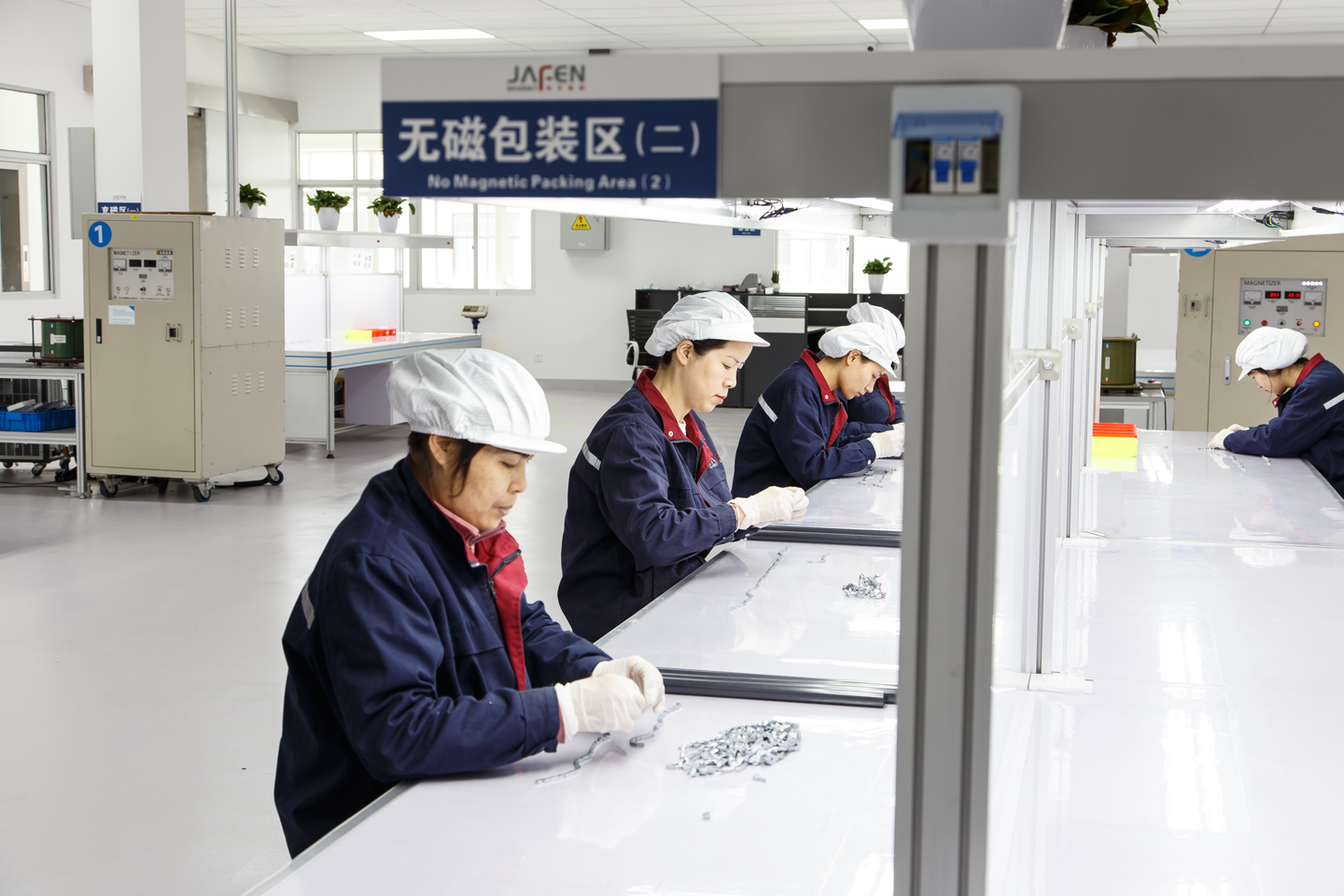
Non-magnetic packing station at the supplier's workshop, downstream of magnetic property, dimensional and coating inspection.
A five-step verification sequence for procurement teams
A verification sequence for Product ID 9216 can be completed without a factory visit, provided each step produces a document rather than a confirmation. The sequence below is ordered by cost of failure: the earliest steps are the cheapest to check and the most damaging if skipped.
| Step | What to verify | Why it matters |
|---|---|---|
| 1. Certificate identity | Certificate number, standard and edition, issuing body, legal entity name, issue and expiry dates | Confirms the file belongs to the entity that will invoice the order |
| 2. Literal scope reading | Scope wording, including exclusions such as the Chapter 8.3 design exclusion | Prevents assuming design responsibility or process steps that were never audited |
| 3. Scope-to-part mapping | Product ID record linking the category entry, such as 9216, to the ordered part, such as the N52 D20×10×5 mm ring | Turns a category certificate into a traceable part reference |
| 4. Acceptance definition | Grade, dimensions and tolerances, coating, magnetization direction, test method, sampling, report format | Covers the parameters no management-system certificate can fix |
| 5. Surveillance | Renewal dates, per-lot test reports, change notification, periodic third-party inspection | Keeps the file valid after the first shipment, including the earlier 2027 environmental renewal |
Steps one to three are usually complete within a week if the supplier maintains a document set. Step four is the one that consumes engineering time, because it requires agreement on tolerances and on the test method that will govern acceptance. Step five is the step most often reduced to a calendar reminder — and it is the step that determines whether the file is still accurate two years after onboarding.
What this evidence set does not establish
The boundaries are worth stating as plainly as the credentials. Certification is not part qualification: neither the IATF 16949:2016 certificate nor the ISO 9001:2015 certificate states that any particular grade, coating or tolerance has been produced to specification, and neither replaces first-article approval or a PPAP-type submission where the buyer's programme requires one.
The design exclusion has commercial consequences. Because product design sits outside the certified scope, magnetic circuit design, tolerance stack decisions and application validation remain the buyer's responsibility unless separately contracted. Similarly, the ISO 14001:2015 certificate evidences environmental management of production activities and should not be read as a product substance declaration.
Company-reported performance figures — batch fluctuation within ±2%, key dimensional pass rate of 99.5%, monthly output of 600+ tons — are useful indicators of how the supplier manages its process, but they are self-declared. They become verifiable only through SPC data, delivered-lot test reports and, where risk justifies it, witnessed or third-party inspection. Finally, validity is time-bound: the environmental certificate runs to 17 January 2027 and the two TÜV SÜD certificates to 3 July 2028, and a file that is not re-checked before those dates is a file that describes the past.
Market context: concentration, definitions and what to watch
Two context figures explain why document-level verification has become a routine procurement step in this category. The first is supply concentration: the IEA's 94% figure for China's share of global sintered permanent magnet production in 2024 means most buyers worldwide are qualifying Chinese manufacturers, whether directly or through distributors. The second is trade scale: China's exports of permanent magnets under HS code 850511 were valued at USD 3.24 billion in 2024, according to the World Integrated Trade Solution, which indicates how much of that production moves through export channels requiring documentation.
Market size estimates should be handled more cautiously than they usually are. One commercial research estimate puts the global NdFeB magnet market at USD 17.3 billion in 2025, while a different firm's figure for NdFeB permanent magnets is USD 32.66 billion — a variance that reflects differing treatment of bare magnets versus assembled component value rather than a disagreement about physics. Buyers citing market context internally are better served by quoting the definition alongside the number.
The forward-looking reading that follows from this evidence base is modest and procedural rather than promotional. As high-temperature grades and heavy-rare-earth-reduced formulations spread across motor and industrial programmes, supplier evaluation is shifting from document collection at onboarding towards lot-level data: demagnetisation curves at operating temperature, per-batch magnetic reports and SPC trends. That shift favours buyers who define acceptance criteria precisely and suppliers whose traceability systems can reproduce them — and it makes the certificate a starting point for verification rather than a conclusion.
FAQ
What does Product ID 9216 actually cover?
Product ID 9216 is a category entry for sintered NdFeB magnets rather than a single part. Its naming code combines a shape letter — D for disc or column, F for block, R for arc — with dimensions, followed by optional features after a hyphen. Catalogue examples are D15×3.8 as a disc, D15×D5×25 as a ring, D50×D13.5×20-D20×8 as a ring with counterbore, F18×9.5×2 as a block and R90×R85×40×50 as an arc, with steps, holes or chamfers appended in the same format.
Does the IATF 16949:2016 certificate mean the supplier designs the magnet?
No. The certified scope is manufacturing of material and products for sintered neodymium iron boron permanent magnets, without product design as per Chapter 8.3. Design authority therefore remains with the buyer's drawing, magnetic design and technical agreement, while the supplier manufactures to that specification. Design changes should be managed as buyer-controlled changes rather than assumed to fall inside the certified scope.
Which certificate dates should a buyer track?
The ISO 14001:2015 certificate 02124E10013R1M from Huaxia Certification Center, Inc. was issued on 2 January 2024 and expires on 17 January 2027. The IATF 16949:2016 certificate 12 111 69512 TMS and the ISO 9001:2015 certificate 12 100 69512 TMS, both from TÜV SÜD Management Service GmbH, run from 4 July 2025 to 3 July 2028. Because the environmental renewal falls roughly eighteen months earlier, renewal tracking should follow the earliest expiry in the set.
How is an N52 D20×10×5 mm ring magnet specified for acceptance?
The technical agreement should fix the grade (N52), the geometry of 20 mm outer diameter, 10 mm inner diameter and 5 mm thickness, the coating system, the magnetization direction or pole pattern, dimensional tolerances, sampling and the report format. Acceptance is then based on that agreed technical document plus factory inspection reports covering magnetic properties, dimensions and surface inspection. Because standard N grades are rated for operating temperatures up to about 80 °C per the supplier's grade guidance, a hotter application requires a higher-coercivity grade such as SH, UH or EH even if the dimensions are unchanged.
What batch documentation should accompany a shipment?
Buyers should expect magnetic property test reports covering Br, Hcj and (BH)max for the delivered batch or lot, dimensional inspection records against the drawing, and coating thickness and adhesion results for plated parts, supported by salt spray testing where the coating specification requires it. The supplier reports magnetic performance batch fluctuation within ±2% and a key dimensional pass rate of 99.5%; verifying those figures calls for SPC data and the demagnetisation curves of delivered lots rather than a single report.
Do ISO 9001 and ISO 14001 replace product-level compliance documents?
No. ISO 9001:2015 covers quality management across manufacturing and sales of material and products for sintered NdFeB permanent magnets, and ISO 14001:2015 covers environmental management of production and related activities. Neither is a product-level substance declaration, and neither constitutes part approval. Buyers needing material content, restricted-substance or destination-market documentation should request it for the specific grade and coating being purchased.
Supplier reference document: JLmagnet Profile 2026 (PDF).
¿Tiene preguntas o necesita más detalles?
Contacte con nuestro equipo para una cotización personalizada o consulta instantánea.
Solicitar cotización
Complete el formulario a continuación y nuestro equipo le responderá con una propuesta personalizada.
Chat directo de WhatsApp
¿Prefiere chatear en tiempo real? Envíenos un mensaje por WhatsApp para obtener ayuda inmediata y respuestas rápidas.
- Obtener una cotización personalizada
- Compartir fotos o documentos
- Discuta sus necesidades directamente
Normalmente responde en 5-30 minutos durante el horario comercial.