
Sinotruk HOWO TX: Tropical Mining and Desert Heat Haul Fit
Two haul environments break trucks in different ways. Humid tropical mining attacks ground bearing capacity, body abrasion and corrosion. Desert high-temperature hauling attacks cooling margin, dust protection and cycle continuity. The SINOTRUK HOWO TX range answers this with separate configurations rather than one universal chassis: a 6x4 dump truck documented for high-temperature, heavy-load and desert road conditions, an 8x4 dump truck documented for mining rough terrain and humid tropical environments, and a water tanker that carries the site water and dust-suppression function both environments depend on.
What follows maps those three configurations to the conditions they are specified for, to the support fleet they must work with — excavators, loaders, bulldozers and graders — and to the procurement checks that decide whether a specification survives contact with an actual site. It also sets out where the fit ends, because a configuration that is right for one environment is frequently the wrong purchase in another.
Why the operating environment, not the payload figure, sets the specification
A dump truck specification is a set of trade-offs, and the environment decides which side of each trade-off becomes expensive. On a humid tropical mining site, the binding constraints are usually ground bearing capacity after rain, haul-road deterioration, wet abrasive material in the body, and corrosion on exposed steel. On a desert high-temperature site, they are heat rejection under continuous load, dust ingress into the intake and cab, tyre and brake heat over long haul distances, and water logistics. Both environments demand durability and low maintenance. They do not demand the same truck.
This is why payload alone is an incomplete buying question. A decision sequence that holds up through evaluation runs in four steps: which documented operating condition the configuration addresses; what body volume and rated load follow from it; which support equipment must be scheduled around it; and which boundaries — emission standard, drive side, tank material, haul-road preparation — apply before an order is placed.
The commercial upside of getting that sequence right is uptime. When the truck matches the ground and the support fleet matches the truck, cycle counts stay stable through a wet season or a hot season. When the match fails, the symptoms are recognisable: spillage because the loader cannot clear the body side, falling cycle counts because a grader has not re-cut the haul road, or a rated load that can never be used because drainage was never built into the tip area.
The three HOWO TX configurations and the conditions they are documented for
QINGONG — Jinan Qingong International Trade Co.,Ltd, an exporter of heavy-duty trucks and construction machinery established in Jinan, Shandong in 2008 — is an official exporter of SINOTRUK and supplies the HOWO TX range to African, South American, Central American, Southeast Asian and Middle Eastern markets. For tropical and desert hauling, three configurations are directly relevant, and the operating conditions documented for them are not interchangeable.
| Configuration | Model code | Documented operating condition | Load / volume | Body material | Primary site role |
|---|---|---|---|---|---|
| 6x4 dump truck | ZZ3257V3847GB1 (specification sheet lists ZZ3257V384GB1) | High-temperature, heavy-load and desert road conditions | Cargo box 5,400 × 2,300 × 1,500 mm; 371 HP | Steel; 8 mm floor, 6 mm sides | Pit-to-stockpile haulage in hot, dry operations |
| 8x4 dump truck | ZZ3317V386GB1 | Mining rough terrain and humid tropical environments | 25–30 CBM; 40 t rated load | Carbon steel | Continuous heavy-duty, off-road mining haulage |
| Water tanker | ZZ1257V464GB1 | Site water supply with water spray; listed for mining, road works, concrete and cement | 20,000–25,000 L | Carbon steel Q235 | Haul-road dust suppression, compaction moisture, site water |
Technical explanation: the 6x4 dump truck in desert high-temperature hauling
The 6x4 dump truck is documented as operating under high-temperature, heavy-load and desert road conditions. Its specification lists a TX-F cab with single bunk, air conditioning, safety belts and front and rear lamp covers; a WD615.47 engine rated 371 HP at Euro II; an HW19710 transmission with 10 forward and 2 reverse gears; a VGD95 front axle with drum brake; an MCX16ZG rear axle with a 5.451 gear ratio; a 300 L fuel tank with cap lock; 12.00R20 radial tyres with one spare; and a cargo box of 5,400 × 2,300 × 1,500 mm with an 8 mm floor, 6 mm sides and a middle lifting system. Overall dimensions are 8,400 × 2,500 × 3,400 mm.
What those figures mean at the point of purchase
- Final drive ratio 5.451. A numerically higher final drive multiplies engine torque at the wheels. That is the standard engineering trade-off against road speed. Where grades, loose sand and repeated standing starts dominate the duty cycle, the trade usually pays; where a unit spends most of its life on paved transfer runs, it does not.
- Ten forward and two reverse gears. Close ratios give the driver control during loading and while reversing to a tip point or hopper, which matters on sites where a spotter is not permanently available.
- Middle lifting system. Progressive lifting allows controlled discharge instead of a single full tip, which is useful where the tip face is uneven or the receiving point is narrow.
- Overall width 2,500 mm, height 3,400 mm. These dimensions, not the payload, are usually what force a haul-road upgrade. Berm height, two-way passing width and overhead clearance should be checked before units are committed to a route.
- 300 L fuel tank. On remote desert hauls the refuelling interval has to be planned from route length and daily cycle count, with a bowser or fuel point scheduled in advance rather than improvised.
- Cab air conditioning and lamp covers. High ambient temperature and night shifts are normal operating conditions in this environment, not exceptions, so both items belong in the base specification review.
Technical explanation: the 8x4 dump truck in humid tropical mining
The 8x4 dump truck is documented as designed for mining rough terrain and humid tropical environments, with a cargo volume of 25–30 CBM, a rated load capacity of 40 tons and a carbon steel body. Listed applications include mining, construction, building and road building. The cab is a TX-F single sleeper unit with air conditioning and safety belt.
Where the 8x4 earns its place, and what it requires in return
- Fewer cycles for a given tonnage. A 25–30 CBM body with a 40-ton rated load reduces the number of trips a site needs, which is the main economic argument for an eight-wheel configuration in continuous mining haulage. The benefit only materialises if loading equipment can fill the body in a reasonable number of passes.
- Rated load is a rating, not a permission. A 40-ton rating assumes a haul road and a tip area engineered to carry it. On soft, waterlogged tropical ground the rating is a ceiling that drainage, route selection and payload discipline must protect.
- Carbon steel in a wet climate. Body corrosion control and a wash-down routine become scheduled maintenance items rather than optional housekeeping.
- Off-road capability has a road cost. The same configuration that copes with rough terrain places higher demands on haul-road preparation than a smaller unit, and the grader becomes a production asset rather than a support vehicle.
The water tanker as site infrastructure, not an accessory
The HOWO TX water tanker (ZZ1257V464GB1) carries 20,000–25,000 L in a carbon steel Q235 tank with a water spray function, on a TX-F cab with single bunk, air conditioning and safety belts. Listed industries are construction, building, cement, road works, mining and concrete. In hot, dry hauling, water is a production input rather than a convenience: dust suppression on haul roads protects visibility and plant intake air, and moisture conditioning supports compaction during road works. On tropical sites the same unit covers site water supply and dust control where surfaces dry out.
A boundary worth stating plainly: the tank is carbon steel Q235 with a water spray function, and it is positioned as a site water and dust-suppression unit. Buyers whose requirement is potable water, chemical transfer or a corrosion-inhibited duty should specify a different tank material and confirm the change with the supplier before ordering, rather than treating the standard tank as universal.
Matching the truck to the support fleet
A dump truck's productivity is set by the equipment around it, not only by its own specification. Four interfaces decide whether a fleet performs as designed.
Excavator and wheel loader: the loading pass
An 8 mm floor and 6 mm sides are sized for abrasive rock, but they cannot compensate for a poor loading match. If the bucket cannot clear the body side height, spillage lands on the haul road and is then re-handled by a grader. The working rule is to match bucket reach and dump height to body side height, and bucket capacity to the number of passes the site can tolerate per cycle.
Bulldozer: bench, tip area and recovery
The bulldozer prepares benches, manages the tip area and stockpiles, and recovers stuck units. In tropical mining its role expands, because wet pit floors need re-grading on a daily rather than weekly basis. A site plan that omits dozer hours from the haulage cost will understate the real cost of a wet season.
Grader: the haul road as a maintained asset
In tropical operations the grader is the difference between a 40-ton rated load being usable and being a recovery job. In desert operations, grading removes loose sand that raises rolling resistance across a long haul. Either way, grader availability should be scheduled against haul cycles, not treated as ad-hoc maintenance.
Water tanker: dust, moisture and scheduling
Dust suppression and compaction moisture consume tanker hours continuously on an active site. With a 20,000–25,000 L capacity, the water cycle should be written into the daily plan so that suppression runs are not competing with production haulage for the same operating window.
| Site condition | What it stresses | Configuration decision |
|---|---|---|
| Wet-season pit floor, standing water | Ground bearing capacity, traction | Use the 8x4 only on drained, re-graded haul roads, with payload discipline by route |
| Long dry haul, high ambient temperature | Cooling, dust, tyre and brake heat | 6x4 with the 5.451 final drive; a refuelling plan sized to the 300 L tank |
| Abrasive wet rock | Body wear, corrosion | 8 mm floor and 6 mm sides, wash-down routine, repainting of exposed steel |
| Dust-generating haul road | Visibility, plant intake air | Water tanker of 20,000–25,000 L scheduled inside the cycle |
| Narrow or unbuilt haul road | Clearance, berm height | Verify the 2,500 mm width and 3,400 mm height of the 6x4 before committing units |

Durability, maintenance and load under long-distance transport
The supplier's stated comparison is that SINOTRUK HOWO new vehicles provide 30–50% lower total maintenance cost compared to used trucks and 2–3 times longer service life over alternatives, including low-cost locally assembled units. Read as a lifecycle claim rather than a price claim, this is the argument that matters in continuous haulage: the comparison is total maintenance spend and service life, not the invoice at the port. Because it is supplier-stated, buyers should ask for the basis of the comparison and match it against their own utilisation, shift pattern and haul distance.
On a remote site, parts lead time is often the binding constraint rather than the repair itself. QINGONG's stated after-sales provision covers spare parts supply, remote technical support and an overseas service network with local agents in key countries. That combination — parts, remote diagnostics and a local node — is the practical definition of what buyers evaluating Sinotruk global distributors should be checking, alongside unit specification.
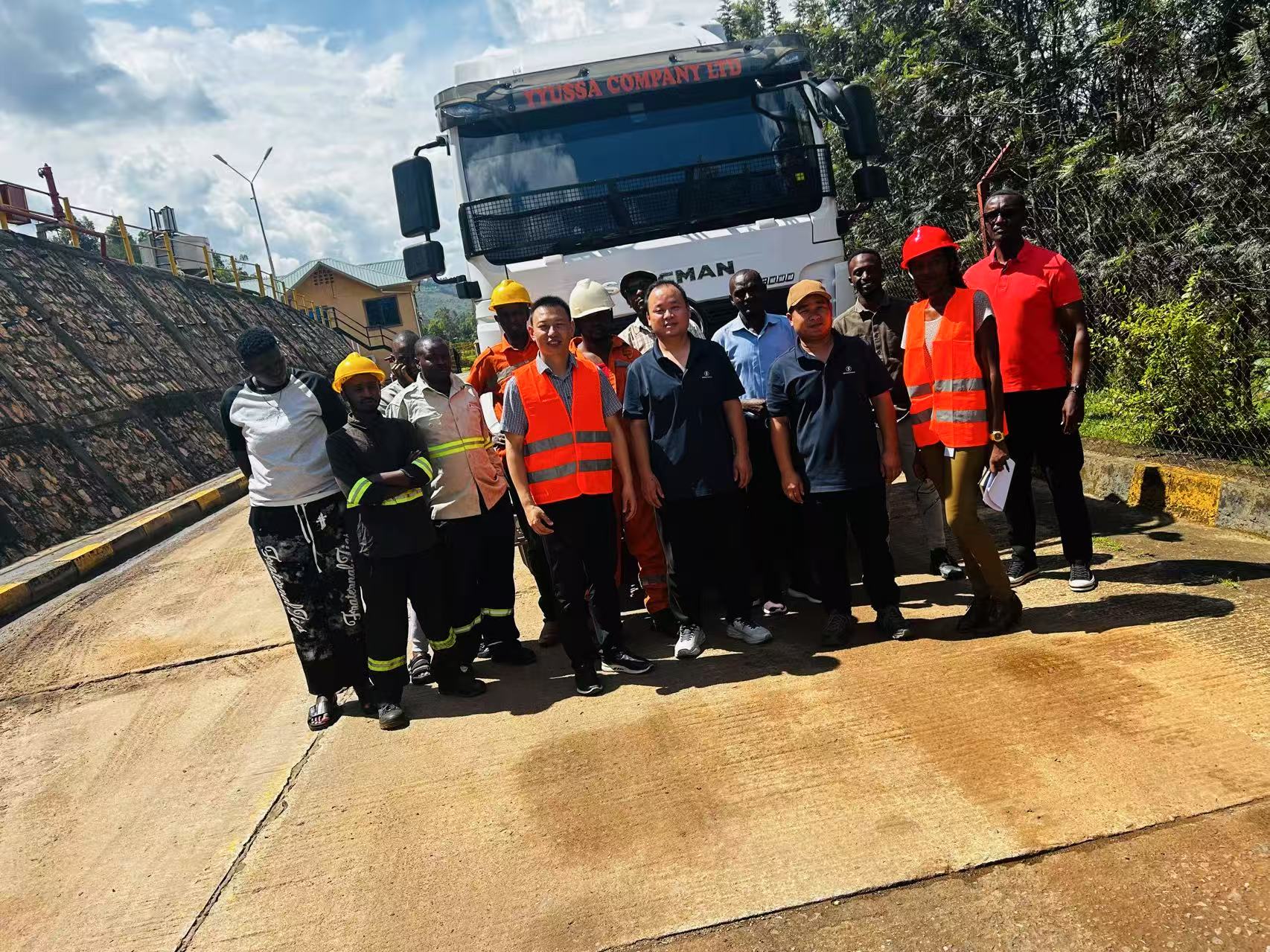
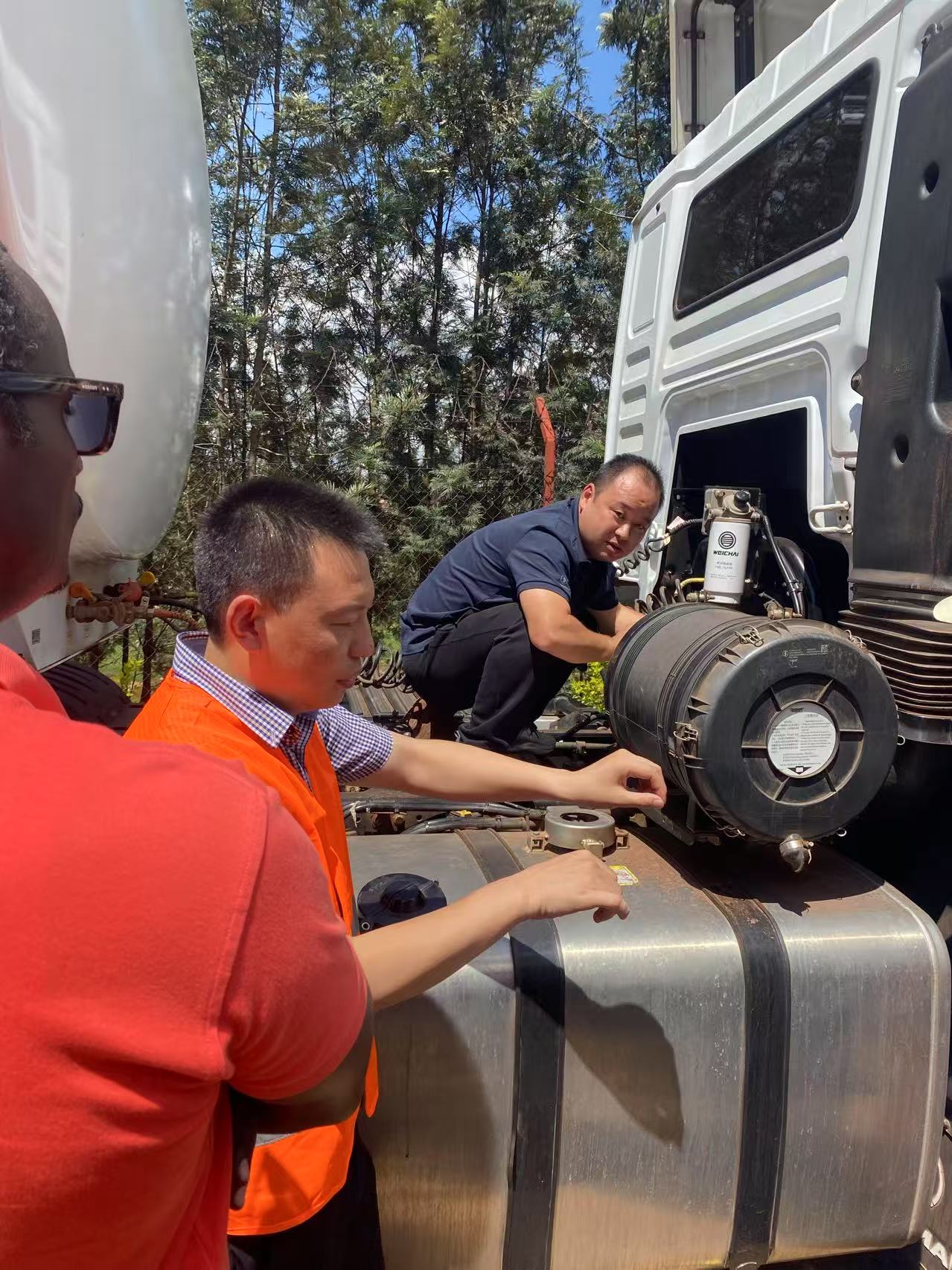
A Rwanda-based customer record describes 70 units operating over two years across mining transportation and road construction material haulage, with complete driver and maintenance training, stable vehicle operation and a reduced fleet failure rate. The detail worth extracting is not the fleet size but the training element: in harsh environments, operator and maintenance competence is repeatedly cited as a contributor to reliability alongside the hardware itself.
Customization, build options and the execution phase
QINGONG offers OEM, ODM and customized manufacturing covering engine power, drive system, cargo body structure, tank volume, logo branding and colour painting. Monthly production capacity is 1,500–3,000 units, varying by model mix. Minimum order quantity is 1 unit, with in-stock units available for immediate shipment and customized orders requiring 30–45 days. Quality control is 100% pre-shipment inspection, with optional third-party inspection by SGS or BV. Acceptance criteria are a pre-shipment test; delivery terms are FOB, CIF, DDU or DDP; payment terms are TT, L/C and flexible installment solutions for long-term partners.
Not every option changes fitness. Engine power and drive system determine grade, altitude and heat margin. Cargo body structure determines abrasion life and discharge behaviour. Tank volume determines the water cycle a site can actually support. Logo branding and colour painting are commercial items and should be settled after the functional ones, not before.
On export authorisation, QINGONG holds a National vehicles export-oriented enterprises certificate from the Ministry of Commerce of China, described as an exporting licence covering Africa, South America and Asia with an issue date of 2015-01-01 and an expiry date of 2030-01-01. Company records also state founding in 2008, 300 employees, 80 engineers, a 90% export ratio, a primary market focus on Africa, exports to more than 100 countries, annual sales above USD 200 million, and subsidiaries established in Tanzania, Indonesia, Zambia and Laos since 2023.
Market trend: distributor depth is where export scale now lands
Sinotruk ranked first in China's heavy-duty truck exports for the 21st consecutive year by 2025, according to an industry publication, and Sinotruk (Hong Kong) Limited reported heavy-duty truck export volume of 134,038 units in 2024 in its annual report. At that scale, the buyer's question shifts from whether a truck can be sourced to who supports it, where, and under what documented authorisation.
In West Africa, SINOTRUK International lists a regional contact covering Senegal, Western Sahara, Mauritania, Gambia, Cape Verde, Guinea, Guinea-Bissau and Mali, and a second contact covering Benin, Burkina Faso, Togo, Ghana, Côte d'Ivoire, Liberia and Sierra Leone. A regional contact is a routing node, not proof of a national distributor appointment. Buyers in those markets should treat the regional contact as the first step of an authorisation check, not the last one — and the same discipline applies to Sinotruk distributor Senegal, HOWO distributor Mali or SINOTRUK distributor Côte d'Ivoire enquiries generally.
QINGONG's status as an authorised first-tier distributor and official export partner of SINOTRUK is reported in secondary industry publications and in the company's own group profile, which also lists the Tanzania, Indonesia, Zambia and Laos subsidiaries established since 2023. Documented authorisation and a local legal presence are the two items that most reduce procurement risk in this region, and both should be confirmed with paperwork rather than inferred from a website or a trade article.
Comparison with traditional solutions, and where the fit ends
The traditional alternatives are used trucks and low-cost locally assembled units. On purchase price, a used truck usually wins, and in low-utilisation fleets it can remain the rational choice. On lifecycle cost, the stated 30–50% lower total maintenance cost and 2–3 times longer service life favour new units. The honest framing is that the comparison is utilisation-dependent: a fleet running low annual hours may never recover the price gap, while a continuous two-shift mining operation usually does.
Where the HOWO TX fit ends
- Emission standard. The WD615.47 engine in the 6x4 specification is rated Euro II. Markets that require a higher emission standard should confirm homologation and import eligibility before ordering.
- Drive side. The listed steering configuration is left-hand drive. Buyers in right-hand-drive markets must confirm availability rather than assume it.
- Tank material. The water tanker's carbon steel Q235 tank with water spray is a site water and dust-suppression specification. Potable water, chemical or corrosion-inhibited duties require a different material.
- Rated load conditions. The 8x4's 25–30 CBM and 40-ton rating are usable only where haul roads, drainage and tip areas are engineered for them. On soft wet ground the rating is a ceiling, not a working assumption.
- Fuel range. A 300 L tank on the 6x4 requires an explicit refuelling plan on remote desert hauls.
- Lead time. Customized orders take 30–45 days against immediate shipment for stock units. That is a planning difference, not a defect, but it changes project timing.
- Model code documentation. The 6x4 appears as ZZ3257V3847GB1 in company documentation and ZZ3257V384GB1 on the specification sheet; the exact code must be confirmed on the order.
A buyer's evaluation sequence
| Step | Question to settle | Evidence to request |
|---|---|---|
| 1. Duty cycle | Is the site hot and dry, or humid and wet? Cycles per day, haul distance, gradient | Site plan and route survey |
| 2. Payload and volume | 8x4 at 25–30 CBM and 40 t, or 6x4 with a 5,400 × 2,300 × 1,500 mm box | Specification sheet with confirmed model code |
| 3. Support fleet | Can the loader fill the body in an acceptable number of passes? Is a dozer and grader scheduled? | Equipment list and hourly rates |
| 4. Water and dust | What tanker hours per day does the site need? | Water balance based on 20,000–25,000 L capacity |
| 5. Compliance | Emission standard, drive side, import and homologation rules | Homologation and import documents |
| 6. Build options | Which functional options are required — engine power, drive system, body structure, tank volume | Custom order confirmation |
| 7. Acceptance and terms | Pre-shipment test, inspection scope, Incoterms, payment | Pre-shipment inspection report; optional SGS or BV; FOB, CIF, DDU or DDP; TT or L/C |
| 8. After-sales | Parts availability, remote support, local agent coverage | Service agreement and parts list |
Future outlook
No forecast is required to read the direction of travel. At manufacturer export volumes reported for 2024, competition between Sinotruk global distributors has moved from unit availability to channel quality: parts logistics, technical training, service response and documentary authorisation. For an operator, the practical consequence is that truck specification and support plan should be evaluated in the same exercise, because a correctly specified unit without parts access behaves like an incorrectly specified one.
Two variables will keep reshaping the decision. Emission and homologation requirements differ by market and change on their own timetable, which makes compliance a per-order check rather than a one-time assumption. And haul-road engineering — drainage in the tropics, compaction and dust control in arid regions — will continue to determine whether a rated load is actually usable. A HOWO overseas distributor that can support both the vehicle and the site plan is worth more than one that competes only on unit price.
Frequently asked questions
Which HOWO TX configuration is specified for desert high-temperature hauling?
The 6x4 dump truck, model ZZ3257V3847GB1, is documented as operating under high-temperature, heavy-load and desert road conditions. Its specification includes a WD615.47 engine rated 371 HP at Euro II, an HW19710 transmission with 10 forward and 2 reverse gears, a 5.451 rear axle ratio, a 300 L fuel tank and a 5,400 × 2,300 × 1,500 mm cargo box.
Which configuration suits humid tropical mining terrain?
The 8x4 dump truck, model ZZ3317V386GB1, is documented as designed for mining rough terrain and humid tropical environments. It carries a 25–30 CBM cargo volume and a 40-ton rated load in a carbon steel body, with listed applications in mining, construction, building and road building.
What capacity and material does the HOWO TX water tanker offer?
The water tanker, model ZZ1257V464GB1, carries 20,000–25,000 L in a carbon steel Q235 tank and includes a water spray function. It is listed for construction, building, cement, road works, mining and concrete applications, and is used for site water supply and dust suppression.
Can the trucks be customized, and what is the minimum order quantity?
OEM, ODM and customized manufacturing are offered across engine power, drive system, cargo body structure, tank volume, logo branding and colour painting. The minimum order quantity is 1 unit. In-stock units ship immediately, while customized orders require 30–45 days, and monthly production capacity is 1,500–3,000 units depending on model mix.
What acceptance, inspection and payment terms apply?
Acceptance criteria are a pre-shipment test, backed by 100% pre-shipment inspection with optional third-party inspection by SGS or BV. Delivery terms are FOB, CIF, DDU or DDP, and payment terms are TT, L/C and flexible installment solutions for long-term partners.
Which supporting equipment should be planned alongside these trucks?
Excavators and wheel loaders handle the loading pass and must be matched to body side height and capacity. Bulldozers prepare benches, manage tip areas and recover stuck units. Graders maintain haul roads, which is especially critical in wet tropical conditions. The water tanker supplies dust suppression and compaction moisture, and its 20,000–25,000 L capacity should be scheduled into the daily cycle rather than treated as standby equipment.
In which situations is the HOWO TX not the appropriate choice?
Where a market requires an emission standard above the Euro II rating of the WD615.47 engine, or requires right-hand drive, suitability must be confirmed before ordering. The carbon steel Q235 tank is a site water and dust-suppression specification rather than a potable-water or chemical tank. A 40-ton rated load depends on engineered haul roads and drainage, and the 300 L fuel tank on the 6x4 requires a refuelling plan for remote desert routes.
Reference document: QINGONG Group Products Catalog 2026 (PDF). Supplier: JINAN QINGONG INTERNATIONAL TRADE CO.,LTD, Jinan, Shandong, China.
¿Tiene preguntas o necesita más detalles?
Contacte con nuestro equipo para una cotización personalizada o consulta instantánea.
Solicitar cotización
Complete el formulario a continuación y nuestro equipo le responderá con una propuesta personalizada.
Chat directo de WhatsApp
¿Prefiere chatear en tiempo real? Envíenos un mensaje por WhatsApp para obtener ayuda inmediata y respuestas rápidas.
- Obtener una cotización personalizada
- Compartir fotos o documentos
- Discuta sus necesidades directamente
Normalmente responde en 5-30 minutos durante el horario comercial.