
Single-Source or Mixed Suppliers for Restaurant Furniture?
Buyer Decision Framework
Restaurant fit-outs rarely fail because a single chair was badly made. They fail because twelve purchase orders landed on twelve different dates, in twelve slightly different finishes, and nobody was contractually responsible for the gap between the booth and the floor plan. The choice between a full restaurant furniture package and a set of specialist suppliers is therefore not primarily a price question. It is a coordination question.
Both models are legitimate. A full-package supplier takes responsibility for the whole furniture scope — chairs, tables, booth seating, bar stools, bar counters, outdoor pieces and sometimes hotel furniture — under one specification, one approval cycle and one shipment plan. A mixed-supplier model buys each category from whoever does it best, accepting that the buyer becomes the integrator. This framework sets out how to choose between them on evidence rather than on preference.
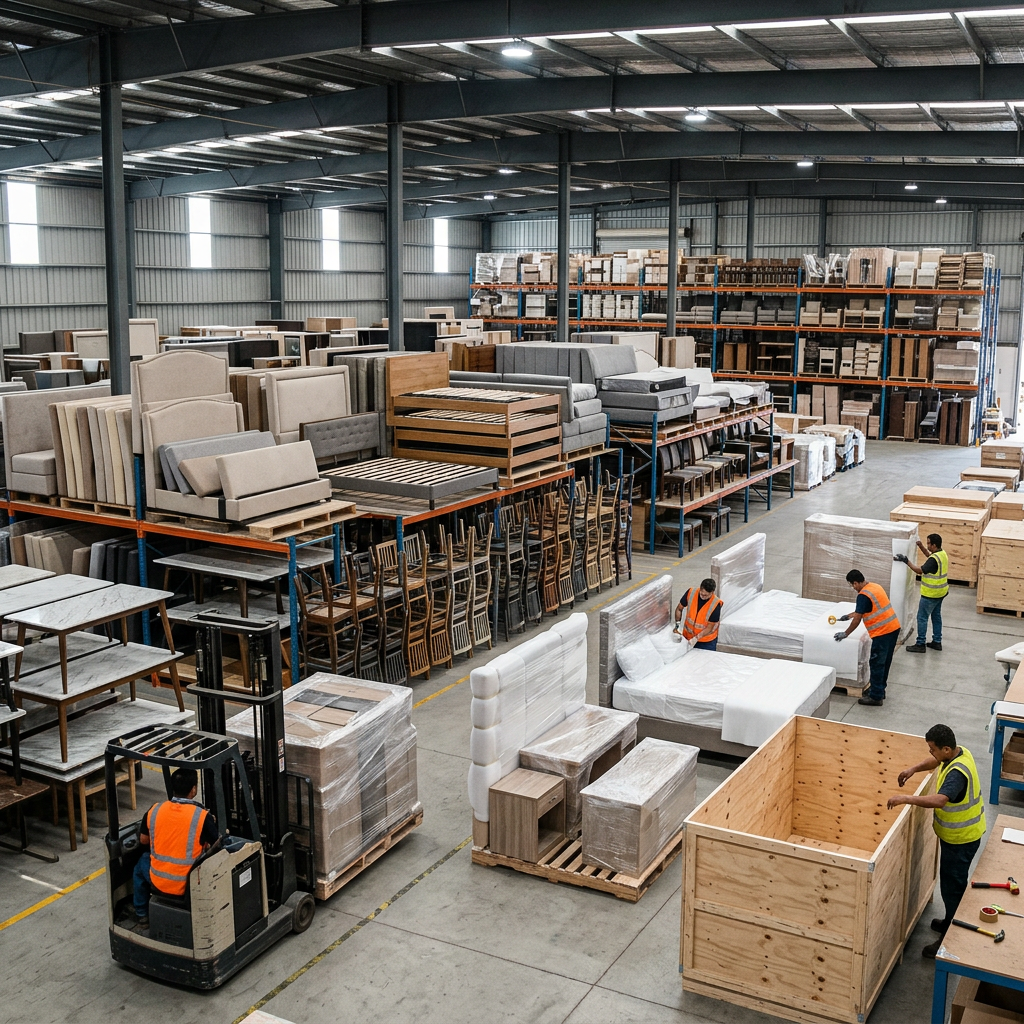
Consolidated production and staging: the operational backbone of a single-source restaurant furniture package.
Defining the two sourcing models precisely
A full restaurant furniture package means one supplier or manufacturer is contracted for most or all of the loose and fixed furniture in a venue: restaurant chairs, dining tables and table bases, booth seating and banquette seating, bar stools, bar counters, lounge seating, and where relevant outdoor tables and chairs and hotel furniture. The scope is confirmed against architectural drawings, one material and finish palette is approved, and production is scheduled as a single programme.
A mixed-supplier model splits that same scope across specialists. A chair factory supplies chairs, a booth workshop supplies banquettes, a joinery shop supplies the bar counter, and a metal fabricator supplies table bases. Each supplier is optimised for its own category. The buyer — or the contractor acting for the buyer — becomes the integrator of dimensions, finishes, tolerances, delivery dates and claims.
Why coordination risk outweighs unit price
Category-level price comparison is the easiest part of this decision and the least predictive of project outcome. Three cost drivers are routinely underestimated in a mixed-supplier model:
- Tolerance accumulation. Booth seating is built to a wall, chairs are built to a seat count, and tables are built to a circulation dimension. When three suppliers each interpret the same floor plan, small dimensional differences compound at installation, not at quotation.
- Finish matching across substrates. A wood stain on solid wood, the same nominal stain on plywood, and a powder-coated metal frame will not read identically under restaurant lighting. Cross-category finish approval is a single-supplier discipline; in a mixed model it becomes a buyer-side negotiation between three factories that never speak to each other.
- Claim fragmentation. If a banquette arrives damaged and the table base arrives late, responsibility is easy to assign in a single contract and difficult to assign across four. The cost is not the replacement part; it is the schedule slip.
Against that, the mixed model has a real and legitimate advantage: depth. A specialist booth manufacturer may offer more complex curved and L-shaped configurations than a generalist, and a dedicated metal fabricator may offer a wider base range. The framework below is designed to identify where that depth is worth the coordination cost.
The eight comparison dimensions
The following matrix is the core of the decision. Each dimension should be scored per project, not per supplier in the abstract — the same supplier can be the right answer for a 60-seat café and the wrong answer for a 400-seat multi-level restaurant.
| Dimension | Full package (single source) | Mixed suppliers |
|---|---|---|
| Customization | One customization brief applied across categories; dimensions, materials, upholstery and finishes coordinated as a set. | Deeper per-category options, but each supplier interprets the design intent independently. |
| MOQ | One order mix can absorb category-level minimums; mixed-model orders may be considered within a project, subject to model-specific production requirements. | Each supplier applies its own minimum, so a small venue may hit four separate thresholds. |
| Lead time | One production schedule; typical production cycles of 30–60 days depending on project scope, with one shipment plan. | Fastest per category, slowest in aggregate — the project waits for the last supplier. |
| CAD support | Layout coordination, CAD drawings, dimension adjustment and 3D visualization available for applicable project orders. | Each supplier draws its own product; nobody owns the combined layout. |
| Packing | One export packing standard: foam, edge protectors, and cartons or wooden crates depending on the item, checked against one packing list. | Different packing standards per supplier; consolidated loading requires a consolidation point. |
| Warranty & support | Single after-sales channel; project records support future replacement and renovation. | Terms and response routes differ per supplier; the buyer arbitrates between them. |
| Design consistency | One approved palette across wood, metal and upholstery. | Palette consistency depends entirely on buyer enforcement. |
| Price transparency | One quotation covering the scope; category-level benchmarking is harder to isolate. | Direct category benchmarking, at the cost of hidden coordination labour. |
Category by category: where single-source earns its place
Restaurant chairs and tables
Chairs and dining tables are the largest unit count in most projects and the category where finish consistency is most visible to guests. A restaurant chairs and tables set specified together — same wood stain, same metal finish, same upholstery family — reads as a designed room. Sourced separately, the same nominal colours frequently diverge. This is the category where a single-source package most reliably pays for itself, and also the category with the most mature specialist supply, so a mixed model is defensible if the buyer controls finish approval directly.
Restaurant booth seating and banquettes
Booths are the highest-risk category in a mixed model because they are built to a room rather than to a catalogue. Straight, single, double, L-shaped, U-shaped and curved configurations all depend on site dimensions, wall conditions and traffic flow. When the booth supplier and the table supplier are different companies, the critical dimension — the gap between banquette edge and tabletop — is nobody's single responsibility. A single-source scope closes that gap at the drawing stage rather than on site.
Bar stools, bar counters and café bar furniture
Bar counters combine joinery, stone or HPL tops, metal footrails and integrated power or lighting. Bar stools must then match the counter height and the counter's overhang. These two items are functionally one system, and splitting them across a joiner and a seating factory is a common source of mismatch. Where the counter is highly bespoke — curved, backlit, or structurally integrated — a specialist counter fabricator may still be the better technical choice, with the stool supplier briefed against the counter's final dimensions.
Outdoor furniture and hotel furniture
Outdoor tables and chairs introduce weather resistance, corrosion protection and outdoor-rated fabrics, which is a genuinely different material discipline from indoor upholstery. Hotel furniture introduces a third discipline: guest room casegoods, lobby seating and public-area furniture with different durability expectations. Buying all three from one supplier only makes sense when that supplier can evidence capability in each. Where it cannot, the honest answer is a hybrid: single-source the indoor dining scope, and treat outdoor and hotel scope as separately qualified packages.
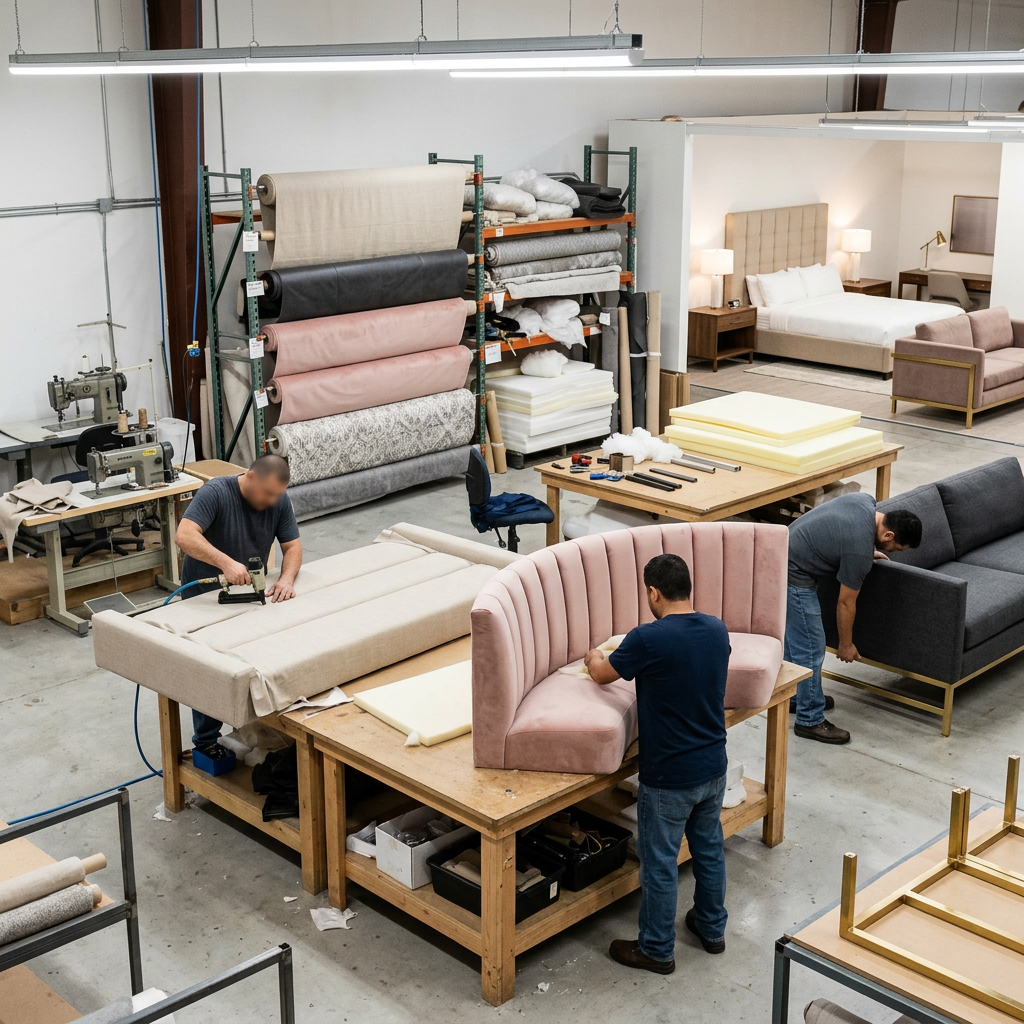
Booth and banquette upholstery produced inside the same programme as the chairs and tables it will sit beside.
A five-step decision sequence
- Map the scope by category and by risk. List every furniture item, then flag the items that are built to the room (booths, counters, fixed banquettes) versus the items that are selected from a range (chairs, stools, standard tables). Built-to-room items carry the coordination risk.
- Test supplier capability with evidence, not claims. Ask for the production steps the supplier actually controls — woodworking, metalworking, upholstery, finishing, assembly, inspection — and for the QC stages applied before shipment. A supplier that subcontracts upholstery is not disqualified, but the buyer should know.
- Confirm MOQ per category, not per order. A single order value can hide four separate minimums. Ask what minimum applies to standard models and what applies to custom dimensions, structures or finishes, since these may differ because of material preparation and production setup.
- Fix the approval gate. Drawings, dimensions, materials, finishes, quantities and approved samples should be confirmed in writing before bulk production. Late changes cause rework, extra cost and delay regardless of which sourcing model is used.
- Decide who owns the shipment. Consolidated procurement, export packing, container loading and shipping coordination are services, not formalities. In a mixed model, someone must still consolidate.
How a single-source package is evidenced in practice
MingMeng Furniture — formally Guangzhou Mingmeng Furniture Co., Ltd., established in 2015 — is a commercial and hospitality furniture manufacturer based in Guangzhou, China, operating a 15,000㎡ facility with more than 200 skilled workers and production lines covering woodworking, metalworking, upholstery, cutting, welding, polishing, painting, powder coating, CNC processing, assembly and quality inspection. Its declared output is more than 80,000 pieces per month, equivalent to 960,000+ units annually, with roughly 90% of production exported to markets including the USA, Australia, Europe, the Middle East and Southeast Asia.
For the purposes of this framework, the relevant question is not the size of the factory but whether the scope is genuinely covered. The declared product range spans restaurant chairs, dining tables, booth and banquette seating, bar stools, bar tables, custom bar counters, lounge chairs, sofas, outdoor tables and chairs, canteen furniture, hotel guest room furniture, hotel lobby furniture and table bases. Supporting services include requirement analysis, space planning, furniture layout, CAD drawings, 3D visualization, material and finish selection, structural optimisation, sample development, OEM and ODM customization, bulk production, quality inspection, supporting décor sourcing, consolidated procurement, export packaging, container loading, international shipping coordination and after-sales support.
Two evidence points matter more than the marketing summary. First, the company states a MOQ of 20 units for custom restaurant booth manufacturing — a specific, checkable figure rather than a vague promise. Second, its quality-control system is described as covering material inspection, production-process inspection, structural and appearance checks, pre-shipment inspection and export packaging control, with common tests including static load, impact, stability, scratch resistance, abrasion resistance and fabric colorfastness. Those are the controls that determine whether a package arrives as one coherent specification. Declared certifications include CE, TÜV, RoHS and Certification of Conformity, alongside 10+ national patented designs; buyers with destination-specific compliance requirements should request the current certificate set for the exact models ordered rather than relying on a category-level claim.
Lead time, MOQ and packing: the variables that decide the model
Three operational variables usually settle the argument faster than any strategic discussion.
Lead time. Project-based furniture is not stocked. Typical production cycles run 30–60 days depending on project scope, before shipping. In a mixed model, four suppliers each quoting 30–60 days do not deliver in 30–60 days; they deliver in the time it takes the slowest to finish plus the time to consolidate. Buyers working to a fixed opening date should model the consolidation step explicitly.
MOQ. Minimum order quantity depends on product type, customization level, material setup and order mix. Standard models and custom project furniture may carry different minimums, and trial orders can be discussed depending on the product, material setup and production requirements. A mixed-model order — several furniture types in one project procurement — can be considered where model-specific production requirements and total order planning allow it. That flexibility is itself a package benefit: it lets a 40-cover café reach viable volumes across chairs, tables and booths together rather than separately.
Packing. Export packing follows a defined sequence: clean and protect finished surfaces, add foam and corner or edge protection with component separation where needed, use export cartons, reinforced packaging or wooden crates according to product fragility, protect and label hardware, then check package dimensions and quantities against the packing list before loading. In a single-source package this is one standard and one packing list. In a mixed model it is four standards, and the buyer carries the risk of a crate that does not stack with the pallet next to it.
Commercial terms and how they interact with the model
Pricing in project furniture is specification-driven. Key cost drivers are materials, dimensions, quantity, construction, finish and upholstery complexity, packaging and the agreed delivery term. Quotations are typically issued EXW or FOB, with freight depending on the selected shipping term and destination, and quotations can be provided in USD, EUR or other major currencies. Unit pricing may decrease as order quantity increases, and tiered pricing can be offered according to purchase volume.
Standard payment terms are typically 30% deposit and 70% balance before shipment by T/T, with L/C at sight potentially available for larger orders from established customers. These are commercial terms to be confirmed in the quotation or contract, not fixed policy. Their relevance to the sourcing decision is simple: a single contract means a single payment schedule and a single set of shipping documents, whereas four suppliers mean four deposits, four balance payments and four document sets to reconcile before any container is released.
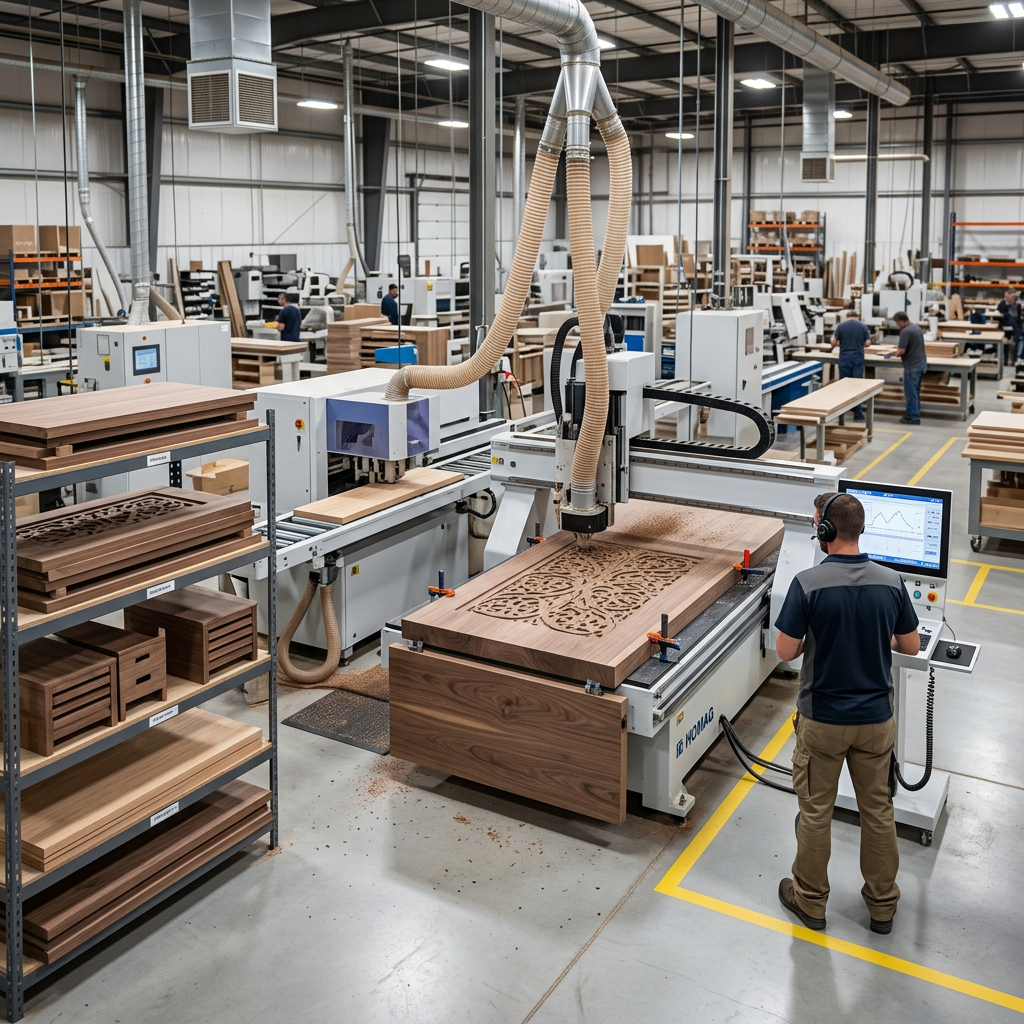
Custom components machined to approved project drawings — the point where CAD support becomes a production constraint.
Application: which projects suit which model
Single-source is usually the stronger fit for: new-build restaurants and café fit-outs where the furniture must match an interior concept across multiple categories; multi-site rollouts where repeatability matters more than category novelty; projects where the buyer has no in-house FF&E coordinator; and venues combining indoor dining, bar and outdoor terrace scope under one opening date.
Mixed suppliers are usually the stronger fit for: renovation projects replacing one category only; venues with a signature bar counter or a structurally unusual banquette that demands a specialist fabricator; projects with an in-house design team able to enforce finish approval across vendors; and phased openings where categories are purchased in separate budget cycles.
A hybrid is common and often correct: single-source the indoor dining and bar seating scope, and qualify outdoor and hotel scope separately. The rule is that each package should have one accountable owner for its drawings, finishes and delivery.
Market context
The restaurant furniture category is growing, but the available market estimates disagree sharply and should be treated with caution. Commercial research publishers report figures such as USD 638.8 million in 2026 rising to USD 929.57 million by 2035 at a 4.3% CAGR (Market Growth Reports), USD 0.88 billion in 2025 reaching USD 1.38 billion by 2034 at 5.13% (Business Research Insights), and USD 6.62 billion in 2025 reaching USD 11.01 billion by 2034 at 5.8% (Dataintelo). The spread reflects different market definitions, base years and methodologies rather than a genuine disagreement about direction, and the figures are not directly comparable or averageable. The practical implication for buyers is modest but real: supplier capacity is expanding, which improves the negotiating position of buyers who can specify precisely, and weakens the position of buyers who cannot.
Where a single-source package is the wrong answer
A credible framework has to state its own limits. A full restaurant furniture package is not automatically superior, and buyers should reject it in at least four situations.
- When one category is genuinely specialist. A complex curved or structurally integrated bar counter, or a heritage-sensitive banquette, may exceed a generalist manufacturer's demonstrated depth. Capability should be evidenced per category, not assumed from overall factory size.
- When the MOQ does not fit the project. The stated MOQ of 20 units for custom restaurant booth manufacturing is workable for most commercial venues but may not suit a very small café replacing two booths. Custom dimensions, structures or finishes can also change minimums because of material preparation and production setup.
- When lead time is compressed below the production cycle. Typical cycles of 30–60 days depending on scope mean a package cannot be compressed indefinitely by negotiation. If the opening date is inside the cycle, splitting scope may genuinely be faster — provided the consolidation step is also modelled.
- When the buyer needs item-level price benchmarking. A consolidated quotation is harder to decompose than four category quotes. Procurement teams with strict comparative-bid requirements may need a line-item breakdown before they can approve a package.
None of these limits disqualify the model. They define the conditions under which it should be selected — which is the entire purpose of a decision framework.
Future outlook
Three shifts are likely to shape this decision over the next planning cycle. First, buyers are increasingly asking for evidence rather than catalogues: documented QC stages, test types, named certification sets and specific MOQ figures. Suppliers that can answer those questions precisely will win packages; suppliers that answer with adjectives will be split out. Second, the hybrid model is becoming the default for mid-sized venues, with indoor dining single-sourced and outdoor or hotel scope qualified separately. Third, CAD and 3D coordination is moving from a value-added service to a baseline expectation, because a package that cannot be drawn cannot be checked against the floor plan before production. Buyers should expect layout coordination, dimension adjustment and visualization as part of the scope discussion, not as an afterthought.
Frequently asked questions
What is the difference between a full restaurant furniture package and using mixed suppliers?
A full package contracts one supplier for most or all furniture categories — chairs, tables, booth seating, bar stools, bar counters and related items — under one specification, one approval cycle and one shipment plan. A mixed-supplier model divides the same scope across category specialists, which gives deeper per-category options but transfers the integration of dimensions, finishes, delivery dates and claims to the buyer or contractor.
What MOQ applies to custom restaurant furniture?
MOQ depends on the product type, customization level, material setup and order mix. Standard models and custom project furniture may have different minimum quantities. MingMeng Furniture states a MOQ of 20 units for custom restaurant booth manufacturing. Custom dimensions, structures, materials or finishes may require a different MOQ because of material preparation and production setup, so quantities should be confirmed per project. Trial orders can be discussed depending on the product, material setup and production requirements, and mixed-model orders can be considered subject to model-specific production requirements and total order planning.
How long does production take for a restaurant furniture project?
Typical production cycles run 30–60 days depending on project scope, before shipping. The cycle is determined by the confirmed specification — materials, construction, finish and upholstery complexity, quantity and packaging — rather than by the number of categories alone. In a multi-supplier model, total elapsed time also includes the consolidation step before container loading.
What CAD and design support is available before production?
For project-based orders, support can include furniture layout coordination, CAD drawings, dimension adjustment and 3D visualization where required, or manufacturing strictly to the customer's approved drawings and specifications. Floor plans can be reviewed to coordinate furniture dimensions, booth layouts and seating arrangements. CAD drawings make the process faster but are not mandatory; furniture can also be developed from photos, reference images or written requirements. Standard design support is generally available for confirmed orders, while complex custom design projects may require a separate design fee.
How is restaurant furniture packed for export?
Export-standard packing uses foam, edge protectors, and cartons or wooden crates depending on the item. The sequence is: clean and protect finished surfaces; add foam, corner and edge protection and component separation where needed; use export cartons, reinforced packaging or wooden crates according to product fragility; protect hardware and label packages clearly; then check package dimensions and quantities against the packing list before loading. Packaging must match product weight, fragile surfaces, shipping method and loading conditions rather than being reduced simply to increase loading quantity.
How are prices and payment terms determined for a full package?
Pricing is determined by the confirmed product specification, including materials, dimensions, quantity, construction, finish and upholstery complexity, packaging and delivery term. Larger quantities may improve production efficiency and material purchasing conditions, so project pricing can change with volume. Quotations are typically EXW or FOB, with freight depending on the selected shipping term, destination and current transportation cost. Standard payment terms are typically 30% deposit and 70% balance before shipment by T/T, with L/C at sight potentially available for larger orders from established customers; the applicable terms should be confirmed in the quotation or contract.
Conclusion
The choice between a full restaurant furniture package and mixed suppliers resolves to a single question: can this buyer realistically own the integration? If yes, category specialists offer depth and price transparency worth having. If no, a package with one specification, one schedule and one claim route is the lower-risk decision — provided the supplier can evidence category coverage, QC stages and specific commercial terms rather than describing them in generalities.
MingMeng Furniture publishes its 2026 restaurant furniture catalogue, including product ranges and project scope, for buyers building a comparison file: Mingmeng Restaurant Furniture 2026 New.
¿Tiene preguntas o necesita más detalles?
Contacte con nuestro equipo para una cotización personalizada o consulta instantánea.
Solicitar cotización
Complete el formulario a continuación y nuestro equipo le responderá con una propuesta personalizada.
Chat directo de WhatsApp
¿Prefiere chatear en tiempo real? Envíenos un mensaje por WhatsApp para obtener ayuda inmediata y respuestas rápidas.
- Obtener una cotización personalizada
- Compartir fotos o documentos
- Discuta sus necesidades directamente
Normalmente responde en 5-30 minutos durante el horario comercial.