
Single Pass Printer Sourcing: A Long-Term Supplier Evaluation Guide for Packaging Buyers
Packaging buyers evaluating a single pass printer for production often focus on print speed, resolution, and price. Yet the decisions that determine whether a digital packaging line stays profitable over five years tend to happen after the purchase: how the supplier handles installation, training, spare parts, firmware updates, and changing production requirements. This guide looks at single pass printer procurement from an ecosystem perspective and outlines what manufacturers should verify before committing to a supplier.
Shanghai Focus Industrial Co., Ltd., commonly known as FocusInc, is an industrial digital printing equipment manufacturer founded in Shanghai in 2008. The company operates a 35,000-square-meter factory and has produced single-pass inkjet systems for corrugated board, flexible packaging, labels, non-woven bags, and other packaging materials. It offers one example of how a supplier can support buyers through the decision and execution stages of a single pass printer investment.
Problem: Single-Pass Technology Is Only as Valuable as the Supplier Behind It
As packaging runs become shorter and more customized, single-pass inkjet technology has moved from pilot projects to standard production equipment. For a packaging operation, this creates an opportunity to eliminate plate-making, handle variable data, and accept orders with a minimum quantity of one piece. The same flexibility raises a risk: if a single pass carton printer or single pass box printer stops production because of missing spare parts, weak documentation, or insufficient training, the entire line can lose more money than the price of the machine.
This is especially visible at the execution stage. A buyer may choose a single pass printer for corrugated printing based on speed, but the equipment must then be integrated with conveyors, dryers, feeders, and plant utilities. Suppliers that cannot provide pre-shipment testing, on-site supervision, or long-term spare parts create hidden costs for the buyer.
Opportunity: Supplier Capability Becomes Part of Production Capability
The opportunity is that a mature single pass packaging printer supplier can contribute directly to production reliability. This includes manufacturing capacity, customization depth, and after-sales continuity. For buyers in decision or execution mode, these factors are not background information. They are specification-level inputs for supplier selection.
What FocusInc Brings to a Long-Term Single Pass Printer Relationship
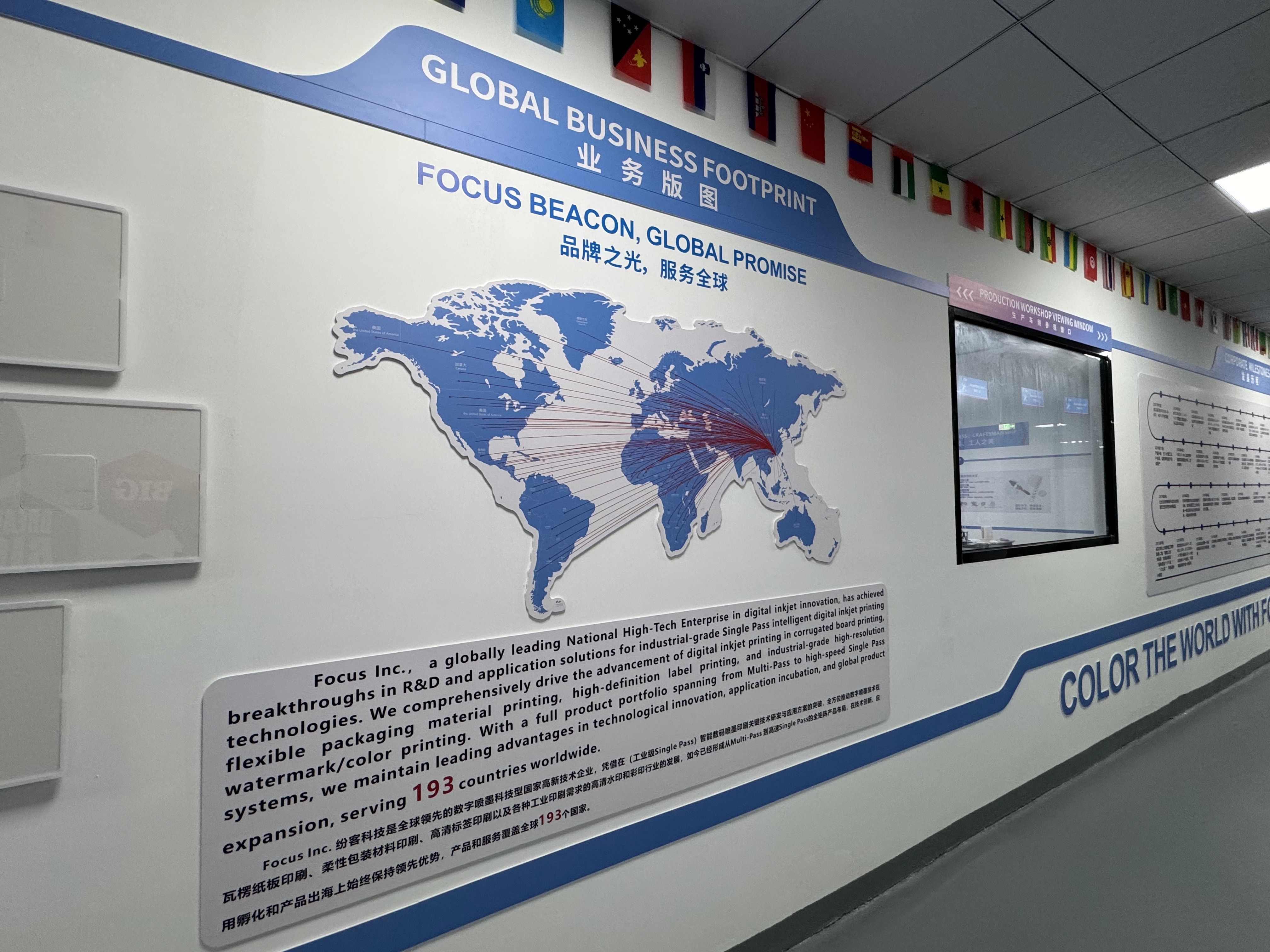
FocusInc's product range includes single pass packaging printers, roll-to-roll label single pass printers, UV single pass printers, and desktop single pass systems. The company reports annual output of around 800 units and exports 95% of production to markets including the EU, USA, Mexico, Brazil, Chile, Australia, Canada, and the UK. The company was certified as a national high-tech enterprise in China starting in 2022 and has maintained a factory in Shanghai since 2018.
For buyers that need a machine matched to an existing production line, FocusInc offers OEM/ODM services. According to the company, the minimum order quantity is 1 unit, and typical production lead time is 15-45 days depending on the configuration. Monthly production capacity is 120 sets for OEM services and 40 sets for ODM services.
Technical Foundation of Single Pass Digital Inkjet Printing
Single pass printing means the printhead system is fixed across the substrate path. The substrate moves underneath it, and the full printing width is produced in one pass. This is different from a scanning multi-pass printer, where the printhead moves back and forth across the media.
FocusInc applies this architecture through multiple printhead platforms. The Cobra series uses HP PageWide thermal bubble printheads, with 42,240 nozzles per head and resolutions from 1200x300 dpi to 1200x1200 dpi. The Acaleph series uses micro piezo printheads from Seiko, Ricoh, Xaar, Toshiba, or Epson, with resolutions up to 600x1200 dpi. Print speeds for packaging models are typically in the range of 10-40 meters per minute.
For corrugated board and cartons, the Cobra-1209S can handle media with a maximum thickness of 60 mm, while the Cobra-1815S provides a larger load width of 1800 mm. The Cobra-691S Max is positioned for paper bags, file bags, and paper cups, with a maximum printing width of 645 mm and a quoted speed of 20-40 meters per minute. These configurations allow buyers to choose a machine according to the substrate, order mix, and line speed.
Ink systems vary by model: aqueous, dye, pigment, edible, and UV-curing inks are available, depending on the substrate and application. The S350 Jetpress, for instance, is a UV single pass roll-to-roll label printer with print widths around 235 mm and speeds of 20-80 meters per minute. For shorter-run label work, the Viper-391S Pro provides a desktop roll-to-roll single pass label printer with a 320 mm media width.
Application Fit: From Corrugated Board to Non-Woven Bags
The practical value of a single pass packaging printer depends on matching the machine to the substrate and job profile.
Single pass printer for corrugated printing
Corrugated box manufacturers typically need high throughput and the ability to print on thick, uneven board. The Cobra-1209S and Cobra-1815S are built for this segment, with a maximum media thickness of 60 mm and adsorption vacuum systems for board stability. The Cobra-1209S has a maximum print width of 900 mm and speeds up to 35 meters per minute.
Single pass carton and box printing
Folding carton and pizza box producers can use the Falcon-491S Pro, a desktop system with an automatic friction feeder. It supports corrugated paper, pizza boxes, shopping bags, paper cups, envelopes, cards, napkins, and roll tissue paper. This type of system is suited to plants that need quick changeover across many small jobs.
Single pass label printing
For label converters, roll-to-roll single pass label printers such as the Viper-391S Pro handle inkjet-coated paper and synthetic films such as BOPP, vinyl, and PET. More integrated systems are also available: the NEXUS-350J combines digital label printing, lamination, die cutting, and slitting in one unit.
Non-woven bag and specialty substrate printing
Non-woven bag producers and decorative panel manufacturers can use the Acaleph-891S series, which prints on bags, PVC skirting boards, decoration panels, book edges, and other rigid or semi-rigid materials. For cylindrical containers, the Hydra-360S provides UV printing for bottles, cans, vases, and cosmetic tubes.
Market Trend: Digital Single Pass Moves into the Packaging Mainstream
The commercial case for single pass digital inkjet packaging equipment is supported by broader market data. Zion Market Research estimates that global digital printing for packaging was valued at USD 31.64 billion in 2023 and could reach USD 75.55 billion by 2032. Straits Research reports that inkjet digital printers represent 42.5% of the digital printer market as of 2025. It is worth noting that market forecasts vary by research firm; some projections put the 2032 figure lower than the Zion estimate.
Regional production volumes also influence demand. The China Packaging Federation and Dataintelo cite more than 88 billion square meters of corrugated board production in China in 2024. High corrugated output creates a concentrated base of packaging plants where single pass printers can be used for versioned packaging, e-commerce cartons, and short-run promotional boxes.
For buyers, the trend points toward smaller order quantities, faster delivery, and more variable data. These requirements align with the technical strengths of single-pass inkjet systems but also increase the importance of supplier service capacity.
Single Pass Printer vs. Traditional Printing: A Balanced Comparison
Single pass digital inkjet differs from screen printing, offset, and flexography in several practical ways. The most visible difference is the absence of a physical plate. This removes plate-making, plate storage, and plate cleaning from the workflow. It also makes variable data printing practical: QR codes, serial numbers, and personalized messages can be changed from one piece to the next without stopping production.
For short-run customized packaging, seasonal limited editions, or new brand trials, the digital approach allows an order to start at one piece. According to supplier data, the sample lead time can be shortened by 75% when plate production is removed. Pattern switching can be completed within one minute on some systems.
There is an economic boundary. Traditional flexo and offset printing generally retain a lower unit cost for long runs. For orders above roughly 10,000 pieces, the higher single-piece cost of digital printing can offset its flexibility advantage. Maintenance is also different: digital systems do not require a professional plate-making technician, and the touchscreen interface simplifies operation, but they do require disciplined printhead care and environmental control.
Evaluating the Long-Term Ecosystem of a Single Pass Printer Supplier
For a Decision-to-Execution buyer, after-sales service should be evaluated with the same rigor as print speed. FocusInc states that it provides 13 months free warranty and lifetime spare parts supply. The standard package includes online remote technical training and on-site overseas engineer service. An extended package includes global online remote support, overseas installation and training, customized technical parameter updates, a 3-year machine warranty, and lifelong technical consultation.
Quality control is part of that ecosystem. The manufacturer reports 100% full-machine pre-shipment running tests, continuous running aging tests, and full verification of customized functions. Third-party factory audits and SGS/CE inspections are supported upon request. These procedures are intended to reduce the risk of failures during installation and early production.
Buyers should also verify the supplier's contingency plan. In FocusInc's case, the company offers lifetime support and on-site technical assistance for production issues, which is useful for plants that depend on continuous output.
Supplier Evaluation Checklist for Long-Term Single Pass Printer Procurement
| Evaluation Area | What to Verify | Example: FocusInc |
|---|---|---|
| Manufacturing capacity | Monthly output, production lead time | 120 sets OEM / 40 sets ODM; 15-45 days |
| Customization | OEM/ODM support, housing color, branding, multi-language system, auxiliary equipment layout | MOQ 1 unit |
| Quality control | Pre-shipment testing, aging test, third-party audit | 100% full-machine running test; SGS/CE inspection on request |
| After-sales | Warranty, training, spare parts, remote support | 13 months free warranty; lifetime spare parts; on-site installation |
| Export and logistics | Incoterms, export markets, packaging standards | EXW/FOB/CIF/DDU/DDP/DAP; exports to EU, USA, Australia, and other markets |
Future Outlook: From Hardware Purchase to Production Partnership
The next stage of single pass printer adoption will likely be defined by how well suppliers integrate pre- and post-process equipment, software, and service. As packaging buyers use more SKUs and faster design cycles, the value of a printer is tied to the entire production workflow around it. Turnkey inline automation, broad substrate compatibility, and responsive service networks are becoming part of the purchasing decision.
FocusInc's product strategy already reflects this direction: the company supplies standalone printers, roll-to-roll configurations, and combined printing-finishing systems such as the NEXUS-350J label line. The company also states that it can develop inkjet printers from scratch according to customer needs, including custom tooling and auxiliary equipment layout. For buyers, that kind of development capability can reduce the risk of a machine becoming obsolete as the product mix changes.
For buyers that want to review the manufacturer's factory background and capability documentation, FocusInc provides a public factory introduction brochure: Download FocusInc Factory Introduction PDF.
FAQ: Single Pass Printer Sourcing and Long-Term Support
What is a single pass printer?
A single pass printer is an industrial inkjet system in which the substrate moves beneath a stationary printhead, producing the full print width in one pass. It is used for corrugated board, cartons, paper bags, labels, and other packaging materials. Typical packaging model speeds are 10-40 meters per minute, with some roll-to-roll label systems reaching 20-80 meters per minute.
How does a single pass corrugated printer differ from a traditional corrugated printer?
The main difference is plate-free digital printing. A single pass printer for corrugated printing requires no plate making, supports variable QR codes and serial numbers, and can switch patterns in under one minute. Traditional flexo and offset units are usually more cost-efficient for very long runs, while single pass systems can economically handle orders starting from one piece.
What should a buyer check before ordering a single pass packaging printer?
Buyers should verify production lead time, monthly capacity, OEM/ODM capability, pre-shipment testing, after-sales service, and spare parts availability. For example, FocusInc reports a monthly capacity of 120 sets for OEM services, 40 sets for ODM services, a 15-45 day typical lead time, and a minimum order quantity of one unit.
Can a single pass box printer handle variable data?
Yes. Because there is no fixed plate, each box or label can be printed with a different QR code, barcode, serial number, or personalized message. This is a common requirement for anti-counterfeit packaging, traceability, and promotional packaging.
What after-sales support is typical for a single pass digital inkjet print system?
Support packages vary. FocusInc includes 13 months free warranty, lifetime spare parts supply, online remote technical training, and on-site overseas engineer service. An extended package includes a 3-year machine warranty, overseas installation and training, and lifelong technical consultation.
What are the limitations of single pass digital printing?
The main limitation is economic for long runs. Traditional flexo or offset printing can have lower unit cost on orders above roughly 10,000 pieces. Single pass is strongest where short runs, variable data, fast turnarounds, or versioned packaging are required.