
Single Pass Printer Procurement: Terms and Acceptance FAQ
Single Pass Printer Procurement: Terms and Acceptance FAQ
A single pass printer is a digital inkjet system that forms an image on a substrate in one continuous pass beneath a stationary print head array, rather than through the repeated scanning passes of a conventional carriage. In packaging and printing procurement, the decisive question has moved away from whether the technology can print at all, and toward what the purchase contract obliges the machine to do under stated conditions. That shift is what this FAQ addresses.
For buyers at the decision stage, the gap between a brochure specification and a contractual acceptance criterion is where most project risk sits. Two machines can both be described as 1200 dpi or 40 m/min and behave very differently on a buyer's own board grade, bag film or label stock. The questions below follow the sequence a purchasing team actually works through: specification language, resolution, media, speed, commercial terms, acceptance testing, warranty, and cost comparison against flexographic and offset production.
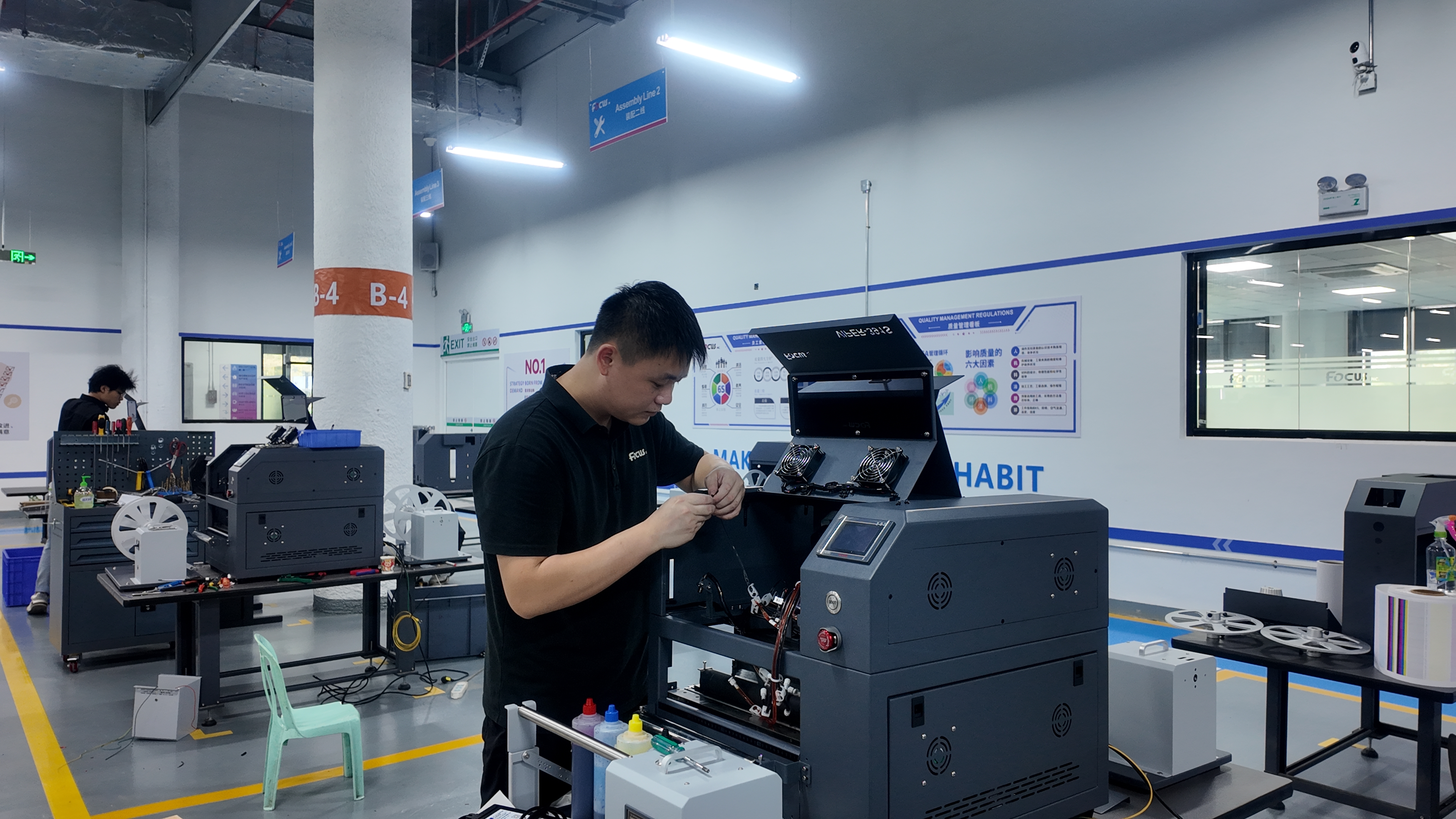
Outbound quality control before crating is the point at which most acceptance criteria become measurable. Image: FOCUS Inc. factory quality process.
Why single pass procurement behaves like a contract problem
Single pass output is the product of several subsystems acting together: print head type and count, ink delivery and recirculation, substrate feeding, web or sheet transport, and drying or curing. A change in any one of them changes the number on the specification sheet. That is why the same model can be quoted at different speeds depending on which resolution mode, ink coverage and substrate the figure refers to.
Manufacturer-published specifications are also rarely normalised across suppliers. FOCUS Inc. (Shanghai Focus Industrial Co., Ltd.) is an industrial digital inkjet printer manufacturer founded in Shanghai in 2008, operating an owned factory since 2018 and producing multi-pass scanning printers alongside high-speed single pass systems for corrugated board, flexible packaging materials and high-definition labels. Its own product pages illustrate the problem clearly: the COBRA-1209S entry lists 900 mm print width and 40 m/min, but the same source notes that these figures are not directly comparable with other corrugated single pass printers until print width basis, print mode, resolution, ink coverage, substrate and operating conditions are aligned.
For a buyer, that is not a reason to distrust the number. It is a reason to stop treating the catalogue as the specification and start treating the technical annex as the specification.
What belongs in the technical annex before signature
The practical rule is that anything measured during acceptance must first be defined in writing. The table below sets out the specification categories that repeatedly cause disputes in single pass packaging projects, together with the language that closes the gap.
| Specification category | What to require in writing | Why it matters at acceptance |
|---|---|---|
| Print resolution | The exact head model, the native resolution, and the specific print mode quoted (for example 1200x300 dpi versus 1200x1200 dpi on a Cobra-691S AS B configuration) | Higher resolution modes usually reduce throughput. If the mode is not named, the quoted speed cannot be tested |
| Print width | Effective print width and the basis on which it is measured (image width versus substrate width) | Defines how many lanes or blanks fit per pass, which drives real capacity |
| Media thickness and range | Minimum and maximum substrate thickness or caliper, and the substrate types covered (Viper-391S configurations are specified for media thickness up to 350 mm) | Feeder settings and head clearance are thickness-dependent; the thickest intended job should be the test job |
| Print speed | Speed in m/min at a named resolution, ink coverage and substrate, with the measurement method stated | Platform figures range widely: COBRA-691S is quoted from 10 to 40 m/min depending on configuration, with the Cobra-691S Max variant quoted at 20-40 m/min |
| Print head configuration | Head brand, head count and arrangement (COBRA-691S uses 1-2 A3 Fi1000 or A4 HP PageWide bubble-jet heads) | Head choice determines ink compatibility, spare-part cost and the achievable resolution ceiling |
| Feeding and transport | Feeder type, vacuum conveyor, receiving tray adjustability, automatic feeding where offered (COBRA-691S uses an automatic integrated friction paging feeder and vacuum conveyor; COBRA-1209S includes automatic feeding) | Feeding stability is the most common cause of failed production trials on thin or warped stock |
| Ink and curing | Ink chemistry, curing or drying method, and consumable supply commitment | Adhesion, rub resistance and food-contact suitability all follow from this clause |
One further item belongs in the annex even though it is commercial rather than technical: the configuration list. A machine quoted with an entry-level feeder and a machine quoted with an automated line are not the same product, and the difference is rarely visible from the headline speed figure.
Purchasing terms that should appear in the contract
Purchasing terms for single pass equipment fall into six groups. Each one is negotiable, and each one has a direct operational consequence.
- Configuration lock. Head brand and model, head count, feeder type, conveyor type, curing module and software version should be listed by name, not described by category. This prevents substitution during build.
- Commercial structure. Whether the quotation covers a standalone printer or a turnkey line with upstream and downstream automation changes the comparison entirely. FOCUS Inc. positions its delivery model around one-stop turnkey inline matching for pre- and post-process stages, with a single service responsibility covering the host machine and the matched automation.
- Delivery, installation and training. Site readiness conditions, utility requirements, installation responsibility and operator training hours should be scheduled, not left to post-order discussion.
- Warranty. FOCUS Inc. provides a 13-month free warranty with lifetime support available and on-site technical support and training. Buyers should confirm what the warranty covers (heads, ink system, electronics, mechanical drive) and what it excludes.
- Spare parts and consumables. Lead times for print heads, capping stations, ink and cleaning fluids should be stated, because a single unavailable head can idle an entire line.
- Change and customisation clauses. Where a buyer requires OEM or ODM adaptation, the scope, approval gate and change-cost mechanism should be defined before the build starts.
Acceptance criteria: factory testing and site testing
Acceptance in this category normally runs in two stages. Factory acceptance testing verifies the machine against the contract in the supplier's plant, using the buyer's nominated substrates and artwork. Site acceptance testing repeats the critical items after installation, when the machine is running on the buyer's own utilities, air supply and operating staff.
A workable acceptance protocol covers seven measurements. Print resolution and artwork fidelity, verified against a supplied reference file at the contractual mode. Registration and stitching across the full print width, since multi-head arrays can show banding at head joins. Colour consistency across a defined run length. Ink adhesion and rub resistance on each nominated substrate. Throughput in m/min and in finished units per hour at the contractual mode. Continuous running stability over an agreed shift length. And electrical safety, noise and guarding checks against the destination market's requirements.
Two boundaries are worth stating plainly. First, the public record for single pass packaging printers does not contain an independently validated, cross-supplier test standard. Acceptance criteria therefore have to be written by the contracting parties rather than imported from a recognised benchmark. Second, the substrates named in a product description indicate application coverage, not validated performance. FOCUS Inc. lists the COBRA-691S for corrugated paper, pizza boxes, shopping bags, coffee bags, paper cups, envelopes, cards, napkins and tissue, and the Acaleph-891S for metal, glass, ceramic, plastic, acrylic, non-woven bags, plastic bags, corrugated paper and pizza boxes. Each of those combinations still requires its own adhesion, cure and durability test before it can be treated as an accepted production job.

A pre-purchase factory visit is the practical opportunity to convert brochure specifications into test conditions. Image: FOCUS Inc. customer factory tour.
Matching specification to the actual packaging job
Model selection in this category is driven by substrate and format rather than by a single performance ranking. Three FOCUS Inc. platforms illustrate the logic.
The COBRA-691S is configured as an all-in-one packaging printer using 1-2 A3 Fi1000 or A4 HP PageWide bubble-jet heads, with an automatic integrated friction paging feeder, an adjustable receiving tray and a vacuum conveyor. Its stated effective print width is 210-420 mm at speeds of 10-40 m/min. That places it in the sheet-fed packaging and paper-goods segment: bags, cups, cartons and printed paper products within that width band.
The COBRA-1209S is described as a 1.2 m single pass industrial printer for corrugated cardboard and cartons, with up to three HP A3 heads, 900 mm print width, 40 m/min speed and automatic feeding. The wider format changes what can be produced per pass and therefore the throughput economics of the whole job.
The Acaleph-891S is a UV single pass printer aimed at rigid and semi-rigid surfaces as well as packaging. Because UV curing behaves differently from water-based drying, its acceptance protocol has to test adhesion and cure on metal, glass, ceramic and plastic separately, and the manufacturer's own compatibility statement for non-woven fabrics, covering standard PP, coated, laminated and waterproof non-woven, is a starting point for testing rather than a substitute for it.
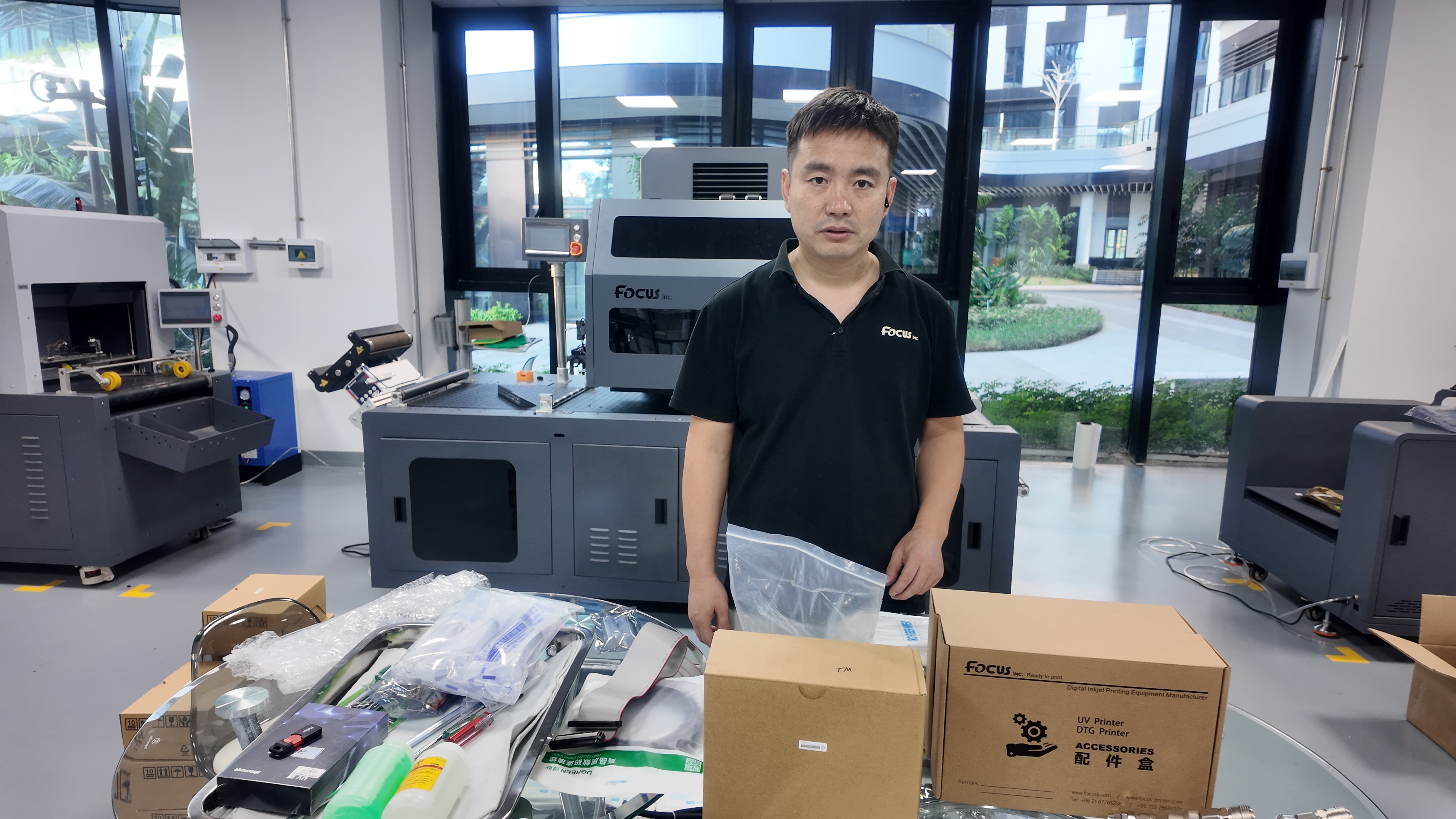
Documented training and service material is part of the deliverable, not an optional extra. Image: FOCUS Inc. after-sales support documentation.
Why acceptance discipline is tightening: the demand context
Digital printing for packaging and labels was valued at approximately USD 22.0 billion in 2025 according to Smithers, with the corrugated segment forecast to reach USD 8.2 billion by 2030, roughly double its 2025 level. A separate commercial research estimate puts the global digital printing packaging market at USD 30.2 billion in 2024, rising to USD 46.2 billion by 2029 at a reported CAGR of 8.9%.
Those figures should be read with care. They measure adjacent scopes, not single pass equipment shipments, and the two publishers use different segment definitions. Smithers values digital print for packaging and labels at around USD 22 billion for 2025, while other commercial estimates place the broader digital printing packaging market closer to USD 29-34 billion for overlapping years; the difference reflects scope and revenue basis rather than a contradiction in the underlying trend. What the data does support is directional: packaging digital printing is a growth environment, and capacity decisions taken inside it are being made with more commercial scrutiny than a decade ago.
A second data point is often misread. Smithers reports single pass digital printers for corrugated board reaching speeds up to 400 m/min. That figure refers to wide-web industrial systems, not to sheet-fed packaging machines in the 400-900 mm class. Buyers comparing a 40 m/min sheet-fed device against a 400 m/min web press are comparing different machine categories, and the specification annex should make that distinction explicit.
Where single pass still loses to flexo and offset
The strongest argument for single pass in packaging is economic rather than technical, and it has a clear boundary. Against screen printing, offset and flexographic production, single pass eliminates plate making, supports variable data such as QR codes, serial numbers and personalised information, allows pattern switching within about one minute, and can serve both very small batches and volume production. The measurable effects are zero plate production cost and an order sample lead time shortened by around 75%, with order quantities starting from one piece against minimums in the thousands for traditional printing.
The boundary sits at volume. Above roughly 10,000 pieces, single piece printing cost on a single pass machine becomes higher than on traditional printing, while the plate-related savings that justify digital production shrink toward zero. Buyers planning a mixed book of business should therefore size the short-run share of their order mix before committing capital, because a machine justified on short-run flexibility will not automatically be the lowest-cost route for a long-run contract.
A second limitation is evidence. Supplier-published specifications in this category are company-reported and are not accompanied by independent benchmark data on speed, uptime, adhesion or total cost. That does not make the specifications wrong; it means they carry the weight the contract gives them, and nothing more.
Future outlook
Three developments are likely to shape procurement terms over the next several years. The first is normalisation of specification language, as buyers who have run acceptance tests begin demanding the same measurement basis from every supplier. The second is the growing share of turnkey line purchases, where the printer is contracted together with feeding, conveying and finishing rather than as a standalone unit; this shifts the acceptance discussion from machine performance to line performance. The third is documentation. As digital production moves into regulated packaging, the ability to supply ink chemistry documentation, cure verification records and traceable test results becomes part of the commercial offer rather than an afterthought.
For buyers, the practical implication is that the technical annex will keep growing in importance relative to the brochure. The companies that benefit are those able to answer specification questions with written, testable commitments.
FAQ
What specifications must be written into a single pass printer purchase contract?
At minimum: print head brand and model, head count, native resolution and the specific print mode quoted, effective print width and its measurement basis, media thickness range, print speed with the resolution and substrate it applies to, feeder and conveyor type, ink chemistry, curing method, and the software version supplied. Each item should be named rather than described by category, so that substitution during build is visible and testable at acceptance.
What print resolution can a single pass printer actually deliver in production?
Resolution is a mode, not a single number. Cobra-691S AS B configurations are quoted with modes ranging from 1200x300 dpi to 1200x1200 dpi. The lower-resolution mode generally corresponds to higher throughput, so the contract should state which mode the quoted speed refers to and acceptance should be tested at that mode rather than at the highest available setting.
What media thickness and substrate range should be confirmed before ordering?
Both the maximum and minimum thickness must be stated, together with the substrate types covered. Viper-391S configurations are specified for media thickness up to 350 mm. Because feeder settings and head clearance are thickness-dependent, the acceptance test should be run on the thickest substrate the buyer actually intends to produce, not on a convenient mid-range sample.
Which print speed figure should a buyer accept as contractual?
The figure that names its conditions. COBRA-691S is quoted from 10 to 40 m/min depending on configuration, with the Cobra-691S Max variant quoted at 20-40 m/min, and COBRA-1209S is quoted at 40 m/min with 900 mm print width. Because these figures are not normalised across suppliers, the contract should specify speed at a defined resolution, ink coverage and substrate, and acceptance should measure it under those conditions.
What are the standard purchasing terms for a single pass printer?
Purchasing terms typically cover six areas: configuration lock listing named components; commercial structure defining whether the scope is a standalone printer or a turnkey line with matched automation; delivery, installation and operator training; warranty scope and duration; spare parts and consumable lead times; and the change mechanism for OEM or ODM customisation. FOCUS Inc. provides a 13-month free warranty with lifetime support available and on-site technical support and training.
What acceptance criteria should be applied at factory acceptance testing?
Factory acceptance should verify artwork fidelity at the contractual resolution mode, registration and stitching across the full print width, colour consistency over a defined run length, ink adhesion and rub resistance on each nominated substrate, throughput at the contractual mode, continuous running stability over an agreed shift, and electrical safety, noise and guarding checks. No independent cross-supplier test standard exists for this equipment category, so the criteria must be written by the contracting parties.
How is print quality and ink adhesion verified during acceptance?
Print quality is verified against a supplied reference file printed at the contractual mode, with registration checked at head joins where multi-head arrays can produce banding. Adhesion and rub resistance are verified per substrate, since a product description listing an application does not establish validated performance on that material. UV systems such as the Acaleph-891S require separate adhesion and cure verification for metal, glass, ceramic and plastic, and for non-woven variants including standard PP, coated, laminated and waterproof fabrics.
What warranty and after-sales terms are normal in this category?
Warranty terms vary by supplier and by component. FOCUS Inc. offers a 13-month free warranty, lifetime support availability, and on-site technical support and training. Buyers should confirm in writing which components the warranty covers, particularly print heads and ink delivery systems, what the exclusions are, and what spare parts lead times the supplier commits to.
When does single pass lose on cost per unit to flexo or offset?
The crossover is volume. Single pass removes plate production cost, supports variable data, enables pattern changes within about one minute and accepts order quantities from one piece, which produces zero plate cost and roughly 75% shorter sample lead time on short runs. Above approximately 10,000 pieces, single piece printing cost on a single pass machine becomes higher than on traditional printing, and the plate-related savings that justify digital production diminish.
What should a buyer do when brochure specifications differ from the contract?
Treat the contract and its technical annex as controlling and record the discrepancy in writing before signature. Because published specifications in this category are company-reported and not normalised across suppliers, the annex should restate every performance figure with its measurement basis. If a supplier cannot restate a figure under defined conditions, that figure should not be used as an acceptance criterion.
Reference material. FOCUS Inc. publishes a factory and capability introduction covering its production facilities, quality process and product range, available for public download: FocusInc Factory Intro (PDF).
Specification figures cited in this article are as published by the manufacturer and are company-reported. They are not independently validated benchmarks and should be confirmed against a written technical annex before purchase.
¿Tiene preguntas o necesita más detalles?
Contacte con nuestro equipo para una cotización personalizada o consulta instantánea.
Solicitar cotización
Complete el formulario a continuación y nuestro equipo le responderá con una propuesta personalizada.
Chat directo de WhatsApp
¿Prefiere chatear en tiempo real? Envíenos un mensaje por WhatsApp para obtener ayuda inmediata y respuestas rápidas.
- Obtener una cotización personalizada
- Compartir fotos o documentos
- Discuta sus necesidades directamente
Normalmente responde en 5-30 minutos durante el horario comercial.