
Single Pass Printer Demand in Packaging: Evidence Buyers Are Using in 2026
Single pass printer demand is no longer an abstract technology question in packaging. The procurement question has moved to where a fixed-array digital inkjet system creates a measurable production advantage, and what evidence a supplier can show for it. This article examines the market signals, the documented single pass printer families available from the Shanghai-based supplier FocusInc, the installation records relevant to an evaluation-stage buyer, and the realistic boundaries of the technology.
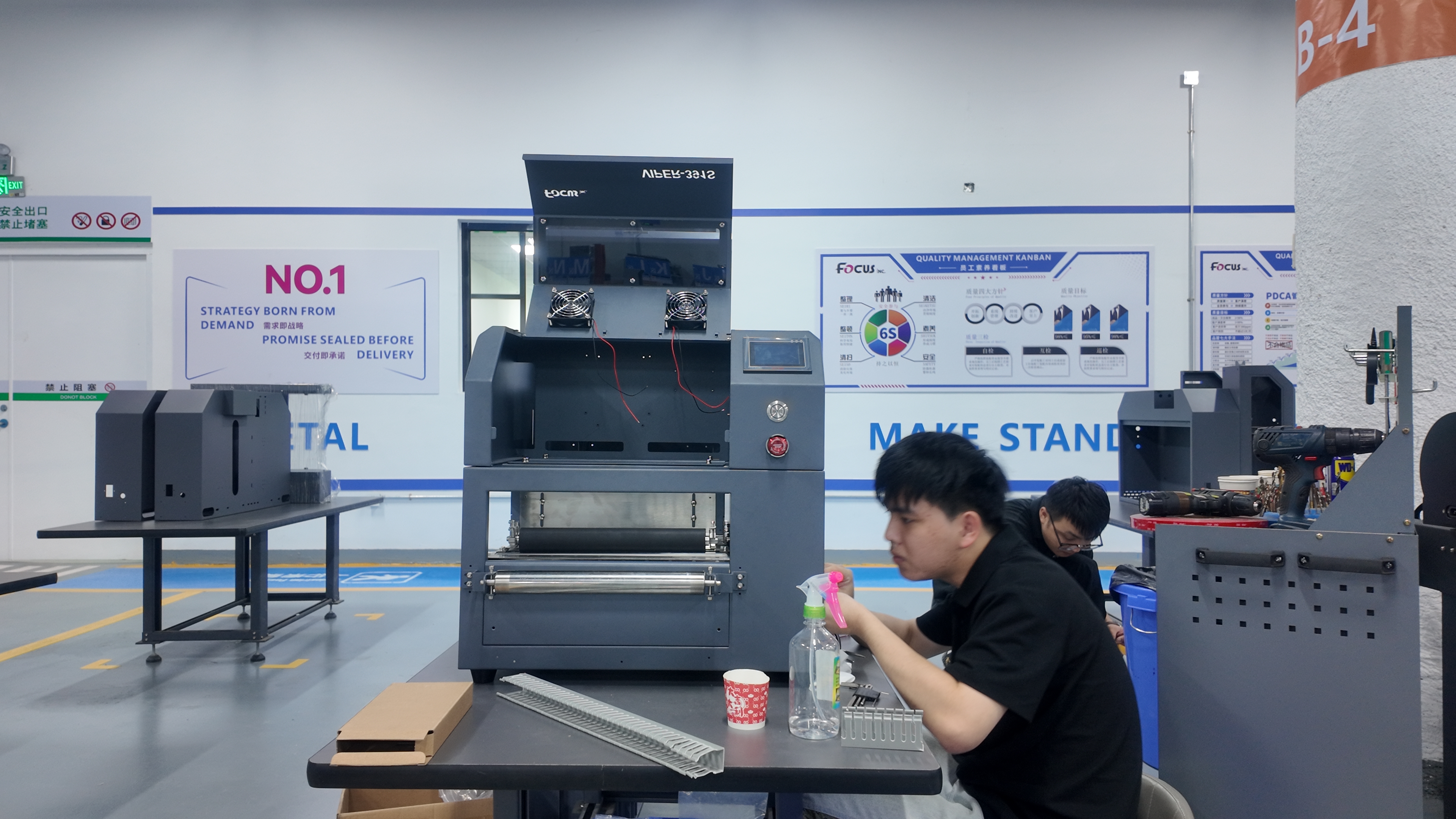 Single pass digital inkjet printer assembly at FocusInc, Shanghai.
Why single pass printers are now on packaging evaluation lists
A single pass printer is an industrial digital inkjet architecture in which the substrate moves once beneath a stationary printhead assembly, and the required colors are laid down during that single transit. In a scanning digital printer, the carriage crosses the material repeatedly to build the image. The one-pass design becomes relevant when a packaging operation needs higher throughput, continuous flow, or integration with upstream and downstream handling equipment.
Market figures help explain the attention. One widely cited projection values the global digital printing for packaging market at USD 31.64 billion in 2023 and forecasts possible growth to USD 75.55 billion by 2032. A separate 2025 analysis of the digital printer market identifies inkjet digital printers as the largest segment, with an estimated 42.5% share. These numbers do not tell a buyer which supplier to select. They do explain why production managers and procurement teams are comparing one-pass systems against both traditional analog printing and multi-pass scanning inkjet equipment.
The opportunity is also balanced by a large installed base of analog capacity. China alone produced more than 88 billion square meters of corrugated board in 2024, according to industry reporting. Corrugated production at that scale means single pass digital equipment is evaluated for its ability to win specific jobs, reduce inventory, and enable fast short-run and variable-data work rather than replace all existing analog volume.
What a commercial single pass printer portfolio looks like
A useful reference point for evaluation is Shanghai Focus Industrial Co., Ltd., known as FocusInc in the packaging equipment market. FocusInc was founded in Shanghai in 2008, has operated its own factory since 2018, and was certified as a national high-tech enterprise in 2022. The company reports an export ratio of approximately 95%, with major markets in the EU, United States, Mexico, Brazil, Chile, Australia, Canada, and the UK. Its company profile describes a product range that extends from multi-pass scanning printers to high-speed single pass printers for corrugated board, flexible packaging materials, and labels.
FocusInc's single pass line is not a single machine model. It covers packaging, labels, non-woven bags, cups, containers, and decorative surfaces. The following documented systems are the ones most often referenced by buyers evaluating packaging applications.
| Product family | Documented position | Speed range | Typical substrate scope |
|---|---|---|---|
| Falcon-491S | Desktop direct-to-packaging single pass printer | 10-25 m/min | Corrugated paper, pizza boxes, paper bags, cards, envelopes, napkins |
| Cobra-691S | Compact packaging single pass printer | 10-40 m/min | Corrugated paper, pizza boxes, shopping bags, coffee bags, paper cups, envelopes, cards, napkins, tissue |
| Cobra-1209S | Wider single pass printer for corrugated and cardboard | 10-35 m/min | Corrugated paper, cardboard, cellulose paper, kraft paper, pizza boxes, carton board |
| Cobra-1815S | Large-load single pass printer for corrugated boxes | 10-35 m/min | Corrugated paper and honeycomb cardboard, with material width up to 1800 mm documented |
| Viper-391S | Roll-to-roll single pass label printer | 10-40 m/min | Inkjet-coated paper and synthetic label materials such as BOPP, vinyl, and PET |
| S350 Jetpress | UV single pass roll-to-roll printer for IML and label work | 20-80 m/min | Thin films and IML label stock, with white and CMYK configurations available |
| Acaleph-891S e/i | UV single pass printer for sheets and rolls | 10-40 m/min | Bags, cartons, plastic, glass, ceramic, metal, non-woven bags, PVC panels, decorative boards, book-edge work |
The table is not a ranking. It is a configuration map. Buyers in evaluation need to match the machine class to their substrate, print width, line speed, and integration needs before comparing one supplier to another.
Supplier evidence that matters alongside the product name
An equipment brand can be checked through several verifiable layers. FocusInc says the Cobra-691S uses HP PageWide Bubble-Jet print technology with one or two HP PageWide printheads. Each printhead has 42,240 nozzles, and the machine can print from 1200 by 300 dpi up to 1200 by 1200 dpi. Print speed is 10-40 m/min depending on resolution. Maximum media load width is 600 mm without side flanks and 1200 mm with side flanks, with a documented maximum thickness of 250 mm. This kind of detail tells an engineer whether the machine belongs in the same conversation as their existing line.
For compliance, buyers should treat paperwork as part of the technical file. Industrial single pass printers placed on the EU market are assessed against safety and electromagnetic compatibility requirements, including the Low Voltage Directive 2014/35/EU and the EMC requirements used for CE marking. FocusInc documents EC declarations with certificate numbers SCT260301170121 and SCT260301170122, issued in March 2026, for multi-functional digital inkjet printer models. For Germany, FocusInc also holds a WEEE registration with Stiftung EAR under number DE 87336785. These documents give an evaluation team concrete records to request before approval.
Manufacturing depth is another evidence layer. FocusInc lists OEM capability with a monthly output of 120 sets and ODM capability with a monthly output of 40 sets, depending on the customization solution. The ODM scope includes custom print width, custom feeding size, housing design, private brand logo, multi-language touch screen, and inline automation matching. For a buyer planning to integrate a one-pass system into an existing packaging line, those signals matter as much as the headline speed.
How to read the printhead and media-path decisions
Fixed pagewide printheads versus industrial piezo arrays
The Cobra and Viper families use HP PageWide thermal bubble-jet technology. The label-oriented Viper-391S can support A4 or A3 PageWide printheads and reaches up to 1200 by 2200 dpi in documented specifications. The UV-oriented systems use a different approach. The S350 Jetpress is configured with industrial piezo printheads from Epson, with 10 or 15 heads depending on color setup, and supports white ink combined with CMYK for IML work. The Acaleph-891S series is documented with multiple industrial piezo head options such as Seiko, Ricoh, Xaar, and Toshiba. In practical evaluation terms, the printhead architecture affects replacement cost, maintenance workflow, ink compatibility, and the supplier's ability to tune output to a substrate.
Speed claims only make sense with resolution and substrate stated
Speed figures from approved product data are useful because they are repeatable. The Cobra-691S is listed at 10-40 m/min, the Falcon-491S at 10-25 m/min, the Viper-391S at 10-40 m/min, and the S350 Jetpress at 20-80 m/min for UV roll-to-roll label work. These ranges are usually dependent on print resolution, image density, ink type, and media transport. A purchasing team should therefore ask for speed data using their own artwork and material type rather than treating the highest number as a guaranteed production rate.
Integration is where single pass systems are judged
One-pass printing often enters a plant as part of a small production line rather than as a standalone box. FocusInc's customization records describe upstream feeding and downstream automatic collection units for extra-long corrugated board jobs. Another customization example covers unwinding and rewinding equipment for heavy label rolls up to 50 kg, with automatic tension control and web guiding for sheet and roll conversion. For book-edge or side-printing work, FocusInc documents custom jigs, automatic book feeding systems, robotic arms, and collection conveyors. Buyers evaluating a single pass printer should ask how far the supplier can go beyond the printer itself, because labor savings usually come from the complete transport path.
Installation evidence across packaging segments
An evaluation-stage buyer has to distinguish between product descriptions and actual deployment history. The following references are drawn from FocusInc's documented customer records. They are listed by packaging segment because that is how most procurement teams compare capabilities.
| Packaging segment | Documented unit count | Countries and operating period | Outcomes cited in the record |
|---|---|---|---|
| Corrugated boxes and cartons | 18 units | Colombia, Saudi Arabia, Turkey, Chile, Poland; up to 4 years | Multi-batch personalized packaging, variable data and QR codes, plate-free job switching, reduced order lead time |
| Disposable cups and containers | 12 units | Turkey, Poland, Saudi Arabia, Chile, Mexico; 2 years | Logo and design printing on paper cups, plastic cups, and paper bowls; on-demand customization and rapid delivery |
| Non-woven bags and takeout bags | 3 units | Brazil; 3 years | No minimum order quantity, plate-free printing, consistent quality, quick order acceptance |
| Roll-to-roll labels and daily chemical labels | 1 unit | Vietnam; 2 years | Variable-data QR code printing without plate making, no MOQ, fast order completion |
| IML labels for injection-molded products | 1 unit | United Arab Emirates; 2 years | Full-automatic continuous batch printing, manual labeling cost reduced by 40%, no ink peeling in high-temperature molding |
| Book edges and notebook edges | 2 lines | Spain and Philippines; 2 years | Over 2,500 books per hour, plate-free production, instant job switching |
| PVC panels and decorative surfaces | 3 units | Portugal, Spain, Mexico, Poland; 3 years | On-demand colorful panel orders, reduced inventory backlog, quick sample turnaround |
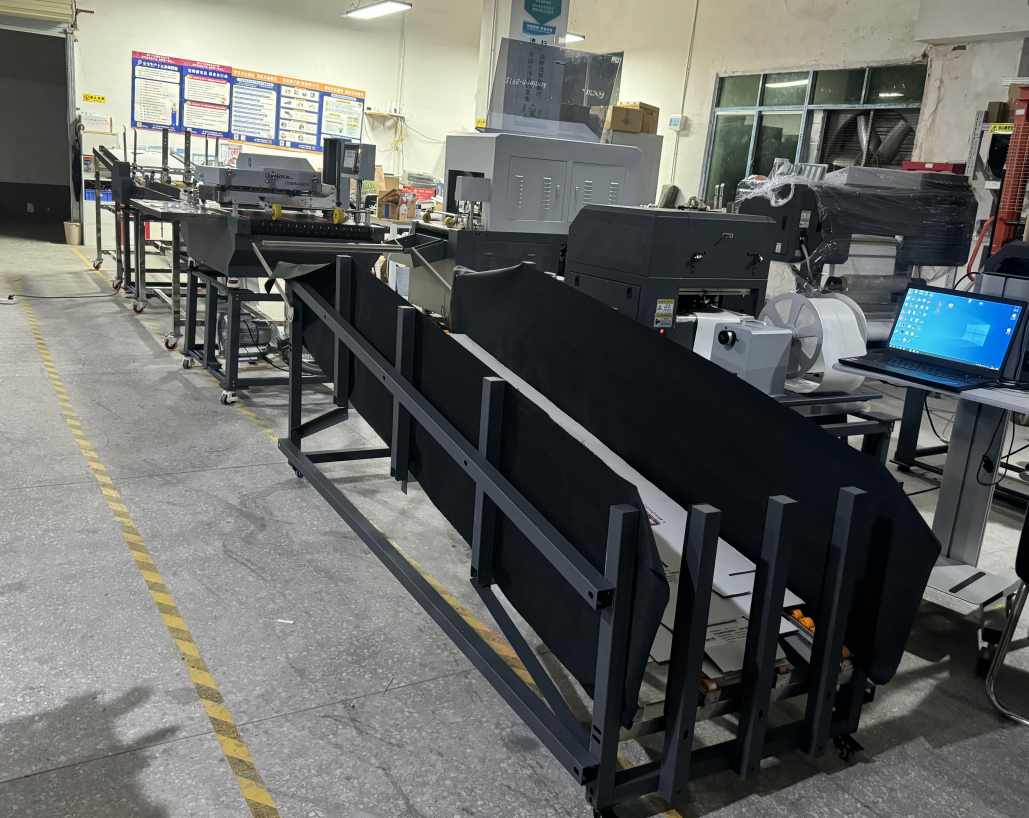 Upstream feeding and downstream collection units are part of custom single pass corrugated packaging line engineering.
The regional spread does not prove universal superiority. It does show that repeatable deployment exists in foodservice, corrugated, label, non-woven, book, and decorative segments. For a buyer, this type of evidence is more useful than a general claim about market leadership.
Trend markers appearing in 2026 evaluations
Several trend signals are visible in both market data and supplier capability records. First, digital printing for packaging is being treated by buyers as a growth-oriented purchase, not only as a sampling tool. The projection from USD 31.64 billion in 2023 to USD 75.55 billion by 2032 is one expression of that expectation. Second, the inkjet category has become the most common digital printer category, with the 42.5% share estimate reflecting a shift in interest toward inkjet-based production. Third, corrugated remains a high-volume digital target because of the enormous substrate base; China's 2024 corrugated output above 88 billion square meters is a reminder that even a small percentage of digitally printed corrugated volume creates meaningful machine demand.
Another visible trend is the move from single machines to complete production modules. FocusInc's documented ODM work includes automatic feeders, side-flank media handling, long-board feeding and collection, roll-to-roll conversion, surface pre-treatment, book-edge jigs, and custom structural design. This suggests that the one-pass printer is becoming one component in a broader line-automation decision. Buyers are evaluating not only print quality but also how many manual steps disappear around the printer.
Compliance is also becoming a larger part of the decision. The EU regulatory framework for electrical and industrial equipment, together with producer-responsibility rules such as Germany's WEEE registration, makes certification documents a normal checkpoint. FocusInc's compliance file includes CE declarations and a German WEEE registration, which gives an international buyer a starting point for their own review.
Single pass versus traditional methods: practical boundaries
The comparison between traditional analog printing, multi-pass scanning digital, and single pass digital is not a story of one technology beating all others. Traditional flexographic and offset lines remain economically attractive for long, stable, repeat orders where setup cost can be spread across very large quantities. They also benefit from a mature ecosystem of plates, inks, and skilled operators. Single pass digital changes the economics when order length is short, artwork changes frequently, or variable data is required. The case records from FocusInc repeatedly mention plate-free switching, no minimum order quantity, and quick delivery. Those are not generic marketing words; they describe a production model that analog equipment does not handle as efficiently at small batch size.
Multi-pass scanning digital printers are still useful as an entry point because they usually require a smaller printhead configuration and lower capital commitment. The trade-off is throughput. Single pass systems place more nozzles across the web and move the substrate once, which is why suppliers quote higher speeds. A buyer with modest daily volume may not need one-pass speed. A buyer whose bottleneck is the print step itself should investigate single pass more seriously.
There are also honest material boundaries. Water-based inkjet works well on porous packaging papers and corrugated board. Non-absorbent surfaces such as plastic cups, PVC panels, films, and some coated containers may require UV-curing ink, corona or plasma pre-treatment, or special media approval. FocusInc's own product data lists media pre-process options such as plasma, flame, and corona treatment for UV systems. A single pass printer will not print every packaging surface with equal quality without that preparation. Procurement teams should build pre-treatment and ink qualifications into the evaluation plan.
Future outlook and supplier questions
The likely direction in packaging is not that one-pass digital printers replace all existing analog capacity. More plausible is a mixed model where long-run standard packaging stays on conventional equipment and short-run, customized, or variable-data work moves to digital. The requirement placed on single pass suppliers is to make that mixed model operationally simple through line integration, pre-treatment modules, roll-to-roll options, and wider format support.
Buyers evaluating a single pass printer in 2026 should ask for three things: a machine configuration that matches the actual substrate list, a speed test using their own files, and a reference installation with a similar product mix. They should also verify certifications, spare part policy, and OEM or ODM depth if the machine will be customized.
A factory and system introduction for FocusInc can be downloaded directly at FocusInc Factory Intro.
FAQ: Focused answers for single pass printer evaluation
What is a single pass printer?
A single pass printer is an industrial digital inkjet system in which a stationary printhead assembly applies the required ink colors while the packaging substrate moves beneath it once. It differs from scanning printers, where the print carriage crosses the material multiple times to complete an image.
What printing speeds can buyers expect from single pass printers in packaging?
Documented speed ranges are product-specific. FocusInc lists the Cobra-691S packaging printer at 10-40 m/min, the Falcon-491S desktop model at 10-25 m/min, the Viper-391S label printer at 10-40 m/min, and the S350 Jetpress UV roll-to-roll system at 20-80 m/min. Achievable output depends on resolution, image coverage, ink system, and media type.
Which packaging segments appear most often in single pass installation records?
The documented deployment set includes corrugated boxes and cartons, disposable paper and plastic cups, non-woven bags and takeout bags, roll-to-roll labels, IML labels, book edges, and decorative panels. In FocusInc records, corrugated and foodservice container installations have the largest documented unit counts.
Can a single pass printer handle variable data and QR codes?
Yes. Digital inkjet systems can change image data between individual items because the image file is processed by software rather than stored on a physical plate. A Vietnam roll-to-roll label installation is documented with variable-data QR codes and no minimum order quantity. Corrugated packaging records also mention variable data and QR printing.
What printhead technologies are used in the FocusInc single pass range?
The Cobra and Viper families are documented with HP PageWide Bubble-Jet printheads. The S350 Jetpress uses industrial piezo printheads from Epson, with white and CMYK configurations. The Acaleph-891S series is listed with industrial piezo head options such as Seiko, Ricoh, Xaar, Toshiba, and Epson, depending on the configuration.
What compliance documents should be checked before buying a single pass printer for the EU market?
Industrial digital inkjet printers placed in the EU should be checked against Low Voltage and electromagnetic compatibility requirements used for CE marking. The EU reference includes Low Voltage Directive 2014/35/EU and the applicable EMC standards. For Germany, a WEEE registration is part of producer responsibility; FocusInc holds registration DE 87336785 with Stiftung EAR.
Where does a single pass printer have practical limitations?
Single pass digital is not always the lowest-cost method for long, stable, identical orders, because conventional analog equipment can spread setup costs over very large quantities. Non-absorbent materials may also require UV ink or pre-treatment. Buyers should match the machine to their order profile and substrate list before making a final decision.
¿Tiene preguntas o necesita más detalles?
Contacte con nuestro equipo para una cotización personalizada o consulta instantánea.
Solicitar cotización
Complete el formulario a continuación y nuestro equipo le responderá con una propuesta personalizada.
Chat directo de WhatsApp
¿Prefiere chatear en tiempo real? Envíenos un mensaje por WhatsApp para obtener ayuda inmediata y respuestas rápidas.
- Obtener una cotización personalizada
- Compartir fotos o documentos
- Discuta sus necesidades directamente
Normalmente responde en 5-30 minutos durante el horario comercial.