
Silicone OCA vs Acrylic OCA: Cost and Reliability in Display Lamination
The move toward large, curved automotive displays has raised the stakes for optical bonding materials. As touch panels and cover glass are laminated to display modules, the adhesive layer must stay clear, stable, and mechanically compliant across extreme operating temperatures. For procurement and engineering teams, the material choice often narrows to two families: acrylic OCA and silicone OCA. This article compares them from a buyer's perspective, with emphasis on reliability, optical performance, and total cost, and looks at how a manufacturer such as Polomo supports the decision.
Why Adhesive Choice Matters in Display Lamination
Optically clear adhesives bond the cover glass, touch panel, and display panel in a laminated stack. The adhesive layer must transmit light without noticeable distortion, resist yellowing over years of use, and absorb mechanical stress caused by temperature changes, vibration, and display curvature. In automotive environments, the temperature range can be wide, humidity can be high, and UV exposure is constant. Any weakness in the adhesive can appear as mura, bubbles, delamination, or a shift in optical clarity.
Acrylic OCA has historically been used in many display applications. It is a known material with established supply chains. However, in large-format or curved display bonding, its relatively high modulus can become a problem. According to comparative data from Polomo, acrylic OCA has a high modulus at low temperatures, which may lead to mura in large-size panels. It also tends to show weaker weather resistance, higher yellowing, and elevated odour/VOC levels under high-temperature use. These limitations become more important as displays grow larger and are placed closer to the vehicle occupant.
Silicone OCA, by contrast, is engineered with a very low elastic modulus. This allows the adhesive to absorb stress from substrate expansion and contraction, reducing the risk of mura, bubbles, and delamination. Polomo's technical comparison notes that silicone OCA supports curved displays, irregular shapes, and narrow bezels, which are common in modern automotive cockpit designs.
For buyers, the question is not simply whether silicone is “better” than acrylic. It is whether silicone OCA delivers measurable improvements in yield, long-term reliability, and total lamination cost that justify the qualification effort.
Silicone OCA vs Acrylic OCA: Key Performance Differences
The table below summarizes performance differences cited in Polomo's comparative material data. These values are provided by the manufacturer and are intended to support engineering evaluation, not to replace independent laboratory validation.
| Parameter | Silicone OCA | Acrylic OCA |
|---|---|---|
| Elastic modulus behavior | Stable under high and low temperatures | High modulus at low temperatures |
| Δb* value (yellowing) | 0.03 | 0.5 |
| Dielectric constant (1 MHz) | 2.9 | >6.3 |
| Odour level | 2.5 | 3.5 / 4 |
| Weather resistance range | -40°C to 120°C | -40°C to 95°C |
Source: Polomo comparative material data. Independent verification is recommended before final supplier selection.
The lower Δb* value indicates lower yellowing after aging, which is critical for displays that may remain in use for many years. The dielectric constant difference is relevant for touch and display signal integrity. The odour level is a comfort factor in enclosed vehicle cabins. The wider weather resistance range gives silicone OCA an advantage in severe thermal cycling, which is a common requirement for automotive electronic components.
Total Cost of Ownership: Why Material Price Is Only the Start
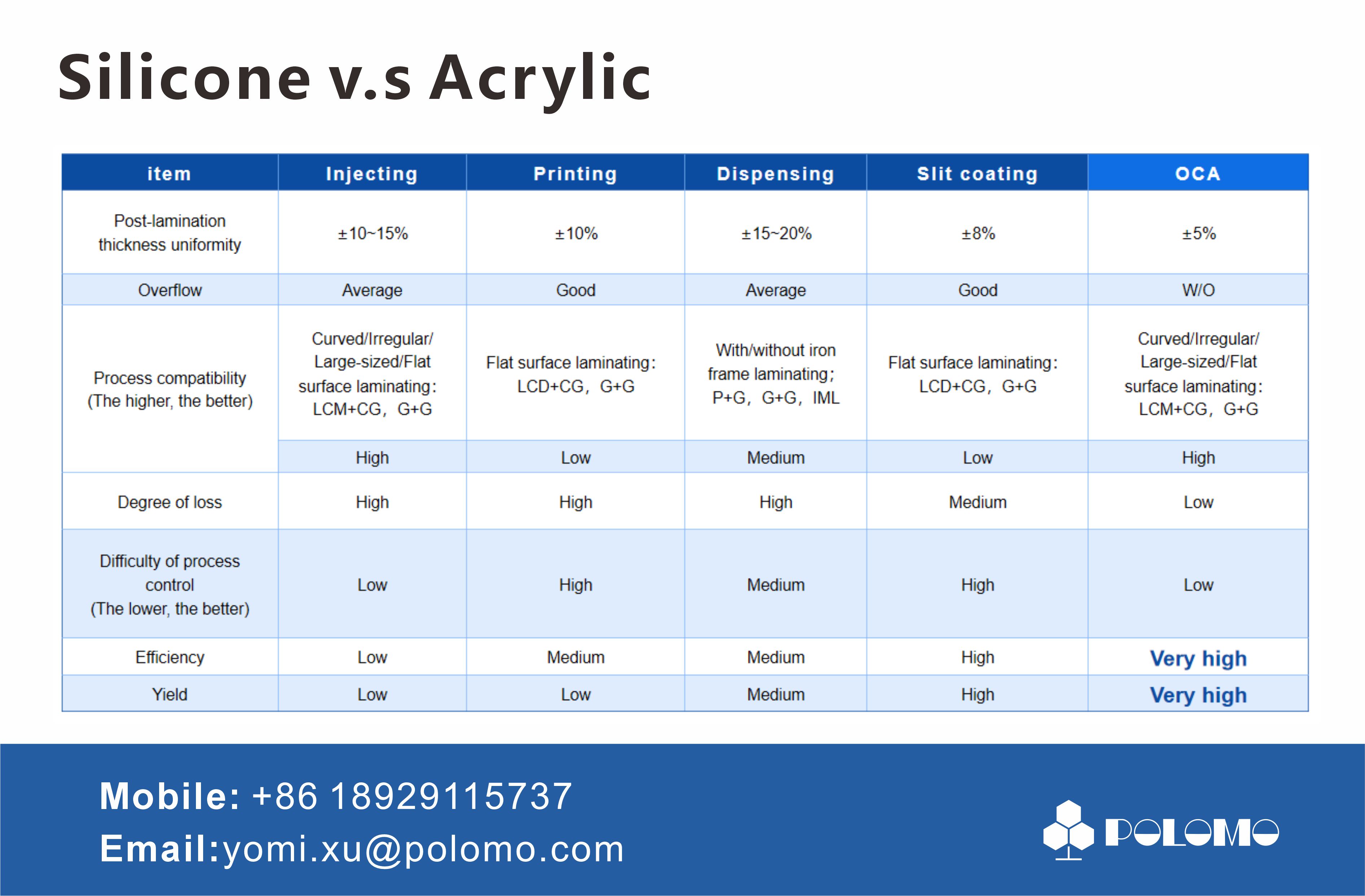
In many procurement evaluations, the initial material price receives the most attention. However, the total cost of a lamination process depends on yield, labour efficiency, equipment requirements, and the cost of quality failures.
Polomo states that the material cost of silicone OCA and acrylic OCA is comparable. The more important difference, according to the company, is in overall long-term cost performance. Silicone OCA is reported to provide advantages in lamination efficiency and yield, while reducing quality complaints and compensation risks. If an adhesive produces fewer bubbles, fewer mura defects, and fewer field failures, the savings from reduced rework and warranty claims can outweigh any difference in material price.
This is especially relevant in automotive display production, where a defective lamination may not be detected until after final assembly or even after the vehicle reaches the customer. Failed displays can trigger expensive service campaigns. Procurement teams that evaluate suppliers only on upfront adhesive price may miss the larger financial risk hidden in process yield and field reliability.
From a buyer's perspective, a cost comparison should include:
- Adhesive material cost per unit area
- Lamination yield in a realistic production line
- Labour hours required for rework
- Autoclave and equipment compatibility
- Quality complaint rate and compensation exposure
- Long-term optical stability and warranty risk
Polomo's position is that silicone OCA's yield and reliability advantages produce a more favourable total cost profile for demanding automotive and industrial applications.
Polomo Silicone OCA: Manufacturer Profile and Product Data
Guangdong Polomo New Materials Technology Co., Ltd (Polomo) is a materials manufacturer headquartered in Dongguan, Guangdong Province, China. Founded in 2002, Polomo integrates R&D, manufacturing, and sales of polymer material technologies, with a product focus that includes silicone OCA for display applications. The company operates a 90,000-square-meter facility with approximately 300 employees. Its R&D team includes 80 engineers, and the company reports an annual output capacity of 10 million pieces. Around 30% of output is exported to global markets.
Polomo's silicone OCA line includes models TS107, TS108, and TS109, which the company describes as all-climate OCA. According to the product specification, thickness can range from 20 to 2000 μm, product size from 3 to 50 inches, and appearance is a colorless transparent solid. The listed modulus is 22±5, Δb is 0.03, haze is below 0.3, water absorption is below 0.3, and dielectric constant at 1 MHz is 2.9. These properties are relevant for lamination processes that require optical clarity and dimensional stability.
Polomo's application documentation states that its silicone OCA is suitable for automotive display applications, including center displays, digital instrument clusters, and HUDs, where reliability and optical performance are critical. The company also references passenger entertainment displays, rear-seat entertainment displays, armrest displays, streaming rear-view mirrors, and air-conditioning displays.
Applications Across Automotive and Industrial Display Segments
Display lamination is used in a wide range of environments. Polomo lists automotive, industrial control, medical, smart home, commercial display, consumer electronics, aerospace, marine, and education as relevant industries. Within automotive, the adhesive must perform in both infotainment and instrument applications, where sunlight readability and long service life are essential.
For large curved or narrow-bezel displays, low-modulus silicone OCA helps prevent the visual distortion known as mura under thermal stress. This has become a recognized requirement in the industry, particularly as curved cockpit displays gain adoption. Industrial touch displays and medical display panels also benefit from silicone OCA when they must tolerate temperature variation, cleaning chemicals, or continuous operation.
For buyers, the key question is whether the display module will face the harsh thermal and UV conditions that make silicone OCA necessary. In benign indoor environments, acrylic OCA may still be adequate, and the qualification burden of switching to silicone may not be justified.
Market Signals: Where the OCA Category Is Headed
Several public market data points indicate growing interest in silicone-based adhesive systems for automotive and display applications.
- The global Optically Clear Adhesives market was valued at approximately USD 2.1 billion in 2024, according to Verified Market Research.
- Automotive displays account for about 20% of total OCA market revenue share in 2024, based on the same source.
- The global automotive silicone market was estimated at around USD 10.2 billion in 2024, according to Grand View Research.
- Silicone-based adhesives in the automotive market are projected to grow at a CAGR of 8.8% between 2025 and 2032, according to Fortune Business Insights.
- Asia Pacific represented 51% of the automotive adhesives market revenue in 2024, according to Precedence Research.
- The global optical bonding market is projected to reach USD 1.5 billion by 2031, growing at a CAGR of 6.63%, per Verified Market Research.
It is worth noting that CAGR estimates for the broader optical bonding market vary from 6.63% to 11.6% depending on the source and scope. Buyers should treat market projections as directional rather than precise.
At the quality-system level, IATF 16949:2016 is the internationally recognized quality management standard for automotive suppliers. It is designed to drive zero-defect manufacturing and continuous improvement. For display component suppliers targeting automotive programs, alignment with such systems is often a baseline requirement.
Industry presentations, such as Dow's Display Week 2024 materials, highlight UV resistance and anti-yellowing as priority formulation goals for automotive silicone OCA. This aligns with the broader trend toward long-life, high-reliability cockpit displays.
Limitations Buyers Should Keep in Mind
Despite the strong case for silicone OCA in demanding conditions, it is not the right answer for every display program. In applications with narrow temperature ranges, low UV exposure, and less stringent reliability targets, a well-qualified acrylic OCA can still provide adequate performance, often with a lower qualification burden.
Switching from acrylic to silicone OCA may also require process changes. Lamination parameters, storage protocols, autoclave conditions, and cleanroom handling must be revalidated. If the display assembler has a mature acrylic-based process, the transition to silicone may involve new equipment settings and additional training.
Another practical consideration is supply chain consistency. Silicone OCA can be sensitive to storage conditions. Polomo's risk-control guidance emphasizes temperature- and humidity-controlled clean warehousing, strict light and dust control, shelf-life management, and first-in-first-out (FIFO) inventory practices. Buyers should verify that their supplier can maintain these controls consistently, especially during peak production periods.
Future Outlook
Display architectures will continue to evolve. Larger curved surfaces, narrow bezels, and flexible form factors are already visible in automotive concept vehicles and high-end electronics. These designs increase the need for adhesives that can absorb stress from bending and thermal cycling while preserving optical quality.
Silicone OCA's low modulus, wide temperature tolerance, and weather resistance make it a strong candidate for next-generation laminated displays. At the same time, procurement teams are becoming more sophisticated about total cost analysis. They are looking beyond material price to yield, rework, warranty risk, and supplier reliability.
As the market matures, qualification standards such as IATF 16949 and display-specific reliability tests will become even more important. Suppliers that can demonstrate consistent quality, controlled manufacturing, and responsive engineering support will be better positioned to support automotive and industrial display programs.
Reference Material
For additional specification data and company background, Polomo's product brochure is available for public download: https://cdn.socialarks.com/sbsp/25134/common/2026/0805/POLOMO%20Product%20brochure.pdf
FAQ
What are the control methods and measures for storage & environmental control risks?
The control method is standardized environmental control combined with FIFO management. Company measures include a temperature- and humidity-controlled clean warehouse, strict control of light exposure and dust contamination, strict shelf-life management, inventory aging alerts, and standardized opening and storage procedures to prevent adhesive layer contamination.
¿Tiene preguntas o necesita más detalles?
Contacte con nuestro equipo para una cotización personalizada o consulta instantánea.
Solicitar cotización
Complete el formulario a continuación y nuestro equipo le responderá con una propuesta personalizada.
Chat directo de WhatsApp
¿Prefiere chatear en tiempo real? Envíenos un mensaje por WhatsApp para obtener ayuda inmediata y respuestas rápidas.
- Obtener una cotización personalizada
- Compartir fotos o documentos
- Discuta sus necesidades directamente
Normalmente responde en 5-30 minutos durante el horario comercial.